A minor road trip with Ray Romano, visiting an ostrich farm, playing paddleball against the backside of an old drive-in movie screen, slipping into a hot tub, staying in a dive motel, etc. Is this the kind of thing you’d want to get into if you were told you only have a few months or weeks to live? Wouldn’t you want to try something a little more transformative and bucket-listy than what this trailer is showing us?
Year: 2019
Naranjo’s “Bala” Is The One
I’m getting a vague feeling that Catherine Hardwicke‘s Miss Bala (2.1) won’t be enjoying the same critical favor that was showered upon Gerardo Naranjo‘s original film, which debuted at the 2011 Cannes Film Festival. The all-media screening of Hardwicke’s film is happening only a day before the Thursday night opening (1.31), with a review embargo that doesn’t lift until that morning.
Gina Rodriguez (the CW’s Jane The Virgin) is playing the beauty contestant (Stephanie Sigman in Naranjo’s version) who gets dragged into the grotesque intrigues of a Mexican drug gang.
HE reaction to Naranjo’s version: “If Michelangelo Antonioni had made a film about a Mexican beauty queen grappling with drug gangsters, the result might have been Miss Bala. For Naranjo has totally ignored the chaotic action aesthetic of Michael Bay and his acolytes, and delivered an action thriller with a truly elegant visual style. By which I mean long shots and almost no cut-cut-cut-cutting. He knows how to handle action and danger in a much more involving fashion than 90% of the bullshit scattershot action directors out there. Those guys know nothing, and Naranjo, I feel, is a master.”
The Antonioni treatment is why Miss Bala felt like such a knockout. Remove the arthouse element and you just have a kidnapping action drama. I have a feeling that this is precisely what the Hardwicke version has done — i.e., removed the Antonioni.
Save yourself the potential grief by simple watching Naranjo’s version, which is streaming on Amazon.
Kareem Explains It All
Woke bullies are gonna hate and membership in the Friends of Green Book Society is well established and locked down. I’m nonetheless presuming there are some who might still be fence-sitting about the merits of Peter Farrelly‘s film, and for this small fraternity Kareem Abdul Jabbar’s essay on Green Book, which appeared this morning in The Hollywood Reporter, is essential reading. He covers all the bases and then some in a sensible, fair-minded fashion.
Question: Given the divisive reactions to this lovable, intelligent, warm-hearted film, why did KAJ’s essay appear only today? Why wasn’t it published 10 or 15 or 21 days ago?
Dear Academy Voters — Nomination Voting Ends Today

Please, please nominate Paul Schrader and Ethan Hawke in their respective First Reformed categories — Best Original Screenplay and Best Actor. Don’t embarass yourselves by blowing off Hawke, who’s been awarded and nominated by everyone from sea to shining sea. Schrader is a living legend in his seventh decade, and First Reformed is his big comeback film — his best since Hardcore.
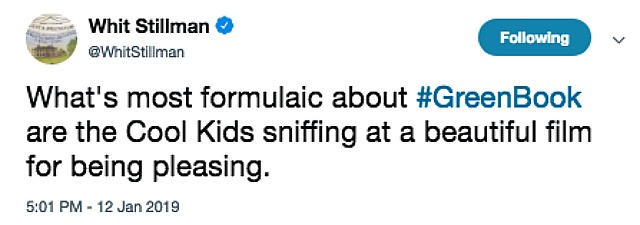
Please stand up to the SJW haters who’ve tried to torpedo Green Book — please tell these strutting lefty fascist bullies to go EFF themselves by nominating Peter Farelly‘s film for Best Picture, Best Director, Best Actor & Supporting Actor, etc.
Please temper your urge to go Roma, Roma, Roma all the way, at least as far as the Best Foreign Language Feature category is concerned. For the Best Foreign Language Feature of the year is — forgive me, Netflix — Pawel Pawlikowski‘s Cold War. Really. It is. Consider the fact that the European Film Awards went Cold War, Cold War, Cold War all the way.
And do not fail to nominate Cold War dp Lukasz Zal for his gleaming monochrome cinematography. Ignoring Zal would be flat-out felonious.
Marielle Heller‘s Can You Ever Forgive Me?, which I’ve seen four times, is UNQUESTIONABLY one of the best films of 2018. Please nominate accordingly — Melissa McCarthy for Best Actress, Richard E. Grant for Best Supporting Actor, Heller for Best Director, etc.
For the sin of not connecting with Joe and Jane Popcorn. you’re planning to give Damien Chazelle’s First Man the cold shoulder as far as the Best Picture category is concerned. You know it, I know it. But you are going to nominate Justin Hurwitz for his magnificent score. Maybe you could squeeze out some additional love for this sadly unloved art film, which bravely forsakes the Ron Howard approach to a Neil Armstrong biopic in favor of an intimate “you are Neil” scheme?
Cream In Them Thar Hills
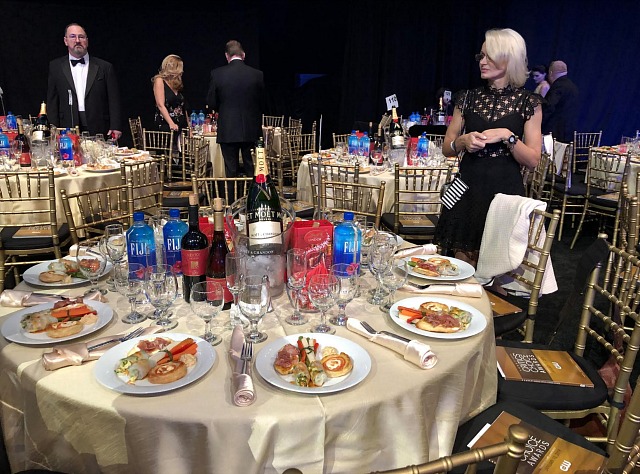
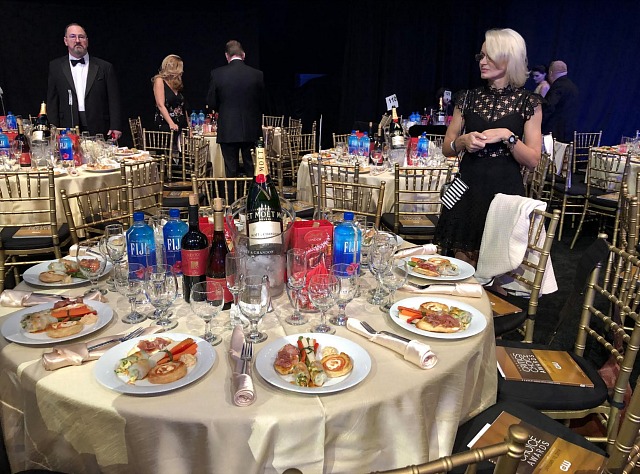
Observation #1: Yesterday Critics Choice awards were well handled all around, despite the fact that some felt it was a tiny bit chilly inside. The organizers were counting on body heat to warm things up, which worked to some extent. The outside weather was nonetheless damp and blustery. Observation #2: Free cups of Ample Hills ice cream were handed out. I was a pig, helping myself to two cups. By the way: I can’t be the first person to interpret “Ample Hills” as a randy euphemism. As in Alfred Hitchcock‘s observation about Grace Kelly in a gold lame dress: “There are hills in that thar gold.” Did I choose the name “Ample Hills”? No.
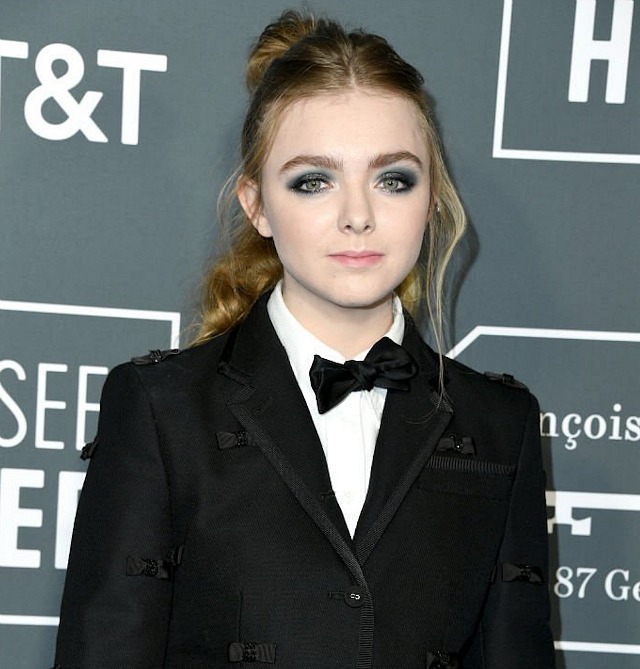
Eighth Grade‘s Elsie Fisher was seated three or four feet from Hollywood Elsewhere during the Critics Choice awards.
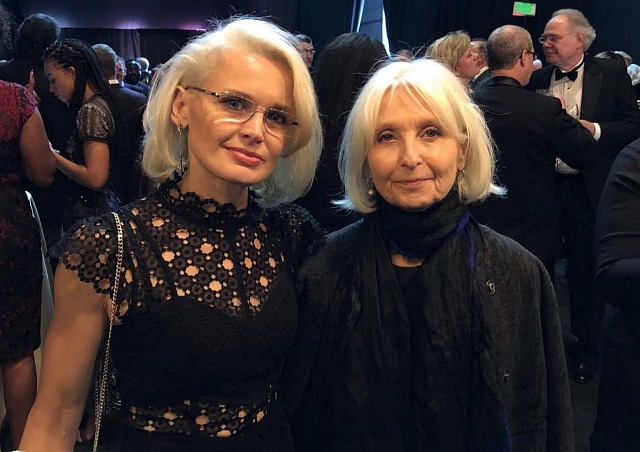
Tatyana and makeup artist Jan Sewell, who worked on Bohemian Rhapsody and the upcoming Wonder Woman 1984.

Ample Hills ice cream stand.
Late Critics Choice Filing But Whatever
Sorry for not filing this last night: Roma and Cuaron and his black-framed, Tom Ford glasses. Roma and Cuaron and his black-framed, Tom Ford glasses. Roma and Cuaron and his black-framed, Tom Ford glasses.
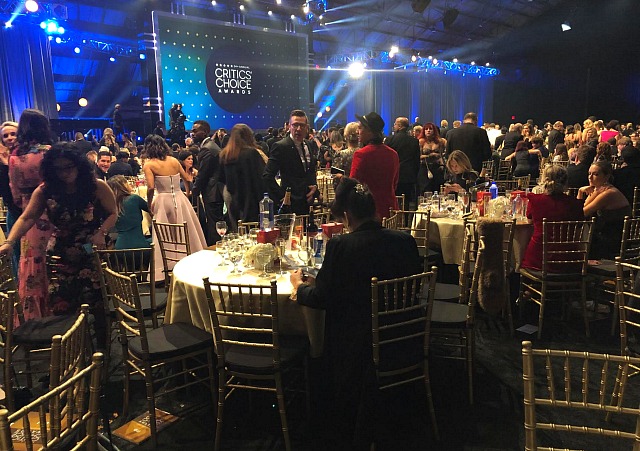
That was the big takeaway from yesterday afternoon’s Critics Choice awards, which Hollywood Elsewhere — wearing a black suit, a black Kooples shirt with a leather collar, and black Beatle boots — attended with Tatyana Antropova. We sat at table #96, which was right next to the A24 table where First Reformed director-writer Paul Schrader and Eighth Grade‘s Elsie Fisher were seated.
Did I go over to Schrader and say “yo, bruh…been with you all the way”? Did I go over to Fisher and tell her to not let those Twitter jackals get her down? Of course not. I don’t know what’s wrong with me but I didn’t. On a certain level I’m a solitary man. I need to work on that.
The Critics Choice gang (of which I’m a voting member) gifted Roma with four awards — Best Picture, Best Director (Alfonso Cuarón), Best Cinematography and Best Foreign Film.
It would be “bad form” to call A Star Is Born a dead duck in the Best Picture race, so let’s not. For that glorious pronouncement we’ll have to wait five days (six counting today) until Saturday, 1.19. That’s when the Producers Guild of America — a reliable bellwether of industry thinking — will reveal its Best Picture winner. Then and only then, in the likely wake of Roma having won yet another top prize, can we say without a doubt that A Star is Born is toast. And (I hate to admit this but I have to) it might not be in the end.
This year’s PGA nominees: Black Panther, BlacKkKlansman, Bohemian Rhapsody, Crazy Rich Asians, The Favourite, Green Book, A Quiet Place, Roma, A Star is Born and Vice.
The PGA and the Academy agreed about The Shape of Water last year but they split in ’17 and ’16 — the PGA went for The Big Short and La La Land, respectively, while the Academy went for Moonlight and Spotlight so don’t count your chickens. Except I am counting my chickens as far as the non-triumphant fate of A Star Is Born is concerned. I want it, I need it, I’m praying for it.
Oscar nominations will be announced on Tuesday, 1.22 — three days after the PGA ceremony. I don’t know about you but I’ll be flying to Park City that morning with my “REJECTED” / “WOKE DEFICIENT” badge around my neck. I’ll have to file my reaction piece from Salt Lake City airport.
Vice‘s Christian Bale won for Best Actor while Glenn Close (The Wife) and Lady Gaga (A Star Is Born) tied for Best Actress. Mahershala Ali (Green Book) and Regina King (If Beale Street Could Talk) won in the supporting categories.
Pressing Social Engagement
I’m sorry to quit early, but 45 minutes hence I have to leave for the 2019 Critics Choice Awards ceremony at Barker Hangar at the Santa Monica airport. I’ll text some of the winners and some thoughts about same as things progress. Please God…please keep the Star Is Born award tally to a minimum.
Those Were The Days
Four-plus years ago a kind of left-handed tribute to Hollywood Elsewhere was posted by John Lichman, aka idiotsavantonline. I happened to re-read it last night, and the natural absence of any comments about SJW goon-squad thinking (which began to take shape in late ’16) made me almost weep with nostalgia for a simpler, less terrifying time.
Excerpt: “If Armond White is the king of Online Film Criticism from Under Troll Mountain, Jeffrey Wells is the wandering samurai-poet on a separate continent.
“Wells resides in the other end of entertainment journalism where euphemism, contacts and advertising are an essential issue but completely alien to folks that treat the Tomatometer or CinemaScore as the scales of justice.
“Wells has always been a strange figure — a traditional print reporter from back before the time most of the online editors that gripe about him on Twitter even knew what a lede meant (whether they still do is arguable). Even then, Wells is the prototype for the modern online film columnist. So much of what Wells writes has become tied into his idiosyncrasies about wifi, fatness and a bit of reporting per se, but also random bursts of striking street photography. The closest encapsulation of his writing resume can be found here.
“I’ve said it before, but for lack of a better term Hollywood Elsewhere is spectacular performance art that happens to involve entertainment media.
“Everything is strife to Wells and how he’s had to adapt to constant reaction whether from his commenters, his peers or his infamous peanut gallery that have their own set of memes and rules at their special circle of comment hell.
“What Wells is responsible for is different than the iconic Internet Trolls of Film Criticism. Wells is, going back to the idea of performance art, the template for the freelance film writer as we know them. Inside every Filmdrunk, /Film, Film School Reject or Gothamist — no, seriously, they used to love him — is the spark of what Wells represents.”
Souls of Wolverines
During the mid-fall of 1987 I had a couple of chats with director Herbert Ross. I was the press kit writer for Cannon Films, and Ross’s Dancers, a mezzo-mezzo Mikhail Baryshnikov film, was being prepared for release. During our second chat I was asking Ross about something I wanted to put into the Dancers press kit, and somehow I miscommunicated my intention and Ross got the idea I was trying to debate him. “This isn’t that kind of conversation!,” he said sternly, almost shouting. I immediately backpedaled and started mewing like a kitten — “No, no, Mr. Ross…I apologize, that’s not what I meant, I’m sorry.”
I cooled him down but after hanging up I said to myself, “Jesus God, that is one fierce hombre! He was ready to take my head off!”
Seven and a half years ago I tapped out a piece called “Bastards vs, Mellowheads.” It basically said that directors have to be muscular, tough-ass mofos or they won’t last. That doesn’t mean they don’t or shouldn’t play the sweet-talk, back-rub game that the film industry more or less runs on, but they have to guard against people trying to roll over them 24/7. If they over-react to this pressure they become known as crazy hotheads; if they under-react they’ll get seriously bitten or eaten by this or that carnivore.
“All strong directors are sons of bitches,” John Ford allegedly said to screenwriter Nunnally Johnson sometime in the late ’40s or early ’50s. His point was that Johnson, in Ford’s view, was too nice, thoughtful and fair-minded to make it as a director. Directors basically can’t be mellow or gentle or accommodating. They need to be tough, pugnacious and manipulative mofos in order to get what they want. And if they’re too deferential, they won’t last.
After the piece ran Wes Anderson got angry with me for mentioning him in this context. But I had done so with respect. Wes is no pushover, no wallflower. All I said in the original piece was that occasionally he seemed to exemplify hard-core battlefield thinking. All movies are wars — enemies all around, one skirmish after another, betrayal lurking, bullets whizzing by your ears
All good directors (Mann, Stone, Tarantino, Cameron, Kurosawa, Nichols, Kubrick) are known to have operated like this in their prime. They don’t kissy-face or twinkle-toe their way through the making of a film — they stress and scheme and argue and finagle to get whatever they want any way they can. Making a movie with them is an organized, guns-blazing, duck-and-weave enterprise that requires hard work. It’s no day at the beach.
That aside all smart, socially attuned directors go out of their way to not be mean or manipulative, of course, being political animals and all. But deep down they have to be that snarly John Ford guy, or the system will eat them up.
The Trade-Up
I’ve finally paid attention to the Jeff and Mackenzie Bezos divorce and the presumed 50-50 splitting of his $137 billion fortune. It’s a familiar scenario. If a super-rich guy has been married for a couple of decades to a quality-level, less-than-dynamically-alluring wife and business partner, sooner or later he’s going to cash out and trade up for a seemingly more cultured, erotically enticing, world-class newbie.
Alpha guys want women who will make them look good and enhance their brand. When they schmooze with other captains of industry in Sun Valley they want ostensibly classy, well-educated women who read books — women with depth and superior genes and excellent cheekbone structure (or, failing that, women who’ve had first-rate “work” done). Remember that Moneyball line about how “a homely girlfriend means no confidence“? Guys everywhere accept that analogy.
But the recent reporting about private sexting between Bezos and Lauren Sanchez? God, that’s grotesque. The reporting, I mean. How low can you go?
Laddie’s Legacy
Legendary producer and studio chief Alan Ladd, Jr. has long been regarded as one of the good guys — a smart, well-respected industry fellow who had quite a run from the mid ’70s to early ’90s.
Ladd was the intrepid 20th Century Fox-based producer of George Lucas‘s Star Wars, promoting and guarding it during a notoriously dicey era when Fox execs feared it might be a clunker. A year or so later his regime also produced Ridley Scott‘s Alien.
After launching The Ladd Company in ’79, “Laddie” produced or otherwise backed Chariots of Fire, Night Shift, Blade Runner, The Right Stuff, Police Academy, The Right Stuff, Moonstruck, A Fish Called Wanda, Thelma & Louise and Gone Baby Gone.
A classy, conservatively dressed, soft-spoken guy who was never much for interviews or colorful quips, “Laddie” — the son of ’40s and ’50s superstar Alan Ladd — was widely respected by filmmakers. Like Warner Bros. honcho John Calley, Ladd brandished something that very few producers would dare to mention in 2019 — upmarket taste. He even occasionally found the balls to take creative risks on what he believed was first-rate material.
He was also the guy who didn’t seem to strongly believe in Blade Runner (he insisted that Harrison Ford record a narration track) and who released a truncated cut of Sergio Leone‘s Once Upon A Time in America for its initial release. (Leone’s director’s cut version is the one everyone thinks of today.) And Laddie had a terrible time as the head of MGM in the mid ’80s, when the company was owned by fraudster Giancarlo Parretti
The trailer for Amanda Ladd-Jones‘ Laddie: The Man Behind The Movies strongly suggests it’ll be a cottonball portrait — basically Laddie’s filmmaker pallies telling us what a shrewd, dependable and admirable guy he was, etc. Ladd-Jones is his daughter — the chances of her delivering even a hint of a warts-and-all approach are probably somewhere between slim and none.
I’m nonetheless interested in catching it at the American Cinematheque on Friday, 1.18. The AC’s website informs that the doc runs 184 minutes — almost certainly a typo. If this was the actual running time, I would be genuinely excited.