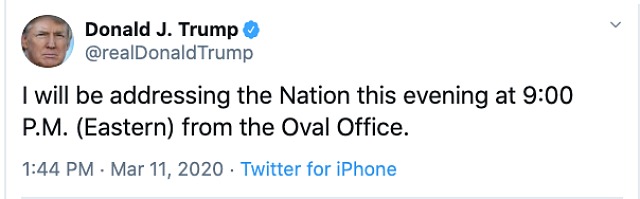
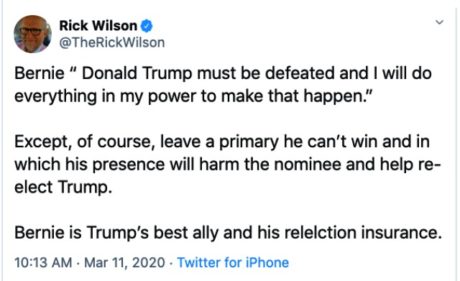
Translation: He’s Scared

All Trump cares about is the stock market, and right now he’s obviously freaking about the big COV-19 downturn. If the economy tanks he’s a dead man and knows it. That’s why he’s going on the air tonight. To try and restore his electoral prospects.

Bernie Hanging On, Won’t Say Die

“Last night was obviously not a good night for our campaign, from a delegate point of view. We lost in the biggest state up for grabs yesterday, the state of Michigan. We lost in Mississippi, Missouri and Idaho. On the other hand we won in North Dakota and we lead in the latest vote count in the state of Washington — the second largest state contested yesterday.

“We are, however, winning the generational debate, and I say to the Democratic establishment that in order to win in the future, you need to win the voters who represent the future of our country, and you must speak to the issues [that] concern them. You cannot simply be satisfied from winning the votes of people who are older.

“While our campaign has won the ideological debate, we are losing the debate over electability. I cannot tell you how many people our campaign has spoken to, who have said and I quote, ‘I like what your campaign stands for, and I agree with that also, but I’m gonna vote for Joe Biden, because I think he’s the best candidate to defeat Donald Trump.

“Tragically we have a President today who is a pathological liar, and who is running a corrupt administration. He clearly does not understand the Constitution of the United States and think that he is a President who is above the law. In my view he is a racist, a sexist, a homophobe, a xenophobe and a religious bigot. He must be defeated [next November] and I will do everything in my power to make that happen.”

Hunt The Bumblefucks

My 3.9 flight to Austin meant missing the Los Angeles all-media for The Hunt. I’ll post a review of this Craig Zobel-Damon Lindelof collaboration after catching it locally tomorrow night. Here’s a response from veteran movie guy and L.A. Times contributor Lewis Beale:

“I just saw this supposedly controversial movie. The main costars are Betty Gilpin and Hillary Swank. It’s basically a straight-to-video exploitation picture — very bloody — given a thin veneer of relevance with some political content. Featuring a bunch of TV actors and other folk — Sturgill Simpson as a rapper! — who obviously did it for the paycheck (a small one, since most are onscreen for only a short period before they’re knocked off).

“It’s about how a bad joke on the part of some wokester liberals about killing Trumpsters metastasizes into a ‘thing’ with deplorable conspiracy types. This forces the liberals to act on their joke and hunt the rightwingers a la The Most Dangerous Game.

“I found it watchable but nothing more, aided in no small part by a 90-minute running time. It portrays both sides of the political equation as jerks, but any controversial content is basically non-existent. The reviews will most likely be brutal.”

From Peter Debruge’s Variety review:

“A gory, hard-R exploitation movie masquerading as political satire, one that takes unseemly delight in dispatching yahoos on both ends of the spectrum via shotgun, crossbow, hand grenade and all manner of hastily improvised weapons.

“The words ‘trigger warning’ may not have been invented with The Hunt in mind, but they’ve seldom seemed more apt in describing a film that stops just shy of fomenting civil war as it pits Left against Right, Blue (bloods) against Red (necks) in a bloody battle royale that reduces both sides to ridiculous caricatures.

“As the umpteenth variation on Richard Connell’s ‘The Most Dangerous Game,’ The Hunt is [nonetheless] one of the most effective executions yet (it surpasses the Cannes-laureled Bacarau, but drags along too much baggage to best last year’s Ready or Not).

“Regardless of one’s personal political affiliations, it’s hard not to root for the victims here, and one quickly distinguishes herself from the pack of Deliverance-style caricatures: Crystal May Creesy (Gilpin), a MacGyver-skilled veteran who served in Afghanistan and whose distrust of any and everyone makes her uniquely suited for a final showdown with Athena.

Read more

Harvey In The Hoosegow

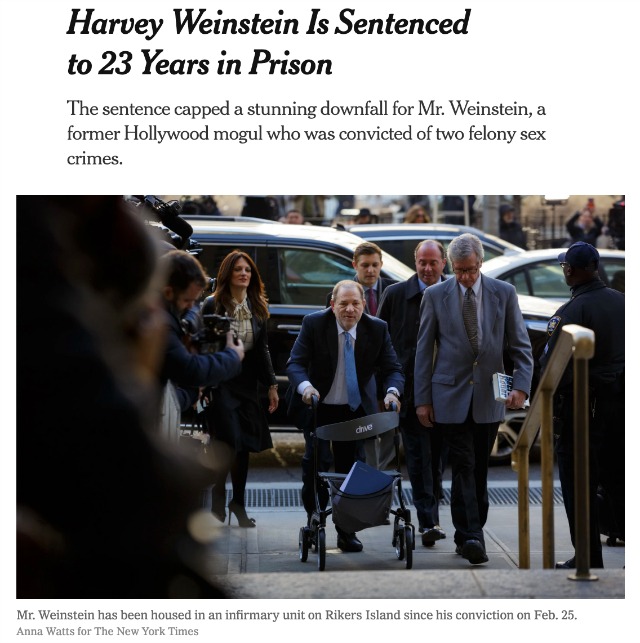
Having been found guilty of one count of criminal sexual assault in the first degree and one count of rape in the third degree, Harvey Weinstein was sentenced today to 23 years behind bars. His wealth and political connections suggest that he probably won’t wind up serving the full term. (Not to mention the ailing-health card.) But he’ll almost certainly do serious time.

I don’t know the calculus in these matters, but I would think he’ll wind up doing…what, 8 to 10 years? A bit more? In the unlikely event that his lawyers are unable to appeal his sentence down and Harvey serves the full 23, the once-powerful movie mogul, who turns 68 on 3.19, would be in stir until age 91. But the sentence almost certainly will be whittled down by appeal, and if not he’ll certainly be granted parole after a few years.

And of course, Harvey still has to face similar sexual assault charges in Los Angeles, stemming from two incidents (one involving an alleged rape of model-actress Lauren Young) that happened in 2013.

1962 Was The Year

At the end of each year there are always 20 to 25 films that qualify as excellent, very good or good. The creme de la creme is usually between five and ten, but the final tally of approvables is always around 20, and 25 if you want to be liberal about it. But 1962 was different. By my count nearly 50 films that anyone would rank as praiseworthy or seriously noteworthy were released that year. Roughly double the average. The HE rundown is below.

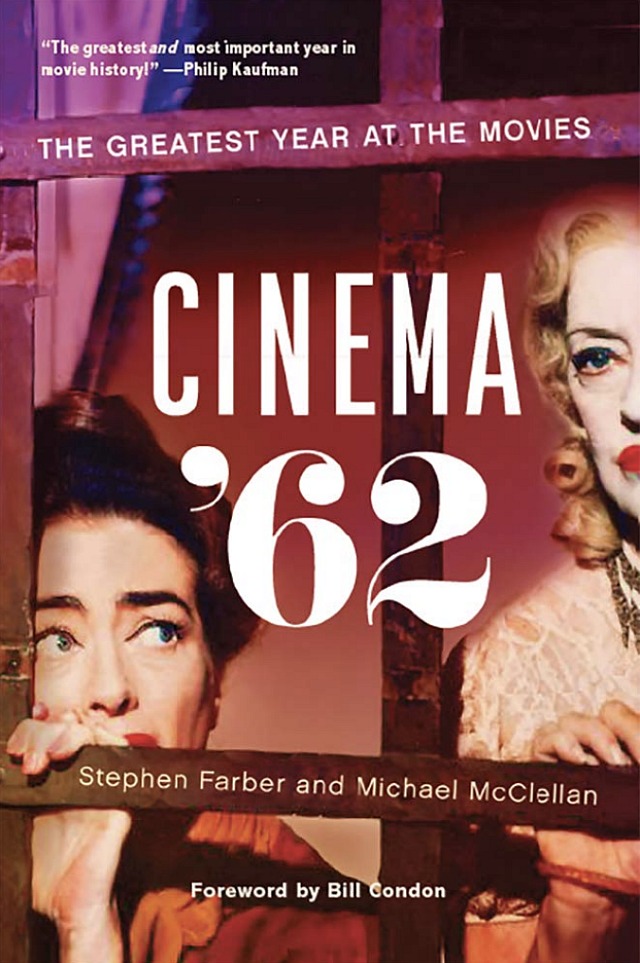
I’ve riffed off and on about the ’62 roster over the last 15 or so years, but now there’s a new book that celebrates this mid-Kennedy administration chapter — Stephen Farber and Michael McClellan‘s “Cinema ’62: The Greatest Year at the Movies” (Rutgers University Press). The pub date is 3.13.

For many years the general consensus has been that the greatest movie years were 1939, ’62, ’71 and ’99. Which others?

Excerpt: “Most conventional film histories dismiss the early 1960s as a pallid era, a downtime between the heights of the classic studio system and the rise of New Hollywood directors like Scorsese and Altman in the 1970s. It seemed to be a moment when the movie industry was floundering as the popularity of television caused a downturn in cinema attendance.

On the contrary, “Cinema ’62′ asserts that 1962 “was a peak year for film, with a high standard of quality that has not been equaled since.”

A decade or so ago I wrote about a BAM retrospective on 1962 films. NYFCC chairman Armond White, the apparent architect of the series, wrote at the time that 1962 “was equal to Hollywood’s fabled 1939 so we welcome this great opportunity to learn and revise film history.”

Here’s my updated rundown of 1962 worthies: David Lean‘s Lawrence of Arabia, John Ford‘s The Man Who Shot Liberty Valance, Sam Peckinpah‘s Ride The High Country, Robert Aldrich‘s Whatever Happened to Baby Jane?, Bryan ForbesThe L-Shaped Room, Howard HawksHatari, Francois Truffaut‘s Shoot The Piano Player, Francois Truffaut‘s Jules and Jim, Agnes Varda‘s Cleo From 5 to 7, Luis Bunuel‘s The Exterminating Angel (10)

Peter Ustinov‘s Billy Budd, the John Frankenheimer trio of Birdman of Alcatraz, The Manchurian Candidate and All Fall Down, J. Lee Thompson‘s Cape Fear, George Seaton‘s The Counterfeit Traitor, Frank Perry‘s David and Lisa, the Blake Edwards‘ duo of Experiment in Terror and Days of Wine and Roses, Pietro Germi‘s Divorce, Italian Style. (10)

Stanley Kubrick‘s Lolita, the great Kirk Douglas western Lonely are the Brave, John Schlesinger‘s A Kind of Loving, Roman Polanski‘s Knife in the Water (released in the U.S. in ’63), Alain ResnaisLast Year at Marienbad, Michelangelo Antonioni‘s L’eclisse, Sidney Lumet‘s version of Eugene O’Neil’s Long Day’s Journey into Night, Otto Preminger‘s Advise and Consent, Terence Young‘s Dr. No, John Huston‘s Freud. (10)

Read more

Why I Hate “Raising Arizona”

I happened to read a draft of Joel and Ethan Coen‘s Raising Arizona in early ’86, before they began filming. I loved the dark humor, the flirting with absurdity, the Preston Sturges-like tone. But I was envisioning a film that would work against all that with a tone of low-key naturalism.

When I saw the finished film I was horrified. It was pushed way too hard — too pedal-to-the-metal. And I hated, hated, HATED John Goodman‘s Gale and William Forsythe‘s Evelle.

I tried re-watching it a few years ago, just to bend over backwards and give it another try. I couldn’t even get through it.

Simon Pegg once described Raising Arizona as “a living, breathing Looney Tunes cartoon” — that’s precisely what I hated about it. Director Edgar Wright has said that Raising Arizona “is his favorite film of all time.” That’s it — Wright is not on my team.

Political and Profane

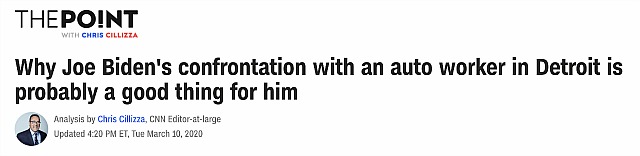
Earlier today Joe Biden had a blunt dispute with an auto worker who had accused him of “actively trying to diminish our Second Amendment rights and take away our guns.” Biden’s response included four eloquent words: “You’re full of shit.” He let this Second Amendment troll have it like any regular guy who’s had enough of the bullshit. When Joe talks tough and straight and true, Hollywood Elsewhere bows with respect. Don’t let the gunnies control the narrative. But why has this clip mainly been posted by rightwingers? And why did Joe’s campaign handler try to shut the conversation down? Combative Joe is a good look.

Between The Lines

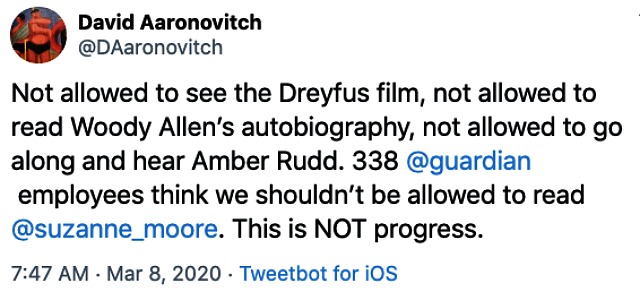
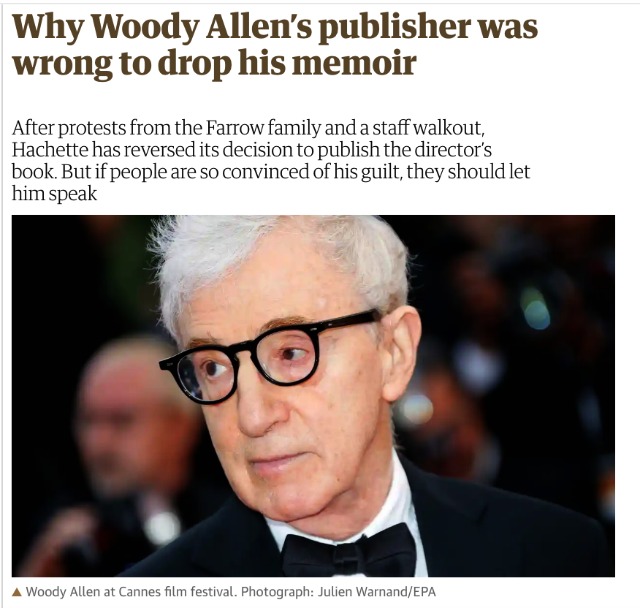
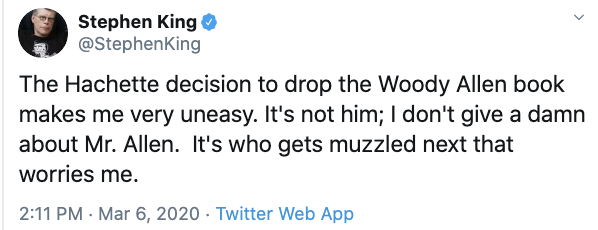
Significant shock waves have resulted from the Dylan Farrow-supporting denialists forcing Hachette management to cancel the publishing of Woody Allen‘s “Apropos of Nothing.”

Is there anyone who believes that wokester mob rule has shown itself to be anything other than deranged and deplorable? The consensus in this instance seems fairly clear.

Except, it seems, among Indiewire staffers. I was noticing earlier today that despite all the Hachette hand-wringing no Indiewire staffer has posted any opinion about the cancelling of the Allen book. Indiewire‘s Ryan Lattanzio has reported the basics and quoted the Stephen King tweets about it, but that’s been the extent so far.

Please correct me if I’m wrong, but the implication seems to be that Indiewire has adopted a shoulder-shrugging attitude about this matter. They certainly don’t seem especially riled by it. I asked a couple of senior Indiewire editors about this earlier today. I gather there are differing views among staffers, and that there’s no official unifying viewpoint. Maybe so, but sometimes silence can betoken.

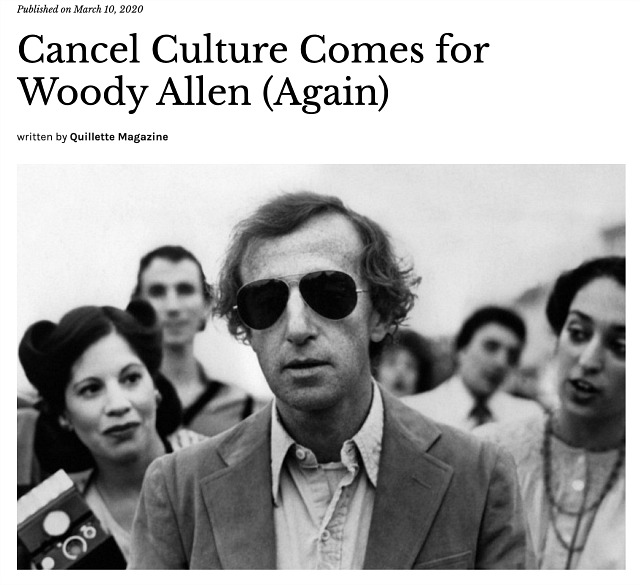
From “Cancel Culture Comes for Woody Allen (Again),” a Quillette essay posted on 3.10.20: “A fair assessment of Kobe Bryant is that he was one of the greatest players in the history of basketball, as well as someone who may or may not have sexually assaulted a woman in 2003. A fair assessment of Woody Allen is that he is a great and influential film director who also tore apart his extended family by entering into a very odd (but not illegal) sexual relationship with his ex-girlfriend’s adopted 21-year-old daughter.

“It would be perfectly normal for the same fans who turned their backs on Bryant in 2003 to eventually forgive him, and then cheer him on when he led the Los Angeles Lakers to championships in 2009 and 2010 — just as it would be perfectly normal for the same cineastes who lavish praise on Woody Allen’s oeuvre to remain unsettled by the origins of his marriage to Soon-Yi Previn, while also recognizing that the Mia-Dylan abuse allegations are nonsense.

“Which is to say that, morally speaking, most of us can walk and chew gum. We recognize that everyone is flawed and complicated, and that forgiveness is possible. True, such attitudes are anathema to the mob mentality. But most ordinary people aren’t part of mobs.

“It’s only on Twitter, a medium that self-selects for hair-trigger puritanism and moral hypocrisy, that mobs get to form a majority government. The problem comes when the firewall between the fake world of Twitter and the real world of human institutions breaks down, and social-media star-chamber verdicts are ratified by institutional gatekeepers.”

Read more

“Aliens” at 48fps…Wow

A year ago Simon Christensen posted a 48 frame-per-second “motion interpolation test” of a portion of Aliens. Using the latest Aliens Bluray, he scanned and somehow doubled the frame rate, calling it a “fan regrade”. It’s obviously much much more vivid than any previous version, and yet it doesn’t deliver a synthetic video or motion-flow feeling. I would love to re-watch the whole film in this process. Hell, I’d watch each and every film in my library in 48fps.

“Game over, man…game over!”

Inoffensive South Austin Blahs

Dylan Wells lives in a quiet, tree-lined neighborhood in South Austin. Our nabe is roughly six miles south of the hipster downtown area. As middle-class districts go it’s “pleasant” enough, but you’d have to add “culturally underwhelming.” It’s somewhere between blandly acceptable and “is that all there is?” Or so it seems, at least, to someone accustomed to walking around and sniffing the air in Brooklyn, Paris, WeHo, San Francisco, Prague, London, Venice, Munich and Rome.

South Austin is “fine” as far as it goes, but it lacks a nutritional quality. The suburbs of middle and northern New Jersey are shadier and more soothing-like, and certainly more architecturally distinctive. Ditto historic Key West and Telluride, Connecticut’s Fairfield County, the North shore of Massachusetts, Virginia’s Shenandoah Valley…I could go on and on.

In and of itself Dylan’s place is quite nice — sizable rooms, large and fragrant backyard, a sedate suburban atmosphere, great wifi, excellent TV. And it’s great to see him again, of course. And I love his husky, Rudy. And a half-mile away there’s a nice little tree-shaded area where you can order gourmet dishes from food trucks. And last night we found an above-average Vietnamese “pan Asian” place. I just wish we were parked closer to East Austin or the Mueller or Second Street districts.

I’m told that not that long ago (i.e., back in the ’80s and ’90s) South Austin had a relatively undeveloped rural atmosphere…small forests of oak trees, green fields, creeks and streams and generally pleasing aromas amid the up-and-down typography. Now the natural elements feel challenged if not smothered by an endless, character-free sprawl of bland-ugly shopping malls and gas stations (no sidewalks, nobody walks) and El Crappo discount stores.

Yesterday we drove for miles and miles and it was like “why would anyone want to live here apart from the fact that the neighborhoods are quiet and rents are reasonable?” There’s a basic feeling of blah-ness everywhere. Given my druthers I would rather live in a one-room rathole in an interesting neighborhood than in a flush spacious home in a neighborhood with a nod-out vibe.

If I had to live somewhere in Texas and couldn’t find a decent place in the downtown Austin region I’d like to live in artsy Marfa, which is way too far to drive to from here. (It’s closer to El Paso, but by “closer” I mean a three-hour drive.)

To escape the South Austin blahs we’ve decided to drive this weekend to Rockport, a beach suburb of Corpus Christi, and then stay another night in Laredo (and maybe mosey across the border for some good Mexican food).

Read more

Feldman’s Sexual Abuse Doc Re-Streaming Today

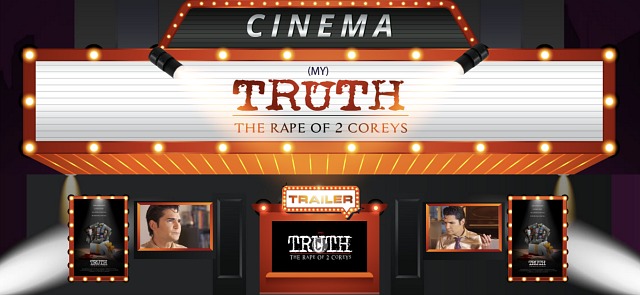
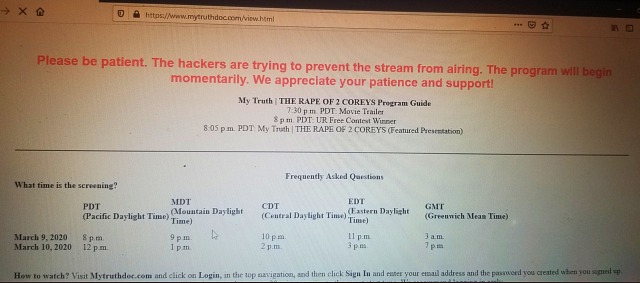
Last night invited guests caught a private Los Angeles screening of Corey Feldman‘s (My) Truth: The Rape of Two Coreys, which contains accusations of sexual abuse suffered by Feldman and his late actor friend Corey Haim when they were child stars in the ’80s. But relatively few people were able to stream the film online, due to technical difficulties or hackers.

EW‘s Rosy Cordero attended the private screening and reported early this morning that Feldman accuses men of sexually assault during this period, and particularly accuses Charlie Sheen of raping Haim while making the 1986 film Lucas.

Cordero reports that Feldman also levels sexual abuse charges at actor Jon Grissom, nightclub owner Alphy Hoffman and former talent manager Marty Weiss. Feldman also accuses the late Dominick Brascia, a former actor who passed in 2018, of sexual abuse.

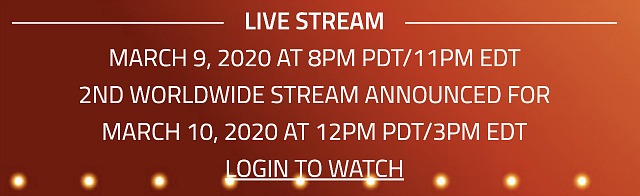
Feldman’s doc will attempt another streaming today at 12 noon Pacific, 2 pm Central and 3 pm Eastern.

Alone In The City

Eliza Hittman‘s Never Rarely Sometimes Always opens on Friday (3.13). As mentioned a few days ago, it’s been hyped as the U.S. indie answer to Cristian Mungiu‘s Four Months, Three Weeks, Two Days.

Basic drill: Autumn (Sidney Flanigan), a pregnant teen from rural Pennsylvania who doesn’t want her parents to know, makes her way to Manhattan to have an abortion, accompanied by her cousin Skylar (Talia Ryder).

They loved it at Sundance ’20, and right now it has a 100% and 91% rating from Rotten Tomatoes and Metacritic, respectively.

It goes without saying that you can’t trust critics on films like this. You can, however, trust Hollywood Elsewhere, and I’m calling this a respectable effort — spare, direct, quietly affecting. But it doesn’t give you enough.

Like Autumn, the film holds back a lot, and is basically buried within itself. That makes it a sad experience on one level, but on another it feels too spare, too closed off. It overuses the less-is-more aesthetic. Hittman tells you what you need to know, but at the same time as little as possible.

I couldn’t finally decide if Flanigan is playing a guarded, fearful, inexpressive women, or if she herself is that way. She connects four times — two singing scenes (one in which she karaokes “Don’t let The Sun Catch You Crying”), a scene in which she throws a glass of water in a teenage boy’s face, and an abortion clinic scene in which she breaks down while being asked some painful personal questions.

But she’s so buried, so shielded. She doesn’t even trust the nice abortion-clinic lady, who has nothing but kindness in her heart.

What a miserable life poor Autumn is leading. So cut off, so solitary. The film isn’t really a story about getting an abortion in NYC. It’s actually a study of Autumn’s isolation and defensiveness and brusque mood pockets. A study of a prisoner living in her own cage, and terrified of leaving it.

I’m sorry but Never Rarely Sometimes Always is nowhere near as accomplished as 4 Months, 3 Weeks, 2 Days. Not even in the same league. The women in Mungiu’s film were sullen and suspicious and kept to themselves also, but Mungiu let you in. You were allowed to peek into their feelings and pressures, to share in their fears and resentments and whatnot. Not so much here.

Ryder’s character is more open and expressive, and a little smarter. Ditto her performance.