How To Ship A Samurai Sword

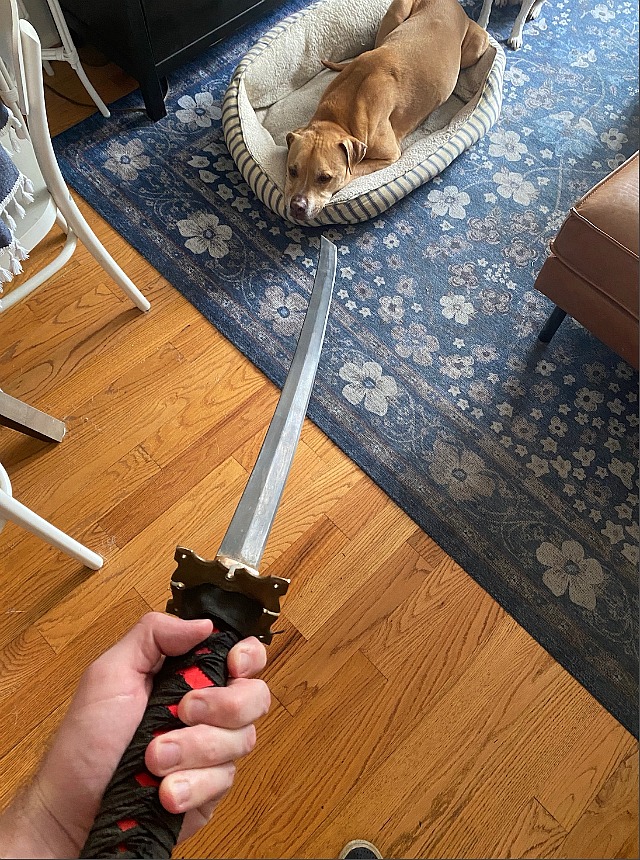
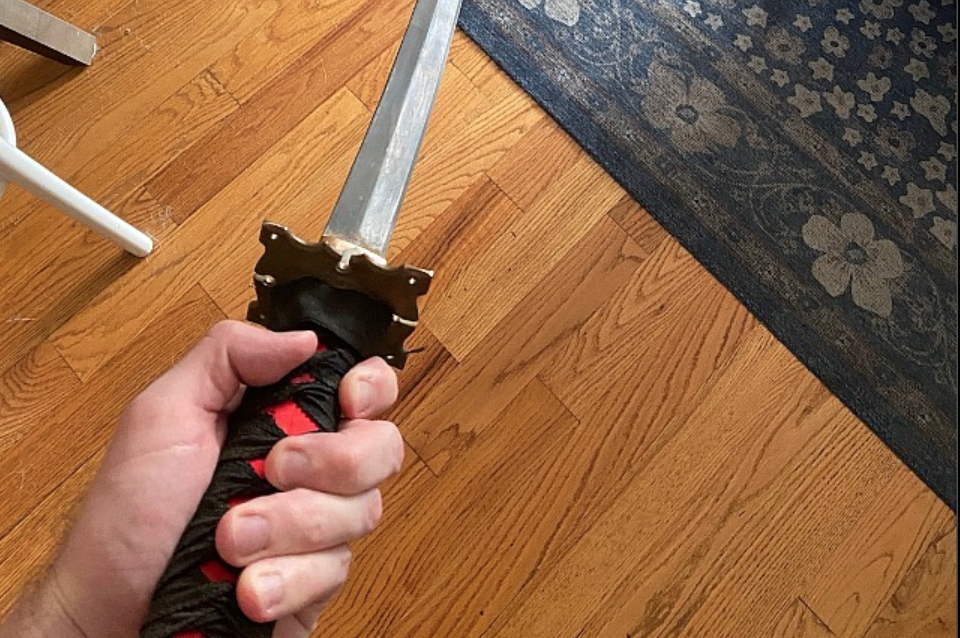
For about 22 years I’ve been a proud owner of a real-deal samurai sword, a Claymore sword from Germany, and what I’ve been told is an 18th Century Barry Lyndon sword. And they’re all in good shape. I had the samurai sword re-sharpened about 15 years ago and it’ll split a hair.

Two days ago Dylan called to suggest that I send the sword to Jett for his 32nd birthday, which was yesterday. Dylan and Jett were totally into swords during the waning days of the Clinton administration, when they were nine and ten.

Dylan’s idea was that the samurai sword would connect Jett to those days, and how we hung out and went on car trips and attended screenings, etc.. So I decided to send the samurai to Jett in Jersey City and the Claymore to Dylan in Austin.

Around 4:45 pm I took them to a UPS store but the guy said he’s not allowed to send weapons. “Well, they’re technically weapons, okay, but not really,” I said. “They’re mainly relics of a distant past. Only Mel Gibson would regard them as actual weapons.”

He suggested FedEx, which was just down the street. I had to pack them first, of course, or the FedEx guys would say the same thing.

The UPS guy sold me a couple of tall boxes and masking tape and a bag of styrofoam peanuts. But I couldn’t wrap them in the store, he said. Out to the parking lot. The wind was blowing and the peanuts were flying all over the place, but I eventually got it done.

The FedEx guys didn’t even ask what was in the boxes. A Thursday delivery was out of the question, but to ensure that the samurai would arrive at Jett’s Jersey City home by today I had to pay them $185 bills. And the box wasn’t even that heavy.

Jett’s text arrived today at 11:49 am: “Thanks for the gift…I guess. Lol.”

Time Tunnel

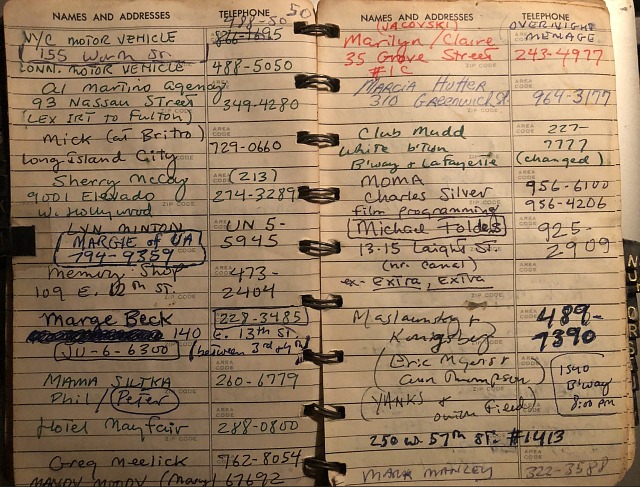
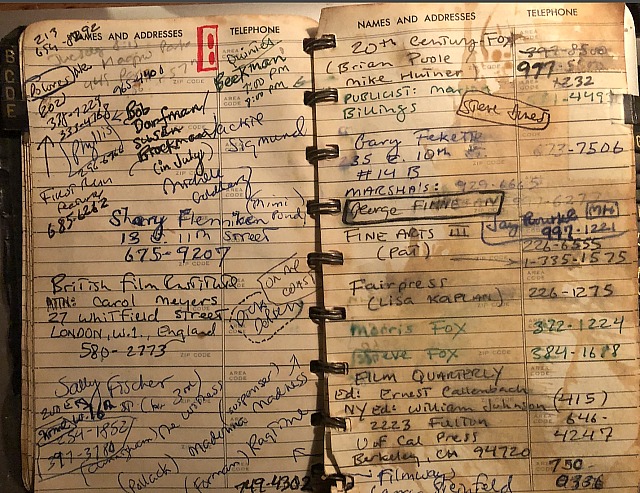
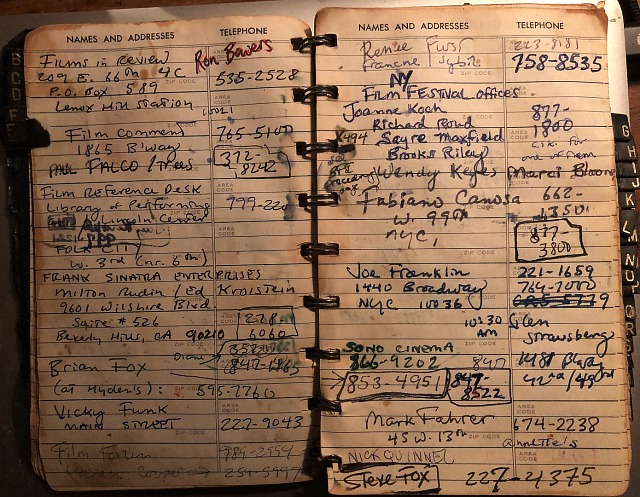
Last night I came upon an old NYC address book, circa 1980 and ’81. It was a replacement of an even better address book that I left in a phone booth just outside El Coyote. Four or five hundred names, street addresses, phone numbers, occasional commentary…all quaintly written with a pen. (I’m figuring the four-decades-old info couldn’t possibly apply in 2020…right?) And I was leafing through and feeling the vigor of those days. Yes, I was a shameless, never-say-die hound. But mostly I was terrified about money and worried about whether my meager writing skills would cut the mustard from a commercial standpoint, and what kind of life I might have in five, ten or twenty years. So I was poor and insecure and hugely intimidated, but somehow I had to keep going, keep pushing. Hence the necessary moxie of youth.

Read more

Oasis

I don’t know this guy (which makes me an asshole, right?) or Da Poets (bigger asshole!), but I instantly warmed to his voice, looks, aura. Plus Franklin Canyon and I have bonded many times over the last three-plus years. Peace-in-the-valley moments haven’t been happening much lately, so this was welcome.

Newsroom Furies

We’ve now witnessed two recent episodes in which New and Old Guard journalists have been sharply at odds. Believers in wokester activist journalism, a Millennial and Zoomer thing that’s about exposing racism, pollution, corruption and all the other social ills and in some cases indicting and/or cancelling old-schoolers (and particularly Trump-aligned righties), have clashed with defenders of traditional liberal journalism — basically a generational rift.

Episode #1 was about wokester N.Y. Times staffers condemning the opinion section’s decision to publish a somewhat rash opinion essay by Arkansas Republican Senator Tom Cotton (“Send In The Military“) that basically said the military should be brought in to stop looters.

Wokester staffers tweeted that running the Cotton piece “puts Black @NYTimes staff in danger”…really? Most Americans believe that the looting has been horrible if not ruinous, and that it should be stopped one way or another.

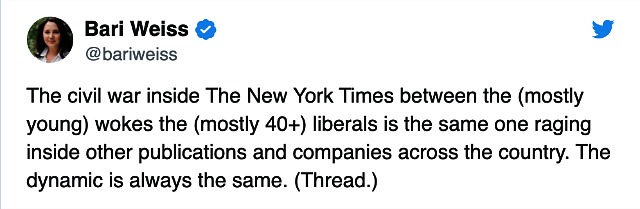
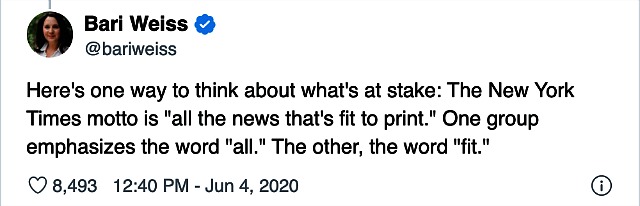
N.Y. Times columnist Bari Weiss explains the clash as follows: “The civil war inside The New York Times between the (mostly young) wokes and the (mostly 40-plus) liberals is the same one raging inside other publications and companies across the country. The dynamic is always the same. The New York Times motto is ‘all the news that’s fit to print.’ One group” — the 40-plussers — “emphasizes the word ‘all.’ The other, the word ‘fit.'”

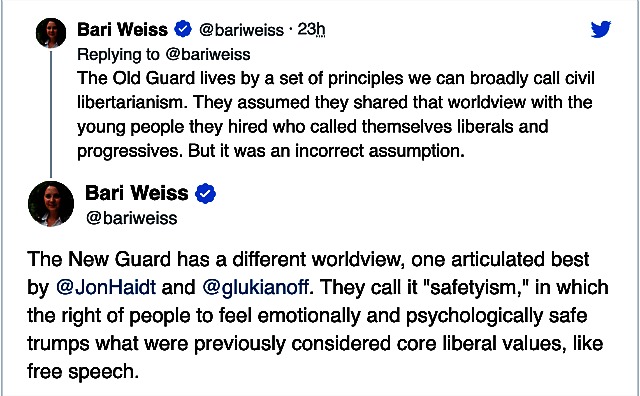
“The New Guard has a different worldview,” Weiss went on. “They call it ‘safetyism,’ in which the right of people to feel emotionally and psychologically safe trumps what were previously considered core liberal values, like free speech.”

Episode #2, which happened last night in Los Angeles, was about safetyism.

Variety editor Claudia Eller was forced to take a two-month administrative leave after a Twitter dispute with freelancer Piya Sinha-Roy about insufficient newsroom diversity. The flashpoint moment was when Sinha-Roy complained that “POC voices are constantly dismissed“, in response to which Eller took umbrage because she felt she and other Variety editors had conveyed an understanding of this complaint and a pledge to improve. “When someone cops to something why would you try and criticize them?,” she said to Sinha-Roy. “You sound really bitter.”

Eller surely understands that you can’t get into a Twitter dispute with any younger POC and hope to win the argument. Or at least, she surely understands that now.

American voters are starting to figure some things out also. Scratch an under-40 wokester-progressive and you may find an ideological Stalinist who’s convinced that change can’t happen without slapping a few people around or even deep-sixing them. A day or two ago I equated this crowd with Tom Courtenay‘s “Strelnikov” character in Dr. Zhivago. I’ve said 50 times that we’re living through a period that’s not unlike the French terror, at least within wokester circles.

We’re also living through a certain strain of liberal hypocrisy in which progressives had insisted for nearly three months that strict social distancing had to be observed for God knows how long. This was followed by the partial collapse of social distancing (certainly among protestors) when it came time to march against systemic racism in the wake of the murder of George Floyd.

Drive though any major city now and you’ll see a whole lot of storefronts covered with plywood, plywood, plywood. Caused by looters but also by the George Floyd protestors who’ve given them cover. What kind of impact is this going to have on Average Joe voters? The vast majority is appalled by racially-driven police brutality and support the demonstrations, but at the same time they don’t like the way plywood has totally taken over.

What would be the right proportional makeup of a properly diverse newsroom, by the way? Should the racial makeup of a newsroom reflect last year’s U.S. census figures, which stated that whites comprise 60.4% of the population with other tribes close to 40% (African Americans 13.4%, Hispanic-Latino 18.3% and Asians 5.9%, etc.). Or is journalism a different kettle of fish? How should it work exactly?

In my view, Weiss is one of the few serious truth-tellers within the N.Y. Times community when it comes to wokesters vs. traditionalists.

Home Stretch

Judd Apatow and Pete Davidson‘s The King of Staten Island will begin streaming on Friday, 6.12. The embargo finally lifts on Monday, 6.8.

A good film is a good film under any viewing circumstance, but as someone who’s streamed KOSI twice I would pay any fair price to be allowed to watch it with a theatre full of appropriately spaced all-media types and/or early adopters. Just to “feel the room”. I’m very sorry that’s not in the cards.

Read more

“Peter Didn’t Go Out Much…”

The final two episodes of Ben Mankiewicz‘s “The Plot Thickens” podcast about the life and career of Peter Bogdanovich (#6 and #7) are extremely sad and deeply moving. An account of a truly terrible tragedy and a calamitous fall from grace.

I was especially touched by Bogdanovich’s singing of a Sinatra song (“I’ll Be Seeing You“) at the end of episode #7.

It makes you want to re-read Andrew Goldman‘s q & a session with Bogdanovich (Vulture, 3.4.19). Posted on 3.6.19: “It’s the kind of interview that almost never happens — the kind in which the interview subject says exactly what he thinks. Exactly as in ‘fuck it, I don’t care.'”

Ancient Roman Principle

The idea of never deploying regular military troops to deal with domestic disturbances goes all the way back to ancient Rome, or at least back to Laurence Olivier‘s thoughts about same in Stanley Kubrick and Kirk Douglas‘s Spartacus (’60).

Olivier’s Marcus Licinius Crassus to John Dall‘s Glabrus: “Have you forgotten Rome’s most sacred law, that a general may never bring his troops within the city walls?” Dall: “Sulla did.” Olivier: “Sulla? To the infamy of his name! To the utter damnation of his line!”

Read more

Marketing Adjustment?

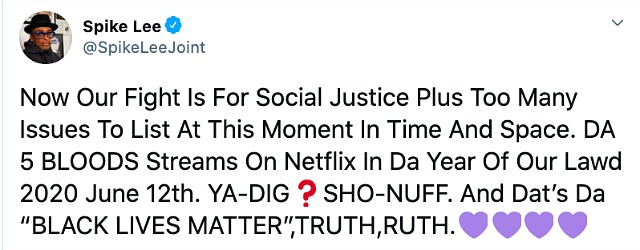
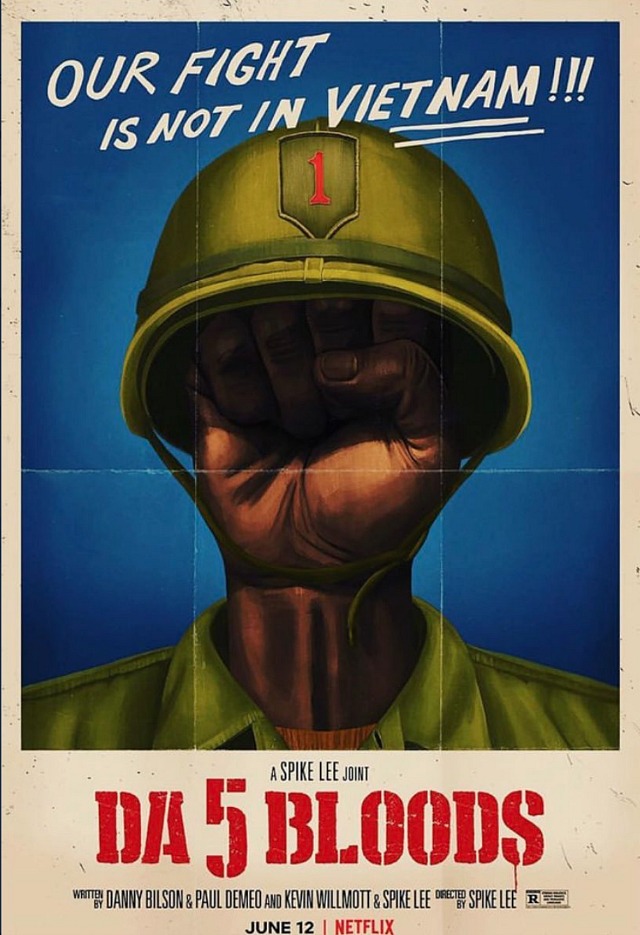
My first thought was that this new Da 5 Bloods poster is an attempt to link Spike Lee’s new film to the George Floyd uprising, et. al. Yes, many if not most African-American Vietnam combat soldiers probably came to a similar conclusion between the mid ’60s and early ’70s, thinking perhaps of the words of Muhammud Ali (“I ain’t got no quarrel with them Vietcong“). And this would fit right in, of course, with the story of four 60something vets returning to Vietnam and reconsidering their shared history. If I’m mistaken I apologize, but I don’t recall reading or hearing that “this ain’t our fight!” is a major theme of this soon-to-stream film until today. Da 5 Bloods will be on Netflix starting June 12th.