Time Reveals All “Gone Girl” Things

Gone Girl is a gas, and I mean that in a truly fascinating ass-wind sense. It’s a wonderfully tight, highly disciplined, utterly delightful ‘who killed the missing wife?’ flick by a master craftsman, but don’t kid yourself about it being just on that level. It’s much more than a rote crime melodrama. Gone Girl is basically an entertaining sociology lecture from Professor Fincher. A blistering assessment of American upscale marriages and social values and self-fuckitude like you’ve never quite seen. How do I get outta here? Look at how miserable we manage to make each other…togetherness! And the pigslop tabloid media brigade…God!

“Women and men are going to have sharply different reactions to Gone Girl, but for openers guys are going to go ‘wow…whoa’ and some feminists are going to howl ‘is this a comprehensive portrait of 2014 male misogyny or what?’ This view is complicated, of course, by the fact that Gillian Flynn, a whip-smart ex-Entertainment Weekly staffer, wrote the book to begin with. On the other hand Fincher brings the shit home.

Gone Girl is a deliciously cold, twisted, half-satiric portrait of elite American values — the whole rotten state of disillusioned post-2008 married yuppie barforama. And fuck me. It’s 10:18 pm on a lovely warm night in midtown Manhattan. I’ve just uploaded two pics and two short videos of the post-Gone Girl press conference at Leows Lincoln Square, and now I have about 15 minutes before heading over to the post-gala party at Tavern on the Green. Later.” — posted on 9.26.14.

Posted on 10.7.14: “Two days ago a Glenn Whipp L.A. Times piece drove a stake through Gone Girl‘s Best Picture chances. The article assessed reactions to last Saturday’s Academy screening of David Fincher‘s film, and the basic take-away was that the 50-plus crowd was mostly underwhelmed or ‘subdued.’

“Nobody Whipp spoke to seemed to understand that Gone Girl is a kind of Luis Bunuel film, and that Gillian Flynn‘s story is only the half of it, that the film is really about the social-cultural undercurrent…about all of us.

“One Academy guy told Whipp that ‘this is first-class filmmaking but, like a lot of [Fincher’s] other movies, you admire it more than you enjoy it.’ In other words, first-class chops and socially pungent content aren’t enjoyable enough. This guy wants to laugh, to be charmed, hugged and caressed, to have his heart melted down. ‘What did I just see?’ one Oscar-nominated producer said to Whipp as he walked along Wilshire Boulevard to his car. ‘That’s it? Really? I’ve seen better social commentary in a good episode of Bob’s Burgers!’

“You can lead a 62 year-old Academy member to a screening, but you can’t make him ‘see’ it. Yes, I wish that just one time Academy members could stand inside my shoes. They’d know what a drag it is to report about them.” — posted on 10.7.14.
Read more

Bumped Again?

Word around the campfire sez that Cannes Film Festival honcho Thierry Fremaux doesn’t like the idea of a masked festival starting on Tuesday, July 6. He doesn’t want to half-ass it — Fremaux wants a classic event in which everyone can relax and breathe openly and be human beings while dressed in sweaters and scarves.

World of Reel‘s Jordan Ruimy, who has some kind of pipeline going with a French guy who hears things, reports that Fremaux is mulling the idea of bumping Cannes all the way into October. Maybe. He couldn’t do it concurrent with the big September festivals so he’d have to choose October.

The thinking (please stop me if I’m wrong) is that if worldwide vaccinations proceed at a good pace then maybe things could get back to normal in, say, six or seven months time. Maybe. Right now, as I’m sure most of you agree, the July 6th date (less than five months henceforth) is probably too soon. I don’t think we’ll REALLY be in the clear until the spring of ’22. At best.

If this turns out to be true, I’m very, VERY sorry about Wes Anderson‘s The French Dispatch and Leos Carax‘s Annette once again getting the shaft end of the stick and having to recalculate strategies. If this happens, of course. I know nothing for a fact.

Ruimy #1, posted on 1.18.21: “I reported in January that the Cannes Film Festival was very serious in eyeing a September/October event this year. It turns out the intel was accurate.”

Ruimy #2: “It seems as though the head honcho of the biggest and most important film festival in the world isn’t opposed to moving the event into the fall. [This] would have to do with Fremaux not being a fan of experiencing a ‘middle ground’ version of the festival. Meaning, he wants Cannes 2021 to be without masks or other PPE. And if that’s the case where France requires that people wore masks at large public events, then he’d rather just wait it out saying, ‘The middle ground is the worst.'”

Ruimy #3: “A Cannes that happens after Venice, Telluride, Toronto and potentially NYFF would throw everything out of whack.”

Uptown film festival veteran: “I’ve long suspected that launching Cannes ’21 on July 6th was a pipe dream. It felt weird and wrong that Thierry would even try it. But the fall? Maybe he will meld it with his Lyon thing?”

Read more

Hammer Snickering Forbidden

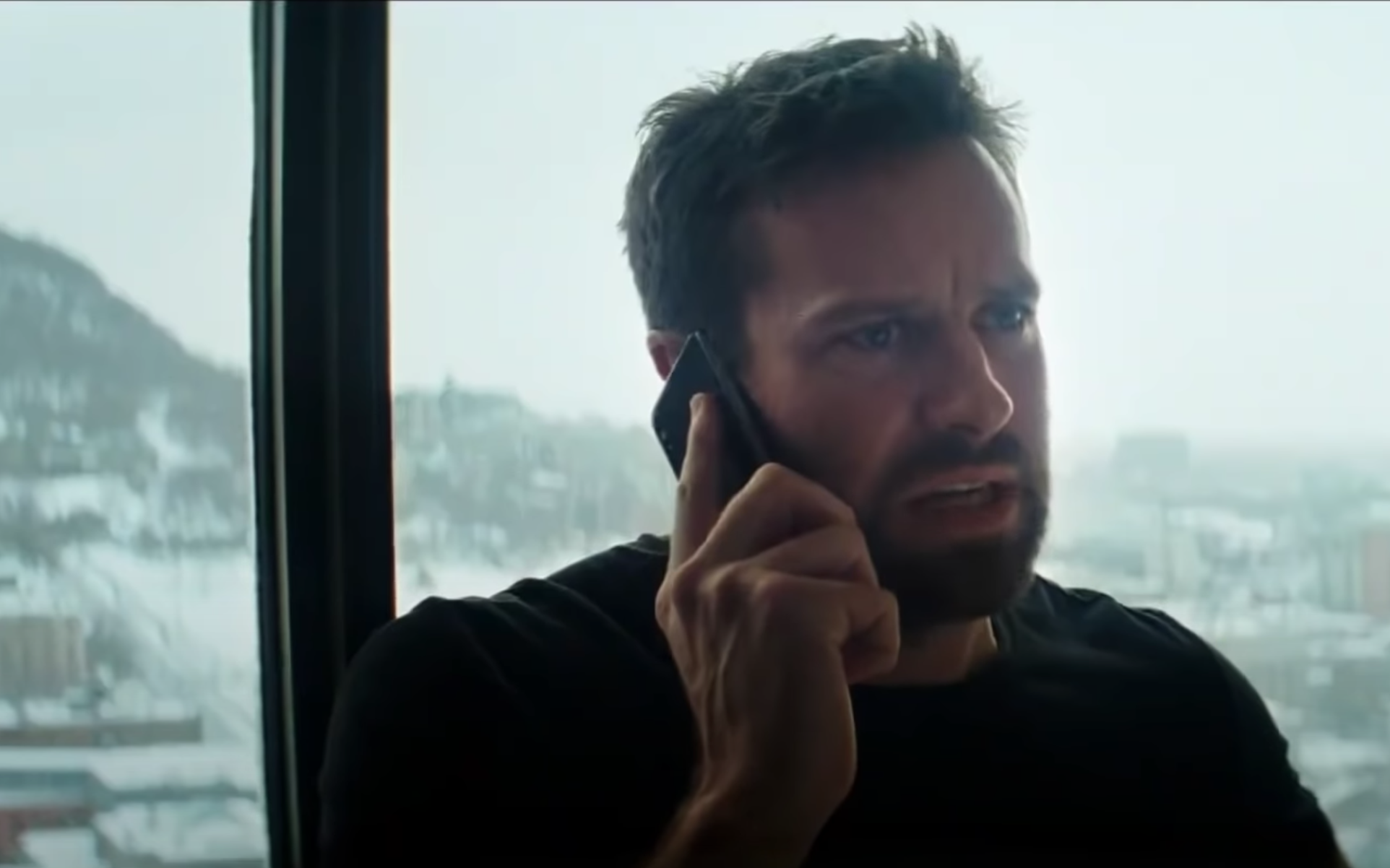
I’ve seen and admired Nick Jarecki‘s Crisis (Quiver, 2.26), a skillfully wrought, multi-charactered, Traffic-like drama about the intrigues and ravages of the opioid epidemic. It began shooting roughly two years ago, and was ready to roll out by early ’20, or roughly a year ago.

I don’t know how it would have fared critically or commercially if the pandemic hadn’t hit, but I know two things. One, Crisis (originally called Dreamland) deserves everyone’s respect, and two, it doesn’t deserve to contend with so much as a single bad Armie Hammer joke.

As Jake Kelly, an undercover double agent dealking with users and sellers and basically in quicksand up to his neck, Hammer delivers a steady, no-frills performance. He doesn’t try to do anything the cute or charismatic way. Crisis is a complex ensemble piece, but at the same time as lean and trim as anyone could imagine, and trouper-wise Hammer fits right in. He holds back.

Not once during my viewing did I think about Hammer’s recent travails. Okay, I did think about them but mostly I was muttering “this is what good cinema does…it brings you in and shuts the world out….nice deal.”

I was also thinking that whatever Hammer might have gotten wrong in terms of excessive zeal or showing a lack of sensitivity or consideration for this or that B&D partner, his troubles are his own turf’s. No overlap, leave it alone.

The same consideration should, of course, be given to the other two Hammer films opening this year — Kenneth Branagh‘s Death on the Nile (20th Century, 9.17) and Taika Waititi Next Goal Wins, which will probably “open” during the ’21 and early ’22 award season.

Damn Train Set

“After all, I was there — in the house, in the room — and I know both my father and mother and what each is capable of a whole lot better than you.” — from Moses Farrow‘s “A Son Speaks Out,” 5.23.18.

And yet Allen v. Farrow (HBO Max, 2.21) suggests that perhaps Moses wasn’t in Frog Hollow that day, or that he wasn’t around much or was off walking or sulking. The doc focuses hard on Moses in episode #4 and does what it can to discredit him. I can’t recall precisely if the contrary information is offered in episode #3 or episode #4, but it arrives when the doc quotes Woody Allen‘s testimony in the 1993 Judge Wilk child custody case.

Although the doc doesn’t excerpt any passages from “A Son Speaks Out“, it passes along a Moses statement about his being at the house and seeing this or that, and then it flashes a statement on the screen: “Allen, during his testimony [at Judge Wilk’s custody hearing], said Moses “was nowhere to be seen” that day, or words to that effect. (I wish I had frame-captured this — my bad.)

And yet at the beginning of his essay Moses writes that he “was present for everything that transpired in our house before, during, and after the alleged event.”

If, like me, you dismiss a notion that Moses was lying when he wrote that he was there “before, durng and after”, it sounds as if Allen v. Farrow directors Kirby Dick and Amy Ziering are being dishonest on this particular point, at least as far as blowing smoke up viewers’ asses is concerned.

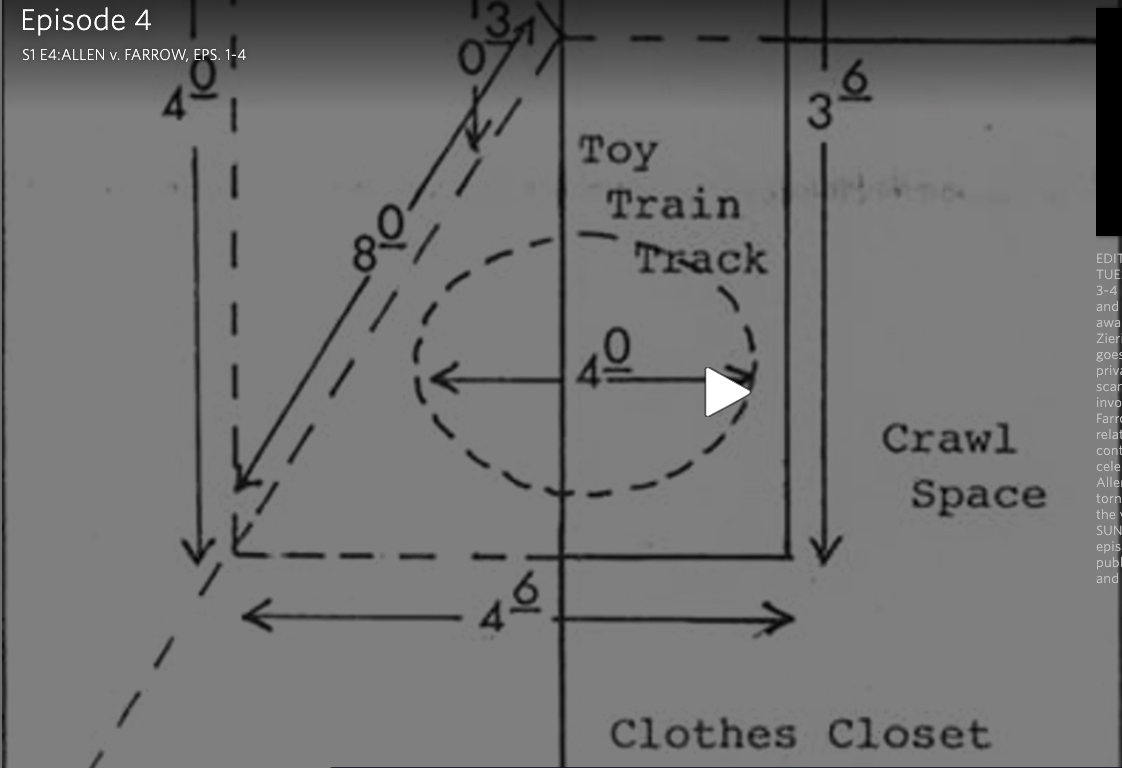
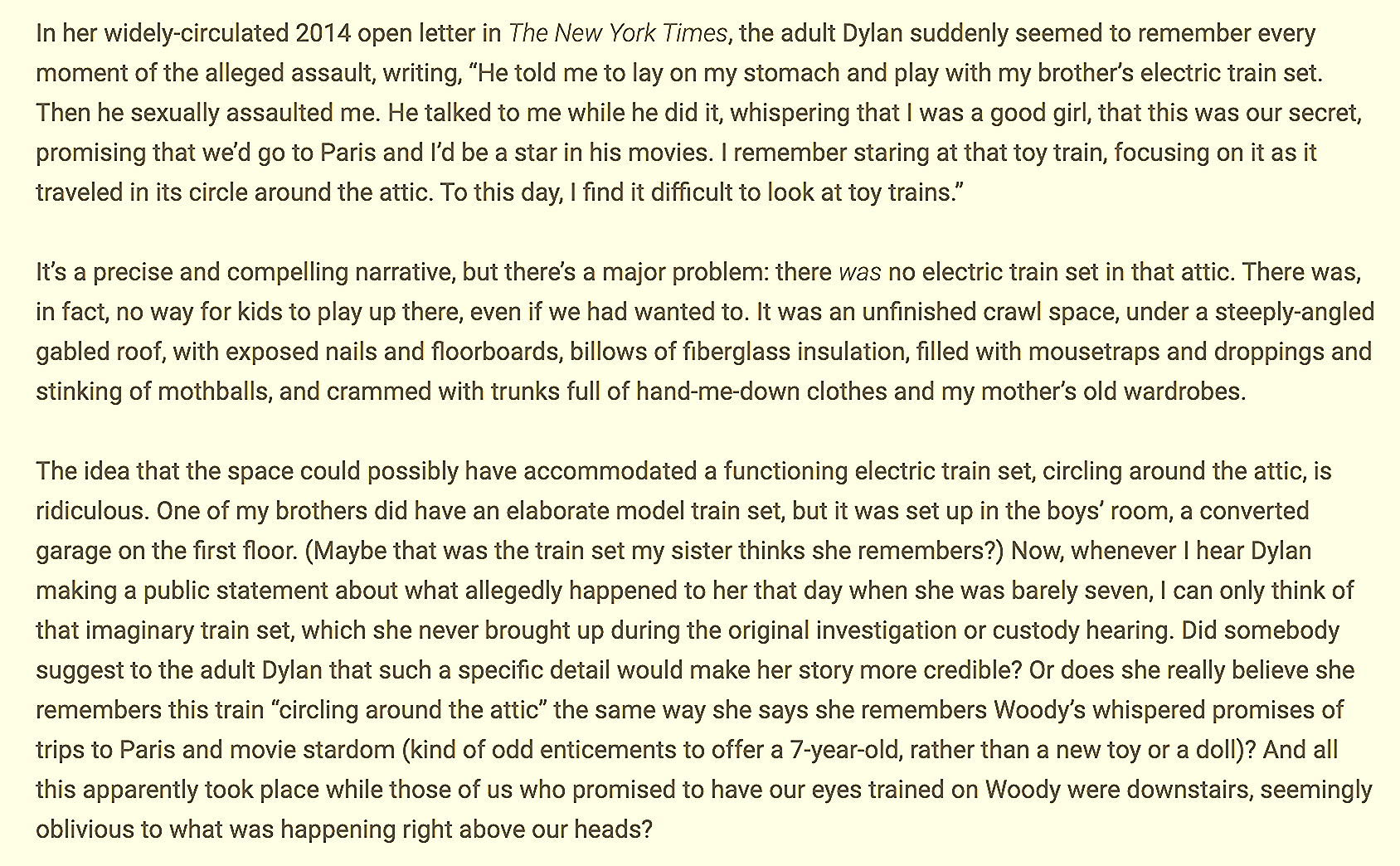
I’m especially bothered — flummoxed is a better word — by the “train set in the attic” thing. Dylan said the train was choo-chooing around the attic — the actual quote is “circling around the attic” — during the alleged assault. In episode #4 an undated Connecticut police drawing (or “schematic”) of the attic crawl space shows a circular (or oblong-shaped) train track of some kind, but why not a photo? Why wasn’t it dated? Who’s the artist?

Moses, on the other hand, wrote flat-out that there was no train set in the attic — period. (He said an electric train set was actually in a first-floor converted garage playroom that the boys used.) Why is this unresolved in the doc? Why didn’t Dylan mention a train set in her earlier statements? Why didn’t the doc drill down and clear this up one way or the other? Who drew the schematic?


Undated police-issued drawing of Frog Hollow attic crawl space, presented in episode #4 of Allen v. Farrow.