Soviet Righteousness Porn

From “Death to Me! — The New York Times and the creepy personal and ideological logic of public confessions,” a 2.10.21 Tablet essay by David Mikics:

“If I were Donald G. McNeil Jr., I would want to tell The New York Times, and its publisher, A.G. Sulzberger, to go jump in a lake. Instead, McNeil chose to declare his love for the paper and proclaim his guilt for having ‘hurt’ many hundreds of people. For McNeil’s professional death to have meaning, the party—or the paper—must be infallible. Death to me!

“That this kind of groveling confession is not unique to the Times, but rather plays a key functional role in the politics of woke anti-racism, can be judged with the frequency with which such apologies are staged across institutional and corporate settings where wokeness holds sway.

“Untold millions of true believers lived and died in Stalin’s Soviet Union. When told they were guilty, they sooner or later agreed with the charges against them, even if they couldn’t locate their guilt in anything they had actually done. When the exhausted prisoner finally gives in to the party, which has sole grasp on truth, a soothing relief may come: History has spoken. Koestler and Orwell testify as much in their famous novels.

“Admittedly, at times the prisoners were merely surrendering to a superior force that worked through the deprivation of sleep and food and relentless interrogations — and through more baroque tortures. And there were always those who refused and resisted. But the Soviet system stood for decades on the bedrock of shared guilt.

“In the absence of real evidence and reporting, public confessions helped buttress the credibility of the system.

“These days we repeatedly confess our racism and misogyny, suppressing any sense that we are perhaps not as sinful as we are told. Maybe we haven’t harassed, demeaned, or insulted anyone — but the very impulse to defend ourselves indicates our guilt. After all, we are all part of ‘the system,’ and only a thoroughgoing racist would dispute the idea that the system is guilty.

“Of course, America is not Soviet Russia, or, for that matter, Xi’s China. Our new political commissars don’t use torture, prison cells, and executions. Today’s woke ideology can be publicly attacked, unlike communism in the Soviet Union. Its critics are in fact legion: According to polls, most Americans of all genders and ethnicities think political correctness is a problem. But people are afraid for their careers, and so they remain silent — no matter how much ‘power’ or ‘privilege’ they ostensibly have.”

Smothered In Sickly Gold

There are two versions of John Huston and dp Oswald Morris‘s Reflections in a Golden Eye (’67) — the repellent gold-and-pink-tinted version that was used for the initial release in October 1967, and a follow-up wide release version that used regular color.

I saw the original version at the Carnegie Hall Cinema or Bleecker Street Cinema sometime in ’79 or ’80, and as much as I’d respected the previous experimental color schemes of Huston and Morris (the rose-tinted color palette of Moulin Rouge, the misty grayish tones of Moby Dick), I despised the sickly golden palette (monochrome flooded with gold) in Reflections. It literally made me feel nauseous, and I distinctly recall that this feeling stayed with me the rest of the day and into the evening.

I didn’t “dislike” Huston’s film. I seriously hated it, and was really and truly sorry that I’d submitted. I knew (and still understand) that it was a serious film that was trying to address (i.e., deplore) emotional and sexual repression, but that didn’t help.

Not to mention the vile content of the damn thing — Marlon Brando‘s rigidly closeted Army major, Elizabeth Taylor‘s acidic bitch of a wife, Robert Forster‘s object of erotic desire, Brian Keith‘s easy-going Lieutenant Colonel who’s having it off with Taylor beyond Brando’s gaze, Julie Harris‘s Alison Langdon (Keith’s disturbed wife who’s cut off her nipples with a pair of gardening shears). Talk about your gallery of grotesques!

Audiences felt pretty much the same way about the gold version, which is why Warner Bros. withdrew it and sent out regular-color prints for the wide release in early ’68.

Last year Warner Archive released a double-disc Bluray that included both versions. (Or so I gather.) Right now HBO Max is offering the regular-color version. I tried watching some of it last night; it was half-tolerable.

What films have made HE regulars literally sick to their stomachs and souls? There must be a few.

Read more

“Vertigo” Peepers Can Stuff It

The only guided film-location tour I’ve ever taken was a San Francisco Vertigo tour. It was sometime around ’02 or ’03, offered under the auspices of the San Francisco Film Festival. Part of the tour, naturally, was dropping by Scotty Ferguson’s apartment at 900 Lombard Street. The red door was missing but otherwise it half-resembled the original location. No longer — Scotty’s place has since been totally rebuilt and walled off in order to give pesky tourists nothing to see. Go away, we don’t want you around, Vertigo was shot 62 and 1/2 years ago, get a life, etc.

Read more

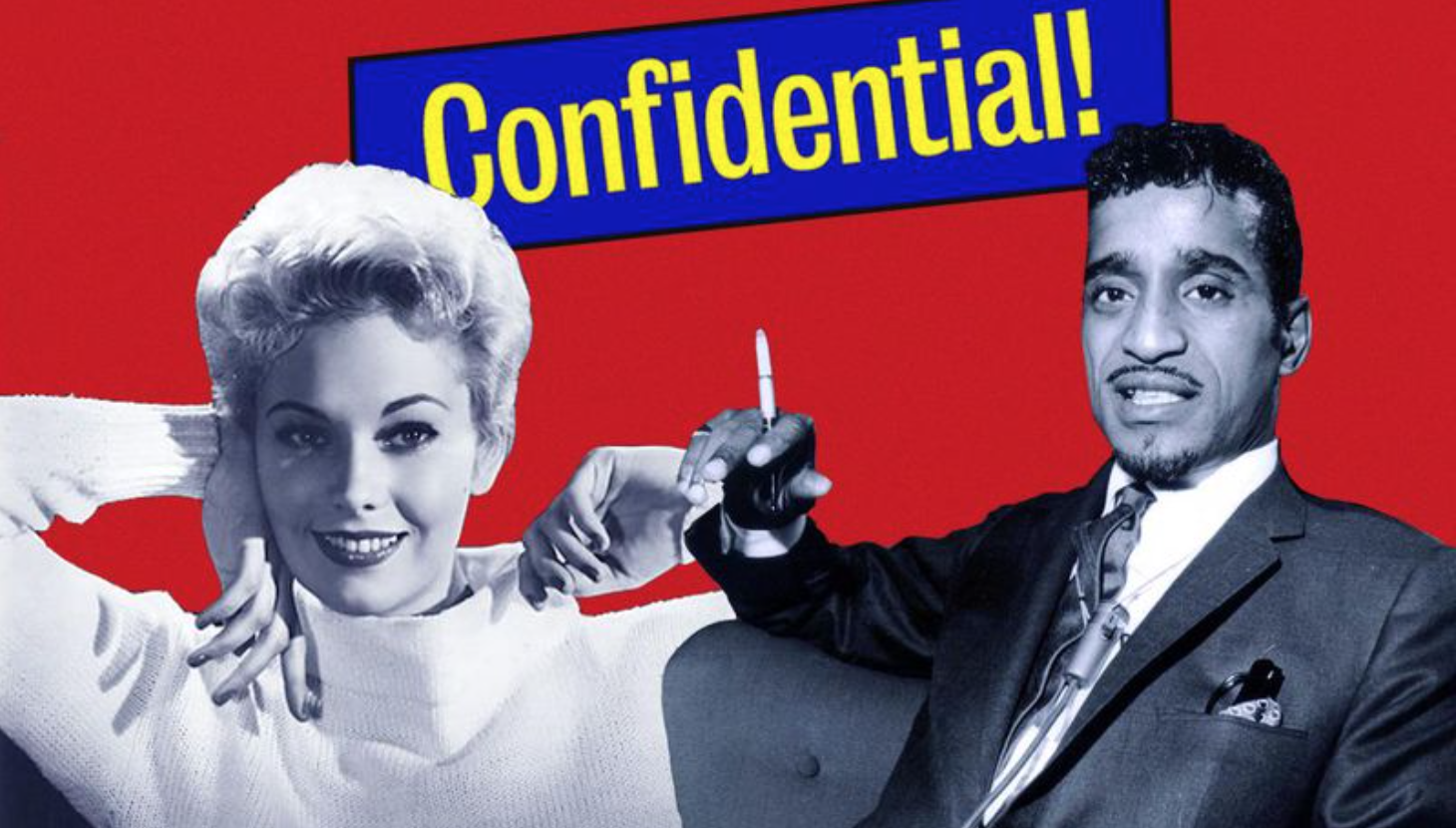
Who Bill Cosby-ed Kim Novak, and Why?

There are two…well, one head-turning takeaway from Scott Feinberg’s 3.12 Kim Novak interview (audio + transcript) in the Hollywood Reporter. Plus there’s a vague refutation of a rumor about Novak having been Bill Cosby-ed by Tony Curtis during a late-night party in November 1957. Plus an interesting inference or two.

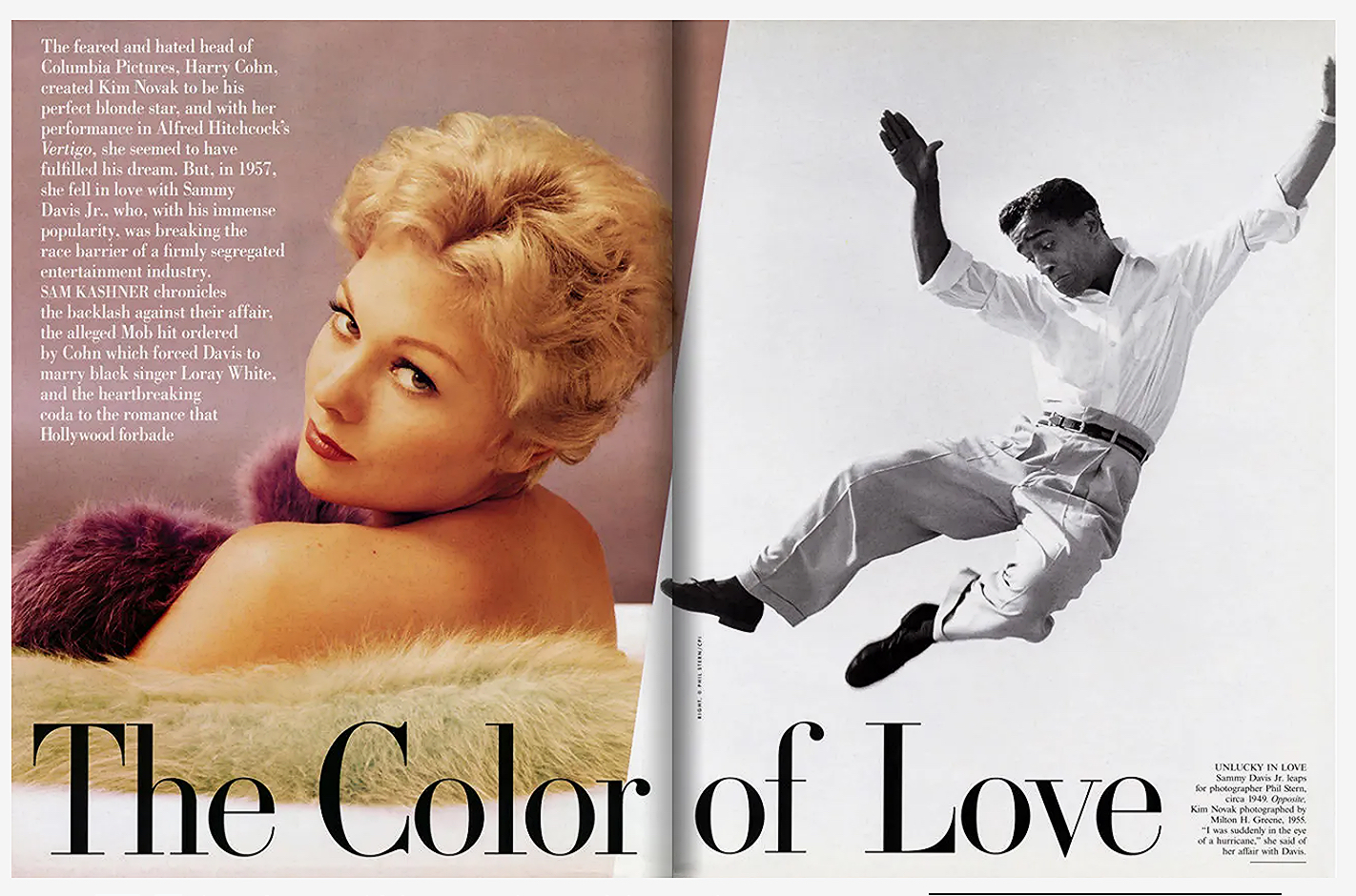
One, Novak’s fabled interracial “affair” with Sammy Davis, Jr. in late 1957, which was chronicled in a September 2013 Vanity Fair piece by Sam Kashner and discussed in an August 2017 Smithsonian article by Joy Lanzendorfer, wasn’t actually sexual**.

Lanzendorfer reported this on 8.9.17, Novak reportedly repeated the claim to Larry King in 2004, and she says it again to Feinberg in the current THR piece — no salami and, the article indicates, perhaps a hint of stalking on Davis’s part.


Vanity Fair art for Sam Kashner’s September 2013 article about the brief Novak-Davis alliance.

Novak tells Feinberg that her much-whispered-about relationship with Davis had more to do with (a) Davis aggressively pursuing Novak — inviting her to join him for a Thanksgiving dinner with his parents in Los Angeles in late November 1957, and then surprising her by showing up when she invited him out of politeness to a family Christmas gathering in Chicago a month later, and (b) Novak not wanting to discourage Davis out of concern that a racial motive might be inferred if she flat-out rejected his advances.

Feinberg’s article also contains a between-the-lines inference that while Tony Curtis may have slipped Novak a Mickey Finn during a late-night after party at his Beverly Hills home (which he shared with then-wife Janet Leigh), Davis may have been “in on it” and perhaps was the guy who drove Novak back to her home, where she woke up in her bed stark naked the next morning, not having the slightest clue what had happened.

Feinberg excerpt: “One day, Novak left Paramount studios — still in her [Judy Barton] wig and green gown from Vertigo — to attend a charity dinner, where Tony Curtis invited her to an afterparty at the home he shared with Janet Leigh. Hearing that [director Richard] Quine would be there, she said yes.

“When she arrived, Quine [with whom Novak was involved to some extent] wasn’t there. But Davis was, and he offered to help her take off her wig.

“‘By the time he got it off,’ Novak recalls, ‘Tony Curtis had brought me a drink. I don’t know…I only had, I think, one drink there. But that’s the last thing I knew. I do not know anything afterward, cross my heart, hope to die. Don’t know what happened after that or how my car got back in front of my apartment.

“Does Novak think someone spiked her drink? ‘I really do,’ she said. “I didn’t think of it then because people didn’t talk about things like that, but I could never figure it out…I’ve never blacked out in my entire life.’

“She adds, ‘I think Tony Curtis did it. I don’t want to think Sammy did that.’ And when she awoke the following morning? ‘I’ll just tell you the honest truth: I didn’t have my clothes on.'”

The “tell” is Novak saying “I don’t want to think Sammy did that.”

Read more