
Fatzilla Is A Meaner, Snarlier Hombre…

…but King Kong‘s bearded, over-sized, angry-assed, middle-aged grand-nephew has more soul. He’s a decent fellow so I’m with Kong and the cute little Kong-whisperer Jia (Kaylee Hottle) even though I know he probably can’t win. He’s got a great monster roar and super-powerful arm muscles, but he just isn’t tough enough to decisively whip Fatty’s ass. And I mean especially when he’s wrestling Godzilla underwater and starts to become weaker as he runs out of breath. Owwwhhhmmmm!

Unless he’s armed with the ancient blue-light axe from Hollow Earth. Then things are evened up.

Could this be a job for MechaGodzilla, the artificial ‘Zilla created by corporate bad guy Demian Bichir? Oh, no, wait…he just killed Bichir! Smashed him like a bug! And now there’s nothing in Hong Kong left standing…the cost of rebuilding will be incalculable! Jia to Kong: “Be careful!” And then Kong yanks off MechaGodzilla’s head…yoowwwrrhhlllrrr!

But honestly? My favorite moment in the whole film came during that Hollow Earth victory scene over the prehistoric winged slime serpent when King rips his head off and drinks the green slime pouring out of the cranial cavity. Which prompts Rebecca Hall to say “That’s gross.” (Or was that Eiza González, who plays Bichir’s daughter?)

This is a movie made by deranged adolescent lunatics with too much money to spend. Okay, I didn’t mean that. Adam Wingard and the Kong vs. Godzilla producers aren’t lunatics. They’re evil winged monkeys from hell, pretending to be human. This movie actually made me feel like one of those monkeys, except I was more the old-fashioned kind with wires on my back and serving Margaret Hamilton‘s Wicked Witch of the West. I started to hop around the living room, cackling and snickering and clapping my hands as I pretended to fly.

Kong to Godzilla at the finale: “Yo…truce?”

Kong too easily flies around like a winged bat or a big helium-stuffed panda bear or a giant mosquito dressed in an ape suit. The fucker weighs hundreds and hundreds of pounds and he yet floats and leaps and falls dozens of stories and it’s all cool. This movie doesn’t respect physics!

But the screenwriters — Eric Pearson and Max Borenstein with “story” assistance from Terry Rossio, Michael Dougherty and Zach Shields — had to be on hallucinogens when they cooked up some of the more wackazoid imaginings. I respect LSD too much to suggest that you, the potential viewer, should see Godzilla vs. Kong on acid, but you could theoretically do that.

And if you were a batshit insane person to begin with, you might get more out of it that way. If you have no soul to begin with and you wouldn’t know satori or enlightenment if they bit you in the ass, why not?

This is the nuttiest, craziest, most imaginative monster destruction-derby movie I’ve ever seen in my wasted, ruined life. And, at a projected budget of $160 to $200 million, probably one of the most wasteful. But if the lower figure is true, Wingard has spent slightly less money that Rian Johnson will spend on the first Knives Out sequel, so at least there’s that.

Does it bother anyone that King Kong has a visible navel? They probably should’ve given him a large schlongola….c’mon, why not?

This movie, by the way, has three overweight characters — Brian Tyree Henry‘s “Bernie Hayes”, Julian Dennison‘s “Josh Valentine” and Fatzilla himself. Kong is actually in pretty good shape all around. Washboard abs. I think it was really cruel, however, to “contain” Kong inside a huge artificial Kong Dome on Skull Island. Leave the poor guy alone…God. Not to mention the cost.

I need to watch Ingmar Bergman‘s Wild Strawberries. Or George Cukor‘s Sylvia Scarlett. Something sane and semi-sedate. Nope, changed my mind. I’ve decided to watch John Carpenter‘s Assault on Precinct 13.

Friendo text (6:32 am Pacific): “I can’t believe you liked that corporate funded, juvenile scripted POS.”

HE reply: “‘Liked it’? It made me scream and howl. It injected feral madness into my veins. The fine fellows who made this film are evil. It’s an insane hallucinogen carpet ride. Corporate derangement syndrome. Sickness incarnate. And yet…dopey!”
Read more

“Above Suspicion” About To Poke Through

Early this morning Collider‘s Jeff Sneider broke the news that Phillip Noyce‘s Above Suspicion, which I’ve been doing cartwheels over since I first caught it in the summer of ’17, will open via Lionsgate in mid May — select theaters and on digital/VOD platforms on Friday, 5.14, Blu-ray and DVD on Tuesday, 5.18.

I wrote last summer about the film’s misadventures on the worldwide distribution and pirating circuit (“Woe to Rashly Distributed Above Suspicion“) that began…oh, sometime in late ’17.

According to the IMDB Above Suspicion‘s principal producers are Mohamed AlRafi and Tim de Graye, whose film companies are called 50 Degrees Entertainment LLC and White Knight Pictures. Despite the curious distribution strategy orchestrated by these fine fellows, there remains a commercially fertile market for what any avid cineaste would call a truly excellent film.

“There are still plenty of people who don’t torrent movies,” Sneider writes, “and [who] would be willing to pay to check out this cinematic curiosity.”

Due respect but that is an unfair and inaccurate way to describe Above Suspicion. It is, no lie, a jug of classic, grade-A moonshine — a brilliant, tautly paced, perfectly written action thriller that plays deep down like an emotional tragedy, and is boosted by an ace-level performance from Emilia Clarke.

The Girl From Lonesome Holler,” posted on 7.24.17: “Above Suspicion, which is based on Joe Sharkey’s 1993 true-life novel, is a triple-A, tightly-wound, character-driven genre flick (i.e., rednecks, drug deals, criminals, lawmen, murder, car chases, bank robberies) of the highest and smartest order.

“Most people would define ‘redneck film’ as escapist trash in the Burt Reynolds mode, but there have been a small handful that have portrayed rural boondock types and their tough situations in ways that are top-tier and real-deal. My favorites in this realm are John Boorman‘s Deliverance, Billy Bob Thornton‘s Sling Blade, and Lamont Johnson‘s The Last American Hero.

“Noyce’s Above Suspicion is the absolute, dollars-to-donuts equal of these films, or at least a close relation with a similar straight-cards, no-bullshit attitude.”

Sneider is a savvy reporter with a good heart, but calling Noyce “an underrated director” is another off-kilter description. Noyce has been consistently proving his grade-A feature chops since the late’ 70s, and there isn’t an actor, screenwriter, agent or producer in this town who doesn’t know this.

Noyce’s theatrical highlights include the brilliant Newsfront, the classic Aussie breakouts Heatwave and Dead Calm, a hugely successful pair of Jack Ryan thrillers (Patriot Games, Clear and Present Danger), the notorious Sliver and a great run of variations that followed — The Saint, The Bone Collector, Rabbit-Proof Fence, The Quiet American, Catch a Fire and Salt.

Read more

Two Kinds of L.A. Crosswalkers

In my anguished Los Angeles experience, I’ve learned that pedestrians fall under two categories when they’re crossing a major boulevard at a stoplight — purposeful speedwalkers and pudgy shufflers. I was watching both kinds this morning at the corner of Santa Monica and La Cienega Blvds…slowly shaking my head, exhaling, going “tsk-tsk.”

Let’s herd the purposeful pedestrians under a general Category A. We’re talking New Yorkers at heart…people like myself who understand that roads are primarily about cars (just as ancient Romans understood that horse-drawn chariots ruled on the Appian Way) and that the rights of pedestrians are somewhat important but not as important as those of four-wheeled vehicles…people who therefore walk briskly in order to increase the odds that they’ll reach the opposite curb before the light turns green, and who walk faster and sometimes even jog when they see the yellow warning light.

Let’s call the pudgies Category B types…roundish pokey folk who saunter across boulevards at their own pace, and wouldn’t dream of hustling along if the light turns green and they’re blocking traffic…their basic attitude is “nobody pushes me around…I’ll get to other side of the boulevard at my own speed, and if that means certain cars will have to wait then so be it. And if you don’t like it, tough.”

Critical Race Theory By Way Of Hulu

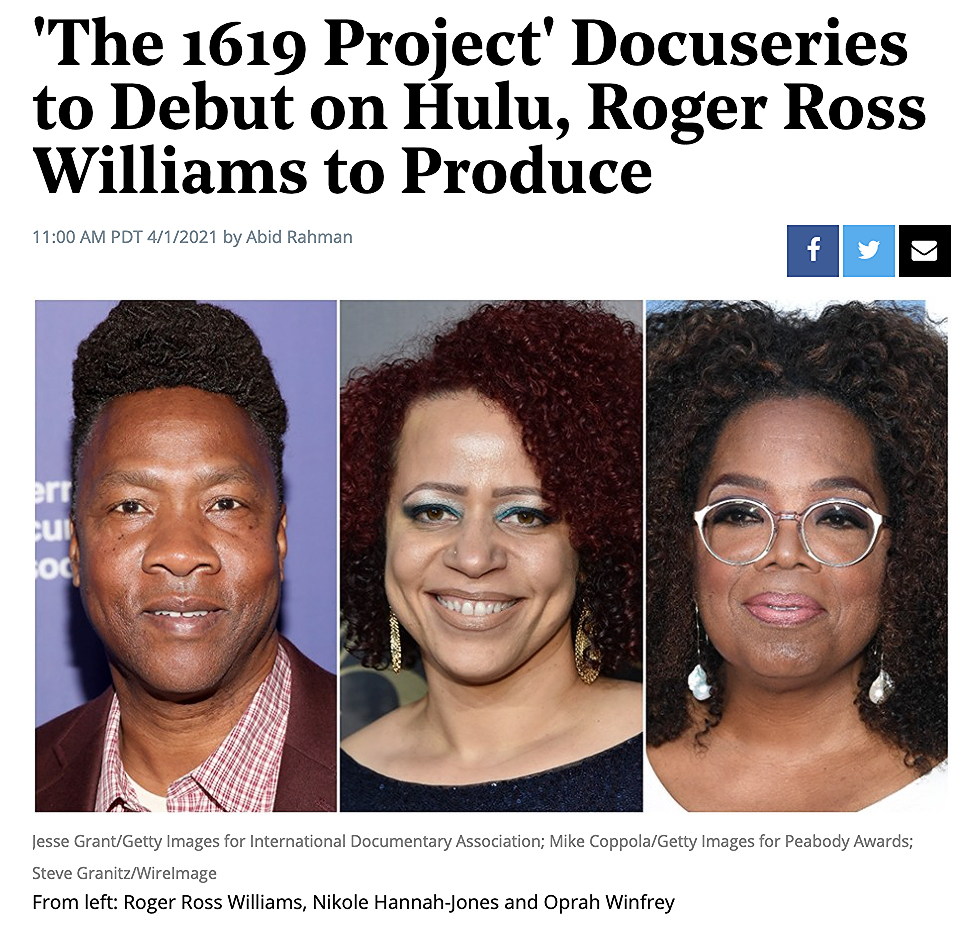
The controversial “1619 Project,” an ambitious reframing and re-branding of U.S. history by way of the N.Y. Times, wokesterism and Critical Race Theory…a massive thesis, published on 8.14.19, that became known in some quarters as (a) historically questionable in some aspects, (b) “ideology masquerading as neutral scholarship” and (c) “a thesis in search of evidence, not the other way around,” will be presented as a documentary series via Hulu.

Roger Ross Williams will produce and oversee the series, and will also direct the first episode. Shoshana Guy will serve as showrunner and executive producer. Kathleen Lingo, editorial director for film and TV at The New York Times, will also executive produce as will Caitlin Roper. The series will be made in collaboration between Lionsgate Television, The New York Times, and Oprah Winfrey’s Harpo Films.

HE on 7.30.20: “Don’t tell me that slavery and racism is and always has been this country’s central definer. The 1619 Project’s revisionist zealotry rubs me the wrong way in more ways than I’d care to elaborate upon.

“Slavery has always been an ignominious chapter in the first 245 years of US history (1619 to 1865) and racism has stained aspects of the culture ever since, but to assert that slavery and racism (which other cultures have shamefully allowed over the centuries) are THE central and fundamental definers of the immense American experience strikes me as a bridge too far.

“One stone in the shoe is the 1619 Project’s contention that the American revolution against England was significantly driven by colonist commitment to maintaining slavery.

“Many factors drove the expansion and gradual strengthening and shaping of this country, and particularly the spirit and character of it — immigration, the industrial revolution and the cruel exploitations and excesses of the wealthy elites, the delusion of religion, anti-Native American racism and genocide, breadbasket farming, Abraham Lincoln, Frederick C. Douglas, the vast networks of railroads, selfishness & self-interest, factories, construction, the two world wars of the 20th Century, scientific innovation, native musical forms including jazz, blues (obviously African-American art forms) and rock, American literature, theatre and Hollywood movies, sweat shops, 20th Century urban architecture, Frank Lloyd Wright, major-league baseball, Babe Ruth & Lou Gehrig, family-based communities and the Protestant work ethic, fashion, gardening, native cuisine and the influences of European, Mexican, Asian and African cultures, hot dogs, the shipping industry, hard work and innovation, the garment industry, John Steinbeck, George Gershwin, Paul Robeson, Louis Armstrong, JFK, MLK, Stanley Kubrick, Chet Baker, John Coltrane, Marilyn Monroe, Amelia Earhart, Malcom X, Taylor Swift, Charlie Parker, Elizabeth Warren, Katharine Hepburn, Aretha Franklin, Jean Arthur, Eleanor Roosevelt, Carol Lombard, Shirley Chisholm, Marlon Brando, Woody Allen, barber shops & manual lawnmowers, the auto industry, prohibition & gangsters, the Great Depression and the anti-Communism and anti-Socialism that eventually sprang from that, status-quo-challenging comedians like Richard Pryor, Lenny Bruce and Steve Allen (“schmock schmock!”), popular music (Chuck Berry, Little Richard, Elvis Presley, Frank Sinatra and the Beatles), TV, great American universities, great historians, great journalism (including the National Lampoon and Spy magazine), beat poetry, hippies, the anti-Vietnam War movement, pot and psychedelia, cocaine, quaaludes and Studio 54, 20th & 21st Century tech innovations, gay culture, comic books, stage musicals, Steve Jobs, etc.”

Read more