
Conflating Racially-Tainted Tragedy with Oscar Futures…Yipes!

Last March the intemperate, hyperventilating woke jackal mob did their best to bring about my death. It was partly about HE having posted an insensitive comment — albeit one that might have been mentioned by any half-attuned industry insider who knows how Oscar-voting sentiments tend to work on deep-down levels — but it was mainly a matter of indelicate timing.

I naturally apologized for this transgression, despite (a) my not having actually written a damn thing myself (I’d posted an excerpt of an email chat) and (b) my having quickly removed the post when the Twitter banshees went nuts.

I was reminded a few days ago that a similar thing happened in late November 2014, in the immediate wake of an announcement by the Ferguson grand jury that no charges would be filed against Officer Darren Wilson in the death of Michael Brown.

Right after the Ferguson Grand Jury verdict was read, and just before a Disney-lot screening of Into The Woods, I tweeted that a possible “strike a match rather than curse the darkness” response to this otherwise tragic event might be a surge of industry Best Picture support for Selma. Yup — another instance of the wrong HE tweet at the wrong time. But all I said was that symbolically lighting a candle rather than lamenting the ugliness might be a good thing in the end.
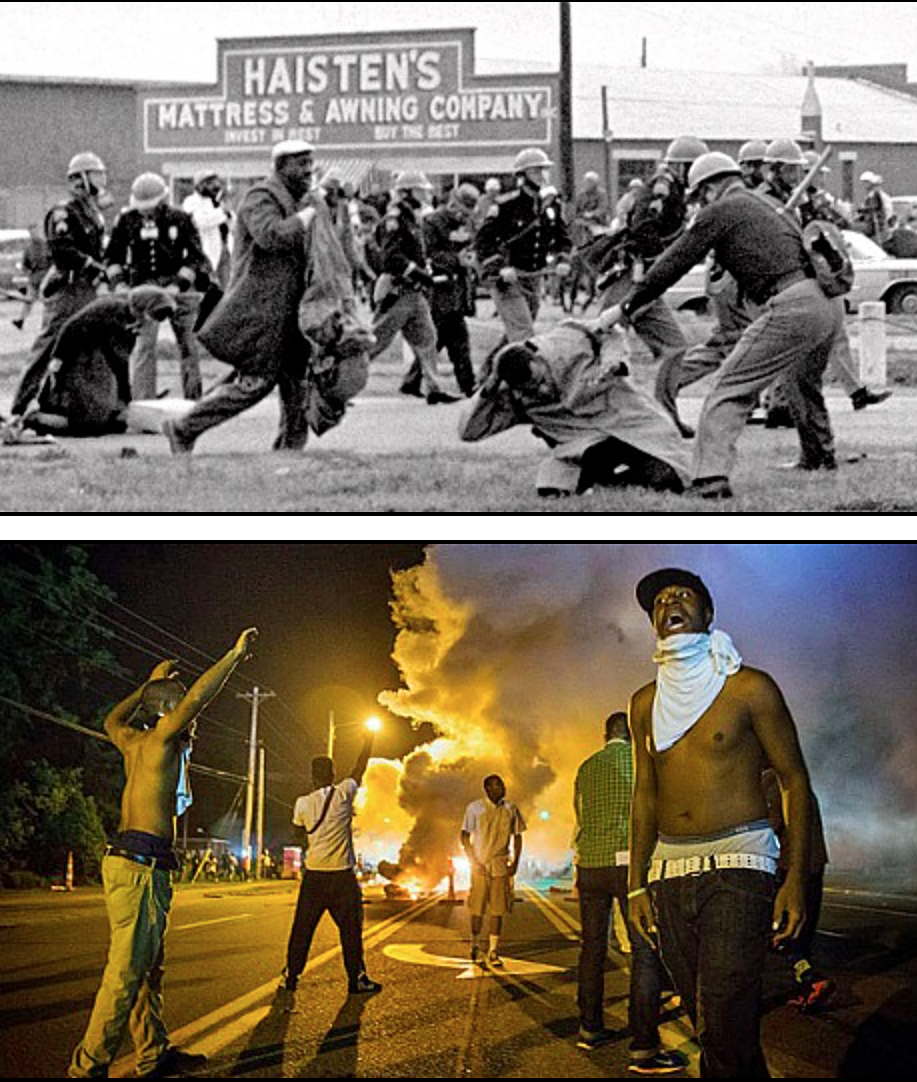
The Twitter community didn’t dig it. I was all but roasted alive for saying this. Many people tweeted that I sounded like an insensitive asshole. How dare I suggest, after all, that there was (or might be) linkage between Ferguson and Selma‘s Oscar chances.

But at heart I had tweeted a positive sentiment. I was thinking, you see, of Martin Luther King’s words about how only love can eradicate hate. I was thinking that standing by a film about human dignity, compassion and human rights would serve as a positive response to the Ferguson situation.

Okay, I didn’t say it in quite the right way. But I was trying to suggest that in a roundabout fashion this would be a way of showing love and respect for the right things and the right people.

A couple of days later Selma director director Ava DuVernay pointed out a direct connection between her film and what had happened in Ferguson.

She did so in an Eric Kohn Indiewire interview with Selma director Ava DuVernay and Fruitvale Station director-writer Ryan Coogler about their support of the Black Friday Blackout.

For me, the stand-out portion was when Kohn asked DuVernay if she saw “any direct connections between today’s climate in the immediate aftermath of Ferguson in the story of Selma.” DuVernay responded as follows: “Yes, absolutely. It’s the same story repeated. The same exact story.

“An unarmed black citizen is ‎assaulted with unreasonable force and fatal gunfire by a non-black person who is sworn to serve and protect them. A small town that is already fractured by unequal representation in local government and law enforcement begins to crack under the pressure. People of color, the oppressed, take to the street to make their voices heard. The powers that be seek to extinguish those voices.”
“The Serpent” Doesn’t Cut It

Over the last two nights I’ve slogged through seven episodes of The Serpent, a limited BBC One / Netflix series about notorious serial killer Charles Sobhraj, who murdered between 20 and 24 young tourists during 1975–1976.

Directed by Tom Shankland and Hans Herbots and co-written by Richard Warlow and Toby Finlay, it’s an annoying, patience-testing, spirit-draining ordeal… it plods along and never ends. It’s an uphill hike.

Tahar Rahim plays Sobhraj, an ice-cold sociopath whose opaque company I immediately didn’t care for. (He lacks that mesmerizing Hannibal Lecter magnetism.) A friend had recommended that I watch this thing, and within the first 20 minutes I was texting him with remarks like “I have to hang out with this asshole for seven more episodes? I’m really not digging this.”

I instantly disliked the whole damn package, although I did find the Asian settings alluring. The show was mostly filmed in Bangkok and Hua Hin, a resort town in Thailand’s Prachuap Khiri Khan Province. At the very least I came away with a fuller appreciation for the look, sounds, aromas and textures of Thailand. That was nice.

Otherwise I felt bruised by the flat, clunky dialogue and particularly by the endless flashbacks and the way it just goes on and on and on. (It should have been a four- or six-hour series.)

The fact that nearly every character was constantly smoking cigarettes drove me nuts.

I was driven up the wall by Jenna Coleman‘s glassy-eyed, impossible-to-read performance as Marie-Andrée Leclerc, who was Sobhraj’s partner and accomplice. (Her final scenes in episode #8 are her best.). Dutch diplomatic staffer Herman Knippenberg, the guy who investigated and hunted down Sobhraj, is played by Billy Howle with the fakest-sounding Dutch accent in the history of filmed drama. I despised Amesh Edireweera‘s performance as Ajay Chowdhury, who was Sobhraj’s sleazy, bushy-haired errand boy.

The only costars I could stand were Ellie Bamber as Knippenberg’s wife Angela, and Tim McInnerny as a Graham Greene-ish Bangkok character named Paul Siemons.

Read more

Cancel Ernest Hemingway?

From Daniel Fienberg’s THR review of Ken Burns’ Hemingway (PBS, airing tonight): “As powerful as the Hemingway mystique was in the first half of the 20th century, it would be impossible to think of a figure less-suited for glorification in the first half of the 21st century.

“Hemingway lived hard, loved hard and worked hard. He was an alcoholic, a philanderer and an abuser. His books celebrated war, or at least a version of heroism that could be expressed through war. They glorified hunting. They mythologized bull-fighting.

“Is 2021 the worst time imaginable for a six-hour documentary about Ernest Hemingway? Maybe.”

So why doesn’t the #MeToo commentariat issue some kind of official statement retroactively cancelling his ass? We all love his pared-to-the-bone sentences, but we all understand the cultural bottom line. Ernest Hemingway roared, wrote, drank, boxed and hunted animals in his heyday, but he just doesn’t belong any more. He doesn’t fit. Corey Stoll played the hell out of him in Midnight in Paris, but Hemingway is not — was never? — a man for all seasons.

And in all seriousness, isn’t it in the best interests of the #MeToo community to make that clear to one and all? In the event that there might be some impressionable young lads out there who, you know, might find the Hemingway thing attractive?

Incidentally: I was asleep at the wheel a few weeks ago when it was revealed that documentarian Ken Burns had abandoned his 1964 Beatles soup-bowl hair style. I finally paid attention as I watched the trailer for Burns’ Hemingway, a three-part, six-hour doc which debuts this evening on PBS stations.

In a 2.19.21 GQ interview by Gabriella Paiella, it was revealed that Burns’ decades-enduring bowl cut was due to his heaving gone to the same hairdresser since 1975. Which makes zero sense, of course. The real reason has more to do with the death of his Burns’ mom, and his wanting to keep the same look he had when his mother was alive.

Read more

Why Did Lean Fudge It?

The first scene in David Lean‘s Lawrence of Arabia (’62) depicts the motorcycle death of T.E. Lawrence (Peter O’Toole). It tells us that Lawrence was speeding so fast that when he saw two wobbly bicyclists that he veered and tire-screeched away and lost control and wiped out. But — I’ve just learned this for the very first time in my life — this Pathe newsreel footage shows that Lawrence crashed into the rear tire of one of the bicyclists, and this is what caused his death. Why did Lean go “naaah” and choose his own accident scenario? Mystifying.

Read more

SAG Wrap-Up (Monday Afternoon Edition)

In a typical, non-BLM year without the hovering, wrath-of-God, Cecil B. DeMille woke cloud (“Do you want to face excommunication for voting or even thinking what some of us might perceive as ‘the wrong way’?”), this year’s SAG winners would have probably tipped for The Trial of the Chicago 7 (ensemble) with the four acting winners being Carey Mulligan, Anthony Hopkins, Daniel Kaluuya and (yes) Glenn Close.

But this was the year and so last night the SAG acting awards went a different way.

SAG/AFTRA felt they had to vote virtuously this year. And was that such a bad thing? Their award picks have to be like their Instagram page. In their own way they meant well. Why did Viola “the black Meryl Streep” Davis win? I suspect that if Andra Day was a Best Actress SAG nominee she and Davis would’ve split the vote with Carey Mulligan the winner, which is what might happen at the Oscars.

Just remember who the SAG/AFTRA members are. There are 160,00 of them, first of all, and they are not, by any notion of any organizational definition, creme de la creme types…be honest. There’s a fair amount of chaff in the Academy, but SAG/AFTRA is mostly chaff.

There’s a certain elite subset of this org, I suspect, that probably wanted to vote for Day but voted for Davis because a Day vote wasn’t possible. I’m talking about name-brand actors and actresses with attuned social awareness, liberal beliefs, hefty salaries, nice homes, Instagram and Twitter accounts.

THR‘s Scott Feinberg: “SAG Award winners are chosen by the entire membership of SAG-AFTRA, the world’s largest union of actors, comprised of about 160,000 members. Academy Award winners are chosen by the entirety of the Academy of Motion Picture Arts and Sciences, an organization of 9,395 people from every facet of the film industry, 14 percent of whom are actors and, in most cases, presumably belong to SAG-AFTRA. So yes, there is some overlap.”

There was definitely a let’s-give-it-to-the-POCs vibe last night. And yet, when it came time to award Best Ensemble — the SAG equivalent of Best Picture — they gave it to the white, mostly Jewish guy movie! So odd. Can’t make sense of that.

In SAG’s Best Actress lineup, there was only one black actress or even actress of color in the lineup. That was an easy call for a group and an industry and a community for an entire year top to bottom prioritizing actors of color and women.

For ensemble it was tougher because there was one white-guy movie and then four movies with casts of color. So figuring out which one to vote for was harder and likely those votes split up. Ma Rainey split with Minari, probably, handing the win to Chicago 7.

A friend claims that that Viola Davis WAS favored to win early on. (I don’t recall that but whatever.) And then Mulligan came along and then Andra Day arrived and then things shifted.

But the inconsistency of it is kind of funny. The way it plays — four neat POC acting winners like woke ducks in a row and yet Best Ensemble goes to the all-white-guy movie — it just shores up the perception that the votes in the acting categories were not sincere.

Every performer nominated was good (even Davis, in her over-the-top and out-of-period “I’m gonna tear whitey a new one!” way, which all you have to do is look at six photographs of the real Ma Rainey to see was probably totally historically inaccurate). But this just has the total ring of “Look how hard we’re trying.”

Knowing Carey Mulligan as I do (or used to), I know she’s not having a Mommie Dearest fit at home this morning, sticking pins in voodoo dolls of Viola Davis and Andra Day. But in her heart of hearts, she’s probably thinking such thoughts. She’s only human.

Yes, at the end of the day Nomadland will probably win the Best Picture Oscar. Chloe Zhao‘s magic-hour film is almost the definition of a reasonably artistic but inoffensive feel-good empowering Oscar movie. And it has the POC thing going for it as well. In this year of anti-Asian hate crimes, the fact that Nomadland would be the second Best Picture winner in a row to be directed by an Asian filmmaker…oh, sorry! I shouldn’t have said that!

Will Day and Davis will really split the “Look at me! I love POCs!” vote. Once you have Day in the category, since both performances are about historical figures who sang, Day’s performance is so obviously greater in every way that who in their right mind would vote for Davis?