“Tiny Dinosaur Arms”

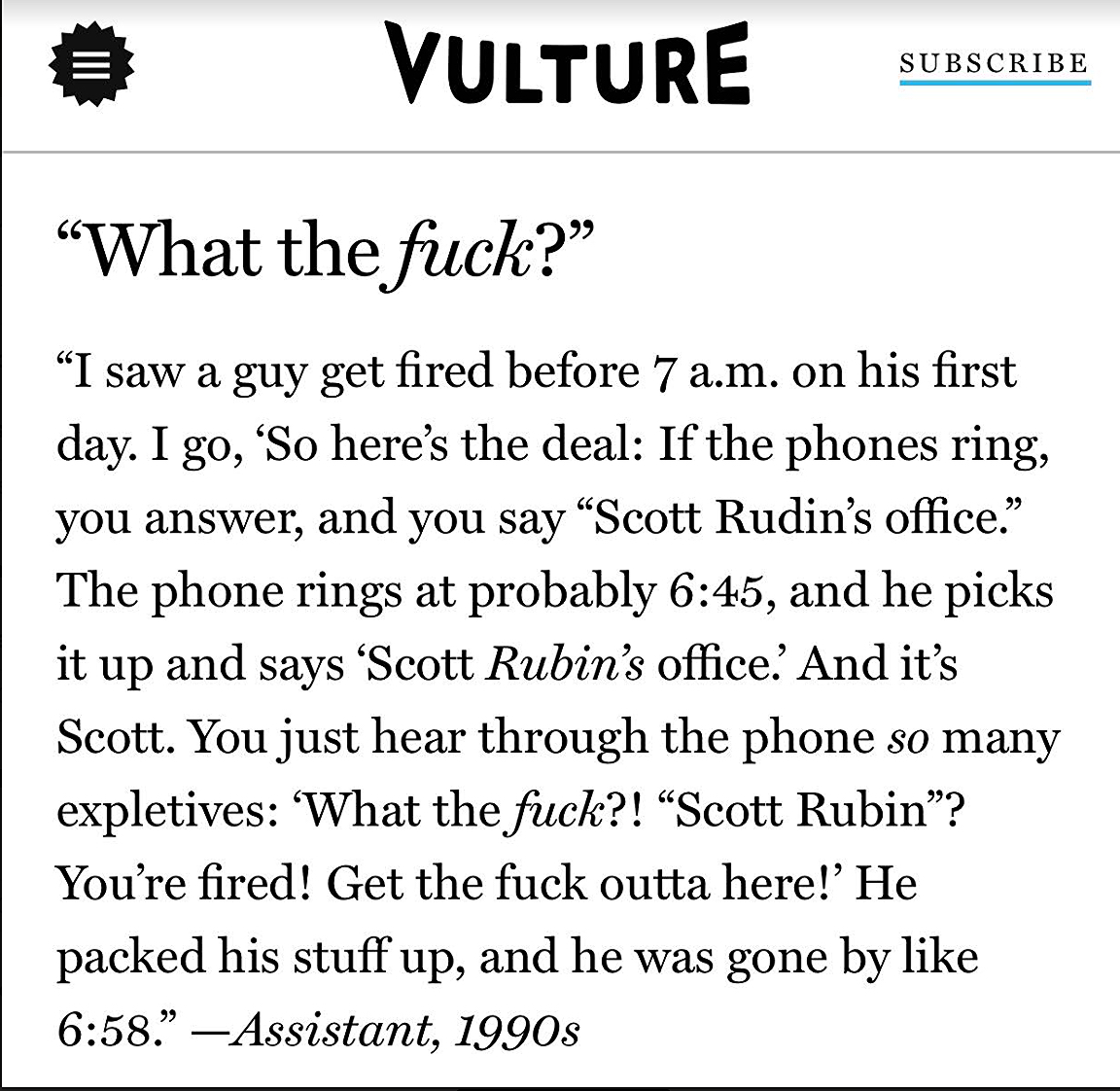
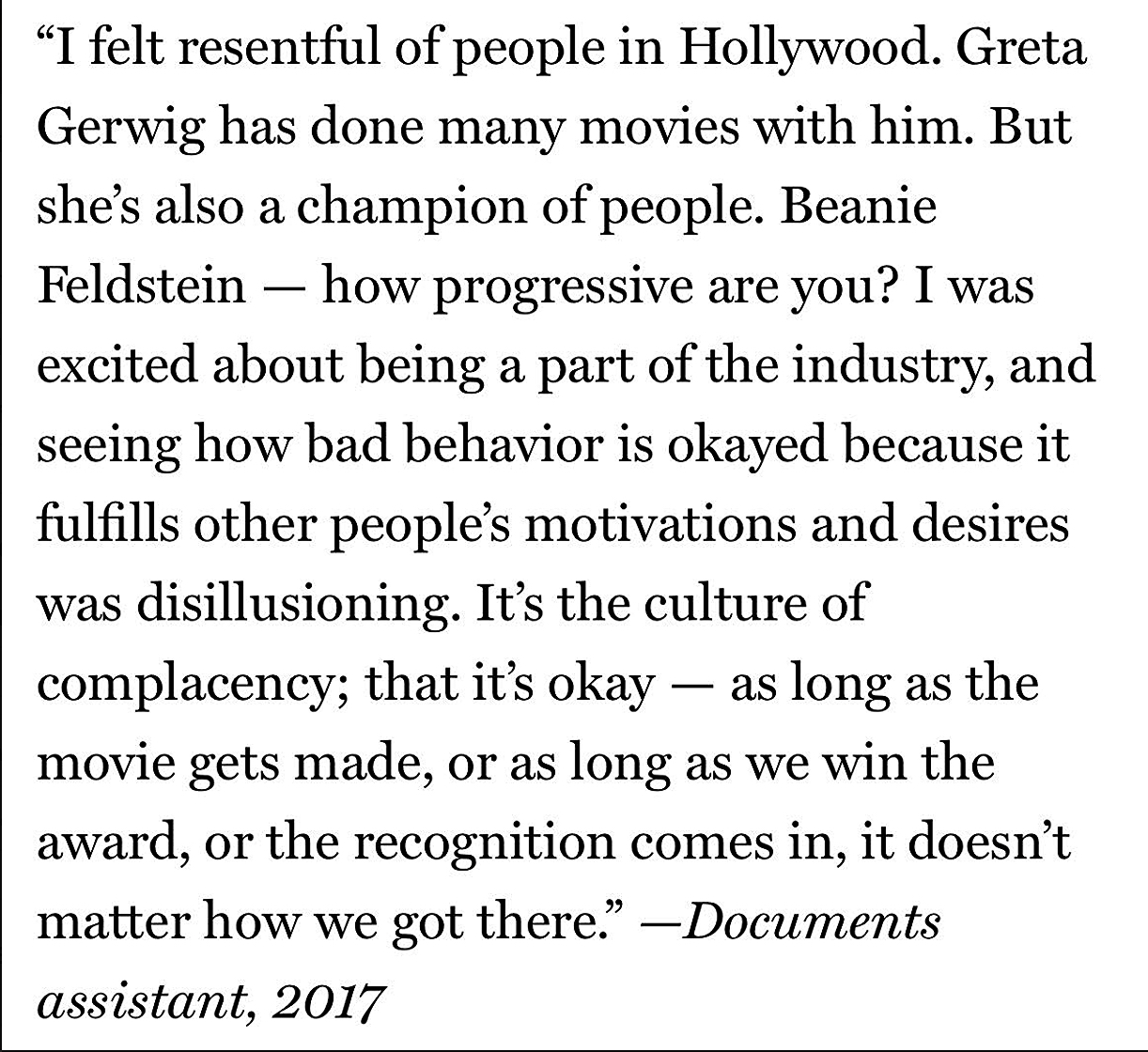
Consider these excerpts from Vulture‘s “Scott Rudin As Told By His Assistants” story — a must-read. In and of themselves and for my money they convey a fuller, franker and more revelatory portrait of Rudin‘s explosive personality and management style (as well as the transactionally expedient showbiz value system) than anything Tatiana Siegel has reported thus far in The Hollywood Reporter.

Siegel’s Rudin article is basically an indictment piece — the Vulture thing is an exploration with all kinds of traumatic side tangents.

Apart from the rage, physical assaults, flying potatoes and whatnot, lessons in two major films, Full Metal Jacket and The Bad and the Beautiful, apply to some extent.

Remember the feeling of chilly irony that followed Matthew Modine‘s shooting of the female Vietnamese sniper at the finale of Stanley Kubrick‘s 1987 war classic? Throughout the film Modine’s “Joker” had been depicted as a resident of his own sardonic, smart-ass planet, but after plugging the sniper Joker stops assessing from a distance and becomes, in the words of Rafterman, “fucking hardcore, man.” A portion of his humanity has left him or least been put aside and sealed away, but he’s also crossed over into the warrior realm — “I am in world of shit, yes, but I am alive and I am not afraid.”

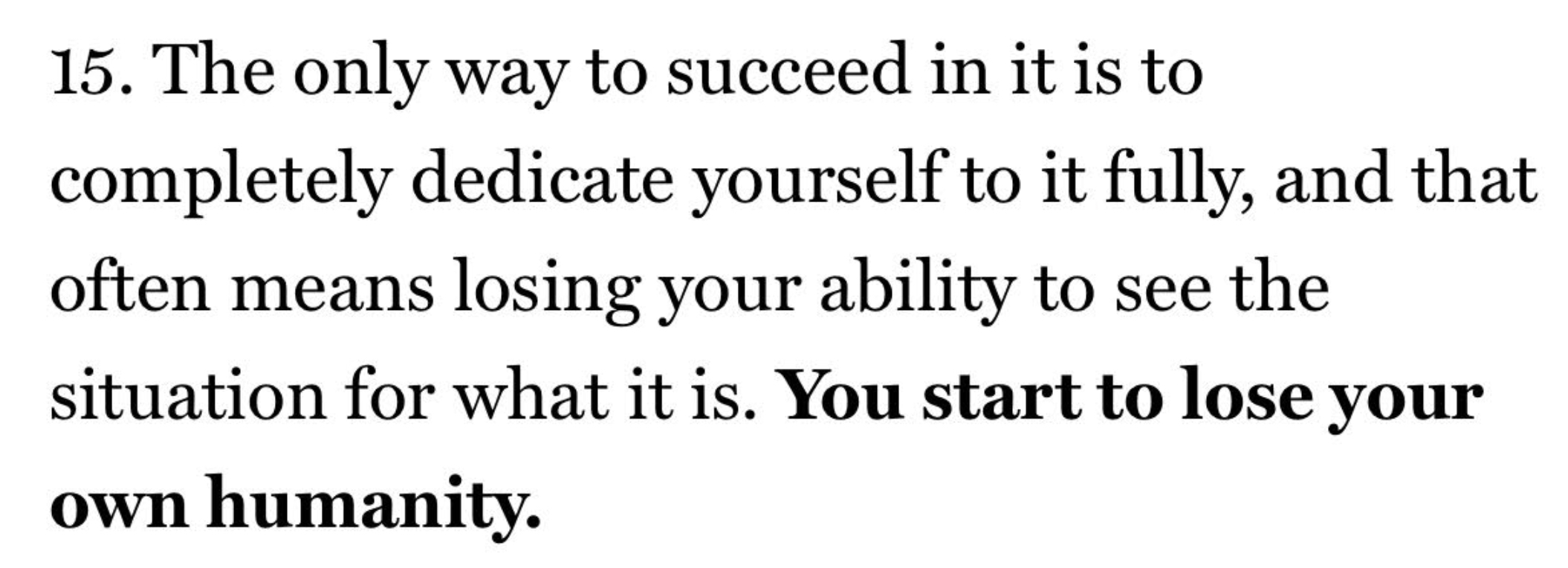
This is what the #15 quote is basically about, rough and tumble-wise. Working for Scott Rudin is like carrying an M16 through the hills and rice paddies of Vietnam, in a sense, and so “the only way to succeed [is] to dedicate yourself to it fully, and that often meant losing your ability to see the situation for what it is…you start to lose your own humanity.”
Vincente Minnelli‘s The Bad and the Beautiful is about a ruthless, abusive producer (Kirk Douglas) who’s fucked over a trio of famous ex-colleagues (Lana Turner, Barry Sullivan, Dick Powell) in his climb to the top. The basic idea is that even though Douglas is a bad, brutal person in many respects, he still has a certain combustible spark and a relentless hunger to succeed that sometimes leads to making great films, and so, at the very end, his ex-colleagues still want to hear his latest idea.
Read more

Kidman-as-Ball Still Doesn’t Work

I was personally shattered when I read a few months ago that Cate Blanchett wouldn’t be playing Lucille Ball in Aaron Sorkin‘s Being the Ricardos, but that Nicole Kidman would. I’m still very sorry about this.

Blanchett is more imbued with that combination of skill, genius, magnetism and whatever-else-you-want-to-call-it than Kidman is…sorry but it’s true. That same spark of nervy madness was in Ball herself, which is why Blanchett would’ve been a perfect fit. Plus the 53-year-old Kidman is too old to play Ball when she and Arnaz first met (during the shoot of 1940’s Too Many Girls, when Ball was 29 and Arnaz was 23).

Javier Bardem as Desi Arnaz will be great…love it.

“It’s the story of Lucille Ball, my actual mother…not Lucy Ricardo. There will be humor in the film, but it’s the story of the two of them and how they met, and what went right and what went wrong [with] their relationship, their love affair. So stop arguing about who should play it, her nose isn’t the same, she doesn’t look like her, she isn’t as funny….just trust us, it’s gonna be a nice film.” — Lucie Arnaz in a Facebook video, posted on or about 1.18.21.

Read more

Duddiest Spirits in 35 Years

Earnest congrats to the winners of the 2021 Independent Spirit Awards, and particularly to the Best Actor and Best Actress winners — Sound of Metal‘s Riz Ahmed and Promising Young Woman‘s Carey Mulligan. And an especially supportive back-pat for emcee Melissa Villasenor — smart material performed for a smattering of miked stage hands, amusing skits (Owen Wilson runs into a testy Frances McDormand)…unqualified HE approval.

And “sorry but tough shit” condolences for the multi-category-nominated Never Rarely Sometimes Always (seven noms including Best feature and Best Director), Ma Rainey’s Black Bottom, Miss Juneteenth, First Cow and The Assistant. Each of these films had gathered a certain amount of earlybird award-season heat, and then it all just melted away.

Why did Never Rarely vaporize so completely? I’ll tell you why. Because it’s an Indiewire movie — an understated, praised-to-the-heavens, Eric Kohn and David Ehrlich-approved Sundance flick, except even indie-world veterans don’t necessarily park their cars in the Ehrlich-Kohn garage.

Same deal with First Cow…totally stamped and sanctified by Kohn-Ehrlich, and where is it now? I’m telling you that Kohn-Ehrlich is an entirely separate planet…an entirely different solar system.

2020 “friendo” comment about Never Rarely: “Sidney Flanigan‘s profound ambivalence about what she’s about to go through, her deep desire not to do it, because there is in fact a live human in there…this element is literally the only drama in the film. That’s what’s so hilarious about the woke film-critic-industrial-annoyance-complex not getting it. What do they think the movie is about? If their left-wing boilerplate interpretation were accurate, it might as well be a movie about two teenagers hopping a bus to go to New York City to pay $500 in unpaid parking tickets.”

Best Feature: Nomadland (Searchlight Pictures) / HE reaction: No shit?

Best Director: Chloé Zhao, Nomadland (Searchlight Pictures) / HE reaction: Ditto.

Best Screenplay: Emerald Fennell, Promising Young Woman (Focus Features) / HE reaction: Respectfully disapproved because of the last-minute, pull-the-rug-out Bo Burnham character abandonment by way of a twist.

Best First Feature: Sound of Metal (Darius Marder, Amazon Studios) / HE reaction: Total approval.

Best First Screenplay: Andy Siara, Palm Springs (Neon/Hulu) / HE reaction: Are they fucking kidding us? Am unsubtle, unfunny, second-rate, hand-me-down Groundhog Day?

John Cassavetes Award (for best feature made under $500,000): Residue / Writer/Director: Merawi Gerima.

Best Supporting Female: Yuh-Jung Youn, Minari (A24) / HE reaction: Plucky grandma burns the barn down…terrific.

Read more

Dudland: Final Gold Derby Spitballs

Gold Derby‘s Tom O’Neill, Indiewire‘s Anne Thompson, Variety‘s Tim Gray and Deadline‘s Pete Hammond deliver their final Oscar predictions. Nobody cares, nobody wants to care, it’s an asterisk year, a shoulder-shrugger, smallest all-time audience, etc.

Significant quotes: (a) “There are so many reasons why Nomadland is secure, and Chicago 7 is not…I think it’s possible that The Trial of the Chicago 7 could go down winning nothing, or only one Oscar for Best Editing”; (b) “Vanessa Kirkby isn’t in the running…I would also suggest that Andra Day isn’t either…I completely discount the Globes”; (c) “We’ve heard that in Academy polling Viola Davis and Andra Day are tied, and could therefore be splitting the vote”; (d) “Moods change, time passes…a month ago I would’ve predicted Carey Mulligan winning [the Best Actress Oscar]… but that momentum is gone…the heat is off her.”

HE comment about Viola Davis possibly winning: Her performance is a fatsuit lipsynch exercise…it simply isn’t good enough…it’s all bluster and “don’t fuck with me”…If she wins (which appears likely) everyone knows Chadwick Boseman will win Best Actor, and that Ma Rainey will probably win for Best Costume and Makeup. Perhaps some will rationalize that it’s better to spread it around and give the Oscar to someone other than Viola.

Four Rationales

In a 4.22 Kim Masters piece for the Hollywood Reporter titled “Why Some Hollywood Execs Are Hoping for Scott Rudin to Return,” “reps and executives” who have worked with Rudin offer four arguments or rationalizations in favor of not ripping his stripes off.

Here they are with HE commentary following each one:

(a) “I’m not condoning the behavior, but it’s hardly news that Rudin is a horrendous bully and if you worked for him, it’s on you.”

HE response: Honestly? He/she is right. Nobody looking to work for Rudin could possibly do so blind — everyone knows what his reputation is, and Rudin would never hire anyone dumb enough (or babe-in-the-woods enough) not to know.

(b) “I’m not condoning it, but there are very few people with [Rudin’s] level of taste and access to material.”

HE response: He/she is not wrong. In today’s Taika Waititi-level world, there are very few upmarket, aspirational, Tiffany-level producers left in this business.

(c) “I’m not condoning it, but he trained a lot of people who went on to have successful careers.”

HE response: True.

(d) “What are we going to do, cancel everyone?”

HE response: No, of course not — only the seemingly guilty will be tried, convicted and forced to walk the plank.

Masters kicker: “A source who has been in touch with Rudin says he’s ‘genuinely sorry the talent will have to answer for him.’ There’s good reason for that beyond whatever empathy he may be capable of mustering. Rudin knows where he’s vulnerable; if talent feels compelled to flee, that’s the final curtain.”

Greatest Street Riot Scene Ever

Posted on 6.24.17: I’ve said this two or three times, but the older I’ve gotten the more I’ve come to realize that Franc Roddam‘s Quadrophenia — loosely based on the Who rock opera and basically the story of Jimmy Cooper (Phil Daniels) and his identity, friendship and girlfriend issues — belongs in the near-great category.

Hands down it delivers one of the craziest, most live-wire recreations of mad generational fervor and ’60s mayhem.

Quadrophenia is the closest thing England has produced to its own Mean Streets” — from “Quadrophenia: Jimmy vs. World” by Howard Hampton.

I first saw Quadropehnia at Manhattan’s 8th Street Playhouse when it opened in November ’79, at the height of my often unemployed “am I even good enough to attempt to be a journalist?” weltschmerz.

For me, Quadrophenia supplied my first encounter with Sting. Dandied up in flashy threads, his hair dyed platinum blonde, Sting played a kind of celebrity mod figure called “Ace Face.” I knew of The Police in ’79, of course, but I didn’t really tune into them until ’80.

During a 3.31.15 interview with Police guitarist Andy Summers (the subject was Can’t Stand Losing You: Surviving the Police), it killed me to learn that The Police performed a CBGBs gig one night in the fall of ’78. Two shows in fact, and that not many people attended the second show, Summers said. I was living at 143 Sullivan Street at the time, and I could have just walked over and seen them up close. Kick me.

I’ve reminded once or twice how Roddam forgot to change the letters on a movie marquee while shooting a crowd scene, and so we read, however briefly, that Warren Beatty‘s Heaven Can Wait and Randal Kleiser‘s Grease — both released in the summer of ’78, when Quadrophenia was shooting — are the current attractions.

Read more

George Who?

There’s a plan for Martin Scorsese to produce and John Carney to direct “a George Gershwin-inspired musical drama” — not a Gershwin biopic — called Fascinating Rhythm.

4.22 Variety excerpt: “An original musical, Fascinating Rhythm will draw creative influence from the life and music of Gershwin. However, the film is not expected to be a biopic. Instead, the story is centering on a young woman’s magical journey through past and present New York City. The Gershwin estate is on board and the movie will feature his music throughout.”

Excuse me but I always thought the famed Gershwin tune (written in 1924, when Gershwin was 25 or so) was called “Fascinatin’ Rhythmn.”

How many Millennials and Zoomers have even heard of Gershwin? You know the state of education in this country. What would be the point of learning about him anyway? MZs were born toward the end of the 20th Century and into the early 21st — why should they know or care about some Russian-Jewish musician (born Jacob Bruskin Gershowitz) who was born in Brooklyn in 1898? Some guy who never went online in his life, not once.

I’d like it understood that I hand-wrote an essay about the life and music of George Gershwin when I was nine years old. I included my own drawing of him. I’d been instructed by my third-grade teacher (Mrs. Phaff) to compose a paper on a classical musician. I complained to my mother that I was bored by the usual stuffy composers (I hadn’t yet discovered Peter Tchaikovsky), and so she turned me on to Gershwin’s “Rhapsody in Blue.” When I came back with my Gershwin essay Mrs. Phaff frowned and even scolded me somewhat. Gershwin, she said, was “too pop, too modern” — she’d been expecting a paper on Schumer or Handl or Mahler. My mother was enraged when I told her this.

Post-“Straw Dogs” Peckinpah Mess

I was going to title this article “Cancel Sam Peckinpah,” but that might sound too extreme. Then again why not? The idea (one that I’m sure the “safeties” would agree with) is that by posthumously cancelling the late, impassioned, gifted-in-the-’60s, booze-addled, cocaine-snorting, notoriously abusive director and keeping him jailed in perpetuity, it would send a message to current industry abusers that they’d better clean up their act or else.

And let’s not stop at Peckinpah‘s memory alone — let’s also cast suspicious eyes upon his film critic admirers, his biographers, his fans, the Criterion Collection execs who approved the Bluray of Straw Dogs, director Rod Lurie for his Straw Dogs remake, anyone who owns Blurays of Ride The High Country, Major Dundee, The Ballad of Cable Hogue, The Wild Bunch…you get the idea. Round ’em all up.

You can’t just cancel the residue of this horrible man — you have to erode and possibly even destroy the lives of those who’ve sought to keep his memory alive. Have you ever gotten down on your knees and tried to remove crab grass from your front lawn? You can’t fuck around. You have to be merciless.

It goes without saying that if Peckinpah was somehow time-throttled out of the ’60s and ’70s and into the present environment that he wouldn’t last five minutes. So why not pretend that he’s still here and act accordingly? Why not send a clear and thundering message that Peckinpah-like behavior will never, ever be tolerated in this industry again? What does the fact that Peckinpah died 36 and 1/2 years ago have to do with anything? In a way he’s still “here”, still among us.

Okay, I’m partly kidding. Peckinpah was definitely a drunken, sexist, coked-up beast (particularly in the ’70s and early ’80s), but he did make a few brilliant films and if you know anything about the movie-making craft you know it’s damn hard to make even a decently mediocre one. Plus the annoying fact that life has never been especially tidy in the corresponding or delineation of great art vs. gentle people and vice versa. But if I was serious you know that a significant percentage of Twitter jackals would approve.

I was inspired to write this by an HE commenter named “Huisache“, whi posted the following sometime this morning in the “Duelling Thompson Sagas” thread:

Huisache: “With the exception of Straw Dogs all of Sam Peckinpah’s films are messes of one magnitude or another, with Bring Me The Head of Alfredo Garcia the biggest mess of all.

The Getaway is enjoyable but the Slim Pickens ending is emblematic of Peckinpah’s resort to just saying ‘screw it, how do I get out of this mess? It was just nailed on. Sam had a mess and he called Pickens for help and the old feller bailed him out with a glorious good-ole-boy bit.

“I saw the film when it came out and was living in the area where it was filmed in central Texas. I thought it a very enjoyable mess and the Pickens ending a hoot. But that’s all the film is — an enjoyable hoot. Acting like it’s some kind of worthy project is a bridge too far.

Read more

Another Best Actress Conversation

HE to Friendo #1: “So please tell me if Carey Mulligan has a decent chance of winning or not. I will be dismayed if Viola Davis (fatsuit, lip-synch, curious SAG acclaim) or Frances McDormand (again?) win. Mulligan is significantly ahead among Gold Derby-ites, as you know. But did Claudia Eller screw the pooch when Variety offered that groveling apology?

Variety‘s Clayton Davis has completely dismissed Mulligan — he says it’s down to McDormand vs. Davis vs. Andra Day. I would love to see Mulligan win if only to see Clayton wipe egg yolk off his face.”

Friendo #1 to HE: “[I suspect that] Clayton writes a fair amount of bullshit [much of] the time. I guarantee you he has no idea what he is talking about but claims to as if it is fact, based on a couple of conversations with publicists pushing their agenda. I don’t believe he has much outreach at all with [Academy] voters, or not as much as he claims.

“Statistically Carey and Frances would seem to have the best chance. Both are in widely seen Best Picture nominees. Viola has a decent shot but there has never been both a Best Actor (Chadwick Boseman) and a Best Actress winner from a film that wasn’t Best Picture-nominated.

“The Best Actress race remains very fluid. I am still predicting Carey, but the Variety review thing with Dennis Harvey has zero visibility among Academy voters — a non-issue.”

HE to Friendo #1: “The Variety apology thing has zero visibility? Justin Chang and the National Society Of Film Critics officially admonished Variety for this. Many stood up and defended poor Dennis Harvey. How could your rank-and-file Academy voters be completely oblivious to this?”

Friendo #1 to HE: “Rank-and-file Oscar voters barely focus on the films, much less the white noise of this or that critic.”

Friendo #2 to HE: “Carey can absolutely still win.”

Friendo #3 to HE: “Voters will be split. There will be those who want to make history to top the 2001 win of Halle Berry as the only black actress to win. Their votes will be divided between Andra Day (younger, more fully realized performance, playing a beloved icon, the second time two black actresses have been nominated and one was playing Billie Holiday) and Viola Davis (veteran, beloved, has the Denzel Washington voting bloc behind her — she’s overdue after being snubbed in 2010).

“The second split will be between those who are voting ‘on performance’ only and they will be split between McDormand (star of the Best Picture frontrunner — it is extremely rare for a Best Actress and Best Picture to match, not since 2004) and Mulligan — the star of the second most nominated (in crucial categories).

“Mulligan or McDormand should have won SAG, but Davis took it regardless. When they were all together Day won (Globes) and then Mulligan (Critics Choice, which doesn’t matter as much).”

Read more

Duelling Thompson Sagas

After re-watching Sam Peckinpah and Steve McQueen‘s The Getaway (’72) a couple of nights ago, I’m all the more certain that Roger Donaldson’s 1994 remake, in which Alec Baldwin and Kim Basinger took on the same Doc and Carol McCoy roles that McQueen and Ali McGraw played 22 years earlier, is a smoother, more involving watch.

The Peckinpah version has a few moments, but it’s also nonsensical at times. Why doesn’t McQueen shoot Al Lettieri in the head after the bank job? Those middle-aged, cowboy-hat-wearing goons who work for Ben Johnson and his moustachioed brother are ridiculous. There’s no reason for McGraw’s bizarre lurching the car when McQueen’s about to get in. The sappy ending with Slim Pickens after crossing the border. And why would Richard Bright‘s train station con artist, who’s pocketed a couple of wads of cash, go to the cops just because McQueen beat him up? He can’t find a local clinic?

Life in Rural Blahtown

Last night I watched episode #1 of Mare of Easttown. I’d read it was about small-town Pennsylvania gloom, despair, Ratso Rizzo limping, “lemme outta here”, downmarket atmosphere and forlorn character shadings with zero engagement on a whodunit level. And it certainly is that.

I wasn’t bored but at the same time I was saying to myself “really?”

All I can say is that if I was an actual resident of Easttown, the idea of Oxycontin addiction would be very tempting. I might even start limping around just for fun.

The only scene I liked was Kate Winslet chatting with her Mildred Pierce costar Guy Pearce at the local bar. That said, I didn’t believe she’d go right back to his place and fuck him immediately. Women of character usually wait a while for that. And as Pearce is the only literate-minded fellow in Easttown with a wry sense of humor who isn’t a rural loser of one kind of another, I definitely didn’t believe that she wouldn’t want to get to know him and see where that might lead. So right away I wasn’t believing it.

The subtitle of this limited HBO series is “Reasons You Don’t Want To Even Flirt With The Idea of Living in Grimtown, Pennsylvania.”

Mare of Easttown‘s creator, writer and producer is Brad Inglesby, who grew up in Berwyn — a hilly suburb of Philadelpha — and knows this hellish “Delco” landscape all too well.

I respect the basic idea of trying to focus viewer attention on the dull, deflating horror of living in a region like this instead of just cranking out another whodunit. (The series was shot in Easttown Township but more specifically Coatesville, Aston, Drexel Hill, Chestnut Hill and Sellersville.)

But the more Inglesby and director Craig Zobel focus on local losers, the more I’m going to feel distanced from this series as it moves along. The only thing that can save it is if they give Guy Pearce more screentime and let his character carry more of the load.