
Characters Who Just Sit There

In an interview with Indiewire‘s Eric Kohn, Robert De Niro spoke about his recently injured leg. “I tore my quad** somehow,” he said. “It’s just a simple stepping over something and I just went down. The pain was excruciating and now I have to get it fixed.

“But it happens, especially when you get older. You have to be prepared for unexpected things. But it’s manageable.”

De Niro said the injury wouldn’t affect his performance as bad-guy cattleman William Hale in Martin Scorsese‘s Killers of the Flower Moon, which is currently rolling. “[Hale is] pretty much a sedentary character in a way,” he said. “I don’t move around a lot, thank God. So we’ll manage. I just have to get the procedure done and keep it straight in a certain position and let it heal.”

And so the point of this riff: Please name the most vividly etched sedentary characters in the history of cinema, starting with Jabba the Hutt and moving on down. How about Orson WellesCardinal Woolsey in A Man For All Seasons (’66)? Or the supreme Martian commander in Invaders From Mars (green head, face of a Mexican woman, communicates with lizard-like pincers or tentacles)? Maybe the iron-lung guy in The Big Lebowski? Or William Hickey‘s Don Corrado in Prizzi’s Honor.

Only full sedentary characters qualify. Sidney Greenstreet sits like an iron Buddha statue 95% of the time in The Maltese Falcon and Casablanca, but now and then he gets up and walks into or out of a room — that’s a disqualifier.
** Quadriceps femoris

Sheridan Gets It Mostly Right

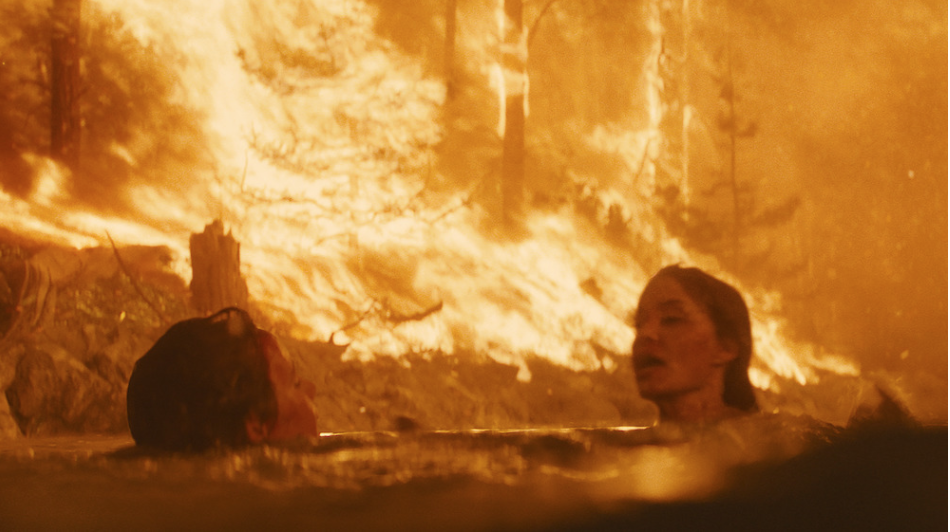
I watched Those Who Wish Me Dead (HBO Max) right after The Woman in the Window, and yeah, it’s pulpy and familiar and swamped with landscape and forest fire CG that looks like CG all the way.

And yes, Angelina Jolie is still too beautiful and well-tended to convince anyone she could be a Montana smokejumper. (She’ll have to bear this cross for the rest of her life.). Not a shred of believability = absence of collateral realism = disengagement. Angie-wise, I mean.

On the other hand this is a better-than-decent Taylor Sheridan flick — not as socially reflective as Hell and High Water or the two Sicario films, but skillfully crafted — well written, tightly composed (no dead spots), decently acted. Am I sick to death of writing lines like “it moves right along”? Yes, I am but it does.

Did I say “no fucking way” four or five times? Yes, especially when it came to Angle falling from a watch tower rope, slamming into terra firma and more or less shrugging it off. Ditto a certain vulnerable pair escaping fire by jumping into a river, and whether or not a certain structure might burn or not, and a certain character’s miraculous ability to dodge bullets fired by a pro.

But overall I wasn’t complaining much. I never bailed. It held me.

I was afraid, you see, that it would be all about Angie’s Hannah Faber saving Conner (Finn Little), the teenaged son of a murdered “forensic accountant”, from a pair of assassins (Aidan Gillen, Nicholas Hoult) looking to erase evidence that will create all kinds of grief for their cool, calm and collected employer, played by Tyler Perry.

Angie protects the kid in the usual resourceful ways, but the story is also about her ex-boyfriend (Jon Bernthal) and his wife (Medina Senghore) and the natural-sounding dialogue (I loved damn near every line that Gillen was charged with) and the extremely welcome use of a deer rifle and a pick axe. All hail Senghore and what her character manages to do.

Perry is great, by the way — not many lines but he nails them all. The best he’s been since Gone Girl.

Gillen and Hoult are supposed to be brothers, by the way, but they don’t resemble each other at all. Plus Gillen is over 20 years older than Hoult, and looks it. They’re not even of similar size. Why not get actors who look like they might be related? And if that’s impossible, don’t call them brothers.

I’ve said many times that you can’t rehash the cliche about a character having a nightmare and then waking with a start — bolting upright, eyes wide open, damp-faced. Been done way too often. Well, damned if Angie doesn’t awake from a forest fire nightmare in the exact same way. How could Sheridan do this? He knows it’s forbidden.

“Woman” Is Pretty Good For A While

Warning: Spoiler material in paragraph #5.

During the first 45 to 50 minutes of The Woman in the Window (Netflix, now streaming) I was saying to myself “hey, this isn’t all that bad…it’s smart, absorbing, carefully composed, shot and cut in fine style and generally kinda nifty.”

Right from the get-go you can feel the presence of Joe Wright, the clever British director who also delivered the audacious Anna Karenina, along with the propulsion of what seems at first like a well-jiggered script, mostly written by Tracy Letts and later tweaked by Tony Gilroy.

There’s also a delicate but highly charged lead performance by Amy Adams, and a dishy one-scene cameo by Julianne Moore. Plus the Hitchcockian references (Rear Window, Spellbound) and hallucinatory flickerings. It’s really quite the package. Until it changes into something else.

I was troubled, I admit, by a weird early scene in which Adams, a wine-sipping, pill-popping, 40something agoraphobic therapist named Anna who lives in a three-story townhouse, is visited by a troubled teenager, Ethan (Fred Heichinger).

Ethan is the son of a bickering, tempestuous couple, Alistair and Jane Russell (Gary Oldman, Julianne Moore), who’ve just moved in across the street, and Anna watches them rant and rave right through their undraped windows. Once Ethan, bearing a small gift from his mom, introduces himself and starts talking jibber-jabbering with Anna, you’re asking himself “is this kid some kind of psycho nutjob? Why’s he so fucking hyper? There’s something Norman Batesy about this guy.”

You’re also asking yourself why Moore is (seemingly) playing a character named Jane Russell. Is there another across-the-street neighbor named Gary Cooper and one around the block named Bob Mitchum? Letts plays Anna’s therapist…what’s his name, Cary Grant?

Spoilers: Anyway I sat up in my seat and began to imagine that the critically panned Woman in the Window might have been misjudged and was actually kinda trippy, as it is during the first 45 or 50.

But then it falls through a trap door when everyone gangs up on Anna/Adams and she folds and confesses to being a delusional fantasist. Another way of putting it is that The Woman in the Window suddenly jumps off a cliff. It goes NUTS. And the climactic third-act scene when a steely-eyed Ethan returns with a knife is CRAY-CRAY.

The problem, in short, is not how Joe Wright directed it — it’s the crazily shifting script. I know Gilroy’s work fairly well, and I know he’s fairly incapable of writing cray-cray so I guess he was stuck between a rock and a hard place and had no choice. It must have been rough on the poor guy.

Read more