String Him Up

Born in 1970, Matt Damon was raised in Cambridge, which can be a rough and brutish culture as far as old-school Boston machismo is concerned. He eventually moved up and out of Cambridge, of course, but you can never entirely rid yourself of the old ‘hood. Pieces and shards of your upbringing have a way of sticking to your skin, and there’s no washing them off completely.

Hence the difficulty Damon has gotten himself into after telling the UK Sunday TimesJonathan Dean that “he only stopped using the “f-slur for a homosexual” months ago.

Damon clarification: “I have never called anyone ‘f****t’ in my personal life…I do not use slurs of any kind. I have learned that eradicating prejudice requires active movement toward justice rather than finding passive comfort in imagining myself ‘one of the good guys.’ And given that open hostility against the LGBTQ+ community is still not uncommon, I understand why my statement led many to assume the worst. To be as clear as I can be, I stand with the LGBTQ+ community.”

Tens of millions of young straight guys who rocked and bopped around in the early to mid ’70s…they were all familiar with certain derogatory terms for gay guys. As urban culture evolved they learned, of course, that failing to jettison those terms…hell, even thinking with such terms would hurt them socially and professionally, and so most of them adapted. But with others the old attitudes hide in the shadows.

Warren Beatty is one of the most socially sensitive and political-minded fellows I’ve ever spoken to — he’s very, very careful with what he says and always uses the most oblique terminology he can think of. And yet even Beatty, in the person of George Roundy, used the “f” epithet in this scene with Carrie Fisher in Shampoo (’75), which was released when Damon was five years old. If Beatty and the Shampoo guys (Hal Ashby, Robert Towne) were okay with using the term, you can be damn sure that the world did back then and that it wasn’t a big deal to anyone. [The passage I’m referring to starts at the seven-second mark, and the epithet is repeated by Fisher at the 37-second mark and again at 1:02.]


Read more

Wokeness, Quality of Outcome, Eating Shit

Earlier today Sasha Stone and I discussed the woke choker that progressives have managed to wrap around the Hollywood industry’s neck, at least as far as hiring and standards and award season values are concerned. Various forms of progressive purity are being insisted upon by the comintern, and if you don’t get in line the whip will come out and perhaps even the stick.

The industry is basically experiencing a shift from the idea of equality of opportunity (i.e., the classic liberal code) to a new social code that requires equality of outcome (wokesterism).

3:04 mark: “Basically what’s going on in the progressive left is a conviction that people of color, for a couple of hundred years or 155 years if you start back in 1865, have had a horrific experience in many ways and [have] certainly led suffocating lives in terms of opportunity and basic fairness….we all know the story of racism in this country. or at least we have some idea of it…and the current idea is that things now have to switch around…in some ways the short end of the stick is going to people of European descent because they have had the upper hand for so long, and it’s time for them to eat shit basically.

“When you think about the symmetry or the balance of this, it’s not a ridiculous idea. But of course, people don’t like eating shit, no matter what the reason is. So naturally there are people who feels it’s gone too much in that direction (i.e., righties). But right now, that’s the way it is.”

Girlfriend Chronicles

[Posted on HE Plus on 10.10.18] If the definition of a successful heterosexual relationship is one that lasts a long while, then I’ve pretty much been an embodiment of failure my whole life. I’m thinking it couldn’t hurt to review this life-long pattern from time to time. If you find this sort of thing icky or tedious, fine — don’t read it. But I have lots of stored-up material.

My basic problem is that in the realm of serious, committed relationships I’ve always been emotionally and spiritually attracted to women of character, steel and substance, which is to say strong, smart, bossy women like my mother. But for whatever reason I’ve always felt less than fully “attracted” to these women on a long-term basis, and so sooner or later — sadly, lamentably — the sensual, Henry Miller or Anais Nin-type currents have always seemed to fall away.

I’ve always completely trusted and valued the various mother-figure types, but I’ve always had a strange concurrent thing for exotic fruit — unhappy or bothered women, passionate loonies like my late sister, impulsive poet-kooks, MILFs when I was in my teens and 20s, kamikaze women, curvy fly-by-nighters and gloomheads of various shapes and modes.

I’ve never been able to reconcile the two, and now that my chasing days are over I’m realizing that my inability to settle into one frame of mind is the fundamental reason for my lifelong failure to find any semblance of long-lasting peace with this or that woman.

The best I can say for myself is that I’ve had good chapters in my life — periods when things were working out pretty well on a professional or creative front, which have left me with a semblance of calm and self-respect, which in turn allowed for the offerings of emotional consistency and trust and financial security as far as that went with journalist-level income, which was never very far.

The best relationships I’ve had with women over the decades have been those of a non-sexual nature, or those that began sexually but then moved past that. I’m glad to say that several women have become this kind of friend and confidante — women whom I love, trust, respect and will always feel close to, and thank fortune for that.

Low self-esteem — a psychological malady that came from my father’s alcoholism — has been tugging at my psyche from the time I was four or five years old, but it really ran the show for the first 25 or 30 years. I know I was plagued with sexual insecurity — a fundamental restlessness or unhappiness with almost every aspect of myself when young — and so the attentions of women were mostly coated with anxiety and terror and feelings of unworthiness until I hit my stride as a writer-journalist in my 30s, and even then things were touch-and-go.

I’ve never regarded myself as any kind of prize, and I’ve felt enormously grateful and redeemed whenever a woman whom I regarded as saucy, formidable or otherwise fetching opened her heart and waved me in, so to speak. I was a complete romantic failure with women until I was 19. I became a total hound in the ’70s and early ’80s, which is when my batting average shot way up. I mentioned a few years ago that the tally is around 175, give or take. I began to make a serious count sometime around ’78, writing down names and dates on a diary-like journal when I was living in a cockroach-infested apartment on Sullivan Street. It took a couple of months but I gradually compiled a list of around 135.

I was out of the game after getting married in ’87, and back into things after the divorce in ’91. I’ve been seriously in love with maybe six or seven women, up to and including my present wife Tatyana.

I came to a realization that I’d bonded with my first “girlfriend” when I was six or seven. I became close with my second significant girlfriend when I was eight or nine. My first “sexual” experience was an awkward thing in the backseat of a car when I was 16 or thereabouts. (Such things happen from time to time.) I only wish I’d been lucky enough to be seduced by a junior-high-school teacher or a divorced or disloyal MILF at that age.

The second most painful relationship of my life was with a Connecticut high-school blonde who had two other boyfriends besides myself, and I wasn’t even a boyfriend but a kind of relief pitcher who never even warmed up in the bullpen. The most painful, achey-brakey, slow-drip relationship of my life was with a married woman whom I met in the offices of People magazine — a relationship that lasted for two and a half years, and which was arduous and humiliating at every turn.

Babysitter and Boyfriend

Posted on 2 1/2 years ago on HE Plus: In Long Shot, Charlize Theron played a 40ish Secretary of State planning a run for the White House, and Seth Rogen plays a political journalist whom Theron hires to be her speechwriter, in part because she babysat him when she was in her teens. The premise got me thinking about a babysitter episode of my own, when I was nine or ten…

It was a warmish spring night in Westfield, New Jersey. My parents went to a party or something, and so they hired a babysitter. “What for?” I asked. “I’m just gonna hang out and watch TV,” etc. But they wanted someone older to watch my younger sister (five or six at the time) and brother (four).

I changed my mind when the babysitter arrived. Cute and curvy, ponytail, 16 or 17 years old, creamy sweater. I wasn’t making an ass of myself by drooling and ogling, but I was certainly pleased that I’d have her company for the next three or four hours.

An hour after my parents left a couple of guys came over — the babysitter’s boyfriend and some friend of his. I was initially disappointed as I wanted the babysitter all to myself. But her boyfriend, kind of a rebel type, smiled and shook my hand and talked me like an equal so I was, well, placated. I’d never spoken to an older teenager before — these guys were 17 or 18, somewhere in there.

An hour later the babysitter started to get down with the boyfriend, in a mildly flirty-touchy way. He was sitting in my father’s living room armchair and she was kind of sitting between his legs, her back to him and his arms around her midsection. I wasn’t exactly staring but I’d glance their way from time to time, and I could see his hands (or at least his fingers) were under her sweater.

I had never been in the presence of any kind of adult sexuality of any kind before that moment. I was all but purring with arousal.

Then suddenly my parents came home. The boyfriend and his friend didn’t run for it — they just stood up and walked out. I forget what my mother’s reaction was but my father was pissed — holding his temper, paying off the babysitter, offering to give her a lift home in a testy tone of voice. Everyone knew she’d never return, having violated the basic trust. But man, what a night.

White Films Will Dominate ’22 Best Picture Race

Over the last few years progressive Hollywood has been doing everything it can to “Black up” Academy membership and by extension the Oscar Awards, and obviously that’s been happening, result-wise and nomination-wise, in the acting categories. But in the broader Best Picture category most voters will tend to support movies that tap into some kind of common cultural current…subjects and stories that reflect the “all” of human experience.

Specific social-agenda movies (going all the way back to I Am A Prisoner From a Chain Gang, They Won’t Forget, The Ox-Bow Incident and Gentleman’s Agreement) are almost always honored and respected, but snagging the big trophy is another equation.

We all understand that the Oscars are no longer the Oscars — they’ve become the Progressive Left Coast Tony Awards, addressing and reflecting the myopic industry culture and the general fear of wokesters on Twitter, etc. Which is why Joe and Jane Popcorn (not to mention Millennials and especially Zoomers) feel estranged if not divested, to put it mildly. Last April’s Steven Soderbergh Oscar show, a calamity by any yardstick, all but drove a stake through the brand.

Earlier today Sasha Stone and I spitballed the most likely 2022 Best Picture contenders, and there are only two one or two Black contenders that might have a shot — Reinaldo Marcus Green‘s King Richard (Warner Bros., 11.19 — obviously a Best Actor nomination waiting to happen for Will Smith) and Denzel Washington‘s A Journal for Jordan (Sony, 12.10).

The rest of the likelies are all white-centric, so even if the word goes out that King Richard and A Journal for Jordan have to be nominated to ensure at least a semi-significant Black presence, you’re still taking eight white films vs. two reflecting the POC experience.

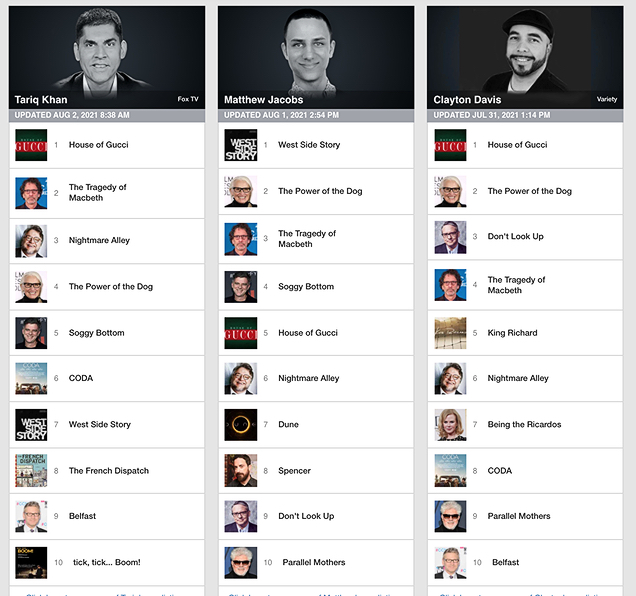
The ten likeliest Best Picture contenders, from a pure-gut, finger-to-the-wind, eliminate-the-negatives perspective:

(1) Paul Thomas Anderson‘s Soggy Bottom (PTA films have never been Oscar-friendly as a rule, but SB is set in the ’70s and has something to do with the industry, or at least with Jon Peters) (UA Releasing, 11.26)

(2) Adam McKay‘s Don’t Look Up (satire about planetary destruction careening toward earth and the limitless human capacity for denial) (Netflix, mid to late fall)

(3) Clint Eastwood‘s Cry Macho (Warner Bros., 9.17)

(4) Ridley Scott‘s House of Gucci (11.24, UA Releasing)

(5) Ridley Scott‘s The Last Duel (20th Century, 10.15)

(6) Reinaldo Marcus Green‘s King Richard (Warner Bros., 11.19)

(7) Steven Spielberg and Tony Kushner‘s West Side Story (20th Century, 12.10)

(8) Michael Showalter‘s The Eyes of Tammy Faye (Searchlight, 9.17)

(9) Aaron Sorkin‘s Being The Ricardos (Amazon, late 2021)

(10) Denzel Washington‘s A Journal for Jordan (Sony, 12.10).

Probably won’t make the cut for this and that reason (17): Dune, The French Dispatch, Nightmare Alley, In The Heights, No Time to Die, Passing, The Power of the Dog, Respect, Tick Tick Boom, The Tragedy of Macbeth, Pig, The Card Counter, Belfast, C’mon, C’mon, CODA, Cyrano, Stillwater.

Read more

Representation

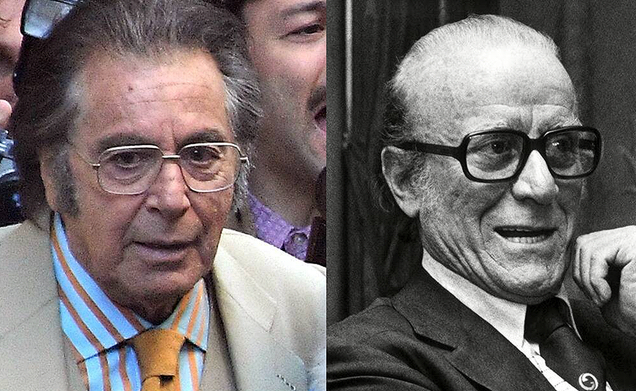
Hollywood Elsewhere sympathizes with the disappointment expressed by Patricia Gucci, author of “In The Name of Gucci“, over the casting os Al Pacino as Aldo Gucci in Ridley Scott‘s House of Gucci (11.24, UA Releasing).

Aldo, who died five years before the 1995 events depicted in the film, was a handsome, elegantly dressed, silver-haired smoothie. (In his middle-aged to 70ish prime, I mean.) No offense, but it can be fairly noted that gnomish Pacino isn’t much of a physical match for the late Gucci executive at this stage in his life. Pacino was cast for his name and box-office-magnet factor, not for his resemblance to Aldo.

The Gucci family is naturally hoping that Scott’s film will depict them as glamorous and attractive, etc. I understand their frustration.

If Scott was somehow motivated to direct a film based on my own exciting, up-and-down life and decided to cast, say, Rob Schneider, I would be very, very upset. I would be outraged. Ditto if he were to cast Will Ferrell or John C. Reilly…the list goes on. The only person who could play the young version of me would be Chris Walken as he appeared in The Dogs of War and Next Stop, Greenwich Village. The only person who could play the current version would be me.

Shameless CG Swill for Easy-Lay Crowd

Venom: Let There Be Carnage (Sony, 9.24) has been directed by Andy Serkis, who has never (and will never) bring subtlety or exceptional finesse to anything. His creative instincts are almost always about pouring it on. (One exception: Serkis’s performance as serial killer Ian Brady in Tom Hooper‘s Longford.) Carnage stars Tom Hardy (bend-over paycheck gig) with Michelle Williams (good God), Naomie Harris (Jesus), Reid Scott, Stephen Graham and Woody Harrelson.