On Its Own Terms

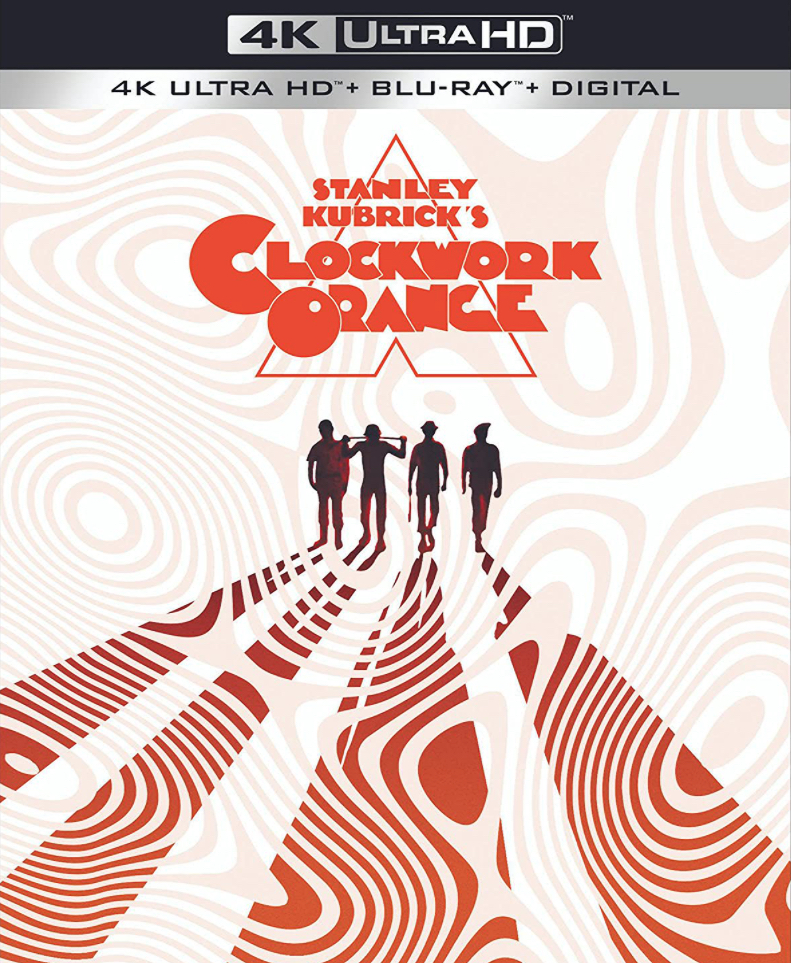
An excellent job of selling a half-century-old film — the forthcoming, undoubtedly spiffy 4K Bluray of Stanley Kubrick‘s A Clockwork Orange (9.21.21).

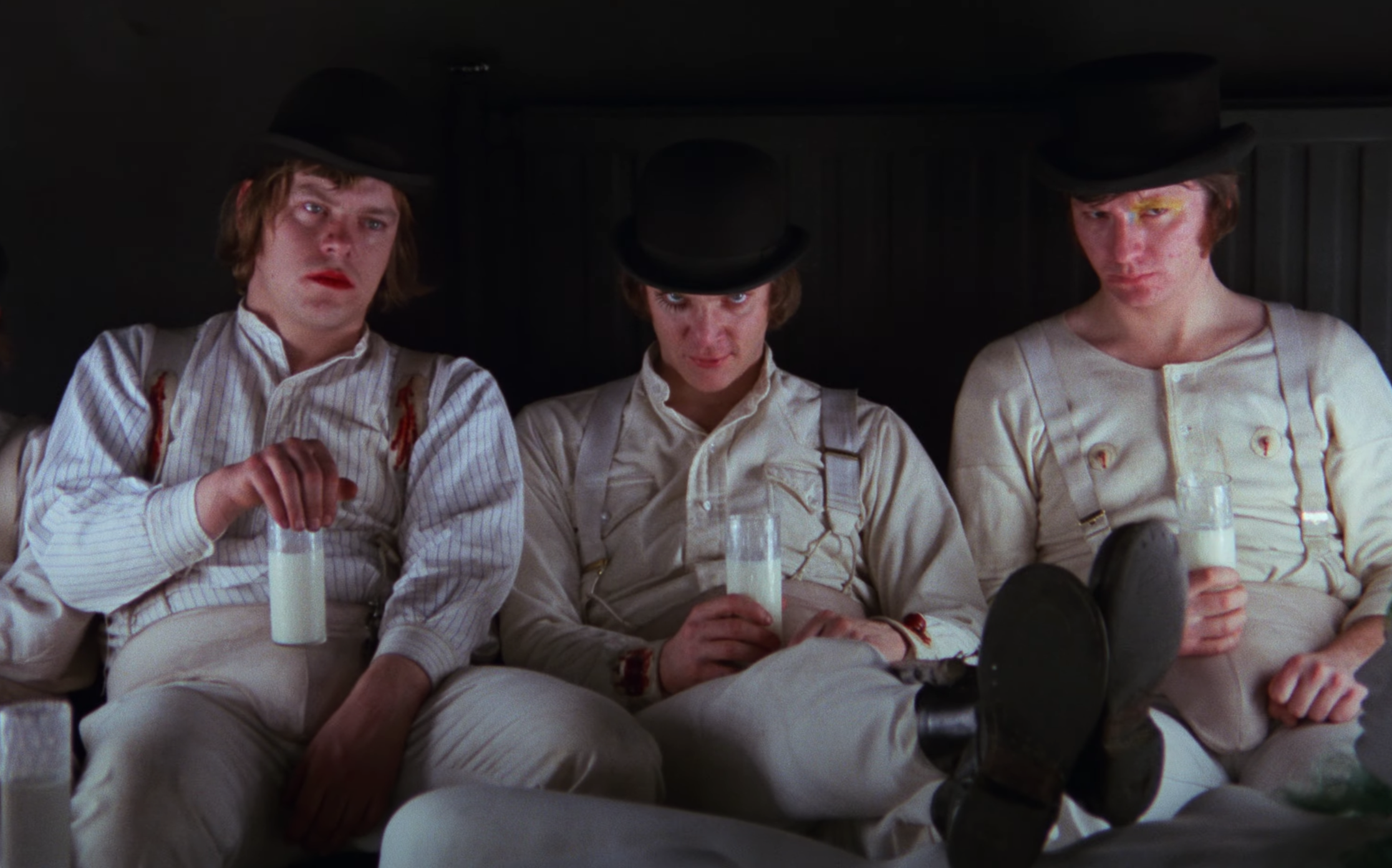
From yesterday’s [8.5] pay-walled assessment: “It’s still a crisp, clean, mesmerizing film, and I’ll never stop worshipping that final shot of those well-dressed 19th Century couples clapping approval as Alex and a scampy blond cavort in the snow. But this is nonetheless one really cold film. And yet at the same time (and this is what makes Orange such an odd duck) it’s genuinely amusing here and there. Every line and gesture delivered by Michael Bates‘ chief prison guard is a hoot, and I chuckle every time I see that fat, middle-aged fuckface making kissy-face gestures at Malcolm McDowell‘s Alex in the prison chapel.

“At the same time I can’t honestly say that I like A Clockwork Orange much any more. I was always more impressed with the scene-by-scene verve than what it all amounted to in the end. I still respect the visual energy and exquisite 1.66:1 framings (John Alcott was the dp) and the Wendy Carlos meets Gene Kelly meets lovely lovely Ludwig Van musical score, and I still “admire” the tone of ironic ruthlessness and even fiendishness, but I’m not even sure if I like McDowell’s performance any more. (I feel a much greater rapport these days with his Mick Travis character in Lindsay Anderson‘s If…) I respect Orange historically, of course, and I still love the stand-out moments from the flawless first act, but it hasn’t delighted me overall for years.

A Clockwork Orange was the first Kubrick film that felt wholly misanthropic** — a high-style show-off movie that sold audiences on the idea that Kubrick-stamped cruelty and brutality were palatable — that irony and arch acting styles somehow changed the game. But it was always more amoral than moral, and pretty much devoid of human compassion. Orange has 23 significant characters with noteworthy dialogue, and only one could be honestly described as decent or humane — Godfrey Quiqley‘s prison chaplain.”
Read more

Minus The Style, “Orange” Is Sour Fruit

Stanley Kubrick‘s A Clockwork Orange will celebrate its 50th birthday on 12.19.21. I don’t know if I’ll be able to summon fresh interest as I’ve seen this cynical, ice-cold film too many times, but the new 4K Ultra HD Bluray from Warner Home Video — a fresh harvest, sure to look better than the current Bluray version — is too appetizing to refuse. I bought it today on Amazon. The street date is 9.21.21.

Orange remains a chilly, dead-on capturing of Anthony Burgess’s 1962 novel, and it seems doubly fascinating when you regard it as a portrait of the chilly, German-like social scientist that Pauline Kael imagined that Kubrick had become in ’71, and indeed the fellow that Kubrick had more or less evolved into since he made Dr. Strangelove seven or eight years earlier.

It’s still a crisp, clean, mesmerizing film, and I’ll never stop worshipping that final shot of those well-dressed 19th Century couples clapping approval as Alex and a scampy blond cavort in the snow. But man, it’s really cold and almost induces nausea from time to time. And yet at the same time it’s genuinely amusing here and there. Every line and gesture delivered by Michael Bates‘ chief prison guard is a hoot, and I chuckle every time I see that fat, middle-aged fuckface making kissy-face gestures at Malcolm McDowell‘s Alex in the prison chapel.

At the same time I can’t honestly say that I like A Clockwork Orange much any more. I was always more impressed with the scene-by-scene verve than what it all amounted to in the end. I still respect the visual energy and exquisite framings (John Alcott was the dp) and the Wendy Carlos meets Gene Kelly meets lovely lovely Ludwig Van musical score, and I still admire the ironic ruthlessness and even fiendishness, but I’m not even sure if I like McDowell’s performance any more. (I feel a much greater rapport these days with his Mick Travis character in Lindsay Anderson‘s If…) I respect Orange historically, of course, and I still love the stand-out moments from the flawless first act, but it hasn’t delighted me overall for years.

A Clockwork Orange was the first Kubrick film that felt truly misanthropic — a high-style show-off movie that sold audiences on the idea that Kubrick-stamped cruelty and brutality were palatable — that irony and arch acting styles somehow changed the game. But it was always more amoral than moral, and pretty much devoid of human compassion. Orange has 23 significant or otherwise noteworthy characters, and only one could be honestly described as decent or humane — Godfrey Quiqley‘s prison chaplain.

A Dickensian crime-and-punishment thing, Orange is composed of four acts or movements. The first act is about the wicked rush of sociopathic “fun”, but the second and third acts (applying the Luduvico technique + Alex suffering for his crimes after being released from prison) comprise a long and punishing slog. The film rebounds during its brief fourth act (the hospitalized Alex cuts a deal with Anthony Sharp‘s Minister of the Interior, and is restored to his old wicked self) and the ending shot, a sexual fantasy sequence, is the equal of Kubrick’s “We’ll Meet Again” finale in Dr. Strangelove.

Read more

Gotham Neutral

In years past the Gotham Awards have (a) never handed out male/female acting awards in the supporting category, and (b) only focused on Best Actor and Best Actress. The new thing, announced today, is that henceforth the Gotham acting awards will be (a) gender neutral and (b) will focus on lead and supporting — i.e., one in each category.

So hooray for supporting actors but boo-hoo at the same time because only one actor of either gender can win a Gotham supporting actor trophy. Likewise, only one lead actor (either gender) can win.

The new acting categories will be called Outstanding Lead Performance and Outstanding Supporting Performance.

May I suggest something? If the Gothams must do the gender-neutral thing, hand out four of them — two lead, two supporting.

Friendo: “While wokesters believe in disappearing gender, they also believe in non-color-blind casting and race relations. These two things do not agree with each other. Plus gender neutral ignores how women have a hard time getting great roles, especially women of color. Having separate categories HELPS them do better. Taking that away gives men the advantage. It’s so bizarre.”

Took ‘Em Long Enough

Many of us look forward to films directed by or starring Clint Eastwood because we know (a) they’ll feel as if they were made in 1984 or ’89 or ’96…way back before the superhero era, (b) they’ll basically be meditative and character-driven, and will most likely be peppered with sardonic humor, and (c) they’ll focus on values and decency and Clint’s ornery old cuss being challenged or put through the ringer by a bad guy or two. It’s also a safe bet that an attractive older woman (40s or 50s) will give Clint’s character a wink.

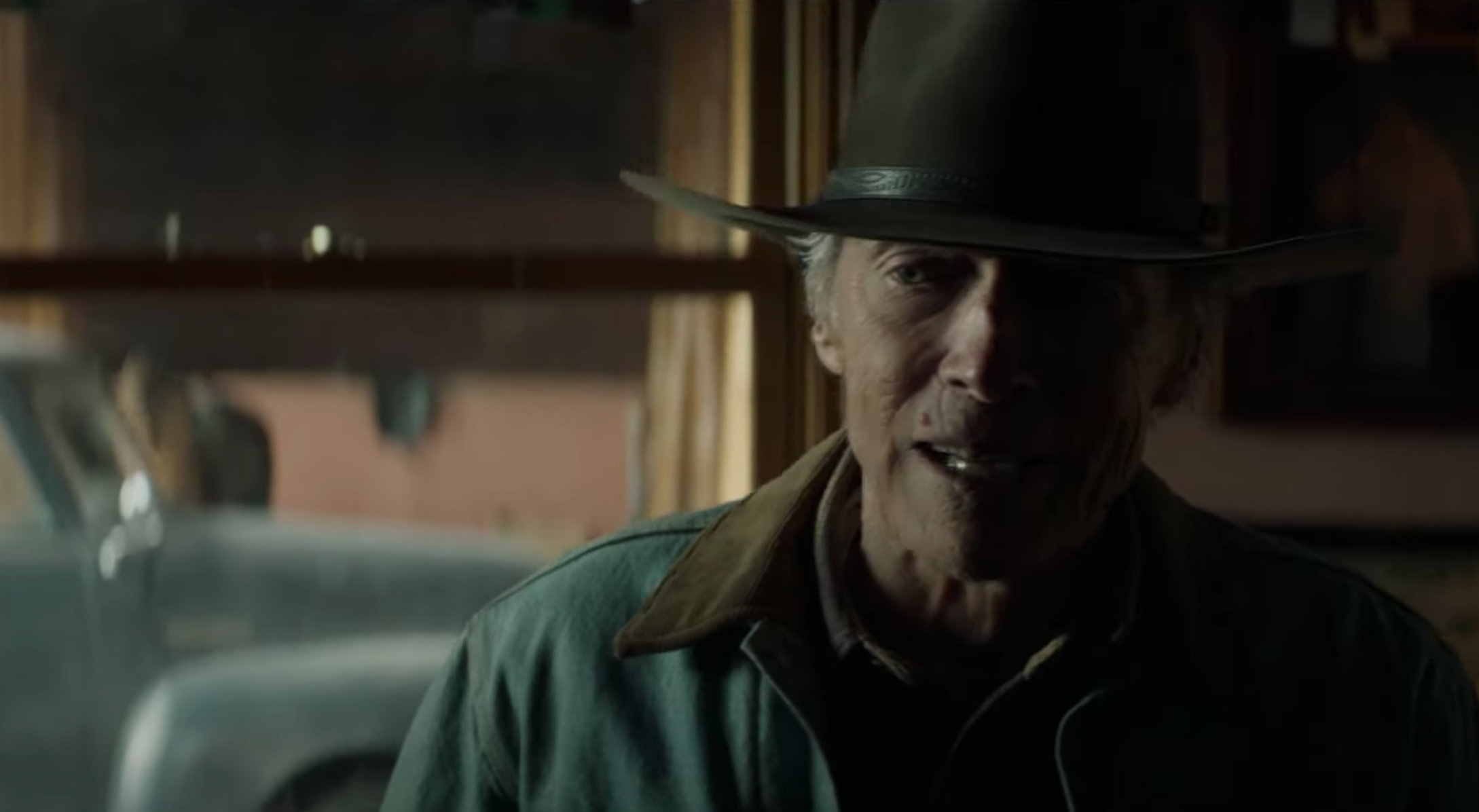
The Cry Macho trailer seems to suggest Gran Torino meets The Mule in Mexico…something like that.

I think Cry Macho (Warner Bros./HBO Max, 9.17) should be bannered as a milestone film. How many legendary, brand-name, Oscar-winning actor-hyphenates have directed and starred in a film at age 91? Has this ever happened in Hollywood history? The Macho script has been around for three-plus decades. Clint almost made it in the late ’80s and then backed away. It has to have something pretty good going on or why did it get made after all this time?

This film appears to have some kind of resonant quality…something that may stick to the ribs…maybe.

Read more

Knox Still Hasn’t Seen “Stillwater”?

Everything Amanda Knox has been saying about Stillwater is sensible and fair.

In admittedly using Knox’s conviction, imprisonment and acquittal on a murder charge in Italy as a jumping off point for an otherwise fictional story, director and co-writer Tom McCarthy has somewhat callously dredged up a lot of bad business and has re-implanted the idea that there’s something possibly sketchy and wanton about Knox herself. And Knox resents this. Who wouldn’t in her position? I can’t imagine anyone telling Knox that her complaints are unwarranted.

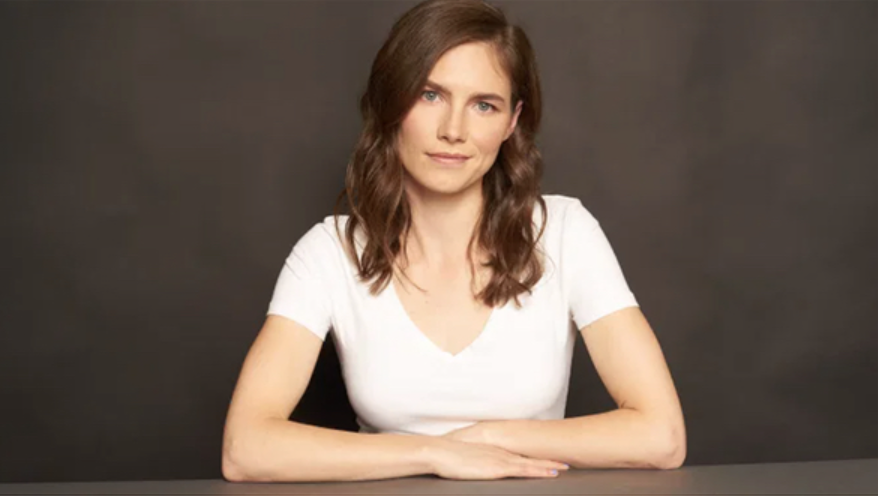
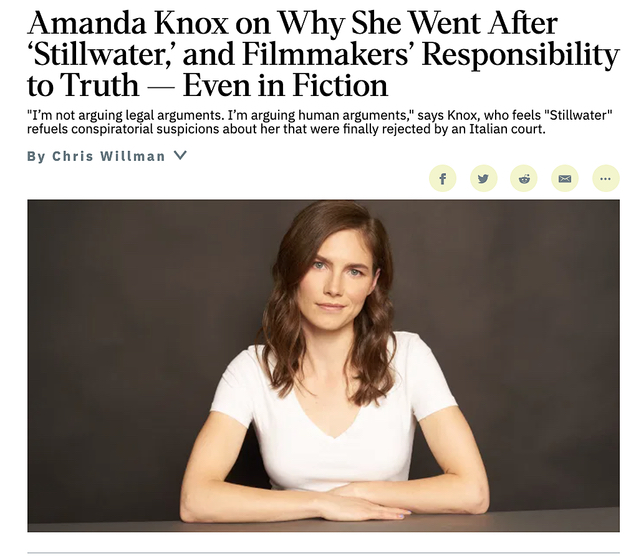
It’s odd, however, that in an 8.4 interview with Variety‘s Chris Willman Knox states that (a) she hasn’t seen Stillwater yet (it opened last Thursday night) and yet (b) she would “absolutely go see it, especially if they invited me…that would be nice.”

Knox tells Willman she’s been informed how the story unfolds (“I did some invest-imigating”), but if you were Knox and giving interviews to everyone about a completely valid complaint about a just-opened film, wouldn’t you take the time to pop into a megaplex and see the damn thing already? Doesn’t that make basic sense?

For one thing it’s conceivable that Abigail Breslin‘s performance as the vaguely-Knox-resembling Allison Baker might radiate certain emotional currents that Knox might be receptive to and which might influence her general thinking…no? Experiencing a film is essential.

Where exactly was the upside in Knox not slipping into a showing last weekend? I really don’t get this part.

In mentioning the hypothetical idea of Focus Features inviting her to see the film, Knox seems to imply that this is her due. (“Since we’re stirring your life up and sending you back into a decade-old nightmare, it’s the least we can do.”) She also seems to be suggesting that personally paying to see the film would be adding insult to injury.

I wouldn’t futz around with this stuff if I were Knox. I would have bought a ticket to one of the very first commercial showings last Thursday night — no ifs, ands or buts. If you have a beef with a movie, you have to watch it.

The Snow Boiled Out

The following is the most plainly worded, pared-to-the-bone, no-bullshit comment in yesterday’s “Sopranos Finale Was Cut Wrong” thread:

“Outside of the influence of surrealism and whatnot, smart, strategic, well-ordered cinema RARELY fucks with people’s heads like the final Sopranos scene did. I explained why many were confused or uncertain about what had happened. It was because of the EDITING — David Chase’s decision to not play by basic editing rules at the very end,

“Except for the various dream sequences, The Sopranos was never some trippy cowabunga metaphysical space cadet David Lynch thing that dropped a tab of mescaline as it went off into the wild blue yonder. It followed the rules of clean, no-bullshit storytelling. It didn’t play bait-and-switch fakeout games. It experienced off passages like any longform, but it generally knew what audience expectations were and more or less MET them, episode after episode, season after season.”

Woke Supermodels

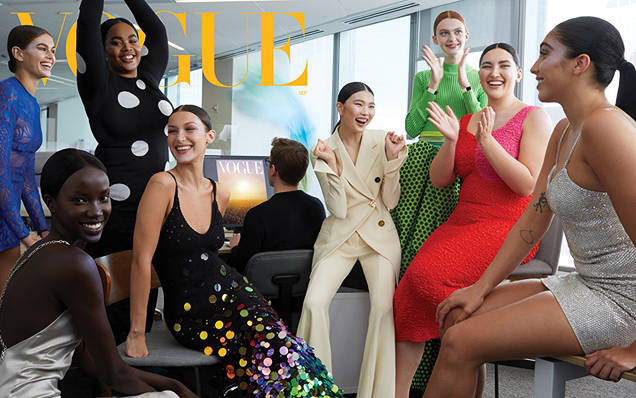
Remember what supermodels used to look like ten, twenty, thirty years ago? We all understood the genetic, glowing signals. Rail-thin, sleek, elegant, striking, beautiful, wow. Well, according to the September issue of Vogue, times have changed. Today’s supermodels exemplify the beauty of great genes but also (and more importantly) diversity, varying sizes, wokeness, women supporting women, equality, no one being marginalized, etc.

And just to drive the point home, the eight Vogue models heralded in the new issue — Kaia Gerber (spawn of Cindy Crawford), Anok Yai, Precious Lee, Bella Hadid, Sherry Shi, Ariel Nicholson, Yumi Nu and Lola Leon (daughter of Madonna and Carlos Leon) — all have their hair in a tight bun or pulled into a ponytail. We get it..

The fashion industry has never been about what straight guys think, of course, but what this photo basically confirms is that the age-old pleasure of guys gazing at supermodels is…well, perhaps not “over” but more of a mixed-bag activity. Because two or three of these women, no offense, are not classic head-turners.

The devastatingly beautiful Yai fits the classic mold, of course; ditto Gerber, Hadid, Leon and Li. The alabaster-skinned, ginger-haired Nicholson…okay, fine. The plus-sizers represent a different aesthetic.

Friendo: “This is just virtue-signaling crap. Instagram and Tik Tok still show what kinds of women draw eyeballs. Honestly, has the world ever beheld a more censorious, strident, militant, punishing generation? It’s like in Orwell where things mean the opposite — Ministry of Love, Ministry of Truth, etc. The idea that they love everyone and marginalize no one and everyone is as accepted as they are is, at the very least, PARTIAL BULLSHIT. You agree with them or you’re destroyed. Accept the new aesthetic or face banishment.”

From left: Kaia Gerber (daughter of Cindy Crawford) wears Tom Ford. Anok Yai wears Ralph Lauren Collection. Precious Lee wears Carolina Herrera. Bella Hadid wears Christopher John Rogers. Sherry Shi wears Proenza Schouler. Ariel Nicholson wears Christopher John Rogers. Yumi Nu wears Mara Hoffman. Lola Leon (daughter of Madonna and Carlos Leon) wears Michael Kors Collection. Hair, Lucas Wilson; makeup, Jen Myles. Fashion Editors: Tonne Goodman and Gabriella Karefa-Johnson.Photographed by Ethan James Green, Vogue, September 2021.