Jeff Sneider is much more into proletariat popcorn movies than myself. Many times I’ve rolled my eyes at films he’s enjoyed. Sneider was the guy sitting right behind me during a Fox lot Jojo Rabbit screening and laughing his ass off — it was all I could do to not turn around and hiss “what the fuck, Jeff?” So his dismissal of Dune means more than myown.
DUNE: Another beautiful blockbuster bore. A totally dissatisfying 2.5-hr STAR WARS movie sans lightsabers. Cast did nothing for me aside from Oscar Isaac. Someone has GOT to convince Villeneuve to return to Prisoners-Sicario territory. And people want a PART 2 to this snoozefest? pic.twitter.com/p0WQ4EBXOl
One of the things I adore about this Sony Pictures Classics release (12.24.21) is that it respects a basic biological fact, a fact that Hollywood has only occasionally acknowledged — the bedrockgeneticrealityoffamilyresemblance.
By the same token George Clooney ‘s The Tender Bar (Amazon, 12.17) has a problem with this, at least as far as the casting of young Daniel Ranieri is concerned. Clooney would have us believe that Ranieri, who seems to be descended from a (take your best guess) Sicilian or Lebanese or Egyptian heritage, is going to grow up to be TyeSheridan — obviously a non-starter.
Clooney could be saying to his audience, “I know the kid doesn’t look like Lily Rabe or Max Martini but there’s this whole woke and diversity thing going on now, and we have to play ball with that.”
Pedro’s film sits on the opposite side of the canyon — it not only respects family resemblance, but uses it as a plot point.
Without giving away too much of the story, Penélope Cruz is Janis, a Madrid-residing photographer who becomes pregnant by Arturo (Israel Elejalde), a kind of biologist-anthropologist who’s doing forensic studies of the skeletons of victims who were disappeared by the Franco regime.
Their affair has been on the sly as Arturo is married to a woman who’s struggling with cancer. Anyway, the baby (a daughter) arrives and one day Arturo drops by. The instant he lays eyes on her you can tell he’s a bit taken aback. Arturo senses that something might be wrong as he sees nothing of himself in the child’s features.
We can see this also — it’s obvious.
This struck me as a revelation. Parallel Mothers is a movie that actually acknowledges that kids look like their parents (or occasionally like their grandparents)…imagine! Only rarely will U.S.-made films allow for this, and certainly not in present-tense Clooneyville.
I finally caught Wes Anderson’s TheFrenchDispatch during Telluride ’21, and there’s no question that it’s brilliant and (I mean this respectfully) oddly hateful in a chilly sort of way.
It’s a visual knockout on a shot-by-shot basis. but except for a scene or two featuring Jeffrey Wright it refuses to provide any sort of narrative tissue or emotional connection with the characters. It’s all arch attitude, snide-ironic voice-overs and deadpan expressions, and after a while it makes you intensely angry. That or your spirit wilts or you become weak in the knees.
TheFrenchDispatch is a bullwhip immersion in hardcore, doubled-down Wes. It’s not that there’s no way “in” as much as there isn’t the slightest interest in offering any kind of common humanity element.
So much so that I began to wonder if Wes might be going through a phase vaguely similar to Jean-Luc Godard’s Marxist-Maoist revolutionary period (‘68 to ‘79). I ask because it’s a pure head-trip objetd’art — there’s no sense whatsoever that Dispatch is looking to engage on any kind of semi-accessible level, even to the extent of reaching people like me.
It’s so mannered and wry and rapid-fire ironic that it sucks the oxygen right out of your lungs.
That said, I loved the boxy (1.37:1) cinematography. I was also kind of wondering why Wes didn’t use 1.66:1 more often. (I’m actually not sure he used it at all.). It seemed to be about 85% boxy and 15% widescreen scope (2.4:1).
For me the most humanly relatable moment doesn’t involve Wright’s character. It happens, rather, during the 1968 sequence that costars Frances McDormand as a Dispatch staffer writing about the fevered climate of French student revolt. Asked if writing is a lonely, isolating profession, McDormand answers “sometimes.”
There’s no chance that anyone this fall will even flirt with the concept of Dispatch being worthy of above-the-line Oscar noms — at best it could land some for production design, costumes, makeup, editing.
At 2:40 am this morning (Thursday, 10.21), Katya, our five-month-old kitten, stepped on the power button of our Crux blender, and suddenly the joint was filled with a terrible howling…a raw, bludgeoning jackhammer that would awaken Irish banshees from the depths of a foul and sulfuric hell…”VurraAAGGHHHRRRrrrrt!” I was dreaming sweet dreams, and within two or three seconds I was up and stumbling into the kitchen and trying to turn the damn thing off…I finally just pulled the plug. And then, of course, I was unable to get back to sleep. An hour of just lying there, and so I began reading and making notes. Finally re-crashed at 6:30 am.
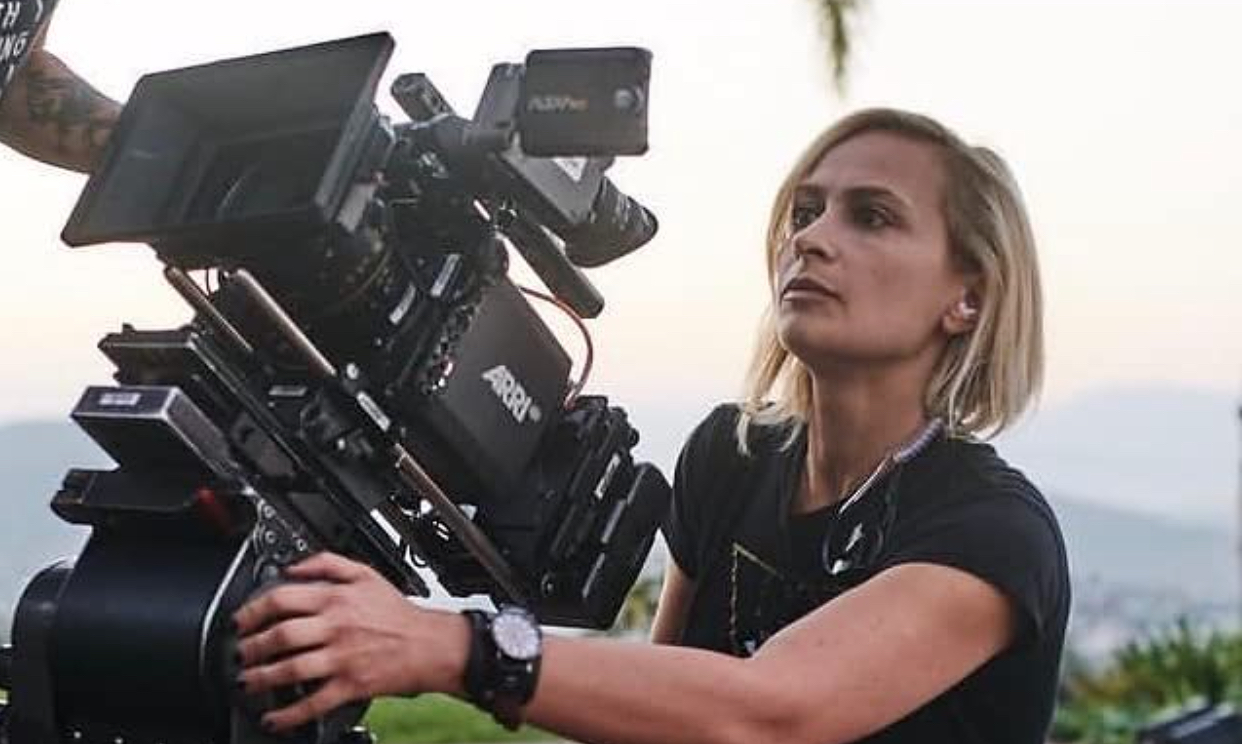
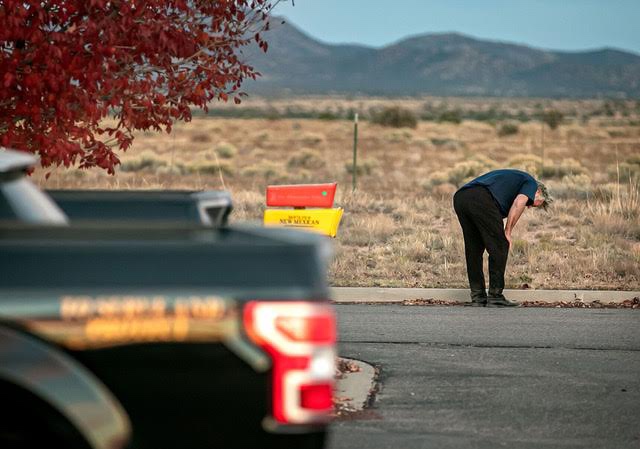
8:05 pm update: With Alec Baldwin now confirmed as the accidental prop-gun shooter in the death of Rust dp Halyna Hutchins, people need to calm down and take a couple of steps back. Baldwin’s reputation as an occasional hothead shouldn’t lead to speculation that what happened was anything other than a tragic accident.
The guilty party, if you will, is the person responsible for loading the prop weapon. Who the hell loads a prop pistol with the potential to shoot any sort of projectile? Talk about a totally crazy magic-bullet situation. One shot apparently went into Rust director-writer Joel Souza, 48, and then exited and hit poor Hutchins, who died soon after. Or vice versa. Just don’t start speculating that this horrible accident had anything to do with anyone’s temperament.
The New York Post‘s Kenneth Garger is reporting that Baldwin, the film’s star and producer, was the accidental shooter in the incident. Variety is reporting the same. Everyone is.
Quote: “Alec Baldwin fatally shot a woman and injured a man when a prop gun misfired at the New Mexico movie set of the film Rust, authorities said.”
Condolences to Hutchins’ family, friends, professional colleagues. Such a terrible tragedy. Nobody knows anything, but it certainly sounds like a case of cavalier or reckless disregard of safety measures.
Pic is a period western costarring Baldwin, Frances Fisher and Brady Noon under director-writer Joel Souza.
TMZ: “We’re told Alec was filming the scene when someone pulled the prop gun’s trigger. It’s unclear if the person who loaded the gun mistakenly placed bullets inside, or if something was lodged in the barrel that hit the director as well as the director of photography.
Souza, TMZ reports, was “hit in the clavicle.” No specifics on Hutchins’ wound, except that it was fatal.
A live bullet or a harmful projectile of some kind was lodged in the barrel of a prop gun? How could that possibly happen? Somebody fucked up hugely.
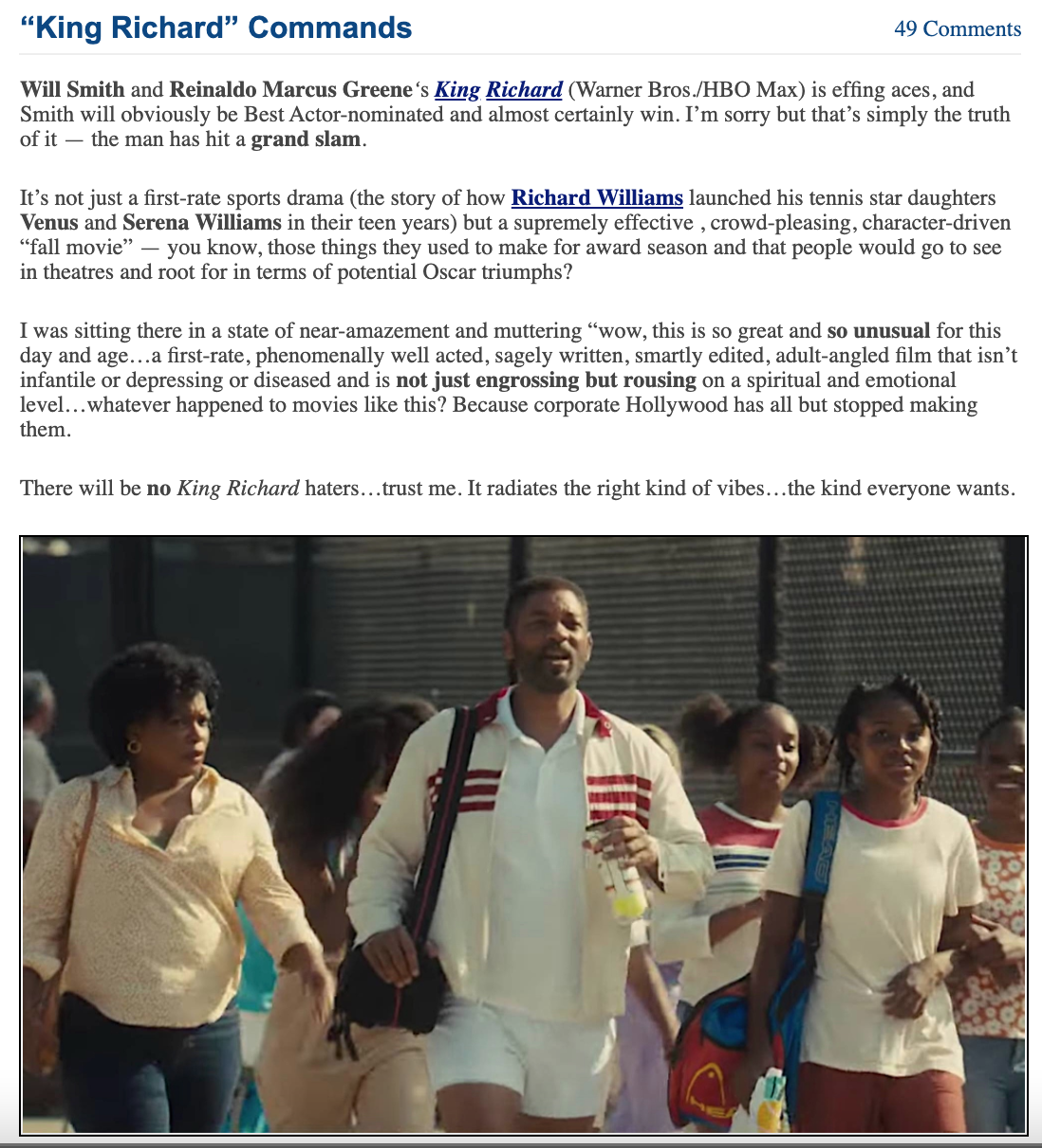
I’m SO excited for you to watch the new trailer for #KingRichard starring Will Smith and featuring the song “Be Alive” by @Beyonce. It’s in theaters and streaming exclusively on @HBOMax November 19. pic.twitter.com/pILYvbJsbw
Two days ago I saw Pedro Almodovar‘s Parallel Mothers (Sony Pictures Classics, 12.24.21). I’m in 100% agreement with the 100% Rotten Tomatoes score. Okay, it’s not perfect, but it comes awfully close to that. I was murmuring to myself “this is easily one of the year’s best so far…this, King Richard, Cyrano and Asghar Farhadi‘s A Hero.”
Variety‘s Owen Gleiberman has written that Parallel Mothers is the finest Almodovar film since All About My Mother. I think it’s his best since Habla Con Ella (’02) or Volver (’06).
HE to friendo: “I’m not fully persuaded that the forensic finale ties in as profoundly or exactingly as Pedro intended, but it ‘works’ for the most part — it harmonizes with the whole children, family and continuity thing. He’s such a clean and commanding and confident filmmaker, especially when the story focuses on women and mothering.”
Friendo to HE: “Yes, some have a problem with the ending and I understand why, but I thought he made it tie in. The idea is that these people in Spain cannot be whole, as individuals or as families, until they come to grips with the past. It worked poetically. I found the last scene powerful and moving.”
One of the things I adore about Parallel Mothers is that it understands and respects a basic biological fact, a fact that Hollywood has only occasionally acknowledged. The bedrock genetic reality of family resemblance.
Almodovar clearly respects the fact that genetic recognition is always there, and don’t tell me that sometimes a baby will resemble his or her grandfather or grandmother more than his or her mother or father because that kind of thing is highly unusual.
I’ve explained that George Clooney‘s The Tender Bar has zero respect for the parental resemblance factor, at least as far as the casting of young Daniel Ranieri is concerned. Clooney would have us believe that Ranieri, who looks (take your pick) Sicilian or Lebanese or Egyptian or Jordanian, is going to grow up to be Tye Sheridan — a non-starter.
Clooney could be saying to his audience, “I know the kid doesn’t look like Lily and Max but there’s this whole woke and diversity thing going on now, and we have to play ball with woke Stalinist attitudes.”
Pedro’s film sits on the opposite side of the canyon — it completely respects the family resemblance thing, and in fact uses it as a plot point.
Without giving away too much of the story, Penélope Cruz is Janis, a Madrid-residing photographer who becomes pregnant by Arturo (Israel Elejalde), a kind of biologist-anthropologist who’s doing forensic studies of the skeletons of victims who were disappeared by the Franco regime.
Their affair has been on the sly as Arturo is married to a woman who’s struggling with cancer. Anyway, the baby (a daughter) arrives and one day Arturo drops by. The instant he lays eyes on her you can tell that he’s a tad confused. He senses thqt something might be wrong as he sees nothing of himself in the child’s features. We can see this also — it’s obvious.
Those crude, gut-instinct, cigar-chomping guys (including the Protestant Daryl F. Zanuck) are nowhere to be found in the Academy’s recently opened temple at the corner of Wilshire and Fairfax. Nor are any of the filmmaking founders — Chaplin, Fairbanks, Griffith, Pickford, etc.
Filmmaker friendo: “This is what I felt when they announced the program but I reserved my judgement until I visited. This is not fair and not good. I hear [Martin] Scorsese is furious about the lack of history of the museum. I’ve also heard that Leo [DiCaprio] was very upset by what he saw there. The museum is a joke.** No D.W. Griffith, no John Ford, no Jewish moguls. What can be done here?”
Cyber Dandy: “I had hoped the museum would also pay homage to the motion picture pioneers who birthed the industry in the early 1900s and reflect the history of families like mine. But after touring the museum’s five stories, I discovered that Hollywood’s pioneers, who busted their [asses] building the industry it celebrates, ended up on the cutting room floor.”
HE to Cyber Dandy, Filmmaker Friendo: To wokesters the original Jewish founders and rulers of classic Hollywood along with the ground-floor filmmakers are defined by one thing — their whiteness.
“That’s all there is really. The Academy Museum is about apologizing for the working atmosphere created by white Jewish moguls and producers. Celebrating or at least acknowledging their historical roles is apparently the furthest thing from the Academy’s collective mind.
“The museum’s viewpoint is that the old days were bad, wrong, cruel, sexist, discriminatory, hugely unfortunate….there is only the wokeness of today and the future that lies ahead. Fairness and opportunity for women, people of color, LGBTQs, etc.”
** Scorcese and DiCaprio’s alleged disapproval of the Academy Museum’s lack of history has not been conveyed directly. It’s strictly “loose talk”, but it comes from persons in or near their circle.
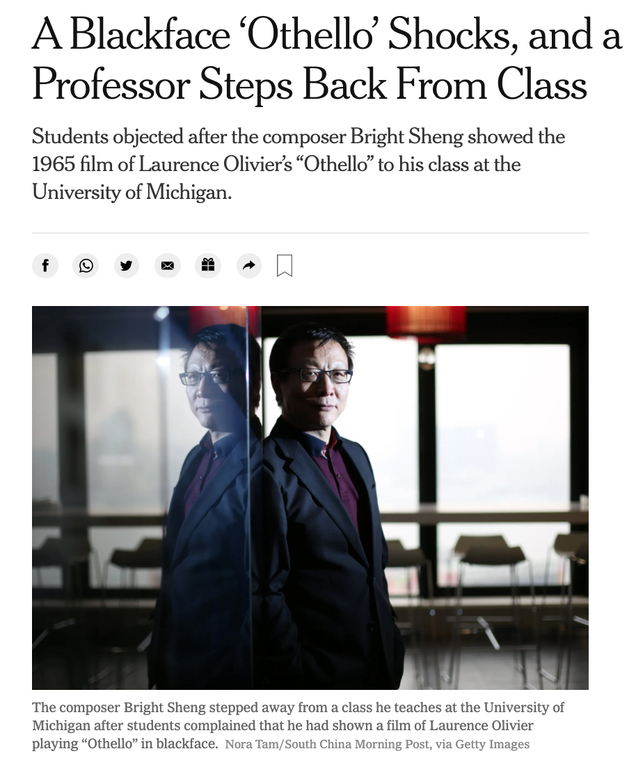
A week ago I read a N.Y. Times story about Bright Sheng, a celebrated University of Michigan music professor, being savagely attacked by campus wokesters for showing a lack of sensitivity blah blah.
Basically Sheng was forced to grovel and apologize and finally withdraw from teaching a high-profile class because he was dumb enough to show the students Laurence Olivier‘s Othello (’65), which in today’s universe is an obscenity because Olivier plays the title role.
Seriously — could Sheng bave been any more blind to the times and socially tone-deaf? Black actors can play this or that historically white character but whites can’t play blacks — not now and never again. How could Shern have not known that?
To wokesters there’s no difference between Olivier playing Othello in ‘65 (or, for that matter, the Muslim “Mahdi” in Basil Dearden’s 1966 Khartoum opposite Charlton Heston) and the worst minstrel shows. It’s all the same offense — the arrogance and temerity of a white person playing a non-white person.
The fact that Olivier’s Othello is quite the tempest and suitably tragic (as was Orson Welles in his 1951 version) is, to woke lunatics, immaterial.
Would a white actor even flirt with the idea of playing Othello today? Of course not. But Denzel Washington can play a medieval Scottish social climber who was done in by his own (and his white wife’s) ruthless ambition. Actors of color can play anyone or anything they damn well please, but white actors have to respect ethnic boundaries or else. It’s simply the way it is now.
Shouldn’t there be respect for historical context and the social climate in which the Olivier and Welles versions were made? Answer: No way, Jose.
Great acting is great acting whatever the guise…right? Answer: Not in today’s climate.
By this same token Marlon Brando’s Emiliano Zapata performance in Viva Zapata! (‘52) also needs to be cancelled and forgotten. No less a personage than Guillermo del Toro once told me that he holds Elia Kazan’s 1952 drama in very low regard. “How would you feel about a Mexican-made film about Abraham Lincoln?”, he said. “And one that you might instantly recognize, as an Anglo American, as inauthentic and therefore disrespectful?”
I’m sure that University of Michigan wokesters would REALLY lose it if they were shown Black Like Me (‘64), a kind of African American or minstrel show-like version of Gentleman’s Agreement. It starred James Whitmore as a white guy who pretends to be black by coloring his skin. Remember that one? And it was made by good-guy liberals.
I love how one of the anti-Chappelle supporters grabbed a pro-Chappelle placard being held aloft by a bespectacled, cap-wearing pudgy guy, and ripped the cardboard sign off. And then one of the anti-Chappelles shouted that the pudgy guy had a “weapon” — i.e., the stick that remained in his hands once the sign had been trashed.
“You want me to drop the weapon?” the pudgy guy asked, mocking the mania. “Yes,” came the reply, “and then leave.”
I also love how a short anti-Chappelle demonstrator with a tennis-ball haircut attempted to push against the pudgy guy by holding his/her arms up, getting right into his 18 inches of private space. There was also a small woman with a shrieky, agitated voice shaking some kind of noisemaker at the pudgy guy. Talk about impolite, rude and disrespectful.
The pudgy guy nonetheless held onto a joshing, light-hearted attitude.
🚨#BREAKING: Dozens of Netflix employees and their supporters staged a walkout outside Netflix Headquarters
To protest the transphobic comments made by Dave Chappelle in his latest comedy special released earlier this month by the streaming giant pic.twitter.com/zkNnSDaE95
Official Focus Features description: “Written and directed by Academy Award® nominee Kenneth Branagh, Belfast (11.12.21) is a poignant story of love, laughter and loss in one boy’s childhood, amid the music and social tumult of the late 1960s.”
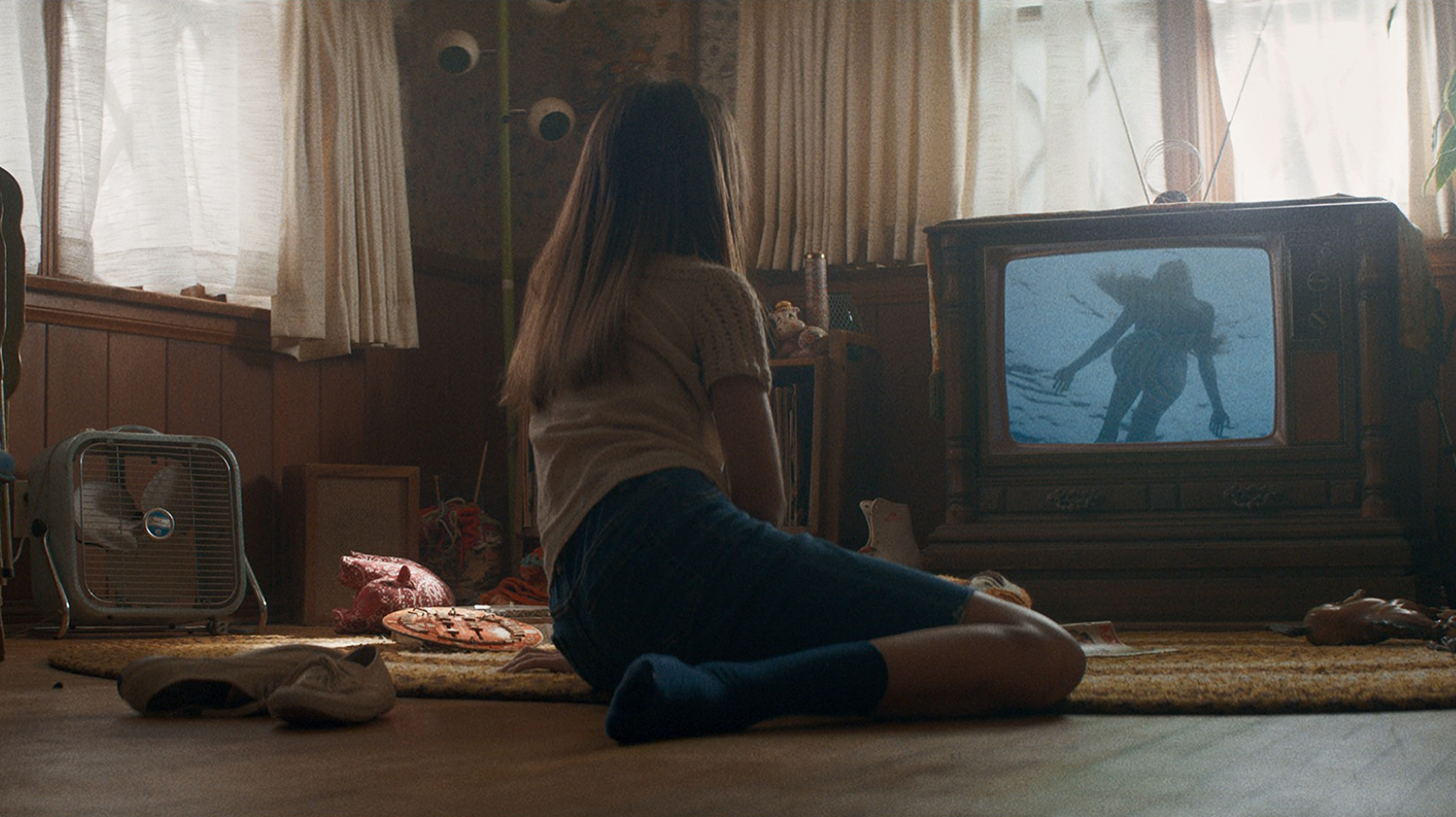
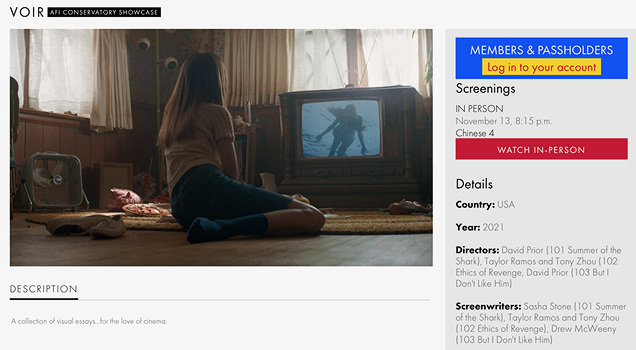
One of the “visual essays about the love of cinema” is titled “Summer of the Shark” — a Jaws recollection by none other than HE’s own Sasha Stone. The essay is nicely narrated by the Awards Daily owner, and it tells about her cinematic awakening, if you will, when she first saw Steven Spielberg’s 1975 classic.
The photo is of a movie-set recreation of teenaged Sasha watching Jaws in her 1970s living room.
The other essays are “Ethics of Revenge” by Taylor Ramos and Tony Zhou, and “But I Don’t Like Him” by Drew McWeeny.
The entire thing will be shown on Netflix a few weeks hence. The trailer will also eventually pop through.