
At Very End, “Heaven Can Wait” Transcends Itself

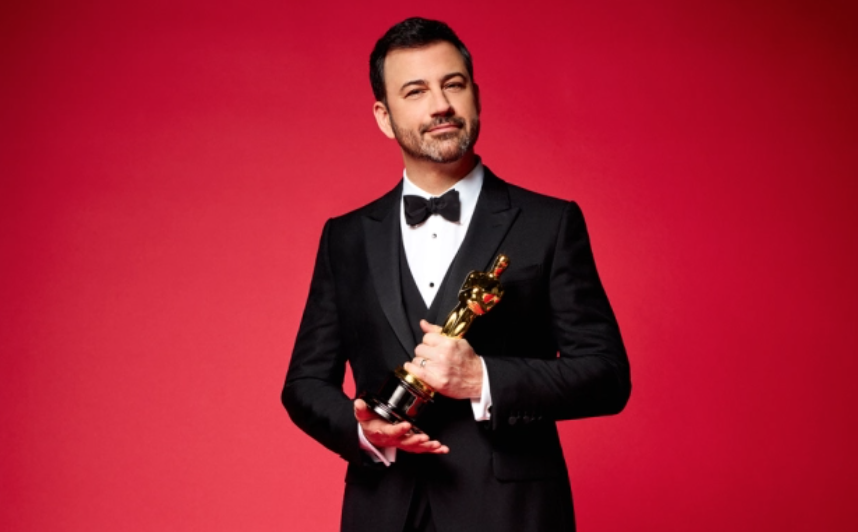
In his “Jimmy Kimmel Is Right About The Oscars” piece, Variety‘s Owen Gleiberman considers 25 Best Picture nominees from the past that were anything but artful and highbrow. These films were certainly audience-friendly. As Gleiberman remarks, “I was surprised to be reminded at times of what a low-to-middlebrow affair [the Oscars] used to be.”

His capsule descriptions of these 25 are spot-on in terms of what they really were or amounted to, except in the case of Warren Beatty and Buck Henry‘s Heaven Can Wait (’78).

Gleiberman describes it as “a popular comedy — but really, it’s just a fluffy afterlife fantasy with Beatty at his most meticulously abashed.” And he’s mostly right. 93% of Heaven Can Wait is a fluffy escapist comedy. But the last 12 minutes are killer. It becomes this WHOLE OTHER THING.

The last scene in that LA Colisseum passageway, the one between Beatty and Julie Christie, is one of the most emotionally affecting, spiritually transporting romantic scenes in movie history.

The film fiddles with the idea that our essence as a person — our settled soul, our eternal centerweight — not only persists through the millenia but would somehow be recognizable to a girlfriend or lover if she happened to run into us in another body. Christie fell in love with Beatty’s Leo Farnsworth and wept when he died, and yet somehow she sensed at the very end that there was something curiously familiar about Beatty’s Tom Jarrett, the Rams quarterback.

This scene (the eye contact between Beatty and Christie is magnificent) is the reason Heaven Can Wait made as much money as it did. Produced for $6 million, it wound up earning $98 million — the equivalent of $419 million in 2022 dollars.

The reason it did so well is that final fantasy scene, and the fact that the movie sold audiences on the notion that we’re all just passing through life and passing through this or that body, but that our spiritual core lives on — that we, in a sense, will never really die. And that even after our time on earth is finished, we’ll move up to heaven and hang out with James Mason and Buck Henry and other angels in business suits.

That’s not “fluffy” — that’s about as primal as it gets. We’re all going to die some day, and it’s enormously comforting to not only imagine but temporarily believe that death is not the end, but just a way station into the next realm. Heaven Can Wait sold a gentle little fantasy that made everyone feel awfully damn good.
What The Academy Has Recently Liked

There are now five opinion-spreaders who’ve argued that Spider-Man: No Way Home should have been nominated for the Best Picture Oscar — myself (two months ago), Variety‘s Owen Gleiberman, Awards Daily‘s Sasha Stone, Jimmy Kimmel and Kevin Smith.

In a 2.12 Variety essay Gleiberman has dug into an issue related to the Spider-Man thing. It’s titled “Why Jimmy Kimmel Is Right About the Oscars.”

Key passage: “The Academy Awards, even as they seem to be discovering a new kind of ‘integrity,’ could end up withering on the cross of that integrity.

“Today, the Oscars reflect an increasingly dichotomized thinking: small movies (good) vs. popular movies (not so good), movies that wear their art on their sleeve (good) vs. movies that just want to have fun (not so good).

HE interjection: Since the woke thing took hold in ’17, Academy members have favored smallish films, true, but especially those that seem culturally meaningful (signifying some form of social awareness or advancement) or emotionally touching in a socially-healing way.

The last five winners: Nomadland (dispossessed nomads, living hand to mouth, shitting in buckets), Parasite (rich vs. poor, social hostility, a director of color, wasn’t another Scorsese goombah film), Green Book (a parent-child road movie, racial rapprochement in 1962), The Shape of Water (great fish sex for homely woman vs. Michael Shannon rage and perversity), Moonlight (three stages in the life of a gay black dude + “ohh, that handjob on the beach!”).

Back to Gleiberman: “That thinking is there on the part of both the media and the Academy voters. Even King Richard, one of the 10 best picture nominees (and one that’s likely to bring Will Smith his first Oscar for best actor), may, at this point, be too conventional and wholehearted for the Academy. I was happy to see it nominated (I think, after Drive My Car, that it’s the best film on the slate), but a decade ago I believe it would have won. Why isn’t it being talked about as a contender?

“It’s hard to generalize about the Oscars — whenever you point to a trend, there’s probably some example from the past that can be used to contradict it. But what my gut says, along with Jimmy Kimmel’s, is that what most of the world thinks of as the quintessence of entertainment is starting to be something the Academy no longer trusts.

“If so, that’s a serious problem. As a night of showbiz, the Oscars should be a lot of things: traditional and audacious, intimate and spectacular, frivolous and sincere.

“The one thing they shouldn’t be is alienating.”

No Brainwashing Required

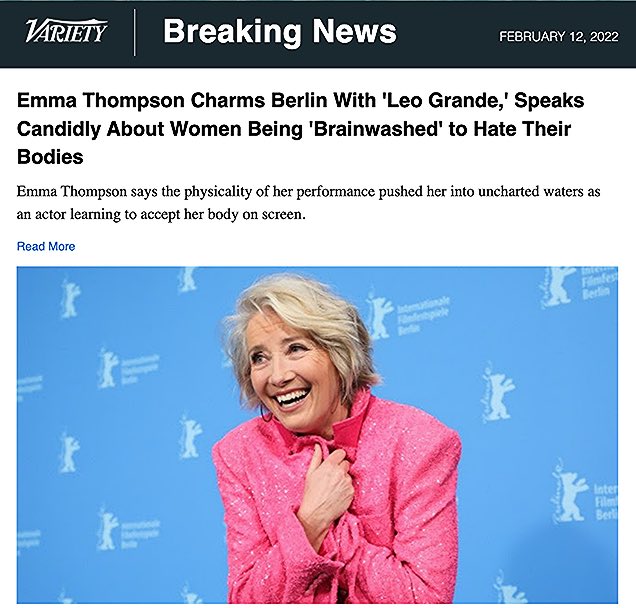
Following last night’s Berlinale screening of Sophie Hyde‘s Good Luck To You, Leo Grande, Emma Thompson, who plays Nancy, a 62 year-old woman (like Thompson) who hires a sex worker (Daryl McCormack) to get her ya-ya’s out, discussed performing a full-frontal nude scene.

“It was hard“, Thompson said during a Berlinale press conference. “This is homework for all of you. We’re only used to seeing bodies that have, you know, been trained…I knew that Nancy wouldn’t go to the gym. She would have a normal body of a 62-year-old woman who’s had two children.

“I can’t stand in front of a mirror like that. If I stand in front of a mirror, I’ll always pull something in [or do] something. I can’t just stand there. Why would I do that? It’s horrifying. But that’s the problem, isn’t it?

“Women have been brainwashed all our lives. That’s the fact of it. And everything that surrounds us reminds us how imperfect we are and how everything is wrong. Everything is wrong, and we need to look like this.”

“So you try. You try standing in front of the mirror and don’t move. Don’t move. Just accept it — just accept it, and don’t judge it. That’s the hardest thing I’ve ever had to do. I’ve done something I’ve never done as an actor.”

HE to Thompson #1: You’re contradicting yourself here. On one hand you’re saying that staring at your buck-naked 62 year-old bod is “horrifying,” but the reason is because of the “brainwashing” that we’ve all been subjected to by advertising, movies and TV shows. I don’t happen to believe that my own bod is horrifying or even distressing, but I can imagine being less than pleased with my physical self 10 or 20 years hence, especially if I stop going to the gym. Most of us understand that bodies which have gone to seed are dismaying all on their own — no “brainwashing” is needed to complete the lamentable fact.

HE to Thompson #2: Nobody who’s seen better naked days ever stands in front of a mirror and just stares…nobody. I didn’t do this even when I was in my absolute prime (i.e., late teens, 20s, 30s). I gave myself a quick glance or two but I never stared…not once. So why the hell would a 62 year-old do this, and why the hell would a director of a movie want an audience to contemplate an older, saggier bod? To what end? Who needs it? Answer: No one.

The trim and tanned Cary Grant was 62 when he made his final film, Walk, Don’t Run (’66). He was one of the best-looking, most-in-shape older males on the planet at that time, and there’s no way he would’ve shot a scene in which he stands in front of a mirror and studies his 62-year-old bod, even if he was wearing swim trunks or gym shorts. No way. Because (again) people never do this, and an audience would rather watch the 50ish Grant with his shirt off in North by Northwest or To Catch A Thief, because he looked better then.

My point, I suppose, is that Sophie Hyde…well, who knows what she was thinking? But if you ask me shooting an MCU of a full-frontal, present-tense Thompson was an act of sadism. To me anyway. Or exploitation. Or even cruelty.

Read more

“Jeremy, You’ve Been Traded to the Phillies”

It was sad to hear of the gunshot suicide of pro baseball player Jeremy Giambi. Not because I’m a huge baseball fan or had followed Giambi’s career all along, but because I vividly recall Nick Porrazzo‘s performance as Giambi in Bennett Miller‘s Moneyball (’11). It’s fair to say that Giambi’s career peaked when he was with the Oakland A’s from 2000 through ’02.

Giambi died at his parents’ home in Claremont last Wednesday (2.9). He was only 47. I’m very sorry.

Whoa, Step Back…It’s Mr. Hot Shot!

Among others, THR‘s Scott Feinberg and Variety‘s Marc Malkin have reported about last night’s “surprise appearance” of Kanye West at a preview screening of the biographical Netflix docuseries Jeen-Yuhs.

Directed by Coodie & Chike, the Kanye doc is divided into three chapters. Chapter one, “Vision”, will premiere on Netflix on 2.16.22 chapters two and three will be released soon after.

A friend says Jeen-Yuhs is “impressive…sort of like Hoop Dreams in chronicling Kanye’s journey over the years, how he came to be the way he is.” In other words, an ass-kisser.

I wonder to what extent the doc will get into Kanye’s erratic behavior during the Kim breakup, his friendship with Donald Trump, the reasoning behind his run for the Presidency in ’20, etc.

HE to friendo after watching clip of Kanye’s post-screening remarks: “Who cares what this rich, overindulged jerk has to say about anything? Particularly regarding matters of God, spirit and the cosmic truth of it all?”

Question: Los Angeles is enjoying a heat wave. (Right now it’s 84 degrees.) And it was definitely on the warmish side last night. So why was Kanye wearing a big bulky, Alaskan-winter jacket with a hoodie? Does he have a deal with Balenciaga to wear their stuff in front of the cameras?