Emily’s Journey

It only took me five weeks to finally watch John Patton Ford‘s Emily The Criminal, which is pretty close to being as good as I’ve been told. It’s not crazy-holy-shit good but good-good, and there’s nothing wrong with that. It’s basically a realistic and wholly unpretentious small-time crime film…no muss or fuss and down to business. But it’s only moderately involving at first. It takes a while to get there.

Aubrey Plaza is suitably fierce and guarded in the title role, a debt-ridden 30something in Los Angeles who gets involved with a phony-credit-card ring. At 93 minutes Emily takes a good 45 or 50 to really put the hook in and get moving, but the last 35 to 40 minutes are quite exceptional.

An expert actress who always invites you in and tells you what’s up, Plaza delivers a pro job as Emily. I really loved her moments in which she was angry and alarmed, and especially a “cut the bullshit” job interview scene with Gina Gershon.

Plaza is one of the producers (along with Tyler Davidson and Drew Sykes) but you know who’s also quite arresting and compelling? Theo Rossi, who plays Youcef, Emily’s mentor-in-crime and later her lover. I’d never paid attention to this guy before, but I will from here on. There’s one moment towards the end when Rossi disappointed me, or his character did rather. I won’t get into it but you have to watch your back.

Emily’s arc is what makes the film fascinating — she starts out as an almost listless, half-invested scammer who’s basically an in-and-outer, but the more criminality takes over her life the stronger and tougher she becomes. By the end she’s almost become a version of Neil McAuley or Michael Corleone at the end of The Godfather. The film basically says “theft and criminality is its own buzz, but you have to become a kind of fierce animal to really survive in this realm…you have to convince others that you’re scary when crossed so they’d netter not fuck with you.”

One reason I didn’t get to Emily before last night was that it’s still not streaming. I’m sorry but it didn’t strike me as worth $18 or $20 plus popcorn and whatnot, and it’s not like it’s playing in a lot of theatres.
Read more

“Don’t Forget Me, Bro!”

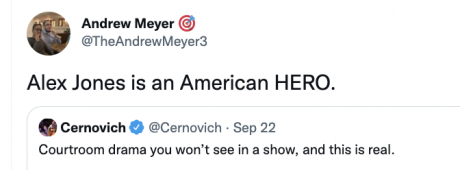
Last weekend or more precisely a week ago yesterday (Saturday, 9.17.22) marked the 15-year anniversary of the “don’t taze me, bro!” incident. It happened on 9.17.07 at the University of Florida in Gainesville. The candy-ass “aagghh!” cries and wimpy “help me!” pleas from the taser victim, Andrew Meyer, are familiar to everyone. They’ve endured as idiot memes ever since.

21 then, Meyer is now a 35-year-old published author (“Don’t Tase Me, Bro!: Real Questions, Fake News, And My Life As A Meme“) and a rightwinger who worships Alex Jones, despises the liberal media and, according to William Fleitch, works for right-wing agitator Mike Cernovich. Meyer is on Twitter, of course — anti-vax, Sebastian Gorka, pedophiles, etc.

Read more

A Moment of Religious Silence

…for arguably the greatest main-title sequence of the 1990s. Thunder and lightning, a talking corpse, tombstones, an octopus, cheap-looking flying saucers…I want to live in it.

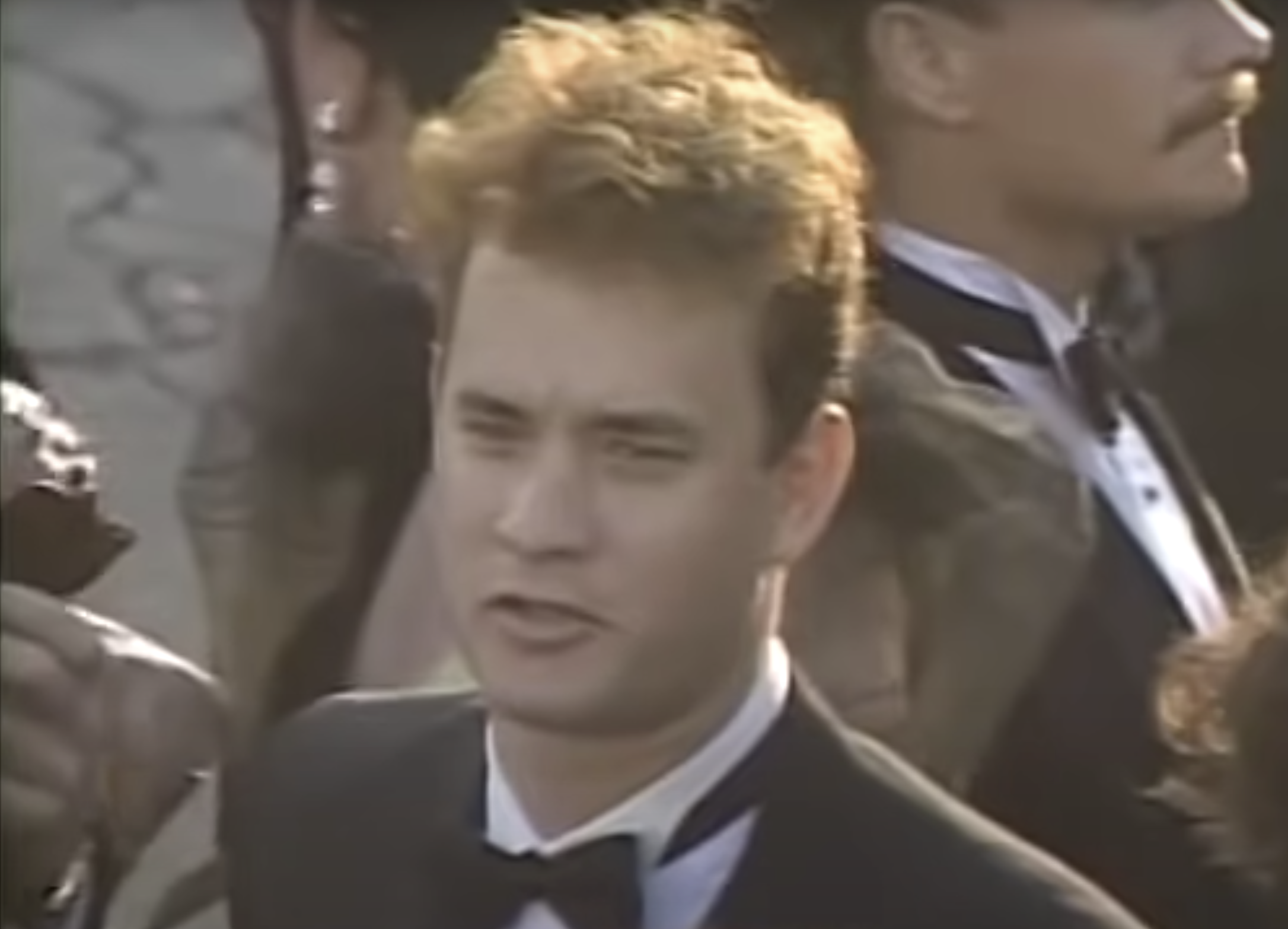
Tim Burton‘s Ed Wood is just shy of 30 years old, but boy, how time flies! Any resemblance between the 30-year-old actor who played the titular lead character and the crusty, stocky, pony-tailed guy who co-starred in a must-watch courtroom reality series a few months ago (4.11.22 to 6.1.22)…well, the resemblance is there, I suppose, but very slight.

Read more

Don McLean’s “The Day The Academy Died”

An article by a veteran Academy member has appeared on The Ankler, and it says something that The Ankler‘s Richard Rushfield, due respect, wouldn’t dare post himself.

As you might expect the piece in question has been written by a guy “who has asked to remain anonymous.” (But of course!) It’s titled “Notes From An Oscar Meeting Gone Wrong“, and the author is a self-admitted white middle-aged malebrrrnnggg!

What the article says, boiled down, is that over the last six or seven years the Academy has not only bent over backwards to address inclusion and equity in the ranks, but has totally lost sight of the fairy-dust factor, which has now all but evaporated.

Yes, the pandemic and streaming did a lot to kill exhibition. But that doesn’t change the fact that over the last seven years (basically since #OscarsSoWhite) the Academy and the industry, hand in hand, have put progressive politics above the creation and celebration of movie magic.

Wolfe Reminds, History Repeats, posted on 3.22.21: “Generally the making of cinematic art, like canvas art of the ’30s, has been largely called off in favor of serving the industry’s social justice revolution.

Just ask the curators at the Academy Museum (aka “Woke House“) — they’ll tell you all about it.

“The result has been a new form of enlightened propaganda cinema — movies that basically say ‘this is what should be‘ rather than ‘this is what is.’

White Middle-Aged Ankler Male: “To be clear, yes, I am a white male, and I believe in diversity and inclusion. But the way the Academy has gone about trying to meet the moment — both in those aspects and in the fight for relevancy — makes no sense.

“I personally can’t point to the exact moment the Academy of Motion Pictures Arts and Sciences died for me, only because there are so many to choose from.

“Was it January 15, 2015 when media strategist and lawyer (but not Hollywood filmmaker) April Reign tweeted #OscarsSoWhite after none of the 20 acting nominations that year included people of color?

“Maybe it was June 19, 2016, when the Board of Governors panicked under Twitter pressure and rushed to invite 819 members, fully 20 percent of the then-current members to join — many of whom existing members did not believe were admitted based on merit?

“How about April 17, 2018 when Bill Mechanic, the former head of Fox who co-produced a great Oscar ceremony in 2010 and was nominated as a producer for Best Picture, resigned from the Board of Governors with his letter including this line: “We have settled on numeric answers to the problem of inclusion, barely recognizing that this is the Industry’s problem far, far more than it is the Academy’s. Instead we react to pressure.”

“Or July 21, 2020 when producer Michael Shamberg (Erin Brockovich, The Big Chill) filed suit against the Academy because it did not want to listen to his constructive initiatives to move the organization into the modern era?

“Was it April 25, 2021, when the Academy produced the lowest-rated Oscar ceremony in the history of the awards? True, it was a pandemic event, but the lack of film choices did not require a lack of entertainment value.”

HE comment: The Soderbergh Oscar telecast was the most despairing, spiritually enervated, bad-acid-trip Oscars in Hollywood history. In no small part because Anthony Hopkins had the temerity to to snatch the Best Actor Oscar that the late Chadwick Boseman was supposed to win…Variety‘s Elizabeth Wagmeister was especially upset by this.

“Certainly the Oscars were already on life support by March 27 of this year when Will Smith, snot dripping from his nose, smacked comedian Chris Rock for a stupid joke (he is a comedian, I said) that Smith didn’t like. No one in charge of the Academy was actually in charge. Smith, guilty of assault, was very soon after feted with a standing ovation by those assembled as he won the Best Actor award — for playing an abusive father.”

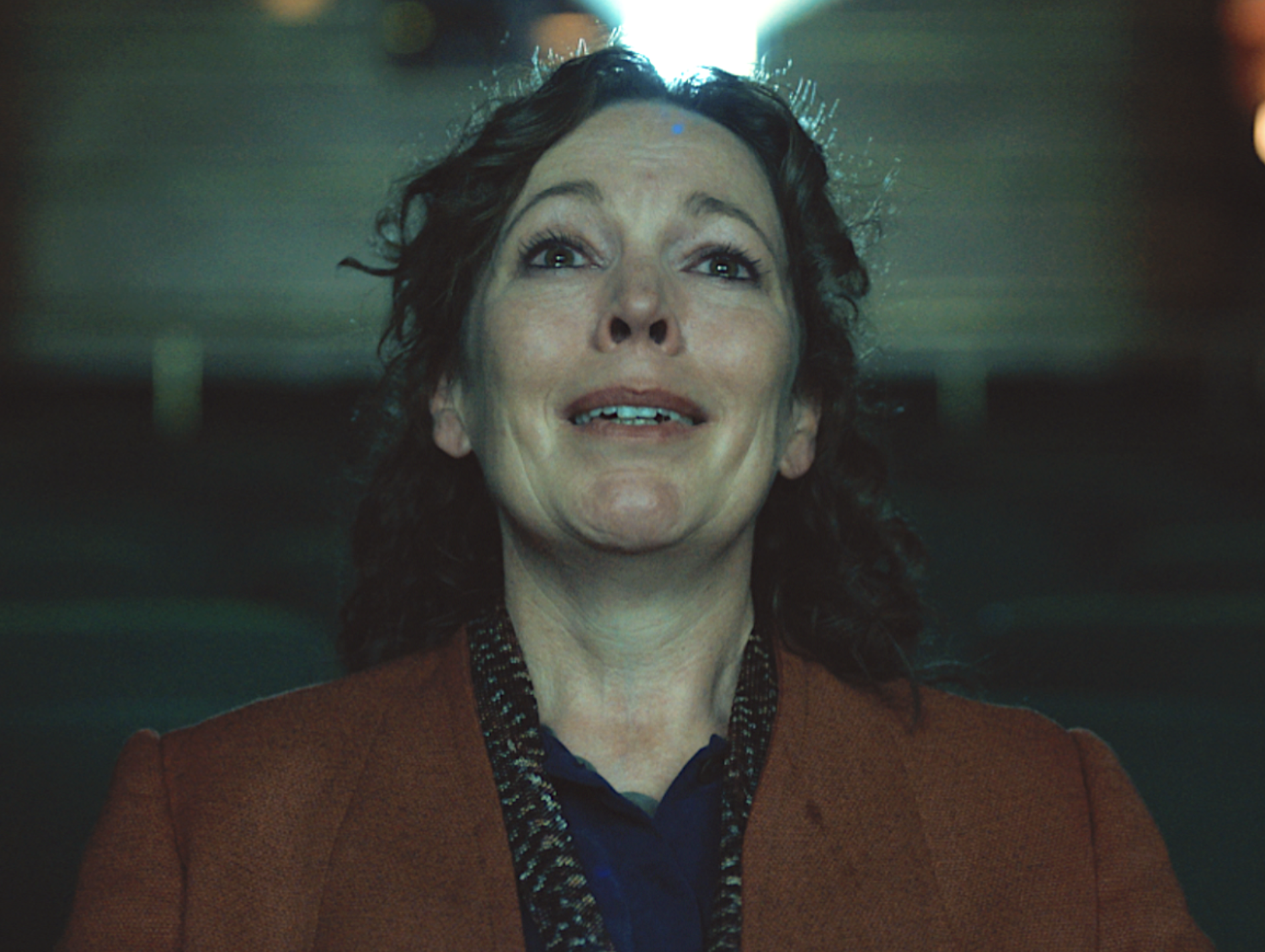
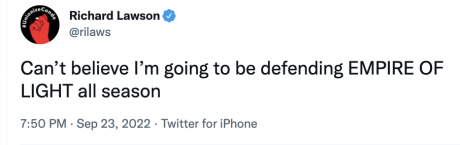
Once More With “Empire”

Yesterday I tried to elaborate upon my positive Telluride reaction to Sam MendesEmpire of Light (Searchlight, 12.9).  Toward the end of the comment thread Rosso Veneziano replied as follows:  “I respect your take but the general consensus is that the movie is bad. 58 on Metacritic, 47% on Rotten Tomatoes…and that means rotten. It’s not just critics at Telluride — the TIFF reviews were even worse.”

HE response:  You first have to remember that many if not most of the critical elite are not standing on the same terra firma as the rest of us.  In more ways than one they’re living on their own frilly planet.  Every consensus opinion that emanates from this bunch has to be filtered through this basic reality.  Most of them are not of this earth.

Trust me — they’re dismissing Empire of Light because they’re unable to buy the curious but ultimately poignant romantic bond between the two leads, played by Michael Ward and Olivia Colman.  (If Ward’s Stephen character was played by a non-POC, the reactions would be quite different.)  I myself was skeptical of this dynamic going in, but the fine writing, acting and overall period swoon effect, which is partly if not largely due to excellent production design plus Roger Deakins‘ handsome cinematography…all of this won me over.

Filmmakers are generally required to depict POCs with a paintbrush of presentism these days (i.e., presenting them according to contemporary sensibilities), and many critics, knowing this, will get all riled when a Black character is presented “incorrectly” within a period film. Many elite critics see themselves as white-knight figures whose task is to bestow dignity or even majesty upon characters of color.

Ward’s performance will never be criticized, of course, but there’s no dodging the fact that he’s a handsome actor of considerable poise and charisma playing a decades-old period character in a film written and directed by an older white man. (Not unlike Mahershala Ali in Green Book.)

And there’s a fascinating violent moment in this film, by the way, that I haven’t mentioned. Racist skinhead goons are lurking on the fringes of this story, and early on a few of them are taunting Stephen on a sidewalk, and one strikes him with a head slap. And what does Stephen do? He does the smart thing by ignoring the attacker as he continues to walk away. He knows these animals are looking for an excuse to beat him senseless, and he doesn’t give them that.

A violent moment such as this runs against the presentism aesthetic. A Black man of today would never ignore or cower from an attack of this nature if it was depicted in a present-tense film.  Our post-George Floyd mythology demands a greater measure of defiance and dignity.  And yet Mendes, adhering to the ugly reality of things in rural 1980 England as much as Paul Thomas Anderson’s Licorice Pizza was truthfully immersed in the Los Angeles culture of the ‘70s, does the stand-up thing.  I know that the instant I noticed Stephen’s reaction to the head slap, I went “wow…that’s unusual but then again that’s Mendes.”