Ben & Jerry’s Is The New Bud Light

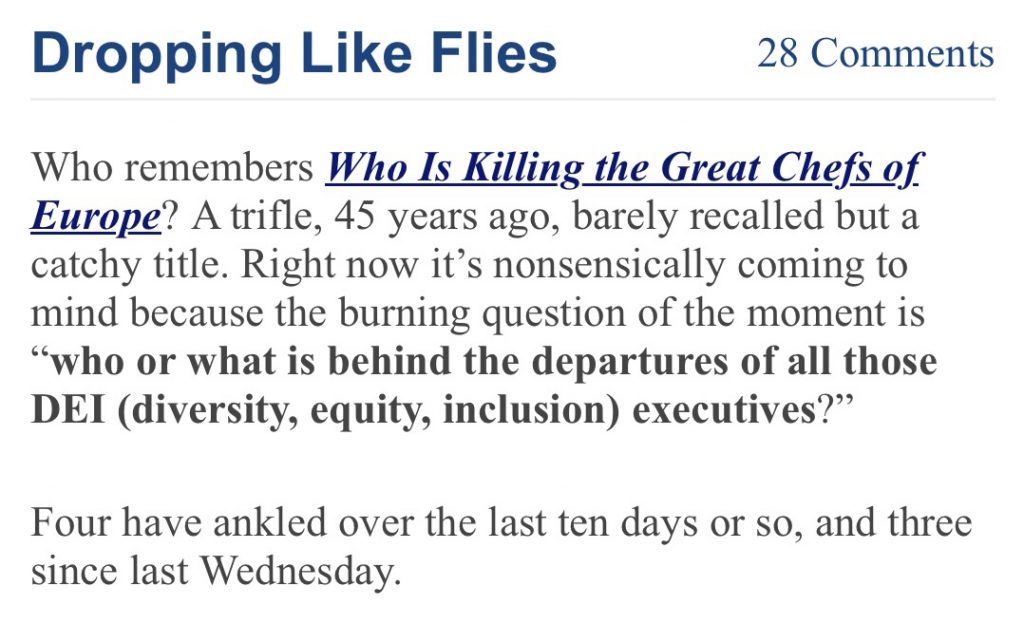
HE to Sensible Centrist Multitudes: There are many excellent choices if you want to buy great ice cream or gelato. You now understand which brand not to buy. Fuck these guys and the horse they rode in on. Ben & Jerry’s need to be Bud Light-ed to death.

Read more

Nutty Roman Bumper Cars

Few critics have angered me more over the years than David Ehrlich, but when he’s right, he’s right:

“The frantic and extremely funny mid-film chase through the streets of central Rome, during which Hunt is handcuffed to the sexy pickpocket (franchise newcomer Hayley Atwell) who might be able to lead him to the MacGuffin. A jaw-dropping ‘how the fuck did they do that?’ mega-flex in an age when movies are seldom magical enough to beg that question, the city-wide jailbreak combines artfully destructive slapstick with the loudest car crashes you’ve ever heard to create the kind of cinematic euphoria that still can’t be faked or forged at home. VR headsets might allow rich people to enjoy IMAX-sized screens on their living room couches, but Dead Reckoning is a bone-shaking reminder that sound is the real secret weapon of the theatrical experience.

“Not since La Dolce Vita has a film more effectively transformed ancient Rome into a modern playground, a fitting touch for a blockbuster so desperate to squeeze a few new dollops of joy from the ruins that surround it.”

Read more

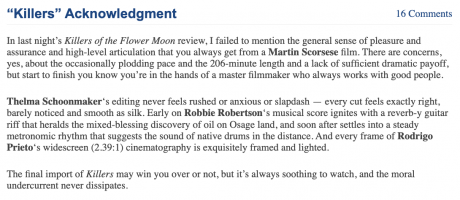
Excellent “Killers” Trailer

The emphasis on tribal chanting and drum beats tells you that Killers of the Flower Moon (Paramount, 10.6 and 10.23) is an angry lamenting thing…anger and outrage felt by increasing numbers of Osage natives in 1920s Oklahoma, and for good reason.

That’s not what Martin Scorsese‘s movie actually conveys — it presents more of a mixed-bag perspective (evil whiteys plus noble natives plus FBI investigators) — but it’s a very effective trailer. Hats off to the agency that cut it together.

After re-appearing at one or two of the early fall festivals, Killers of the Flower Moon will open select theaters on 10.6 before a wide release on 10.20.

It’s already been decided that Lily Gladstone‘s performance as Mollie Burkhart will not only be Oscar-nominated (I would recommend the Best Supporting Actress category) but will most likely win because of her Native American heritage. In terms of her actual performance Gladstone delivers sufficiently, although she isn’t allowed much in the way of emotional range and is given precious few lines. Mostly she stares a hole into the camera lens…quietly enraged, guilt-trippy, “God will get you,” etc.

Posted from Cannes on 5.20.23:

It pains me to report that Killers of the Flower Moon-wise, there’s a little bit of trouble in River City. Not a huge amount of trouble, mind. I was moderately and at times actively engrossed and l certainly wasn’t in any kind of pain but…

It holds and occasionally fascinates in a dutiful, believable, step-by-step fashion, and it certainly radiates profound moral lament and heartache for the many Osage victims, but overall it doesn’t quite get there.

It’s basically a bit more than two hours of scheming and murder and fiendish plotting between Robert De Niro’s “King Hale” and Leonardo DiCaprio’s Ernest Burkhart, and a bit less than 90 minutes of Jesse Plemons and his FBI team arriving in Oklahoma and getting to the bottom of it all — but at the end of the day Killers doesn’t really generate enough juice.

Killers is certainly watchable in a steady, methodical way, but it never really builds up a head of steam. Authentic period atmosphere (early to mid 1920s) and beautifully shot. It certainly feels real and lived in, but also lacking a certain fire in the belly quality — a bit too measured and matter of fact and low-flamey.

It’s a good film but it feels too quiet and subdued and even…no, I won’t say mezzo-mezzo. It holds your interest and never bores. But it never really excites either.

All I can say is thank God for Plemons and the G-Men, whose arrival kicks up the dramatic tension and delivers a certain limited gusto.

Cheers for sad-eyed Lily Gladstone (it’s definitely her movie — Native American actress wins acting Oscar!!) and a superbly suffering DiCaprio as the yokelish, none-too-bright, puffy-faced Burkhart — but the film is slowish and drawn-out and kinda plodding at times…obviously dialogue-driven but altogether rather quiet and far from any definition of incendiary. It never really combusts.

Was the 206-minute length really necessary? And was the massive budget really justified? Minus the stars and the enormous budget and visual sprawl it could have been a modest four-episode HBO movie that would earn respect…at least that. But with few jumping and shouting for joy.

Read more

Dystopian Vibes

When it opened on 12.25.06, Alfonso Cuaron‘s Children of Men (’06) was a dystopian foretelling of social breakdown and urban degeneration 21 years hence. The opening scene is captioned “16th November, 2027,” and the general London atmosphere (are we looking at Regent Street?) instantly tells us that this once-great city — once a nourishing spiritual watering hole for Charles Dickens, Benjamin Disraeli, Lytton Strachey, Virginia Woolf, Winston Churchill, Alfred Hitchcock, Tony Richardson and The Beatles — has become a bit bedraggled and third-worldish, air-polluted and populated with riff-raff…over-crowded, cacophonous and generally down-at-the-heels.

Not all of it (there are still pockets of order and tranquility with green-lawned parks and red-coated king’s guards marching along) but London is clearly edging toward some kind of ruffian, seen-better-days anarchy.

As we speak 11.16.27 is only four years hence or just around the corner, and I have to say that as I was walking east on 42nd Street last week in the mid-evening (following the AMC Empire all-media screening of Mission: Impossible — Dead Reckoning Part One) I was glancing at the overweight, sandal-wearing, presumably under-educated animals and feeling the general decay and lack of couth and even fraying civility and saying to myself “Jesus, this is almost like Children of Mennot classically dystopian in a Cormac McCarthy or Mad Max sense but drifting in that direction…even when 42nd Street was a grindhouse rathole in the ’60s it had a certain regimented order and aspirational vibe….no longer.”

Read more

Reminder to Cowards, Woke Douchebags

Initially posted on 9.19.21: As most HE readers know, I got “Scarlet Letter”-ed in March ’21 when Critics Choice honchos Joey Berlin and John DeSimio booted me out of their organization after being pressured by hysterical wokesters.

It all stemmed from my having posted a sentence written by someone other than myself — a statement which sat on HE for an hour or less before I took it down.

The sentence alluded to the Atlanta massage parlor killings (the victims of which were Asian woman, although Robert Aaron Long‘s motivation wasn’t racial as much as an “intersection of gender-based violence, misogyny and xenophobia,” according to state Rep. Bee Nguyen) and how this tragedy might have affected Oscar voter sentiments.

The sentence read as follows: “If there was one millionth of a chance in hell that Chloé Zhao and Nomadland weren’t going to win Oscars, the Atlanta massage parlor killings just snuffed out that chance.” Not my thought and or a view I believed in or cared about, but for one fleeting moment I thought “wow, that’s a hot-button statement that readers might want to kick around.” Throw him to the wolves!

Certain publicists who didn’t like me to begin with for my bluntly worded opinions seized upon the CCA eviction as an excuse to take me off their screening invite lists, etc. Six weeks ago I wrote Joey Berlin and John DeSimio a letter about this incident and gave them what-for.

Not long after the article appeared HE regular Bobby Peru posted the following:
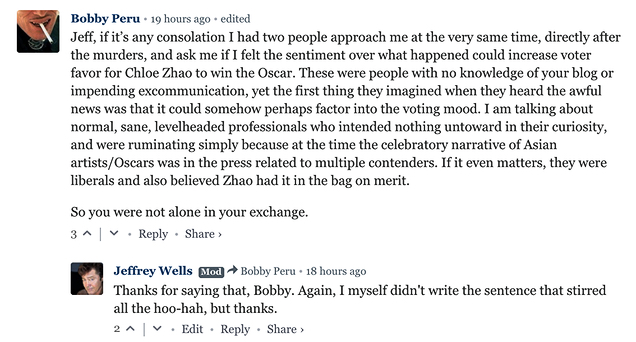
I’ve pointed this out before, but three similar incidents (tragic news affecting Oscar fortunes) happened within the last nine years.

1. In Boris Kachka’s 2.25.14 Vulture piece about Oscar bloggers (in which I was prominently covered), THR‘s Scott Feinberg was referenced doing the same thing.

Kachka: “Every controversy is quickly spun into the 24-hour Oscar cycle. A few short hours after Dylan Farrow renewed her molestation charges [against Woody Allen], there was Scott Feinberg, The Hollywood Reporter’s tireless columnist (and this year’s most accurate predictor so far) authoring a piece titled “Dylan Farrow’s Op-Ed Targets Woody Allen, But Could Hurt Cate Blanchett More (Analysis).”

2. Right after the Ferguson Grand Jury report came out on 11.25.14, I tweeted that a possible “strike a match rather than curse the darkness” response to this otherwise tragic event might be a surge of industry Best Picture support for Selma. Yup — another instance of the wrong HE tweet at the wrong time. But all I said was that symbolically lighting a candle rather than lamenting the ugliness might be a good thing in the end.

The Twitter community didn’t dig it. I was all but roasted alive for saying this. Many people tweeted that I sounded like an insensitive asshole. How dare I suggest, after all, that there was (or might be) linkage between Ferguson and Selma‘s Oscar chances.

But at heart I had tweeted a positive sentiment. I was thinking, you see, of Martin Luther King’s words about how only love can eradicate hate. I was thinking that standing by a film about human dignity, compassion and human rights would serve as a positive response to the Ferguson situation.
3. A couple of days later Selma director director Ava DuVernay pointed out a direct connection between her film and what had happened in Ferguson.

She did so in an Eric Kohn Indiewire interview with herself and Fruitvale Station director-writer Ryan Coogler, the main subject being their support of the Black Friday Blackout.

For me, the stand-out portion was when Kohn asked DuVernay if she saw “any direct connections between today’s climate in the immediate aftermath of Ferguson in the story of Selma.” DuVernay responded as follows: “Yes, absolutely. It’s the same story repeated. The same exact story.

“An unarmed black citizen is ‎assaulted with unreasonable force and fatal gunfire by a non-black person who is sworn to serve and protect them. A small town that is already fractured by unequal representation in local government and law enforcement begins to crack under the pressure. People of color, the oppressed, take to the street to make their voices heard. The powers that be seek to extinguish those voices.”

Feinberg, Kachka, DuVernay, Kohn…they saw a real-life tragedy in the real-news world, detected an Oscar-reflecting narrative and jumped right into it. And nobody said boo. I posted a real-lfe-tragedy-meets-Oscar-odds comment that someone else had written (and which I posted for a mere hour), and I was sent to the guillotine. If there was a God, my head would be seamlessly re-attached and others (many others) would be facing the kiss of steel in my place.

Awful, Catastrophic Career Turn

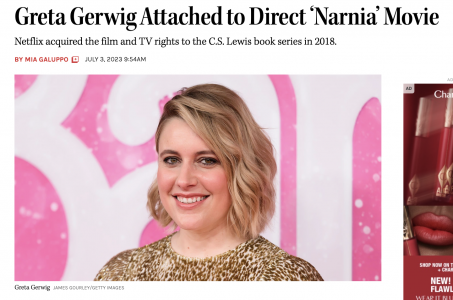
Friendo: I’m not saying that Greta Gerwig intending to make a Narnia movie necessarily suggests anything about the nature or character of Barbie.  But what are the odds that Barbie and her forthcoming Narnia film are completely and utterly unrelated?

A Failure I Will Never Forgive

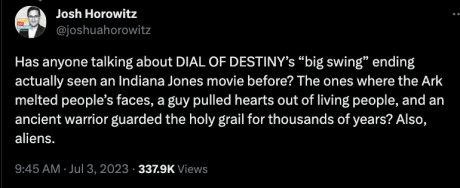
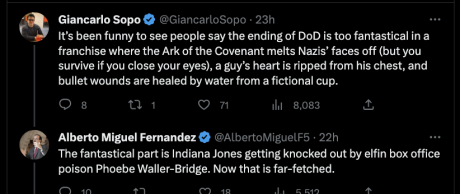
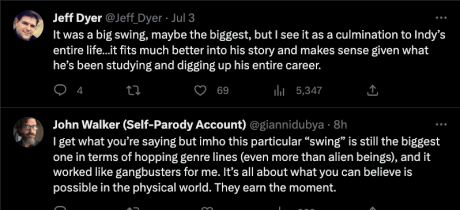
SPOILERS FOR SLUGS WHO LIVE UNDER ROCKS: I’m repeating myself as I often do, but now that everyone (and I mean everyone) in every continent on the globe has seen Indiana Jones and the Dial of Destiny, I need to again emphasize something important:

Failing to allow poor wounded Indiana Jones to remain in 212 B.C. Syracuse and in the glorious company of Archimedes was a huge mistake, as that would have been a perfect finale all around.

I wasn’t just disappointed about Phoebe Waller Bridge slugging Harrison Ford and somehow dragging him back to 1969 New York City, I was crestfallen. Hell, I was on the verge of tears — “They just blew a perfect ending!”

“Just Call Me Shame”

Posted on 12.2.11: Steve McQueen‘s Shame demands a spinach-eating looksee from all non-Eloi viewers, but hoowee, it’s a bucket of bleak.

Here’s my 9.5. Telluride Film Festival review: “Steve McQueen‘s Shame is a prolonged analysis piece that’s entirely about a malignancy — sex addiction — affecting the main character, and nothing about any chance at transcendence or way into the light.

Michael Fassbender plays a successful Manhattan guy with a sex-addiction issue. He’s into slamming ham like a vampire is into blood-drinking, minus any emotional intimacy whatsoever. And at the end of the day, all the film does is show you how damaged and deranged he is. The guy is lost, tangled, probably doomed.

Act One: Fassbender is one smooth, obsessive, fucked-up dude. Act Two: Fassbender really is a twisted piece of work, you bet. Act Three: Boy, is this guy a mess!

“This is what an art film does — it just stands its ground and refuses to do anything you might want it to do. But Shame has a point, delivered with a methodical intensity, that sinks into your bones. And part of the point is that suppressed memories of incest…I can’t do this.

“But Shame has integrity, and is one of those films, like A Dangerous Method, that you might not like as you watch it but you think about a lot in the hours and days and weeks afterwards.

“The sex scenes are grim and draining and even punishing in a presumably intentional way. Fassbender walks around with his dick hanging out and flopping against his upper thigh, and I suppose it ought to be acknowledged that he’s fairly well hung.

Carey Mulligan, who plays his effed-up sister, has (a) a longish nude scene in a shower and (b) a song-singing moment that goes on for three or four minutes.”

Chilly and clinical as it is, it’s all but impossible to not think about Shame, a lot, after it’s over. Failing to see it means hanging your head in shame the next time an intelligent film discussion occurs in your circle.

On 9.30 N.Y. Times critic Manohla Dargis called Shame “another example of British miserablism, if one that’s been transposed to New York and registers as a reconsideration of the late 1970s American cinema of sexual desperation (Looking for Mr. Goodbar, Hardcore, Cruising, etc.).”

From 11.10: “What if Michael Fassbender’s sex-addict character was called ‘Shame’? And if everyone called him that — all the girls he picks up, his sister (Carey Mulligan), his charmless boss at the office and so on? And what he if struck up a relationship with a 10 year-old kid who lives in his building, and what if the kid found out he was a sex addict and said, ‘I’m ashamed of you, Shame!'”

Read more

Grandson of Shame in the Lobby

Last posted on 7.10.20, originally posted on 12.8.06: “Not long ago, the Bagger was at a restaurant event with a major film writer and director and ended up in a booth with him for several hours. He admired the man tremendously, [but] did not like his last project. Finally, the subject came up and the Bagger told the truth, after which there was suddenly very little to say.

“Later, Carr asked an experienced colleague if he, Carr, had been wise to speak his mind. ‘No, that was profoundly stupid,’ he was told. ‘They really don’t want to know the truth.’” — from David Carr‘s “Ten Things I Don’t Hate About You, or At Least Your Movie,” also posted on 12.18.06.

“Carr’s friend was right, but I’ll never forget my initial reaction to Michael Bay‘s Armageddon after an Academy screening in June of 1998. It gave me a headache because of the machine-gun-like cutting. As Variety‘s Todd McCarthy famously said at the time, the pace felt like that of ‘a machine gun locked in the firing position.’ This over-accelerated editing, I was later told, was a result of a deliberate Michael Bay strategy of cutting out as many frames as possible in each scene order to make the film play as fast, hard and compressed as possible — i.e., ‘frame-fucked.’

“In any event, when I saw Bruckheimer in the lobby after the screening I did the usual chickenshit industry thing — I half-lied. I told Jerry that the film ‘rocked’ or felt like ‘rocket fuel.’ (Which wasn’t a total lie — it did feel like that, sort of.) As soon as I said this, however, Bruckheimer cocked his head and gave me a ‘look’. He knew I was snowing him, and I knew that he knew. I felt like a snivelling coward, possibly due to the fact that I was being precisely that. He didn’t look at me for the rest of the evening.

“I later shared this moment with a director friend, and he told me one of his own. A very big (one could use the word ‘legendary’) producer told him that an actress in a scene he was directing was ‘fucking smiling‘ too often, ‘just like fucking Tom Cruise…always smiling, always with the teeth. Tell her to cut it out.’ The director later spoke to the actress, who had seen him speaking with the big-name producer. ‘Did he say anything about me?’ she asked. The director replied, ‘He compared you to Tom Cruise.'”

Read more