HE sez…

“Listen, you fuckers, you screwheads…here is a man who would not take it anymore. A man who stood up against the scum, the cunts, the dogs, the filth, the shit. Here is a man who stood up. Here is…”
The Sun‘s Simon Boyle is reporting that Robert De Niro will reprise Travis Bickle in a currently lensing Uber ad campaign. De Niro will be riffing on the Bickle thing (“You talkin’ to me?”) in a series of spots being filmed in London this week. “He’s going to be Travis Bickle, saying some phrases and playing up to it,” etc.
First of all, Bickle died in that 1975 East Village shoot-out. As his soul hovered over the carnage Bickle dreamt that blowing away three guys (Harvey Keitel‘s “Sport,” that gray-haired asshole in the brown suit, that creepy-looking detective with the white shoes) had not only restored his life and made him into a hero (bullshit) but also persuaded Cybill Shepherd to find him attractive, but he’s dead so fucking forget it.
Secondly, even if Bickle had lived it would be meaningless to show him driving an Uber at 80 years of age. Complete bullshit.
However, if the Uber ads use the young Bickle of the mid ’70s…then we’d have something. Then all would be cool.
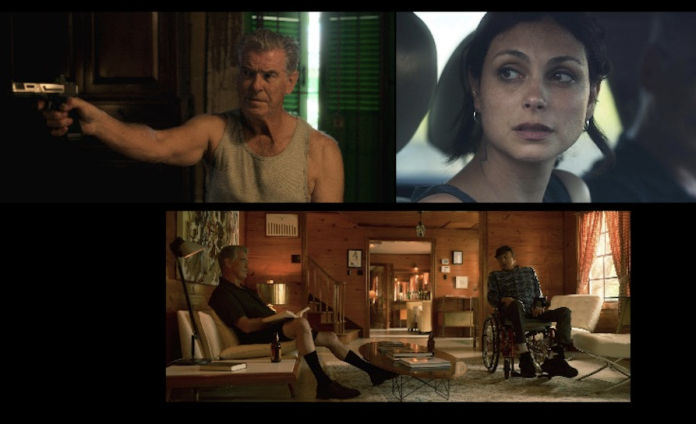
Phillip Noyce‘s Fast Charlie will have its big debut at the Mill Valley Film Festival debut on Saturday, 10.7. Screening invites and links have been received.
I became a fan after catching it at a buyer’s screening during last May’s Cannes Film Festival.
It’s half of a laid-back, settled-down relationship drama between Pierce Brosnan‘s Charlie, a civilized, soft-drawl hitman who loves fine cooking, and Morena Baccarin‘s Marcie, a taxidermist with a world-weary, Thelma Ritter-ish attitude about things. And half of a blam-blam action thriller.
There’s a suspense scene involving a hotel laundry chute that I’m especially taken with.
A trailer will hit in a month, or just after the MVFF debut.
Fleetly performed by Brosnan, Baccarin, Gbenga Akinnagbe and the late James Caan in his final performance, Fast Charlie is….ready?…a mature, unpretentious, character-driven, action-punctuated story of cunning and desire (not just romantic but epicurean) on the Mississippi bayou. Four adjectives plus gourmet servings.
The Brosnan-Baccarin thing reminds me of Robert Forster and Pam Grier in Jackie Brown. Sprinkled with a little Elmore Leonard dressing. One of those smooth older guy + middle-aged woman ease-and-compatibility deals.
Richard Wenk‘s screenplay, adapted from Victor Gischler‘s “Gun Monkeys,” is complemented by cinematography by Australian lenser Warwick Thornton (director of The New Boy).
Except for the red tint of the cars, of course. My understanding is that colored autos began to appear in the 1920s and 30s, but most pre-World War II autos were black or gray or brown or subdued green. Hardly any were red.
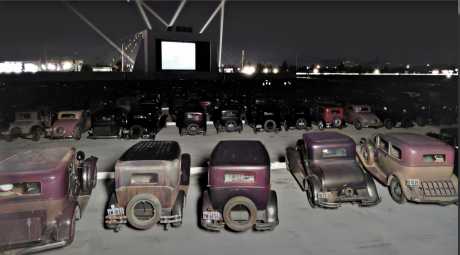
“Rhyme of the Ancient Drive-In,” posted on 8.16.20 (or four months into the agony of the pandemic):
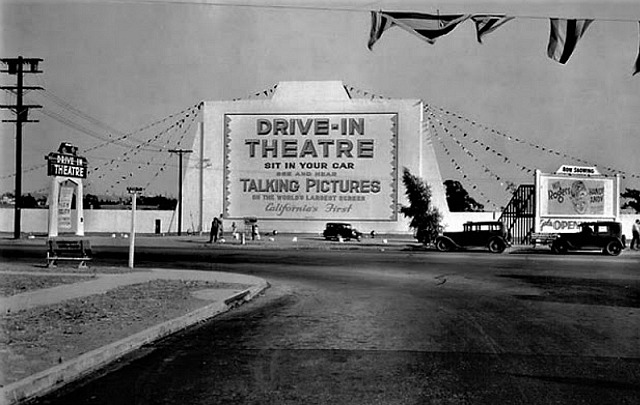
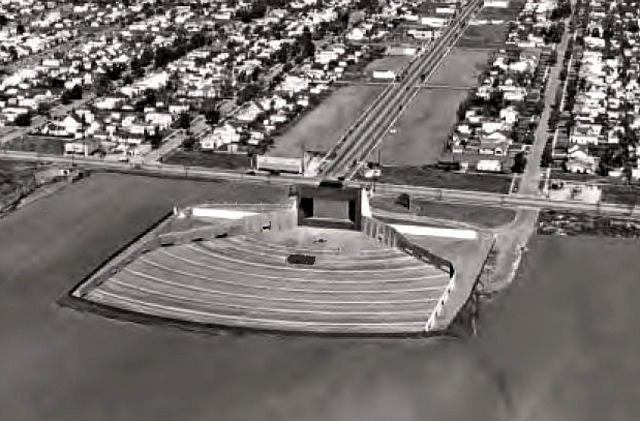
Yesterday (8.15) The Hollywood Reporter‘s Seth Abramovitch posted a piece about the old Pico Drive-In, which opened on 9.9.34 and could hold 487 cars. The very first California drive-in was located at 10860 Pico Blvd., which today is a big-ass Google building.
Between 1948 and ’85 the Google area was near where the old Picwood theatre stood. The Picwood address was 10872 W. Pico Boulevard, just wast of the Pico and Westwood Blvd. intersection.
The most interesting detail didn’t make it into Seth’s article: Westwood Blvd. dead-ended on Pico in 1934, and so the Pico drive-in was built on a dusty patch due south of Pico (or where the neighborhoody, tree-lined, south-of-Pico stretch of Westwood Blvd. now sits).
After the Pico Drive-in closed in 1944, the postcard screen tower was moved to the corner of Olympic Blvd. and Bundy to become part of the Olympic Drive-In, which stood until ’73.
All the above and below comes from losangelestheatres.blogspot.
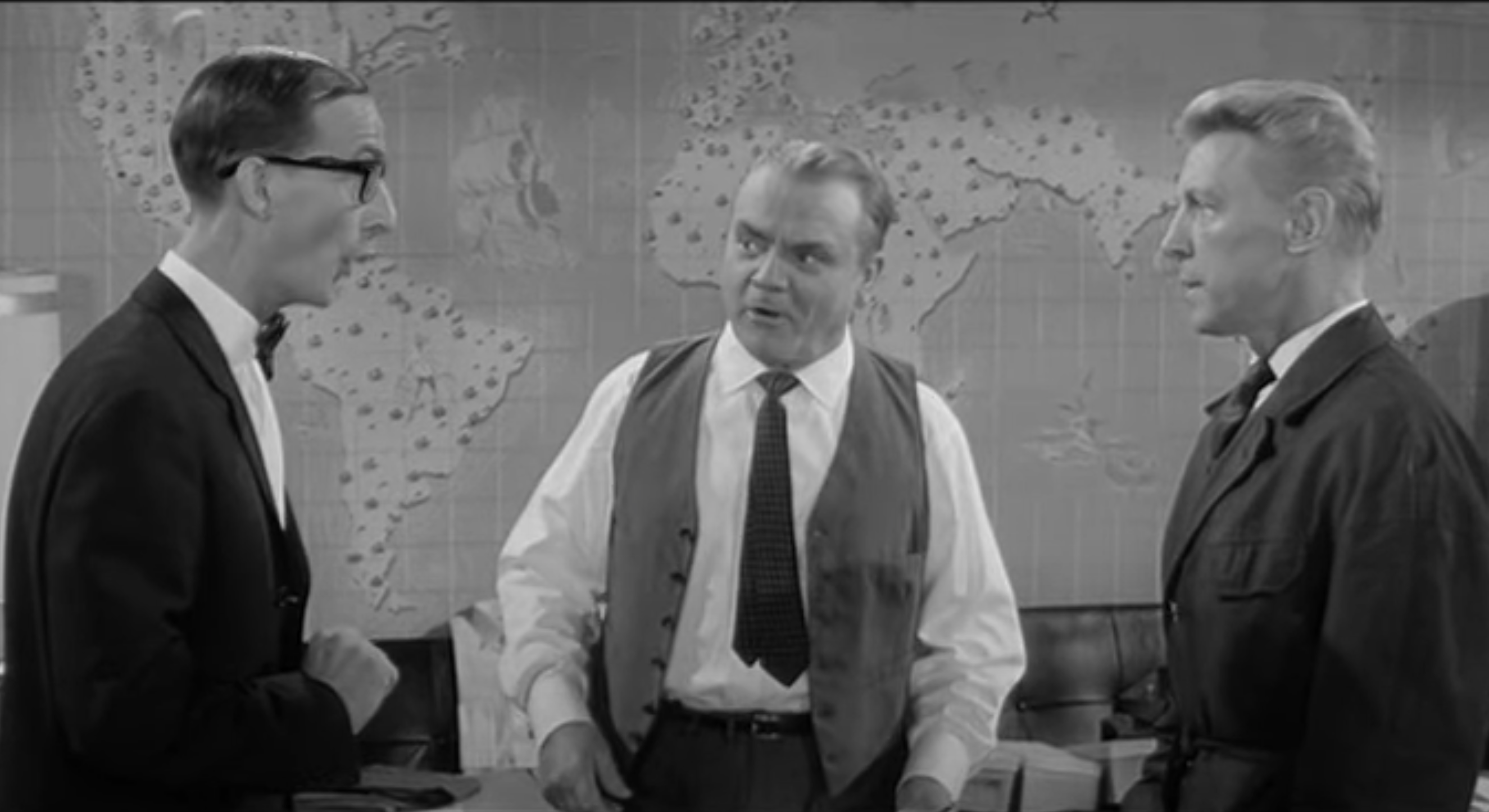
I’m sorry but every time I listen to the brief conversation between James Cagney‘s “C.R. MacNamara” (inspired by then-Defense Secretary Robert McNamara?) and the painter guy, I bust out chuckling. It happens between 2:12 and 2:19.
“We had to go with Cagney because Cagney was the whole picture. He really had the rhythm, and that was very good. It was not funny, but the speed was funny…the general idea was, let’s make the fastest picture in the world…and yeah, we did not wait, for once, for the big laughs. — One Two Three director-writer Billy Wilder talking to Cameron Crowe.