Herrmann’s music was only used, however, during the first season (10.2.59 through 7.1.60).
Herrmann’s haunting theme and layered orchestration was trashed and replaced with the start of The Twilight Zone‘s second season on 9.30.60 — the first episode was “King Nine Will Not Return”
The new theme, the plink-plink-plink-plink-plink-plink-plink-plink which I’ve never really approved of, was subcontracted by Lud Gluskin and composed by the Romanian-born, Paris-based Marius Constant.
The plink-plink was actually a blend of two Marius themes, “Milieu No. 2” and “Étrange No. 3,” that were spliced together.
Woody Allen‘s Celebrity (’98) was indifferently reviewed and proved a commercial bust ($12 million budget, $5.1 million in ticket sales). But at least it provided the last glimpses of the young (24) and slender and floppy-maned Leo, two years after Romeo + Juliet and immediately post-Titanic, and the 22- or 23-year-old Charlize Theron, post-Devil’s Advocate, pre-Mighty Joe Young (’98) and five years before her Oscar-winning turn in Monster (’03).
As HE reader “Mark” said a few years ago, “Leo’s last foray at being young, beautiful and still knowable, and Charlize fully in control of all her powers for the first time.”
Posted on 10.21.20: I admired several things about Celebrity. Sven Nykivst‘s beautiful black-and-white cinematography, of course. I occasionally felt amused and invigorated by Leonardo DiCaprio‘s manic superstar behavior (partly his character as written, partly drawing from his own post-Titanic popularity). Donald Trump‘s droll little cameo about tearing down St. Patrick’s Cathedral offers a decent chuckle. A lot of stuff works. Woody keeps trying and trying.
I was never bored and was somewhat taken with the flavor of Allen’s screenplay (i.e, forlorn acidity), and everyone loved the last shot. But otherwise Celebrity is less than masterful.
If only Woody had taken Kenneth Branagh aside before shooting and said, “You’ve obviously developed a half-decent imitation of my way of speaking — I respect that, it’s pretty good — but play this role as yourself. Use your own British accent. Playing me is too on the nose, critics won’t like it for that, and I wouldn’t blame them.”
This in itself would’ve improved things considerably.
The other problem is the deflating drift of the thing…the downswirl feeling, the repetitive moralizing, etc. Branagh’s Lee Simon could be wry and sharp and self-aware in a fleeting, in-and-out way, but it was clear within the first 20 or 30 minutes that he was also overly anxious, obsequious and stricken with a lack of self-awareness.
After a while you knew the film had no intention of doing anything more than making sure that Lee Simon wasn’t going to experience an epiphany of any kind…a breakthrough wasn’t in the cards
Todd McCarthy called the film “a once-over-lightly rehash of mostly stale Allen themes and motifs,” and noted that “the spectacle of Branagh and Judy Davis doing over-the-top Woody impersonations creates a neurotic energy meltdown…Branagh is simply embarrassing as he flails, stammers and gesticulates in a manner that suggests a direct imitation of Allen himself…Celebrity has a hastily conceived, patchwork feel that is occasionally leavened by some lively supporting turns and the presence of so many attractive people onscreen.”
By the way: The second syllable in Peter Biskind‘s last name is not, of course, pronounced like the second syllable in David Susskind‘s name.
Chris Walken‘s Scotland-born mother, Rosalie Walken (1907-2010), was born out of wedlock to Mary Burgess Russell, a domestic servant, and Joseph Egen, a leather merchant who eventually served a five-year sentence for receiving and re-selling stolen goods.
In 1932 or at age 25, Rosalie travelled alone from Glasgow to New York City. She married Paul Joseph Walken, who ran a bakery in Astoria, Queens. Chris was born in 1943, but out of shame or revulsion or whatever Risalie never told him about Egen, Chris’s biological grandfather.
Chris’s signature as an actor has always been a subtle blend of chilly, underlying malice and a touch or two of perversity. One presumes that at least some of the menace stuff was inherited to some degree from Joseph Egen.
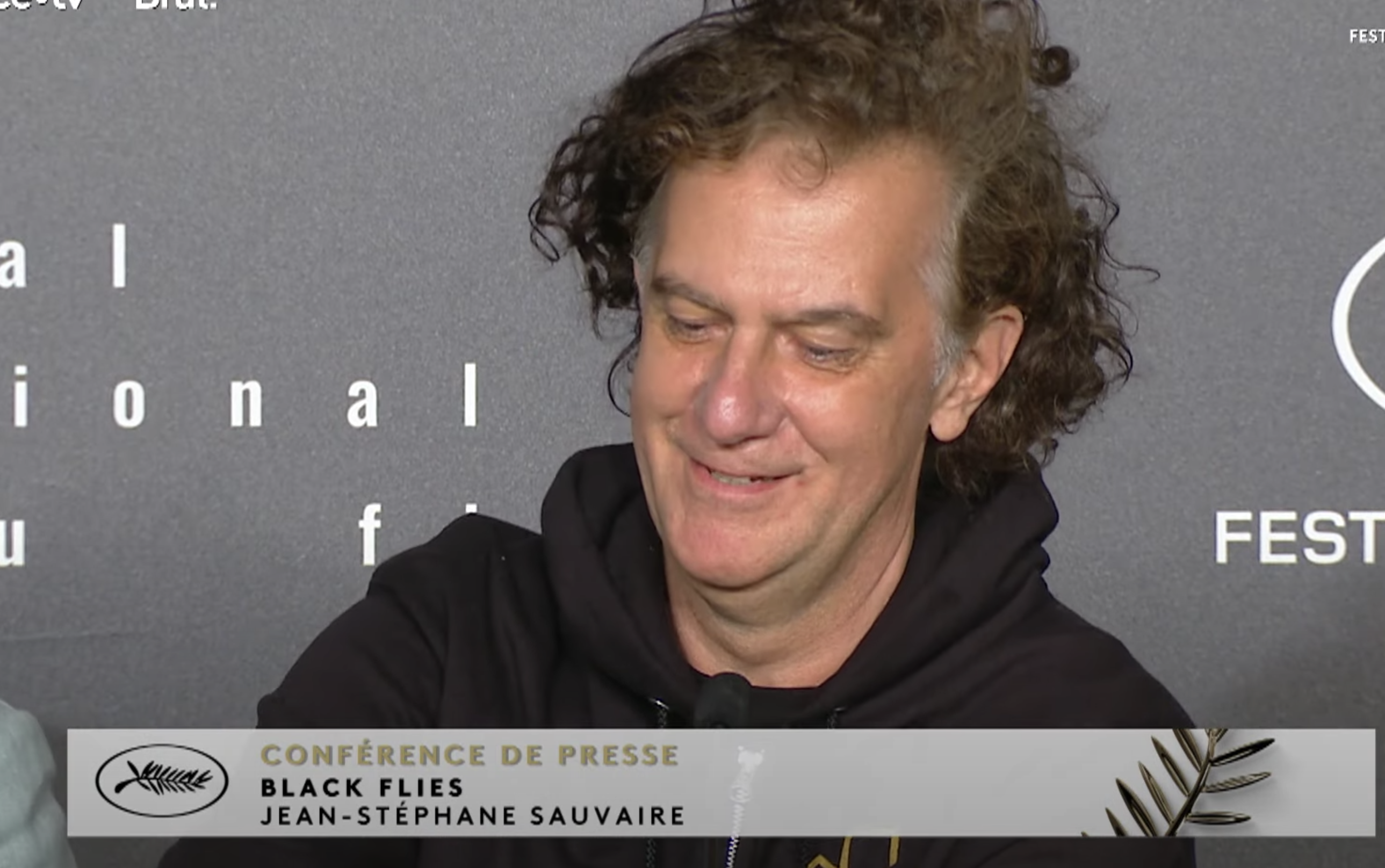
I’ve been wondering about the curious absence of Black Flies (Open Road, 11.30) since its 5.18.23 debut in Cannes.
It may not be a great, game-changing film or what any fair-minded viewer might call piercing or compassionate or startlingly original, but I for one decided right away that it’s a more absorbing dive into the lives of living-on-the-ragged-edge paramedics than Martin Scorsese‘s Bringing Out The Dead (’99).
Like it or not, this is my opinion and I’ve no intention of modifying or watering it down.
Based on a drawn-from-hard-experience 2008 novel of the same name by Shannon Burke, adapted by Ryan King and Ben Mac Brown and directed by Jean-Stéphane Sauvaire, Black Flies didn’t deserve a 47% Rotten Tomatoes rating.
It stars Sean Penn, Tye Sheridan, Katherine Waterston, Michael Pitt, Mike Tyson and Raquel Nave.
Dargis wasn’t alone. A significant percentage of Cannes critics ganged up on Black Flies due to what they saw as an overly unsympathetic view of Brooklyn’s primitive, ragged-edge underclass.
Film Verdict‘s Jay Weissbergaccused it of being “tone-deaf” and hampered by a “problematic treatment of immigrant communities and women.”
Translation: Some critics detected a certain callousness flecked with racism and sexism. I found that view simplistic and ridiculous.
HE verdict, posted on 5.19: “It beats the shit out of you, this film, but in a way that you can’t help but admire. It’s a tough sit but a very high-quality one. The traumatized soul of lower-depths Brooklyn and the sad, ferociously angry residents who’ve been badly damaged in ways I’d rather not describe has never felt more in-your-face.
“In terms of assaultive realism and gritty authenticity Black Flies matches any classic ’70s or ’80s New York City film you could mention…The French Connection, Serpico, Prince of the City, Q & A, Good Time, Across 110th Street.
“And what an acting triumph for Sean Penn, who plays the caring but worn-down and throughly haunted Gene Rutkovsky, a veteran paramedic who bonds with and brings along Tye Sheridan‘s Ollie Cross, a shaken-up Colorado native who lives in a shitty Chinatown studio and is trying to get into medical school.
“Rutkovsky is a great hardboiled character, and Penn has certainly taken the bull by the horns and delivered his finest performance since his Oscar-winning turns in Mystic River (’03) and Milk (’08).
“And Sheridan is also damn good in this, his best film ever. His character eats more trauma and anxiety and suffers more spiritual discomfort than any rookie paramedic deserves, and you can absolutely feel everything that’s churning around inside the poor guy.
“At first I thought this 120-minute film would be Bringing Out The Dead, Part 2, but Black Flies, which moves like an express A train and feels more like 90 minutes, struck me as harder and punchier than that 1999 Martin Scorsese film, which I didn’t like all that much after catching it 23 and 1/2 years ago and which I’ve never rewatched.
Here are HE’s finest films of the first eight and 1/3 months of ’23 — post-Telluride and Venice, less than four months to go.
As before, a special demerit system applies in the case of otherwise commendable, first-rate films that delivered (a) manosphere pissnado or (b) caused my soul and knees to ache due to slow pacing and density of dialogue.
1. Alexander Payne‘s The Holdovers (a ’70s character-driven thing, yes, but an absolutely first-rate resuscitation of this type of film)
2. Tran Anh Hung’s The Pot-au-Feu (aka Tbe Taste of Things)
3. Yorgos Lanthimos‘ Poor Things (rousing nutter filmmaking…bawdy, nervy, wildly imaginative and yet a tad over-praised at Venice and Telluride due to the hothouse atmosphere of those two gatherings)
4. Guy Ritchie‘s The Covenant
5. Christian Mungiu‘s RMN
6. Eric Gravel‘s Full Time
7. Chris Nolan‘s Oppenheimer — first-rate film but I groaned at the one-hour mark, knowing there were two full hours to go…my soul softly wept.
8. Greta Gerwig‘s Barbie [manosphere pissnado demerit]
9. Cruise & McQuarrie‘s Mission: Impossible — Dead Reckoning, Part One
10. Errol Morris‘s The Pigeon Tunnel (richly visual, beautifully scored doc about John le Carre…enveloping and rather dazzling)
11. Martin Scorsese‘s Killers of the Flower Moon
12. Matt Johnson‘s Blackberry
13. Ari Aster‘s Beau Is Afraid
14. Jonathan Glazer‘s The Zone of Interest
15 Ilker Çatak’s The Teacher’s Lounge (official German submission for Best Int’l feature).
16. Ben Affleck‘s Air
17. Aki Kaurismäki‘s Fallen Leaves (Chaplinesque, slightly glum relationship comedy-drama..quietly touching performances from costars Alma Pöysti and Jussi Vatanen)
17. Celine Song‘s Past Lives
18. Jean-Stephen Sauvaire’s Black Flies.
19. Steven Soderbergh‘s Magic Mike’s Last Dance
20. Nicole Holofcener‘s You Hurt My Feelings
The more I read about Christy Hall‘s Daddio, the sorrier I am that I ducked it in Telluride. I was especially persuaded by Todd McCarthy’s Deadline review. I’m very much looking forward to the next viewing opportunity.
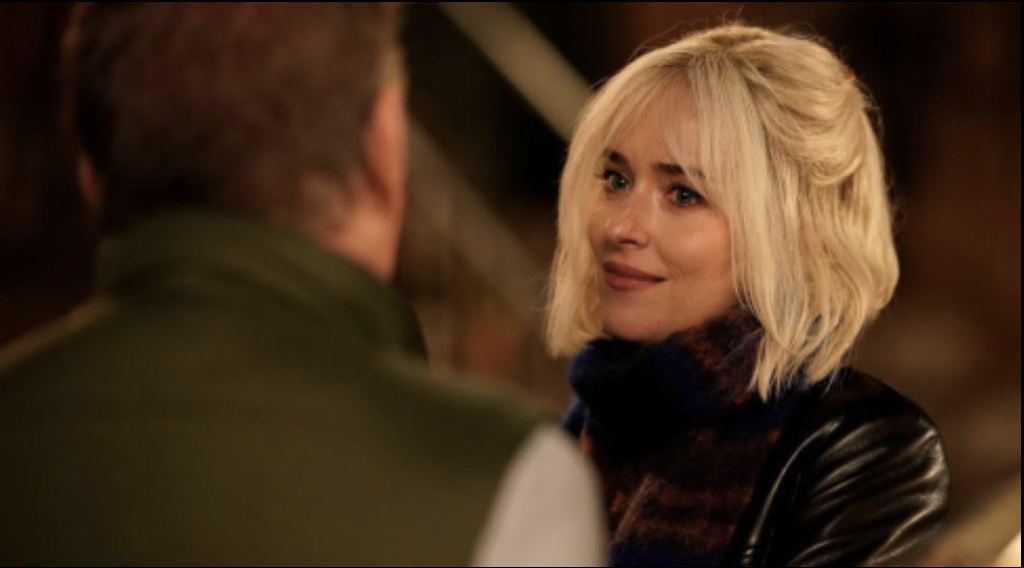
Pic is a two-hander about a grizzled New York City cab driver named Clark (Sean Penn) covering the verbal and cultural waterfront with his blonde 30something passenger (Dakota Johnson).
I should admit there was a specific reason why I didn’t see Daddio last week. It was because of the dopey Millennial spelling. If it had been spelled right I would have gone in a heartbeat.
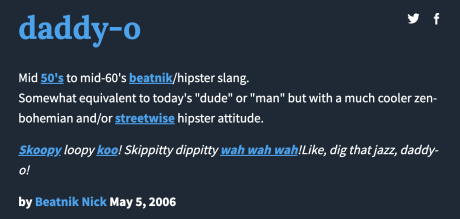
Daddy-o is a beatnik anachronism. The root term (duhh) is “daddy” with a “y”. Daddio is for dingleberries.
Among the leather jacket-wearing, Marlon Brando wannabe set in the 1950s “hey, dad” was a term of respectful affection…a cool familiarism.
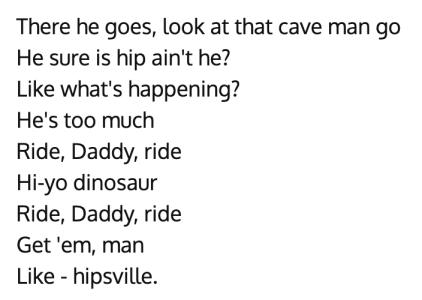
In the 1960 jukebox tune “Alley Oop” (written in ’57, released in ’60) the phrase “king of the jungle jive” is rhymed with “ride daddy ride.”
In Brando’s One-Eyed Jacks (’61) Karl Malden‘s character is named “Dad” Longworth — a nickname that ignores western culture in deference to ’50s be-bop sensibilities.
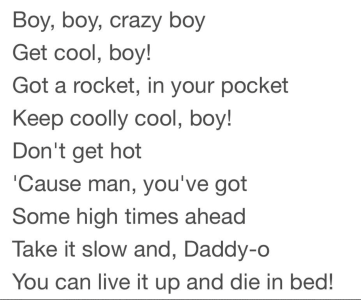
In Stephen Sondheim‘s lyrics for “Cool,” the West Side Story song, it’s spelled “daddy-o”
In the real-deal world of rebellious Rebel Without A Cause-era attitudes, there were never any “daddios.” It was daddy-o or nothing.
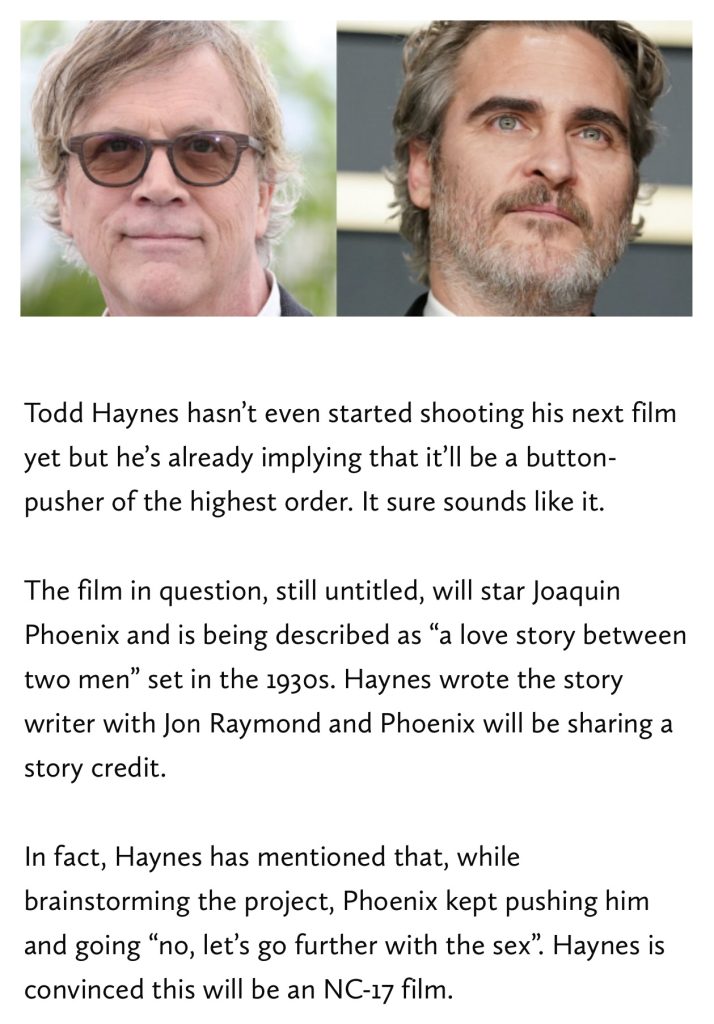
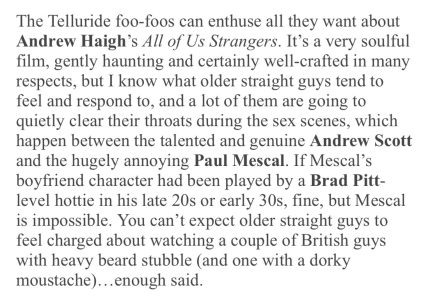
My recent Telluride viewing of Andrew Haigh’s AllOfUsStrangers reminded me that I really, really don’t want to be subjected to explicit gay-male sex scenes, especially if they involve older guys with beard stubble. And double-triple especially if they involve JoaquinPhoenix…pushing 50, paunchy, salt-and-pepper, etc.
I wouldn’t want to watch Phoenix having sex with a woman either. Please.
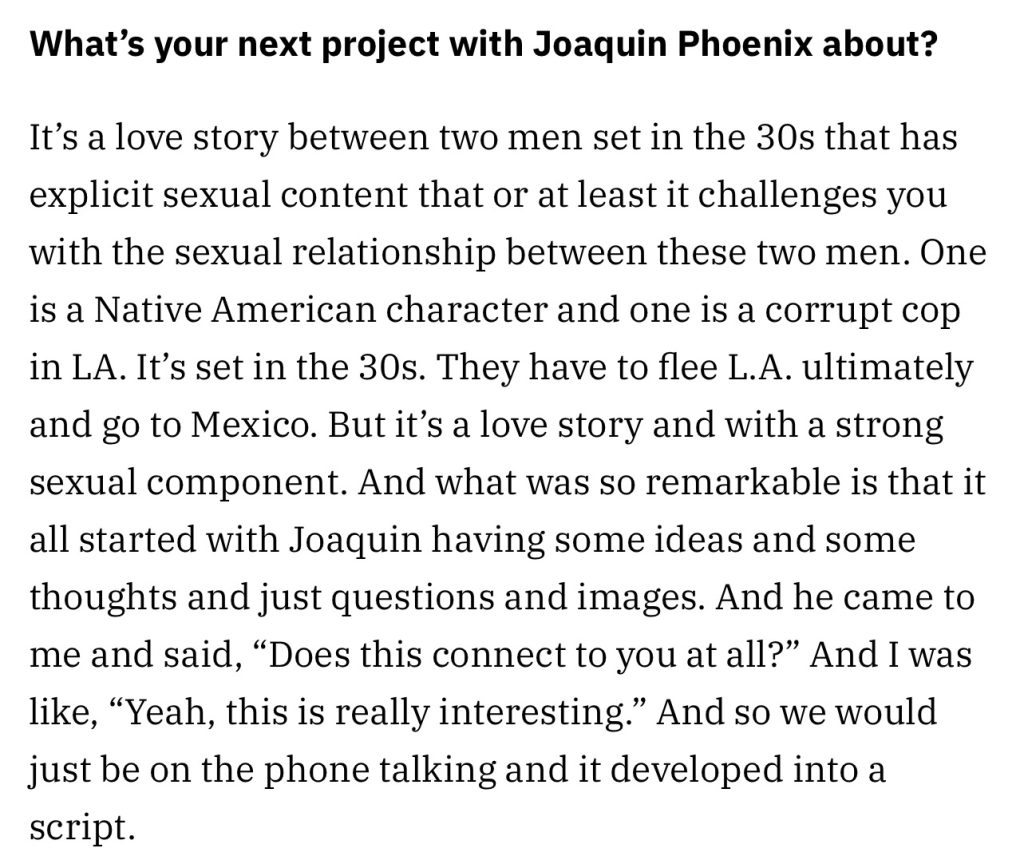
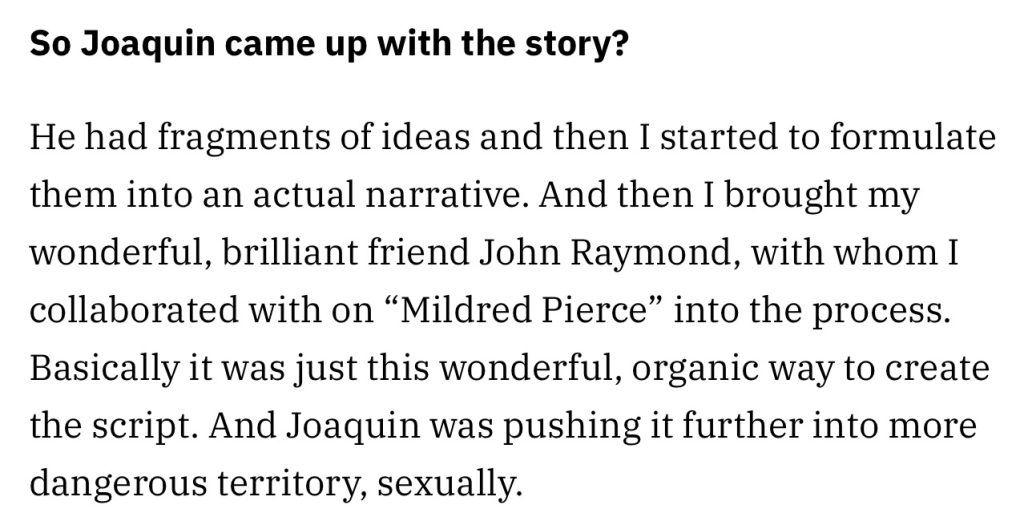
Todd Haynes has toldVariety’s ElsaKeslassy that his next film will be a 1930s-era gay love story starring Phoenix and a not-yet–cast younger guy, and that it will feature “explicit” or otherwise “challenging” sex scenes, and that during their discussions Phoenix had been “pushing it further into more dangerousterritory, sexually.”
What the hell would “dangerous territory” mean? I could speculate but let’s not.
Compromise: Back in the 1950s and ‘60s producers used to shoot two versions of sex scenes — tamer, less graphic ones for the U.S. market plus racier, more explicit versions for Europeans. What about Haynes and Phoenix shooting explicit sex scenes for those who are game plus straight-friendly versions intheveinof CallMeByYourName or Brokeback Mountain for fraidy cats like myself?
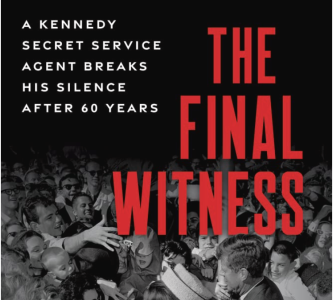
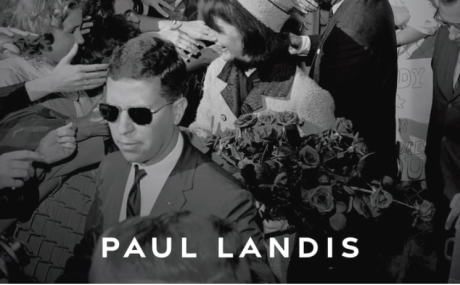
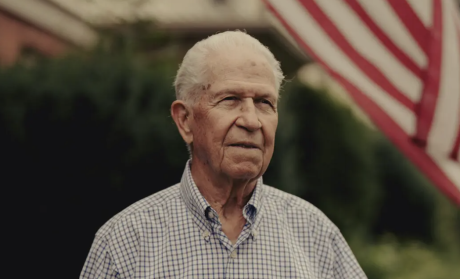
“Paul Landis was a twenty-eight-year-old Secret Service agent in President Kennedy’s Dallas motorcade on November 22, 1963. Though he was a witness to the events that day, he was never interviewed by the Warren Commission, and has kept his recollections private until now, including details surrounding a key piece of evidence.” — copy on Amazon page for Landis’s “Final Witness” (Chicago Review Press, 10.10.23).
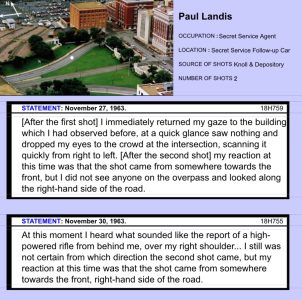
If you know anything about the JFK assassination and the Warren Commission Report, you know about the magic bullet theory. A Sept. 9th N.Y. Times article by Peter Baker summarizes a startling recollection from Landis — one that strongly challenges this long-questionable assertion. Here are the key paragraphs:
“What it [all] comes down to is a copper-jacketed 6.5-millimeter projectile.
“The Warren Commission decided that one of the bullets fired that day struck the president from behind, exited from the front of his throat and continued on to hit Texas governor John Connally, somehow managing to injure his back, chest, wrist and thigh. It seemed incredible that a single bullet could do all that, so skeptics called it the magic bullet theory.
“Investigators came to that conclusion partly because the bullet was found on a stretcher believed to have held Mr. Connally at Parkland Memorial Hospital, so they assumed it had exited his body during efforts to save his life. But Mr. Landis, who was never interviewed by the Warren Commission, said that is not what happened.
“In fact, he said, he was the one who found the bullet — and he found it not in the hospital near Mr. Connally but in the presidential limousine lodged in the back of the seat behind where Kennedy was sitting.
“When he spotted the bullet after the motorcade arrived at the hospital, he said he grabbed it to thwart souvenir hunters. Then, for reasons that still seem fuzzy even to him, he said he entered the hospital and placed it next to Kennedy on the president’s stretcher, assuming it could somehow help doctors figure out what happened. At some point, he now guesses, the stretchers must have been pushed together and the bullet was shaken from one to another.
“’There was nobody there to secure the scene, and that was a big, big bother to me,’ Mr. Landis said. ‘All the agents that were there were focused on the president.’ A crowd was gathering. ‘This was all going on so quickly. And I was just afraid that….it was a piece of evidence, that I realized right away. Very important. And I didn’t want it to disappear or get lost. So it was, ‘Paul, you’ve got to make a decision,’ and I grabbed it.’”
“Mr. Landis theorizes that the bullet struck Kennedy in the back but for some reason was undercharged and did not penetrate deeply, therefore popping back out before the president’s body was removed from the limousine.”
“Mr. Landis has been reluctant to speculate on the larger implications. He always believed that Lee Harvey Oswald was the lone gunman.
“But now? ‘At this point, I’m beginning to doubt myself,’ he said. ‘Now I begin to wonder.’ That is as far as he is willing to go.”
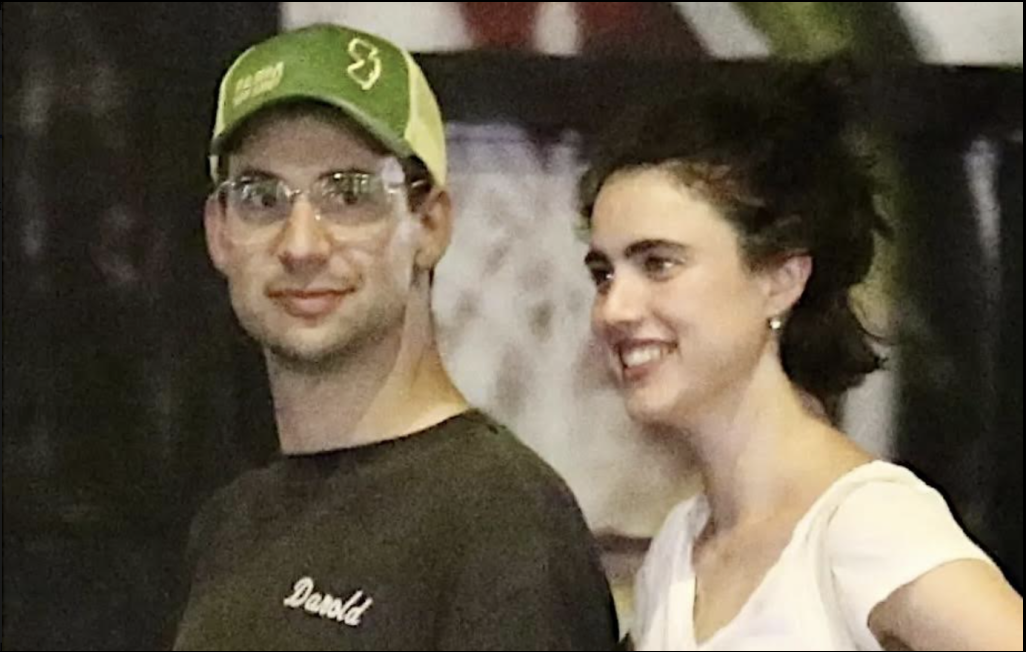
I’m trying to imagine being Jack Antonoff, a wealthy, super-successful, top-of-the-world, Grammy Award-winning musician and record producer (not to mention a highly valued Taylor Swift and Lorde collaborator and a recently betrothed husband of Margaret Qualley)…I’m trying to imagine having so much of the world figured out and having audaciously influenced contempo pop music over the last decade or so…
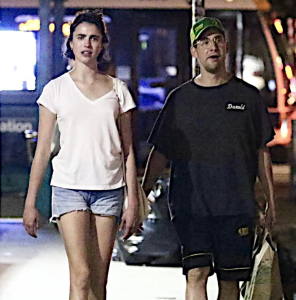
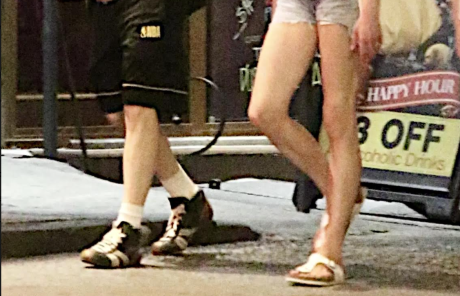
I’m trying to imagine being Antonoff in his bedroom and deliberately choosing to wear a standard low-rent basketball bruh outfit (baggy NBA-brand shorts, black Darold T-shirt, shamrock green cap, sneakers and white socks) and thereafter walking out onto the streets of New York City on his way to Whole Foods and saying “yeah, no sweat, of course.”
Rich or poor, ugly or handsome, famous or obscure, I wouldn’t wear this kind of low-rent outfit with a knife at my back. Goons could hold me down on the bedroom floor and say “wear this crap or you’re dead” and I’d snarl and say “go fuck yourselves”…and yet guys like Antonoff are like “yeah, man…this kind of sartorial signature really does it for me…blends with who I am, what I feel deep down”… imagine Cary Grant weeping in heaven…even the ghost of James Dean would say “the fuck?”
Something in me doesn’t trust Shawn Levy‘s All The Light We Cannot See (Netflix, 11.2), a limited series based on a 2014 novel by Anthony Doerr. I don’t trust the concept of using a young blind girl as the main protagonist — it feels a bit cloying and manipulative. Especially with an actual limited-sight girl playing the role.
The stain of Naziism can never be erased, of course, but at the same time a voice is telling me that relatively few in this day and age are willing to see it for what it was. I don’t get the feeling that Levy and his creative collaborators have really grappled with the roots of what happened in Germany in the 1920s and ’30s.
The teaser for Levy’s film feels too 21st Century…too morally smug and self-righteous. As if to say “if we had been living in Germany back then we would have known better…we would have stood up and refused.”
“Shameful Heritage“, posted on 10.26.20: Almost every day I get scolded and shat upon. An opinion or confession that would barely raise an eyebrow in private conversation a week or a decade ago will often as not get you lynched today. Such is the fate of semi-honest fellows in this wonderful wokester age we’re living through.
A couple of days ago I mentioned that I was grateful for my health (i.e., my body’s ability to rebuff infections), which I’d been told all my life by my mom was due to “strong German genes.” I should have said strong family genes but mom always said they principally came from her German-descended dad and German-immigrant granddad. This, of course, led to some branding me as an Aryan supremacist. So I posted the following to address this:
There’s no ignoring the horrid legacy and cultural associations between early to mid 20th Century Germany and horrific Nazi genocide. The stain was embedded 80-odd years ago, and will never be forgotten. Nor should it be.
My mother was filled with such revulsion by what happened between 1920 and ‘45 that she never once visited Germany her entire life.
That said, Germany is a rich and stirring culture (the beers, the cuisine, the desserts, the singing in the pubs, the historic operas, the architecture, the medieval remnants in Rothenburg) and the people I’ve met and dealt with there are as recognizably human as anyone or anywhere else.
The horror of Naziism and the Holocaust is a lasting national disgrace, and yet in a certain progressive sense it’s been scrubbed clean and built upon. It’s also been acknowledged all over in Germany — officially atoned for from the top down. There are memorials, moral messages and reminders all over Berlin, for example. There’s a huge Holocaust memorial right smack dab in the center.
In 2012 the boys and I visited Dachau, which is northwest of Munich and only a 20-minute train ride away. Talk about a lingering after-vibe.
Does anyone expect that any kind of similar atonements will happen here in the wake of the Trump administration? That some kind of institutional recognition of our ghastly racist history will be built? Don’t hold your breath.
All to say there’s nothing inherently evil or odious about being partly descended from Germans. Just as no one is saying there’s something inherently evil or odious about J.D. Vance having grown up in a small MAGA community in southern Ohio.
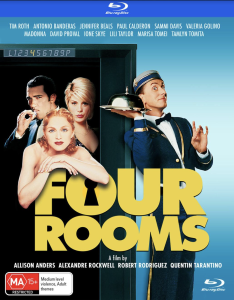
I was extremely disappointed when I saw Four Rooms, a ’90s hipster anthology comedy that opened 28 and 1/3 years ago (12.25.95). It consisted of four episodes directed by four directors — Allison Anders, Alexandre Rockwell, Robert Rodriguez and Quentin Tarantino. Tim Roth‘s performance as Ted the bellboy provided the narrative follow-through and connective tissue.
Tarantino’s episode was titled “The Man From Hollywood” — very twisted and perverse but not especially funny. It was based upon Roald Dahl‘s “Man From The South” and more particularly a 1960 Alfred Hitchcock Presents episode costarring Steve McQueen, Neilie Adams (who had married McQueen in ’56) and Peter Lorre.
L.M. Kit Carson passed me the Four Rooms script before it began shooting, and I was floored by some of it. I was convinced that it would almost certainly work as a hip black comedy. Carson and I visited the Raleigh Studios set during filming (in either late ’94 or early ’95). Slender Quentin was there, quietly strolling around. I saw it once in late November or early December of ’95, and whoo boy…that was the last time.