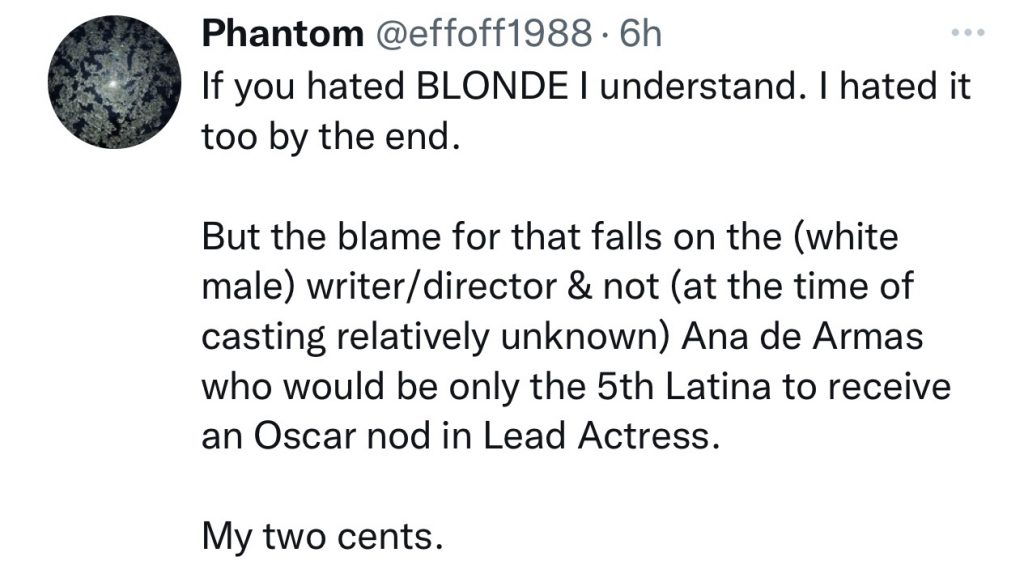
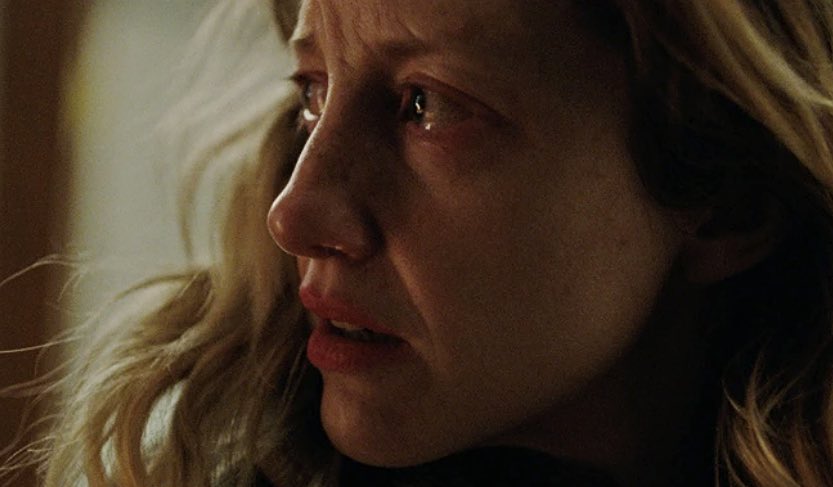
Riseborough Campaign Is Approvable But…

I’m also scratching my head about the seemingly scripted Andrea Riseborough Best Actress campaign for her performance in To Leslie. Her performance as an all-but-hopeless drunk who takes forever to hit bottom is…well, the first term that comes to mind is “whew!” Yes, she’s raw, real, scalding — you can’t help but say “wow, Andrea really went for it…I mean, she doesn’t care if the audience likes her character or not.”

Except an actor isn’t going to get Oscar-nominated just for craft and honesty alone. He/she has to deliver a performance that has at least some degree of empathy. If you’re playing a drunk the audience has to be able to least tolerate the character in question. There has to be, you know, a certain palatable sadness or sympathy factor or dark charm.

For the first hour of To Leslie, Riseborough — an excellent actress — is so committed to the psychology of a pathetic, lying, disreputable drunk that you can’t stand her. Or at least I couldn’t. She’s “great”, yes, but Jesus, man…

And She Drinks A Little,” posted on 3.20.22 — an ironic date for me as I embraced sobriety exactly ten years earlier (3.20.12).

Having dealt with an alcoholic dad and coped with my own boozing issues until I embraced sobriety on 3.20.12, I’m not especially interested in films about alcoholics. Even without that history movies about drunks have always seemed more or less the same to me.

In Michael Morris‘s To Leslie, which recently screened at South by Southwest, Andrea Riseborough plays the 40ish Leslie, an all-but-hopeless drunk who’s nothing but rat poison to everyone she’s ever known or been close to, including her son.

The first 50 minutes or so are pure hell to get through, and then Leslie finally falls in with a couple of low-rent guys who run a 2nd-class motel. One of them, an amiable, low-key dude named Sweeney, is played by Marc Maron, and right away you’re asking yourself “is Sweeney a fucking idiot? Why has he offered Leslie a job as the motel’s maid? Why did he give her a chance? She’s obviously a lost cause and nothing but trouble.”

But he gives her a chance anyway, and after another relapse or two Leslie finally pulls out of the long downward spiral. But there’s so much ugliness in this film. I mean it’s really and truly awful.

Remember the opening scene in Bruce Beresford‘s Tender Mercies (’83), when Robert Duvall‘s Mac Sledge, a semi-retired country singer, is shouting and slugging someone and generally behaving like an abusive drunk? The ugly happens in one brief scene, and then Mac is on the mend for the rest of the film. But in To Leslie, Riseborough does the ugly for a whole damn hour before she starts to self-reflect and turn a corner. It struck me as too much to bear.

Riseborough’s performance is raw and scalding and frankly dispiriting. I believed her in every scene, but I also wanted to see her get hit by a truck. I didn’t believe Maron — I thought he was just laying on the charm with a shitkicker accent. But high marks for the other costars — Allison Janney, Andre Royo, Stephen Root, Owen Teague, etc.
Cat’s Cradle

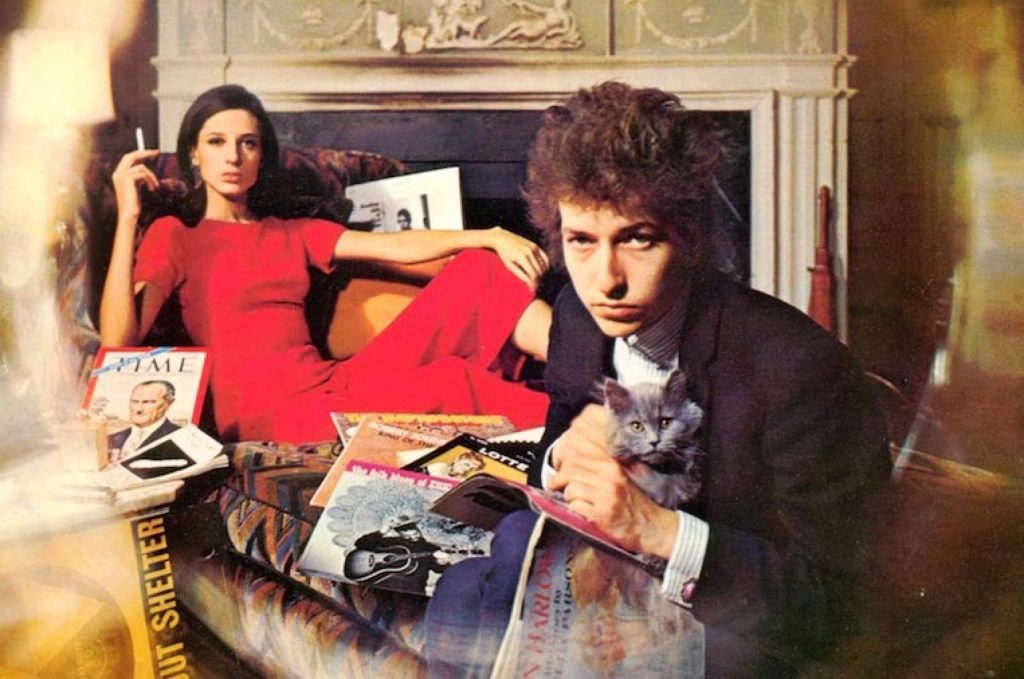
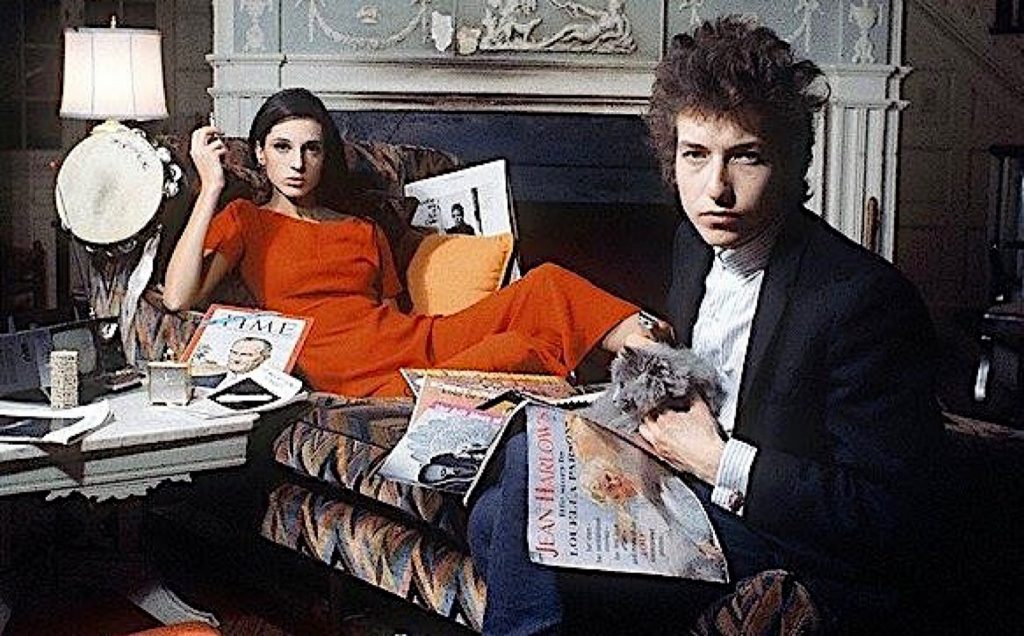
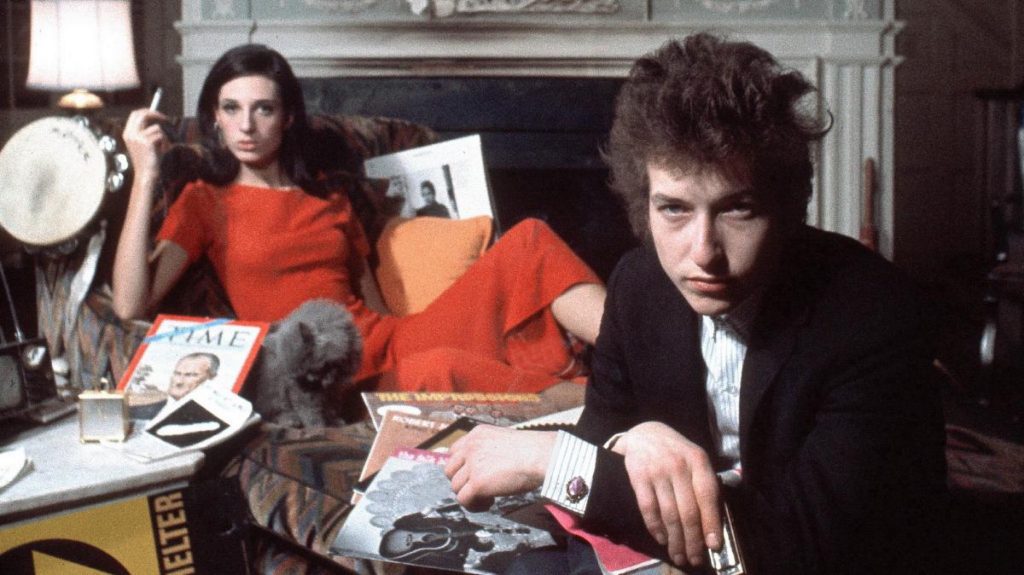
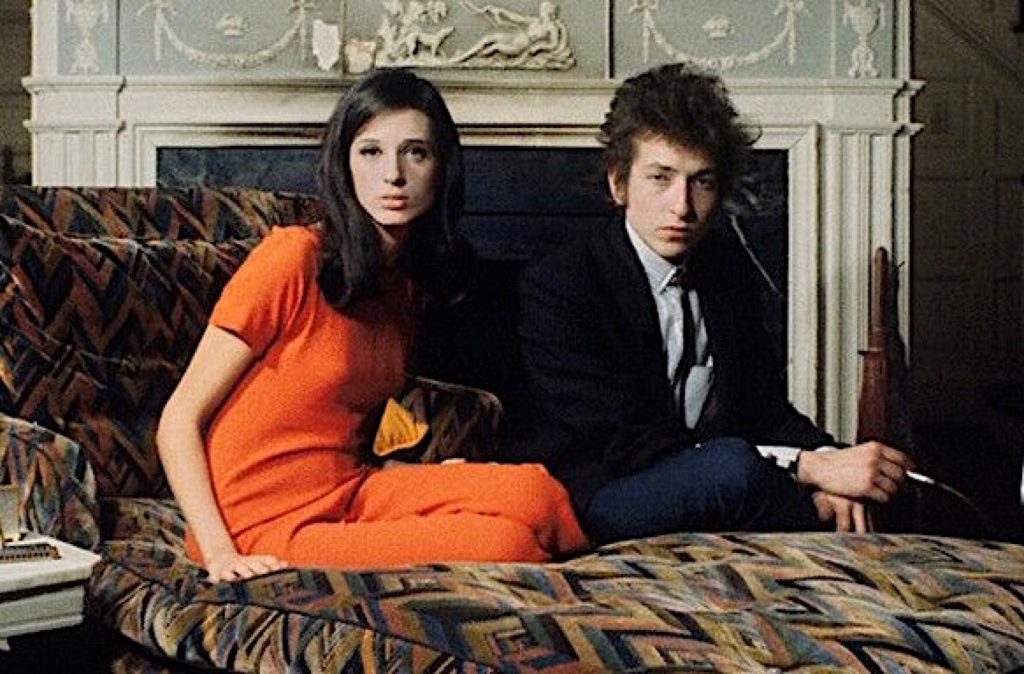
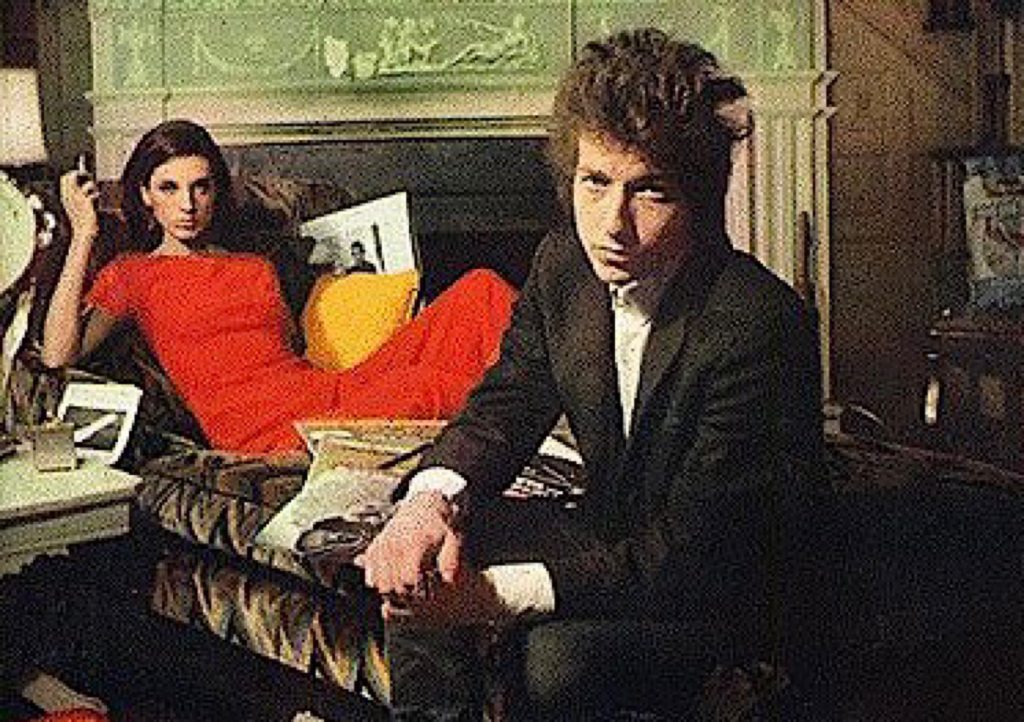
It was the cat. It’s always been the cat. The cat had to be in Dylan’s lap and looking at the lens.

Sally Grossman passed on 5.11.21 at age 81. She led an engaged life as honcho of Bearsville Records following the 1986 death of husband Albert Grossman, but nothing she did or said after the April ‘65 release of Bringing It All Back Home could rival the iconic power of that red pants suit, lit cigarette and neutral-bordering-on-chilly expression.

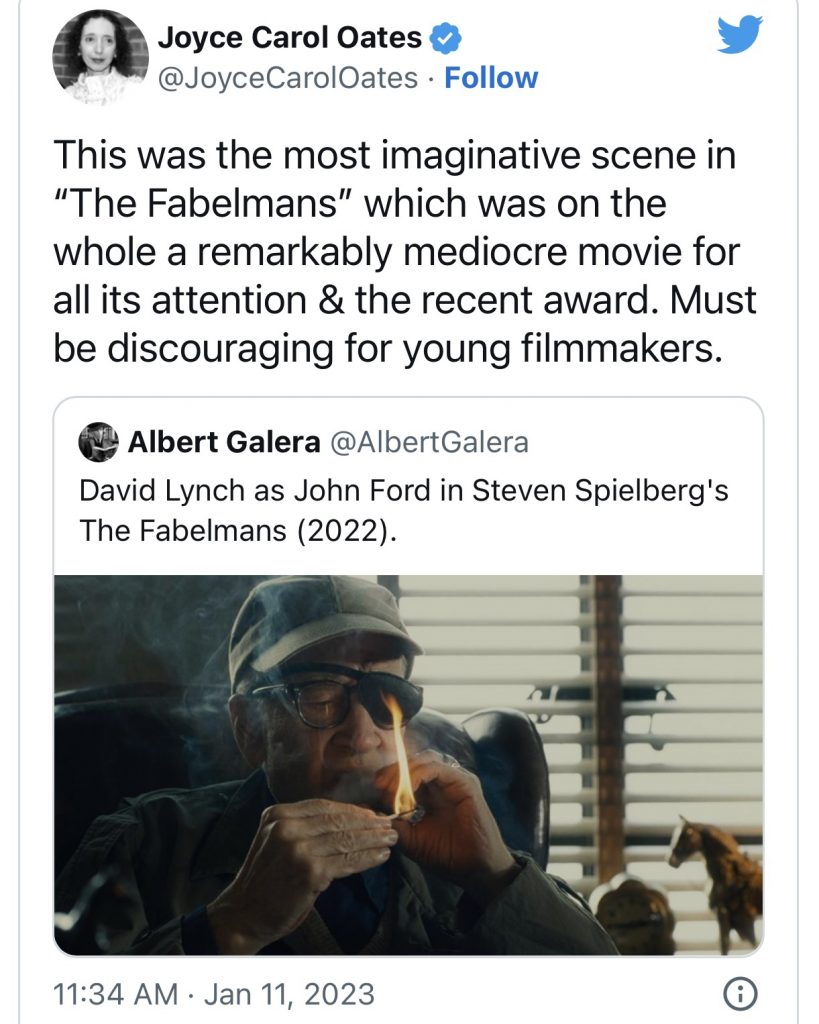
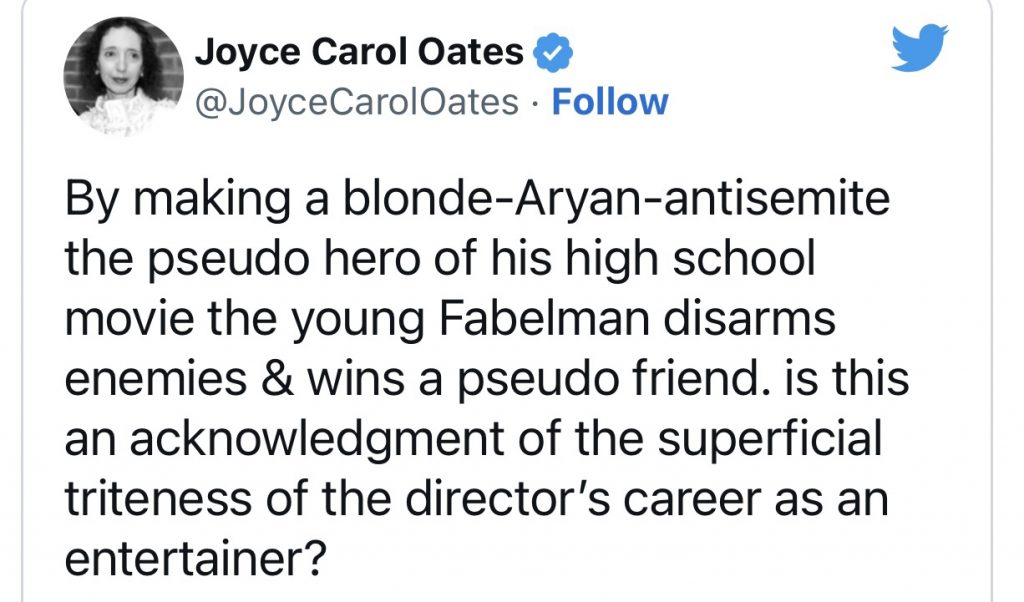
Oates Disses Spielberg

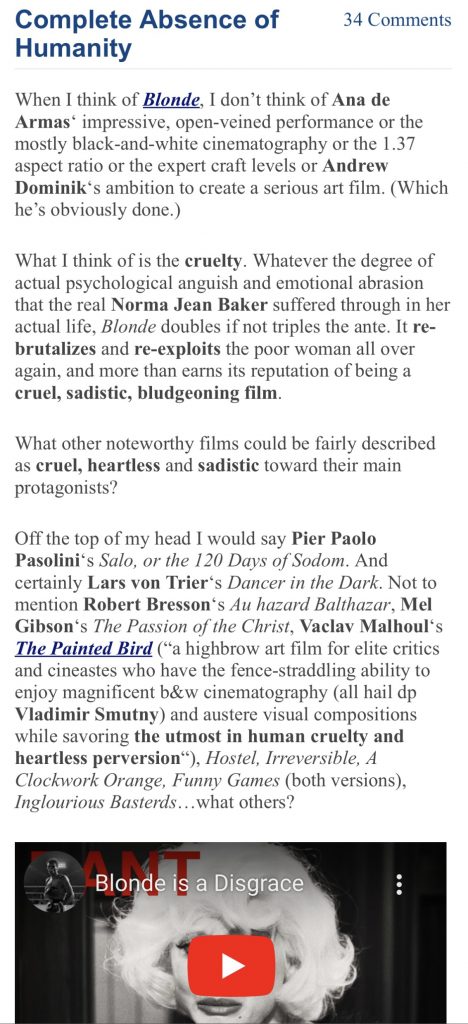
Joyce Carol Oates, author of “Blonde: A Novel”, isn’t altogether wrong about Steven Spielberg’s The Fabelmans, and there’s no arguing that in terms of delivering a tough, unsparing biopic within an artful impressionistic realm, Andrew Dominik’s Blonde is a lot more probing and less inclined to turn the other cheek. But almost everyone dislikes Dominik’s film for its heartlessness, and that’s always the bottom line. Heart always wins.

Posted on 10.7.22:

“Body Snatcher” Awakening

Compassionate Seed Pods,” posted on 10.29.20…people didn’t want to listen then, but things are different now:

Dr. Kauffman: Less than a month ago, West Hollywood was like any other town. People with nothing but problems. Then out of the progressive community came a solution. Seeds drifting through space for years took root in a farmer’s field. From the seeds came pods which had the power to reproduce themselves in the exact likeness of any form of life.
Miles: So that’s how it began…out of the sky.
Dr. Kauffman: Your new bodies are growing in there. They’re taking you over cell for cell, atom for atom. There is no pain. Suddenly, while you’re asleep, they’ll absorb your minds, your memories and you’ll be reborn into a simpler, purer world.
Miles: Where everyone’s a wokester?
Dr. Kauffman: Exactly. If you give in, tomorrow you’ll be one of us, and you can become the new Perri Nemiroff. You’ll be happier. You’ll smile all the time.
Miles: I love films by Roman Polanski and Woody Allen. Will I feel the same tomorrow?
Dr. Kauffman: [shakes his head] There will be no more need for Allen or Polanski or any other artist who hasn’t accepted the new reality.
Miles: No more watching J’Accuse or Rosemary’s Baby or The Pianist? No more Manhattan or Crimes and Misdemeanors?
Dr. Kauffman: You say it as if it were terrible. Believe me, it isn’t. We’ve all seen their films. They never last. They never do. Sardonic wit. Love and desire. Intrigue. Betrayal and facing evil. Without their films, life will be so much simpler, believe me.
Miles: You’re basically saying I need to stop fighting the idea that if I wasn’t a huge fan of Little Women, I’m a sexist who doesn’t get it.
Dr. Kauffman: Miles, if you didn’t like Little Women you are a sexist who doesn’t get it. Don’t you understand that?
Miles: I don’t want any part of it.
Dr. Kauffman: You’re forgetting something, Miles.
Miles: What’s that?
Dr. Kauffman: You have no choice.

Recent Male Characters Are Bad-Newsy For A Reason

An absence of steady stoic cool among male characters in today’s films has been, like, noticed and commented upon.

Critical Drinker: “In functional terms what we’re seeing on-screen aren’t really ‘men’ in the normal sense. They’re basically hyper-active, hyper-emotional, hyper-talkative children forced into men’s bodies.”

Funny excerpt: “In Star Wars: The Last Jedi, director-writer Rian Johnson “understood exactly what he was doing…[with his sculpting of old Luke Skywalker] he performed the most epic character assassination of all time, determined to kill not just the man but his legacy along with him.”

Read more

Irish Marlowe

“Forty-four years have passed since a feature film was last built around Raymond Chander’s harder-than-hardboiled fictional detective Philip Marlowe — a screen absence that seems both unduly long and now, in the wake of Neil Jordan’s Marlowe, not quite long enough.

“A phony, flimsy attempt at vintage noir, the film is adapted not from a Chandler work but ‘The Black-Eyed Blonde,’ an authorized Marlowe entry from 2014, by Irish novelist John Banville. Minus Banville’s own knack for literary ventriloquism, however, this all too evidently European co-production can’t help but feel multiple degrees removed from the real thing, not helped by the shuffling, ungainly presence of a wildly miscast Liam Neeson in shoes once filled by Humphrey Bogart and Robert Mitchum.” — from Guy Lodge‘s 9.24.22 Variety review.

Kaling’s Diverse “Velma” Hated All Around

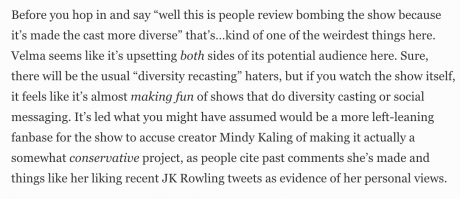
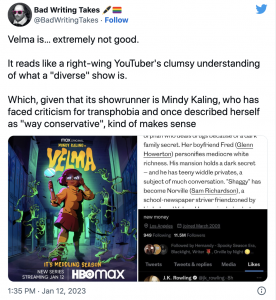
Four years ago I was persuaded by Late Night that Mindy Kaling, the writer, producer and costar of that feminist-sisterhood comedy, isn’t that funny. I’m therefore uninterested in catching Kaling’s animated Velma, a woke Scooby Doo that began streaming on HBO Max yesterday (1.12). ForbesPaul Tassi, however, has assessed the situation. The show is basically getting slammed by both sides while viewership plummets.

HE to Industry Friendo: “I’ve never found Mindy Kaling the least bit funny. In any context, woke or non-woke. What do her fellow comedy writers think of her material?”

Industry Friendo to HE: “She’s referred to as the ‘anti-Mel Brooks‘ as everything she writes never offends anybody, is safe and ‘woke,’ and isn’t necessarily ever funny. She plays it safe and is more fashionista than comic, and hopelessly entitled. The only risks she takes are in her clothing.”

A Film That Saved Hollywood Could Also Save The Oscars

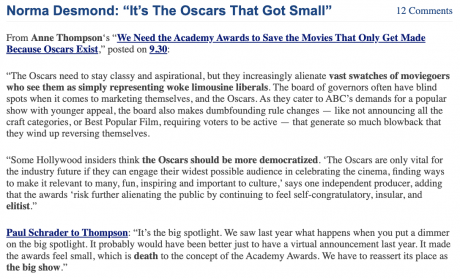
Presumably everyone understands that the Oscars were created in 1927 and continue to exist to this day in order to promote the joys of moviegoing. They’re essentially about glamour and celebration and not necessarily the praising of lofty cinematic art (to say the least), and right now the film industry and exhibition in particular really need to be promoted because Joe and Jane Popcorn hate the fact that the Oscars and Hollywood films for the most part have totally gone down the woke rabbit hole.

The plummeting Oscar telecast ratings over the last few years translate into one sentiment and one sentiment only: “We hate you for turning into woke assholes.” There’s no escaping this fact. Award-season films are largely despised and/or ignored by a majority of ticket buyers.

And yet despite all this, Top Gun: Maverick and Avatar: The Way of Water have connected big-time. If there’s any cultural life or spiritual juice in the moviegoing experience today, it’s because of these two films.

Academy voters know that of the three likeliest Best Picture contenders, only one — Everything Everywhere All At Once — has earned decent theatrical coin ($103.9 million). If it wins Best Picture (which it won’t), it could be said that a populist favorite has prevailed. Except EEAAO is not a populist favorite outside the realm of Millennial and Zoomer taste buds. The fact is that people burdened with a sense of grounded cinematic calculus hate this ludicrous, all-but-impossible-to-follow fantasia by Daniel Kwan and Daniel Scheinert. It drives them crazy, and the levels of loathing among GenXers and boomers are such that it can’t win. Of this I am dead certain.

This leaves the other two favorites, The Fabelmans and The Banshees of Inisherin, but Academy voters know that both are fairly weak sisters in a theatrical-revenue sense. Banshees has made $24.8 million; The Fablemans currently stands at $17.1 million.

Yes, I know — relatively modest box-office revenues (pre-Oscar) didn’t stop The Hurt Locker from winning six Oscars, but we’re living in desperate, do-or-die times. With the public having turned against Hollywood wokesters and despising their anti-straight-white-guy criteria, the Oscars have no choice but to run in the opposite direction of the infamous Steven Soderbergh Oscar show, which all but killed the brand after airing in April 2021.

The best message that the Oscars can send to the general public, in short, is “yes, of course we get it….we’ve been acting like self-regarding jerks, we’ve woked ourselves to death and you hate us for this…of course you do! We get it! And so, as a way of conveying this understanding, we’re happy to announce that the winner of the 2022 Best Picture Oscar is a film that you guys loved…a well-made, pro-level populist flyboy flick that even the snootiest critics admitted was a rousing, well-produced ride.

For God’s sake, Academy members — wake up by saving the industry and in the process yourselves. Do the right thing by saying the right thing by handing the Best Picture Oscar to one of the two best-loved films of 2022. Don’t go over the cliff like lemmings. Promote, celebrate, embrace.

Gas Stoves Have Soul

I hate modern electric stoves. They’re infuriating. You turn them up the level 8, let’s say, and they go on and off. Red, dark, red, dark…I hate that.

This is why I love gas stoves. You turn them on and they stay on until you turn them off. Old-world technology, yes, but steady, dependable and never quirky. Anthony Bourdain swore by gas stoves; ditto chefs worldwide. Preferring gas stoves does not make me some kind of rightwing wacko. I am a sensible left-centrist.

First Glimpse

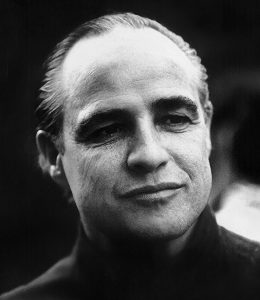
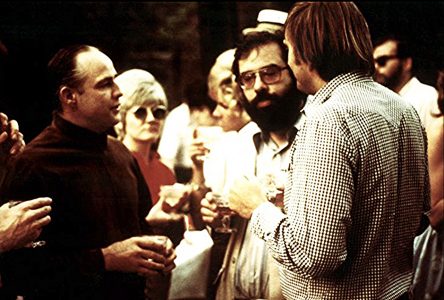
Before a few minutes ago I’d never once seen any photos of the normal Marlon Brando around the time of shooting The Godfather. Sans Vito Corleone makeup, I mean. No bulldog jowls, no pencil-thin moustache.

Pics were snapped at the wrap party, which almost certainly happened in Manhattan on the weekend of 7.2.71, 7.3.71 and 7.4.71. (90% of The Godfather was filmed in the New York City region.) Francis Coppola‘s classic gangster flick shot in New York between 3.29.71 (Monday) and 7.2.71 (Friday). Shooting of the Sicily section began in late July and ended on 8.7.71.

Brando had celebrated his 47th birthday on 4.3.71. Vito Corleone was born on one of two dates — 4.29.87 or 12.7.87. The Godfather begins in 1945, when Vito was 58. He died on 7.29.55, at age 68. Not that old.