Escapism Is A Dish Best Served Cold

Ten days ago I wrote six paragraphs about David Fincher‘s The Killer, and it came out just right because (this is important) I hadn’t really explored what I was feeling deep down…I just said “this movie made me feel so damn engaged and electrified, escapism-wise”, and I did so without asking why or trying to protect myself from the usual HE slings and arrows. Because that is what this site is partly about….dicks firing beebee pellets.

If I had a magic wand I would wave it like Mickey Mouse in Fantasia and transform The Killer into one of the locked-and-loaded, no-escape-clause 2023 Best Picture nominees…I would have no hesitation about this whatsoever. Because the Movie Godz are sold on the value of this film and so am I….and when you’re right, you’re right. And I don’t want to even think about what the Perri Nemiroffs of this world feel about The Killer. It’s not worth fooling with.

I knew deep down that I’d said the right and necessary thing when I wrote that Fincher’s revenge film (and that’s what it is — a sleek and efficient survival and revenge thing that will only warm the hearts of earth-orbiting, X-factor, don’t-fence-me-in fellows like myself)..I said that it “feels like a kind of new-age opiate…it’s about the joys of living a cold and barren life….it mainlines the hollow.”

Strange as this may sound, typing these words felt like a breakthrough of sorts. Without planning it out or thinking it through I had randomly but decisively admitted that there’s something to be said for living a life of smart solitude and fleet escapism…a life defined or punctuated by apartness, alert alienation, fake IDs and chilly satisfactions. And at the same time I live for rare meltdown moments in exceptional grade-A films…I’ve been watching the 1951 version of A Christmas Carol every holiday season since I was nine or ten years old…at the same time I love staying a step or two ahead of pursuers and living for the chase and the game of it all.

The instant that I acknowledged that a cold and barren life could radiate joy and satisfaction…well! I don’t think I’ve ever read something like this from any movie critic anywhere, and to compound matters I’m not even sure why I’m making this distinction as we speak.

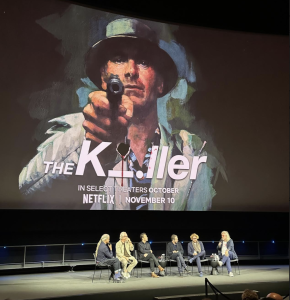
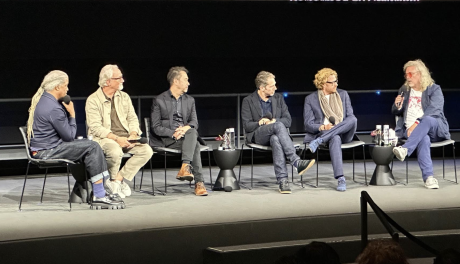
It’s 4:45 pm and I have some stuff to do, I’m afraid, so I have to shut this down, but I can’t leave without asking what’s up with Elvis Mitchell‘s baggy-ass, dark-blue, fresh-off-the-rack jeans with the cuffs folded up, not to mention those plastic, lace-up space shoes with the three-inch soles? The photos are from last night’s post-screening q & a at the David Geffen Theatre at the Academy Museum.
Posted on 10.15.23:

I loved David Fincher’s The Killer (Netflix 10.27)…a great escape film if I’ve ever seen and felt one. It took me out of myself and dropped me into a higher realm, or at least my idea of one. It redefines the meaning of the word “chill” in a way that will either knock you out or, if you’re an ideologue or a shoulder-shrugger or a constipated, closed-off type, leave you with shards.

It’s first and foremost about the supreme comfort of living in a super-clean, perfectly crafted Fincher film, and about the joy of being a ghost and travelling alone like a nowhere man, and about the blissful solitude and curious joy of disassociative technique…about the existential solace and solitude of having a wonderfully endless supply of fake IDs, fake passports and fake license plates, and maneuvering through flush and fragrant realms and the zen of nothingness…about the almost religious high of not giving a single, solitary fuck.

Despite sitting in a too-small Paris theatre seat (I could barely move my legs) and despite Fincher’s film starting almost a half-hour late, I was in heaven start to finish. It’s all about eluding fate and slipping the grasp, about playing a fleet phantom game and, much to my surprise and delight, about chasing down several unlucky functionaries and nefarious upper-caste types and sending them to God.

It’s about a side of me (and of Fincher, of course) that loves being on the move and managing to slip-slide away like Paul Simon but in a GOOD way or at least an extremely cool one…about being blissfully free of conventional entanglements and concerned only with slick stealth and ducking out of sight and, despite suffering a bruise or two, gaining the upper hand.

The Killer is about the joys of living a cold and barren life…it mainlines the hollow but feels like a kind of new-age opiate…it turned me on like Joni Mitchell’s radio, and I’m still feeling the buzz and humming the melody the morning after. I can’t wait to see it another two or three times, bare minimum.

Thank you, Mr. Fincher, for slipping me a great nickle bag of smack and what felt last night like the best meaningless-but-at-the-sane-time meaningful movie high I’ve had in a dog’s age.
This Shit Again?

Worldwide apocalypse, everything falling apart, deer emerging from the forest….Rumaan Alam‘s Leave The World Behind (Netfix, 11.22) appears to be M. Night Shyamalan‘s Knock at the Cabin, Part II only with bigger names (Julia Roberts, Mahershala Ali, Ethan Hawke) and minus the idiotic plot contrivance about how the death of four people can somehow save the world….I don’t want to remember it.

“It’s Hard For Me To Be Alone”

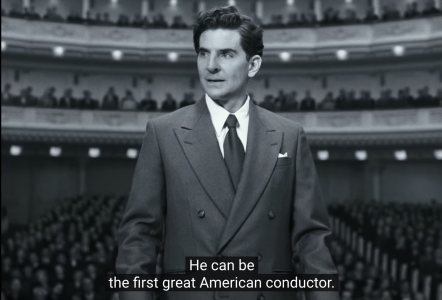
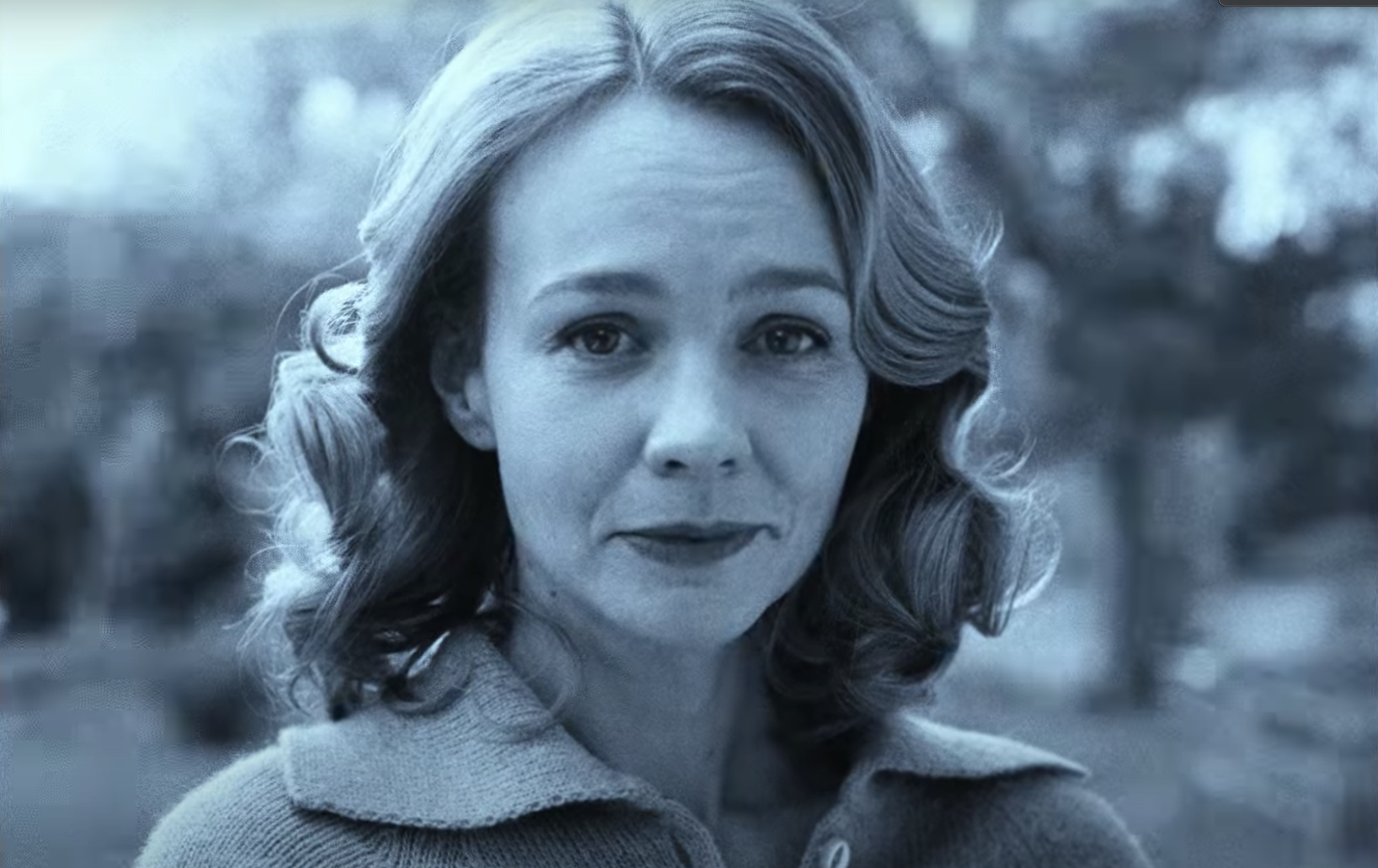
This is Carey Mulligan‘s film…that seems obvious. Felicia forever. Bradley Cooper‘s Lenny seems like a combination artful dodger and attention whore.

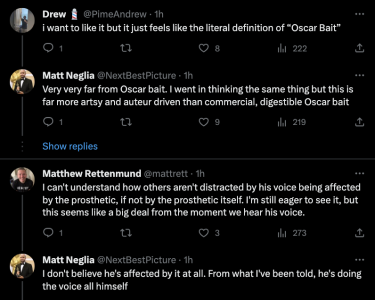
What’s with Cooper’s accent? It sounds fascinating in some respects, but it also sounds like he has an odd nasal condition.

A Netflix presentation, Maestro goes up against Ridley Scott‘s Napoleon on 11.22, and then begins streaming on 12.20.

One Of The Lamest Twist Endings of All Time

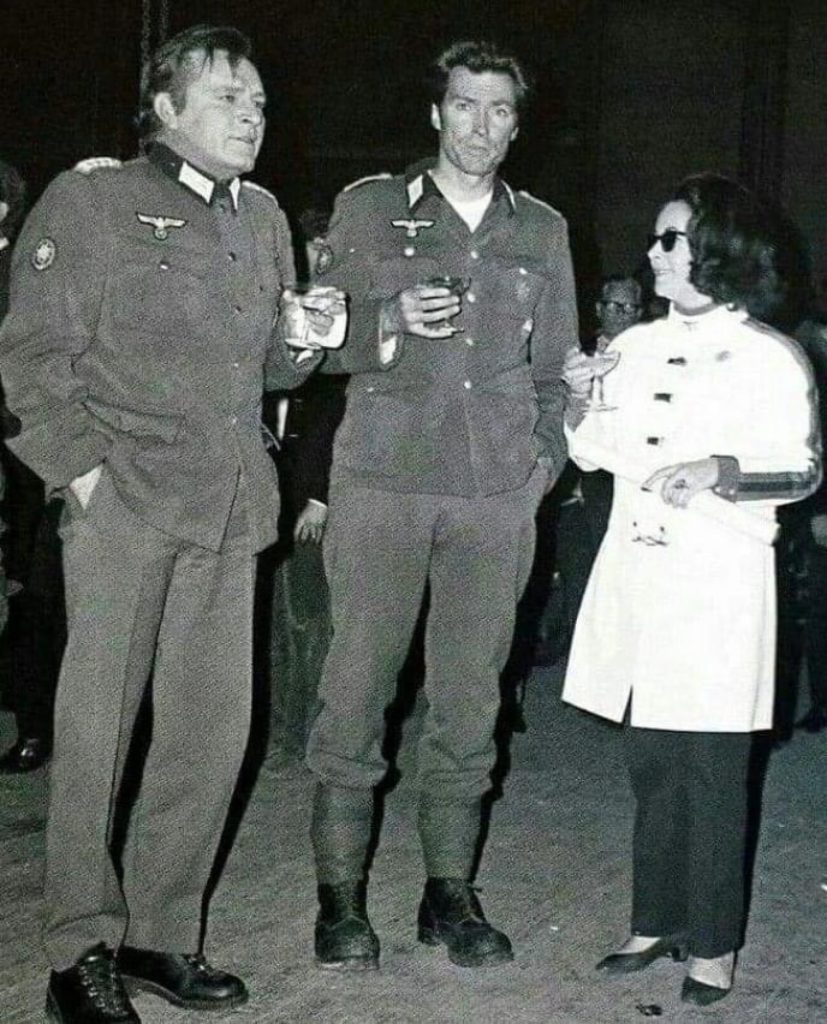
In the comment thread of a two-day old (10.23) piece called “Hello, Claude…Where’d Ya Get The Midget?“, I said I’ve never had the slightest interest in seeing Brian G. Hutton and Alistair MacLean‘s Where Eagles Dare (’68). I have, in fact, avoided it like the plague all my life. HE commenters insisted I was missing a goodie and should watch it at the first opportunity, and that “if you don’t like Where Eagles Dare you don’t like movies” and so on.

Last night I decided to watch a few YouTube clips, and was fairly dumbfounded by the finale (below). It turns out that the actual motive of the Bavarian Alps rescue mission was about ferreting out a British double agent — someone high up who was actually serving the Germans.

While the film’s four chief players (Richard Burton, Clint Eastwood, Mary Ure, Patrick Wymark) are flying above the Austrian or Swiss alps, Burton’s Maj. John Smith informs Wymark’s Col. Turner that he’s been fingered as the Nazi rat. Smith suggests to Turner that in order to avoid being executed for treason, he might want to honorably jump out of the plane and thereby save his family the shame.

And Turner, who has a fleshy face and a conversational manner that procaims the virtues of accomodation and riding along, does that! He swallows, frowns, opens the hatch, stares at Burton for four or five seconds and jumps without a parachute. After which Burton, Eastwood and Ure sit there calmly and more or less shrug their shoulders…”c’est la guerre.”

If Hollywood Elsewhere had directed Where Eagles Dare I would have insisted on a different outcome. A chubby, gray-haired British Colonel willfully jumping out of a plane and splitting his skull open as he smashes into the rocky, snow-capped mountains below…that’s not an ending. It’s too civilized, too dull, too absurd.

HE alternate #1: Wymark/Turner pulls a knife, leaps across the aisle and stabs Burton/Smith in the heart, slugs Eastwood and wrestles with him on the floor of the plane, and they both fall out….whooooossshhh! Ure, the last survivor, pulls out a pack of Lucky Strike cigarettes and lights up, blase and unaffected.

HE alternate #2: Wymark/Turner grabs an inflatable raft before jumping out of the plane. He inflates it as he falls, Indiana Jones and the Temple of Doom-style. He lands on a steep snowy hillside and slides to safety, thus setting up a sequel in which Burton and Eastwood are assigned to hunt Turner down and kill him.

HE alternate #3: Wymark/Turner crashes into the cockpit, knifes the pilot to death and steers the plane into the mountains….they all die.

HE alternate #4: Rather than share a flight with a despised traitor, Burton, Eastwood and Ure put on parachutes and leap out of the plane in tandem. Alas, Burton’s chute doesn’t open and his body is shattered and torn to pieces as he hits the rocks. Eastwood and Ure’s parachutes open, however, and after a short hike they find shelter in a warm mountain cabin that just happens to be stocked with cold beer, potatoes, weinerschnitzel and sauerkraut. Eastwood and Ure decide that “if you can’t be with the one you love, love the ones you’re with.”

Dargis Vision Is No-Go

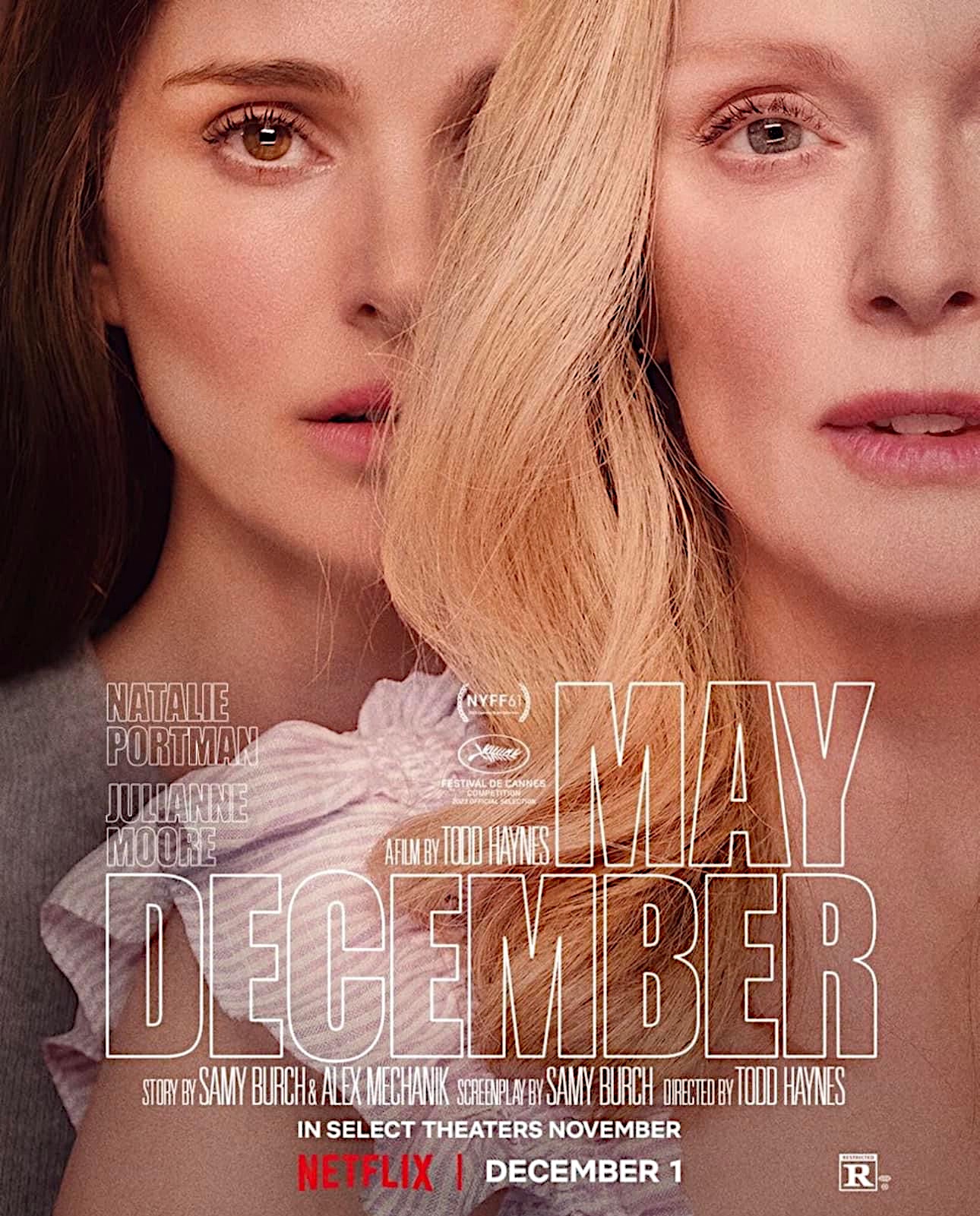
During last May’s Cannes Film Festival N.Y. Times critic Manohla Dargis, who’s become an unbridled celebrator of feminist-brand cinema in recent years, praised Todd HaynesMay December (Netflix, 12.1), an underwhelming (to put it kindly) attempt at blending the Mary Kay Letourneau saga with a semblance of a re-heated Persona. Dargis actually went apeshit, predicting Oscar glory. I wouldn’t say that reactions to the recent N.Y. Film Festival screenings of Haynes’ film have necessarily put the kibbosh on this fantasy, but I would say that the general lack of excitement is palpable.

HE’s most recent May December piece appeared on 9.26.

1931 Knockout POV Sequence

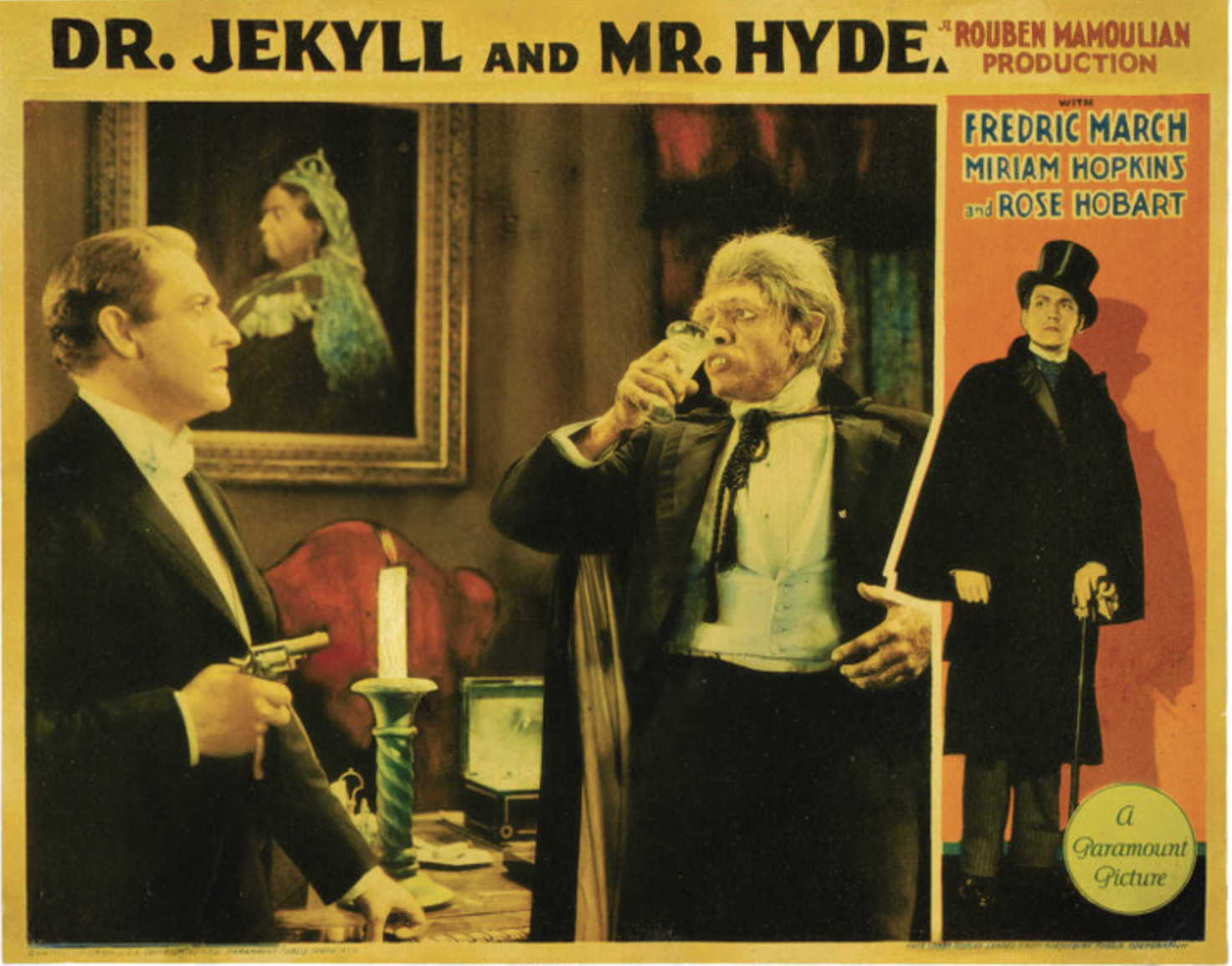
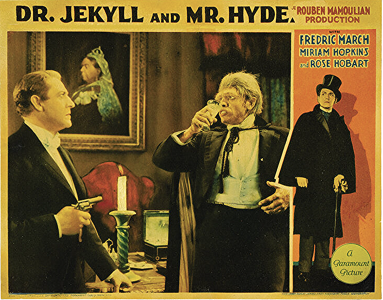
Last night I saw for the very first time Rouben Mamoulian‘s Dr. Jekyl and Mr. Hyde (’31). I had watched two or three segments (particularly the Miriam Hopkins stocking-removal + side-boob scene) but never the entire thing.

It was a beautifully restored version showing on the Criterion Channel, but I was doubly impressed and actually astonished by the extended POV sequence in the very beginning, which I had somehow never read about.

It was almost certainly Mamoulian’s idea to begin with, I’m guessing, but the renowned cinematographer Karl Struss (Sunrise, The Great Dictator, Limelight) was obviously a full partner. The shot uses a circular, partially-closed iris view, and it starts with Fredric March‘s unseen Dr. Jekyll playing an organ, talking to his butler, walking through his home, putting on an evening cape, leaving his home (we finally get a peek at March when he looks in a mirror) and arriving as a college classroom for a lecture.

If before last night you had asked me what film was the first to make use of extended POV cinematography, I would have said Robert Motgomery‘s Lady in the Lake (’47), a hardboiled Phillip Marlowe crime story.

Read more

Don’t Wanna Be Sedated

Everyone has a look of excitement and anticipation in their eye after they’ve graduated high school and are about to start college. The great adventure! When I attended my 25th celebration most of my ex-classmates had either surrendered that gleam or put it into a bureau drawer somewhere. To me they looked sedate, staid, settled. All except for a small fraternity, which I estimated to be maybe 5% of the crowd. X-factor types with a semblance of life in their veins. Looking for action, adventure, the next discovery.

Posted on 6.29.15: The other day a friend mentioned a pending high-school reunion. Okay, fine, I wanted to say, but if you were fundamentally unhappy and occasionally miserable in high school (as many of us were, and as I definitely was), you’ll need to stash that history in your locker and keep it there until the reunion is over.

Reunions tend to remind a lot of us what a regimented environment and cultural concentration camp high school was. Most of us only realize this after we’ve found our footing as adults. I was lost but now I’m free, or certainly a lot freer.

My high-school years didn’t feel “miserable” in an unmistakable, lemme-outta-here sense; the unhappiness I lived with seeped into my system in a hundred subtle ways. I was so down it looked like up to me. All of it. I didn’t expect any semblance of “happiness,” but I was hoping all the time that life might eventually become less grueling.

I wasn’t anti-social but I didn’t party and run around all that much until my senior year, and once that phase kicked in I became a madman. The truth is that on a certain level I was a kind of functioning alcoholic (no serious behavioral problems but a few serpents under the surface) from my late teens until I quit the hard stuff in the mid ’90s. The real healing didn’t begin until I went sober in March 2012, or so I tell myself.

Before I socially flowered I watched a shitload of TV and listened to a lot of music and basically lived in my head. I was a secret genius who could potentially be persuaded to join the crowd, but no one ever asked. I know that my father’s alcoholism felt and smelled like mustard gas in our home, especially during dinner hour, and that my self-esteem was in the basement. I mostly felt apart, diminished and unworthy when it came to women. In school I didn’t do sports or join clubs or do anything extra-curricular except for detention.

My life didn’t really kick into gear until my mid 20s when the journalism thing started, and even that was agony until I became a half-decent writer and had learned the ropes and had gotten to know people, etc. Things didn’t actually kick into a good place (confidence, comfort, fair reward) until the online column era started, in late ’98 — a quarter-century ago.

Least Inspiring Teacher I Ever Had

…was a Wilton high school science (or was it biology?) teacher named Dan Cappel. It wasn’t his teaching methods which threw me off — he was actually a very bright fellow who knew his stuff cold, and was likably mild-mannered to boot — but his voice sounded so depleted of raw energy, and he had this seemingly exhausted, baggy-eyed, beaten-down appearance.

I once spotted Dan driving his three or four kids around in a VW van, and he looked so weary and bedraggled and sleep-deprived and generally sagging at the seams. Something inside me recoiled in horror at this sight, and from that moment on I couldn’t listen to Dan. I couldn’t unsee that exhausted guy. I had decided “whatever kind of biology this guy’s selling, I can’t buy it. Because I really don’t want to be him when I get older.”

Paul Giamatti’s Paul Hunham: “I can tell by your faces that many of you are shocked at the outcome. I, on the other hand, am not because I have had the misfortune of teaching you this semester, and even with my ocular limitation I’ve witnessed first-hand your glazed, uncomprehending expressions.”

Brady Hepner’s Teddy Kountze: “Sir, I don’t understand.”

Hunham: “That‘s glaringly apparent.”

Kountze: “No, it’s…I can’t fail this class.”

Hunham: “Oh, don’t sell yourself short, Mr. Kountze. I truly believe that you can.”

Kountze: “I’m supposed to go to Cornell.”

Hunham: “Unlikely.”

Read more

“Not Boring But A Bit Flat”

“Head-Scratchy “Occupied City” Includes Heavenly Entr’acte Musical Passage,” posted from Cannes on 5.18.23:

I reluctantly sat down this morning with Steve McQueen‘s Occupied City, a doc about the Nazi occupation of Amsterdam during World War II and the various oppressions, suppressions and terrors that arose from this. “Reluctantly” because I’d read that McQueen’s film is a bit of a tough one or, in the words of Variety‘s Owen Gleiberman, “a trial to sit through.” It seemed at the very least unworthy of a four-hour-plus investment. Maybe.

I was nonetheless ready to engage, and I can at least report that I didn’t hate it. Given the historical aspect you might presume that McQueen would be using troves of digitally enhanced archival footage from the war years, but it was all shot during the pandemic of ’20 and ’21, and in vivid color inside a boxy (1.37:1) aspect ratio, and overflowing with Amsterdam capturings.

It’s based upon “Atlas of an Occupied City: Amsterdam 1940-1945,” a purportedly exacting coffee-table book by McQueen’s wife Bianca Stigter, and it’s basically one fixed-tripod tableau after another of Amsterdam, augmented or expanded upon by narration (read by Melanie Hyams) about this or that dark anecdote or tale about Jewish residents of that Dutch city who were persecuted or hid in attics or were eventually murdered in concentration camps. But it feels awfully dry and rote and static, I can tell you. It’s not boring or uninvolving but a bit flat, but within 12 or 15 minutes I was muttering to myself “this is it?”

McQueen’s basic idea (hold on, it’s a lulu) is that the bureaucratic repression of the Covid years, which we all felt pained and smothered by in more ways than one, and the deeply injurious Amsterdam restrictions, suffocations and violations of the early to mid 1940s are somehow related. Or, you know, not dissimilar.

This is what the film keeps saying over and over, that we’re all living in the now but that the past is still with us (and isn’t even “the past”, heh-heh) and lingering in our hearts and souls and all that. It’s a strange concept but I went with it, and I certainly came to know the various neighborhoods and bridges and weathered buildings and town squares of Amsterdam look like these days, much more than ever before, I mean, and I’ve been to Amsterdam, mind. Too many British pubs, too many party boys.

But I have to be honest and admit that my eyelids didn’t make it all the way through. I’m blaming this not on myself but on a certain fellow I’m sharing the apartment with, and more particularly his grizzly bear-snoring…make that his Steven Spielberg T-Rex snoring. (More on this in subsequent story.)

McQueen’s film includes an intermission, and it’s finally time to fulfill the promise of the above headline and state that the musical entr’acte interlude between parts one or two is truly, oddly moving. In a liturgical sense. I loved just sitting there and letting it sink in. It made me feel oddly happy, and also persuaded me that there might be something deeper to Occupied City…something that i wasn’t paying sufficient attention to. But I let that notion go.

Read more

Secular, Elitist, Virtue-Signalling, Self-Satirizing Gotham Nominations

The Gotham Award nominations were announced at noon today, and hoo boy…talk about an organization and a community that lives in a deep mine shaft within its own secular planet…nominations that represent an elitist bubble of urban progressive sensitivity that could choke a plowhorse…a mindset that frequently spits upon Joe Popcorn cinema and enforces a social prejudice agenda…diverse, convulsive, queer-friendly, gender-neutral, indie-favoring, right index finger inserted in rectum, down with older white guys, “we know what we know and if you don’t like where we’re coming from that’s on you because we represent the better angels of the human condition, in large part because we’re more highly evolved”…

Okay, I’m half on-board with a few of the acting nominations…some of them are fairly spot-on so the people who selected them aren’t knaves but perceptive, sensible types for the most part. But the Best Feature and Best International feature nominees…yeesh.

The five Best Feature nominees are Ira SachsPassages (forget it), Celine Song‘s Past Lives (the fix is in on this one, trust me), Tina Satter‘s not-half-bad Reality, Kelly Reichardt‘s Showing Up (a reasonably decent woke-lifestyles-in-Portland film) and A.V. Rockwell‘s A Thousand and One (not a chance).

The Best International Feature noms are All of Us Strangers, Anatomy of a Fall, Poor Things, Tótem and The Zone of Interest. Yup, that’s right — they’ve blown off the audience-friendly The Taste of Things (i.e., The Pot-au-Feu). I didn’t realize that Poor Things was a truly international production….whatever.

Outstanding Gender-Free Lead Performance noms: Aunjanue Ellis-Taylor in Origin, Lily Gladstone in The Unknown Country (peresumably a KOTFM stalking horse), Greta Lee in Past Lives, Franz Rogowski in Passages, Andrew “beard stubble” Scott in All of Us Strangers, Cailee Spaeny in Priscilla, Teyana Taylor in A Thousand and One, Michelle Williams in Showing Up and Jeffrey Wright in American Fiction.

Outstanding Supporting Performance noms: Juliette Binoche in The Taste of Things (obviously NOT a supporting performance), Penélope Cruz in Ferrari (yes!!), Jamie Foxx in They Cloned Tyrone (what about his knockout performance in The Burial?), Claire Foy in All of Us Strangers (very good performance), Ryan Gosling in Barbie, Glenn Howerton in BlackBerry (first-rate!), Sandra Hüller in The Zone of Interest, Rachel McAdams in Are You There God? It’s Me, Margaret (good performance), Charles Melton in May December (forget it), Da’Vine Joy Randolph in The Holdovers (best of the bunch or at least tied with Penelope Cruz!).

Back to the root elements: Remember Ray Walston in My Favorite Martian with the insect antennae popping out of his head? Many of the Gotham nominators are 2023 Walston variations…alien humanoids with a knowledgable, sophisticated, well-educated dweebo sensibility…Snidely Whiplash foo-foos who all drink from the same well or the same teapot…Justin Chang, K. Austin Collins, Jessica Kiang, Claudia Puig, Alison Willmore, Thelma Adams, David Fear, Jon Frosch, Wendy Ide, HE’s own Guy Lodge, plus Carlos Aguilar, Lindsey Bahr, Lovia Gyarkye, David Sims, Monica Castillo, Robert Daniels, Tim Grierson, Tomris Laffly…okay, I’m not 100% certain that each and every Gotham Awards nominating committee member is a “bad” person but many of them are, in my humble opinion.

These folks are mostly ideological sycophants, political cowards, go-alongers…people who have sworn loyalty to the politically purifying, disruptive, anti-populist social serum that’s been flowing through the veins of Stalinist theological authoritarians and generally plaguing cinema since ’17 or thereabouts by attempting to transform the art of motion pictures into an instrument of progressive social change…these are basically your Strelnikovs, your enlightened cool kidz…advocates of sweeping social change first and movie fanatics second.

Formerly Obedient Trumpie Weeps In Court

If, for the sake of self-protection and your own professsional survival, you’ve decided to flip against a certain mouth-breathing sociopathic bully boy, fine. It simply means that your interests are now being harmed by your previously obedient association with Donald Trump, and that you’ve trying to wash yourself clean of this ignominous chapter in your life and move on. But the weeping in court is pathetic. Suck it up, comport yourself like a responsible adult and read the statement, but theatrical displays of remorse are basically cheap theatre.