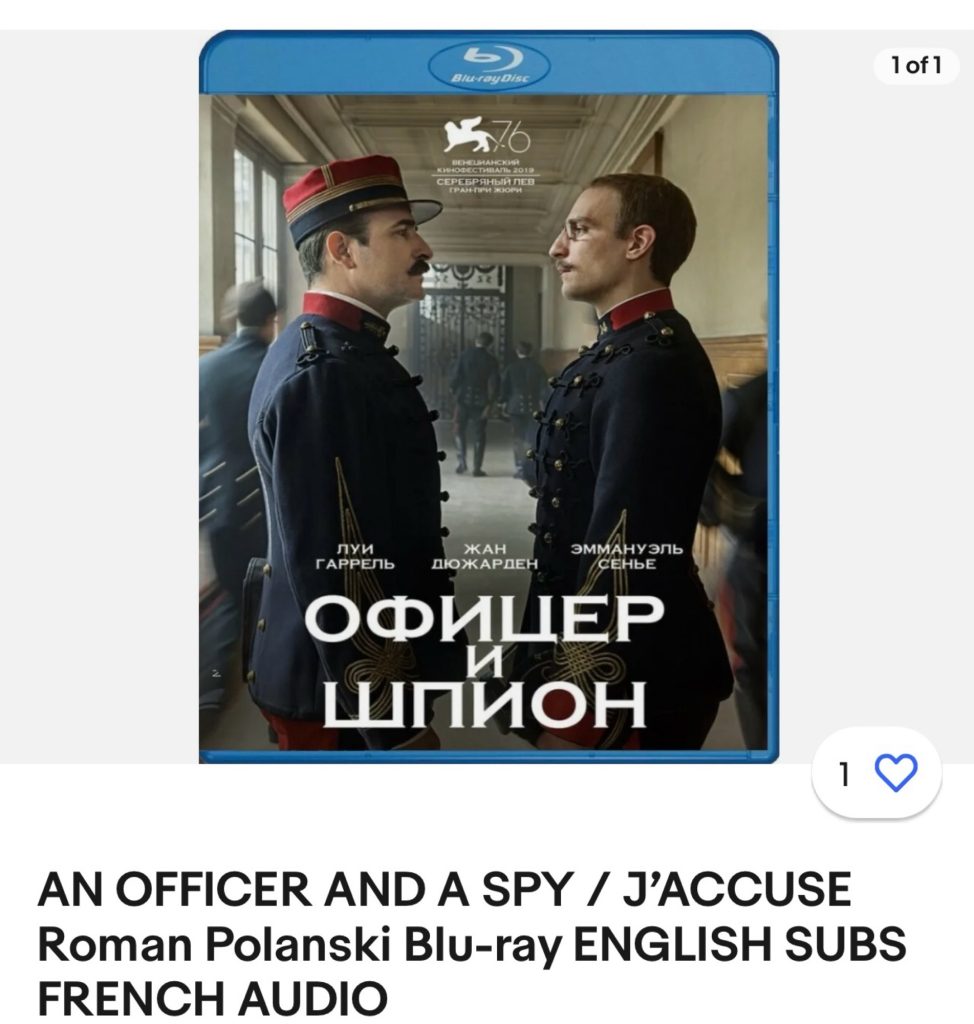
As we speak there’s only one copy selling on EBay, but there are quite a few more available in Russia.


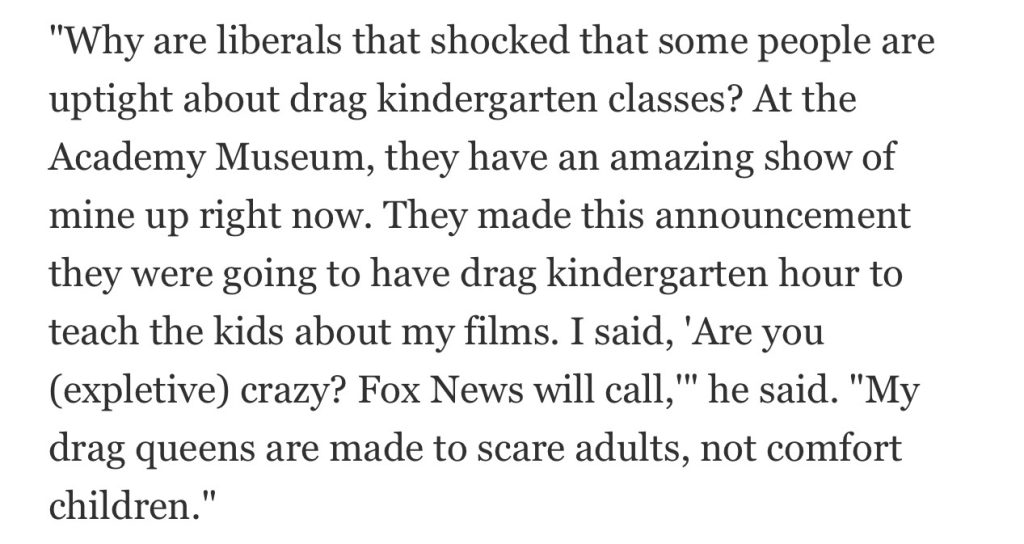
The great John Waters on the nonbinary sexual revolution, as reported last week by the Desert Sun’s Ema Sasic:


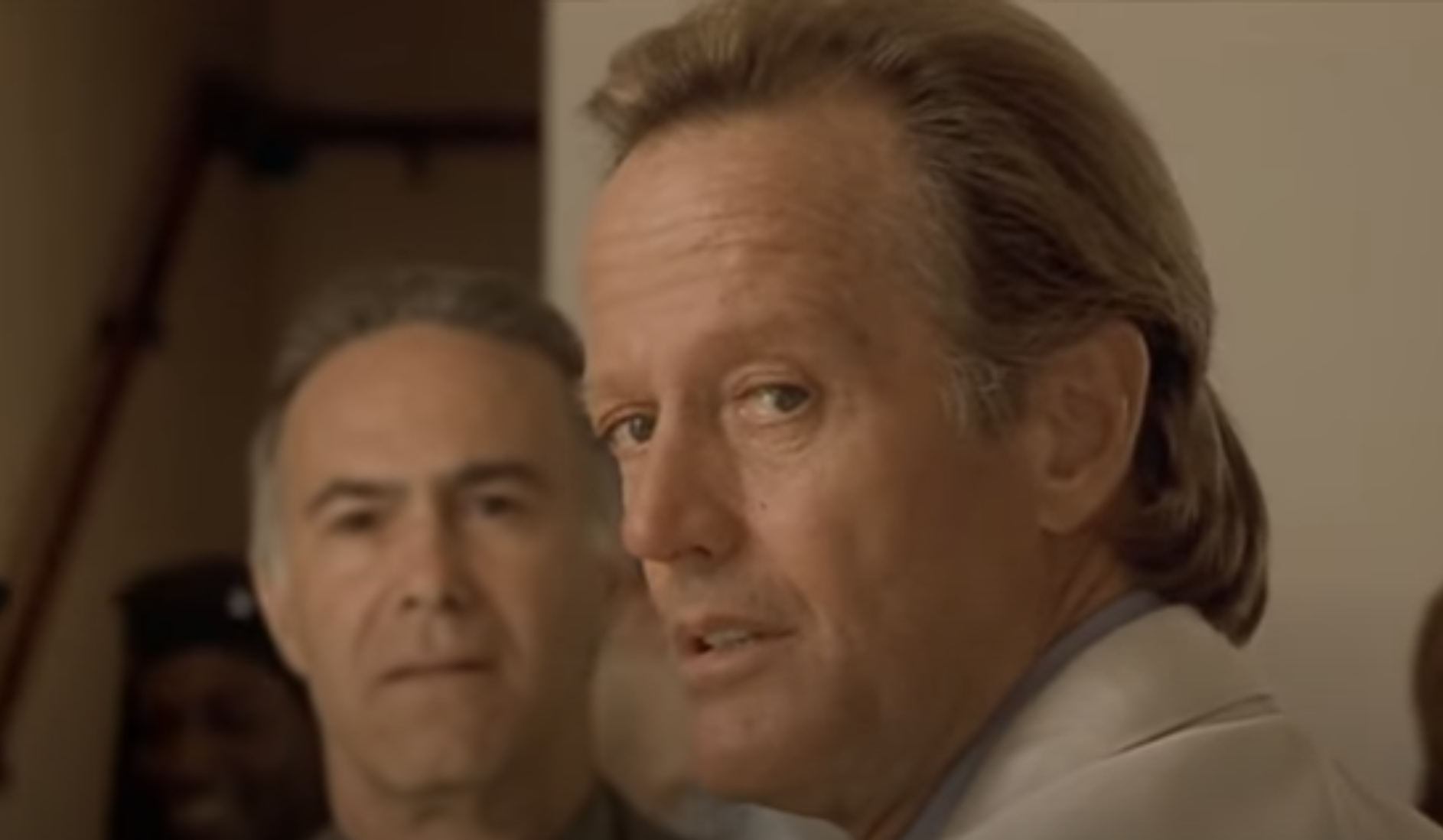
In Steven Soderbergh‘s The Limey (’99), the “King Midas” montage rules (:09 to 1:09). All hail The Hollies when Graham Nash was front and center.
Peter Fonda (1940-2019) was an easy guy to talk to…interviewed him a couple of times, talked to him at parties, etc. Terry Valentine was by far his most interesting and layered role, more so than Easy Rider‘s Wyatt or the guy who dropped LSD in The Trip…pick of the litter.
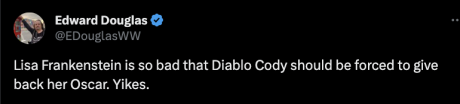
Film maven Edward Douglas is not a brutally frank critic, much less a harsh one. In the realms of fantasy and horror he has tended to be obliging, and sometimes even bend over backwards. So this outright dismissal of Zelda Williams and Diablo Cody‘s Lisa Frankenstein (Focus, 2.9) means something, I think.
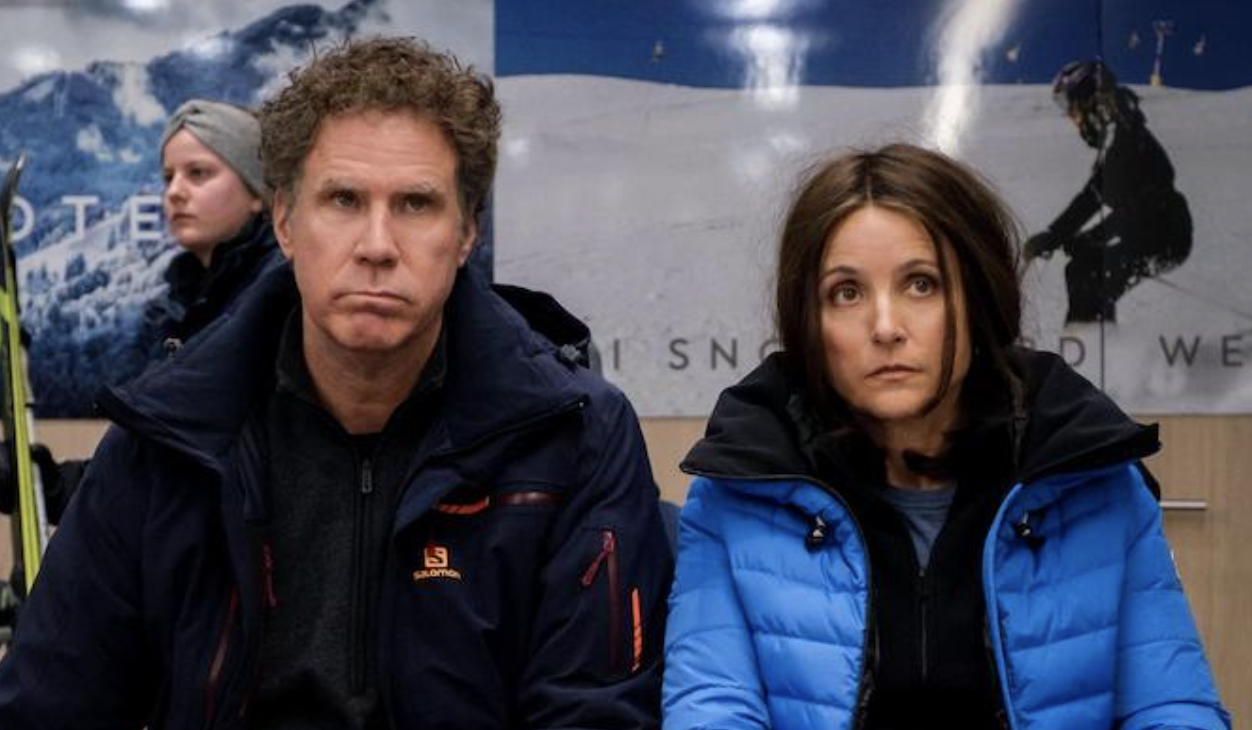
Ruben Ostlund‘s Force Majeure (’14) is a better film than Nat Faxon and Jim Rash‘s remake titled Downhill (1.20). But the latter isn’t half bad, and it’s a half-hour shorter, and it ends well. And so I’ve decided to re-watch Downhill this evening rather than Ostlund’s original.
Downhill, which opened almost exactly four years ago, struck me as better than decent — adult, well measured, emotionally frank, well acted and cunningly written. (Faxon and Rash shared screenplay credit with Jesse Armstrong.)
It’s not a burn, it’s not about a “black and white situation” (as one of the less perceptive characters puts it) and it provides ample food for thought and discussion.
Both films conclude that a father running from an impending disaster (i.e., a huge avalanche) without trying to save or protect his wife and kids is a bad look. Which of course it is. Obviously.
Both films condemn the dad in question (Will Ferrell in the American version, Johannes Bah Kuhnke in Ostlund’s version) and more or less agree with the furious wives (Julia Louis Dreyfus, Lisa Loven Kongsli) that dad should have (a) super-heroically yanked the wife and kids out of their seats and hauled them inside in a blink of an eye or (b) hugged them before the avalanche hit so they could all suffocate together.
Hollywood Elsewhere says “yes, it’s ignoble for a dad to run for cover without thinking of his wife or kids,” but I also believe that instinct takes over when death is suddenly hovering. I also feel that Dreyfus and the two kids acted like toadstools by just sitting there on the outdoor deck and hoping for the best.
Question for Dreyfus and sons: A huge terrifying avalanche is getting closer and closer and you just sit there? I mean, you do have legs and leg muscles at your disposal. A massive wall of death is about to terminate your future and your reaction is “oh, look at that…nothing to do except watch and wait and hope for the best”?
Both films film basically ask “who are we deep down?” They both suggest that some of the noble qualities we all try to project aren’t necessarily there. But Rash and Faxon’s film also says “hey, we’re all imperfect and yes, some of us will react instinctually when facing possible imminent death. So maybe take a breath and don’t be so viciously judgmental, and maybe consider the fact that tomorrow is promised to no one so just live and let live.”
I was especially taken by Downhill‘s spot-on philosophical ending (i.e., “all we have is today”). Seriously, it really works. I came to scoff at this film (due to the less-than-ecstatic Sundance buzz) but came away converted.
Has there ever been a real-life situation in which a famous person didn’t die in their home (and I mean a nice homey-home with a warm fire going in the fireplace and pets lying on their bed) and wasn’t surrounded by family members?
I’m asking because each and every time a celebrity death is announced we’re always told that the passage-into-infinity hasn’t happened in a hospital and that the deceased was absolutely surrounded by family and loved ones.
Don’t most people die in hospitals, and often in the wee hours when family members are home sleeping?
Not once has a celebrity passed while family and friends were out to dinner or otherwise and only a professional caregiver was there…right? Do I have that right?
“We’re born alone, we live alone, we die alone. Only through our love and friendship can we create the illusion for the moment that we’re not alone.” — Orson Welles.
Very few of us are going to die as pleasantly as we’d like to. Death usually happens under circumstances we can’t foresee, much less plan for, and sooner than we’d like. And the likelihood that you’re going to die while lying comfortably in bed between recently-washed sheets is almost nil. The odds are that your final throes are going to either be painful or traumatic or grotesque, and possibly a combination of all three.
By the way: There used to be a stand-alone site called Cinemorgue, which featured listings and descriptions of thousands of death scenes that are alphabetized by the names of actors and actresses.
Cataloguing endless death was apparently too much work for someone, and so Cinemorgue became Cinemorgue Wiki, which allowed readers to submit their additions and corrections directly.
I’d forgotten how many times Elke Sommer was gruesomely killed on-screen. Two skiiing accidents, shot three times (machine gunned in 1969’s The Wrecking Crew, the Dean Martin-Matt Helm movie), blown up, and bludgeoned to death.
Almost all movie deaths, it seems, are brutal, bloody, sudden, ghastly, traumatic and otherwise unpeaceful. Nod-off deaths — like Sir Cedric Hardwicke ‘s passing in The Ten Commandments — have been few and far between over the last 40 years. Is real-life death ever smooth and easy? Only if you do yourself in with pills.
I’ve learned that Woody Allen‘s Coup de Chance, which received enthusiastic reviews when it premiered at last September’s Venice Film Festival, will receive some kind of limited U.S. release in April, possibly a streaming-only deal or perhaps a brief theatrical exposure in major cities followed by streaming.
My understanding is that the distribution arrangement will be announced sometime this week. The distributor isn’t an indie major but an outfit like Vertical or Ketchup…someone in that vein.
This indicates a change in the political weather as Woody’s films have been unwelcome domestically for several years now, especially in the wake of woke terrorism, which kicked off in 2018 or thereabouts. I’m presuming it won’t play any theatres as exhibitors are generally terrified of wokesters and don’t want the hassle.
A couple of weeks ago I reported that “a certain U.S.-based distributor is looking to open (or at least stream) Coup de Chance a couple of months hence, give or take.”
I also noted that a 4K Italian Bluray of Coup de Chance will be released on 3.18.24.
Two months ago I riffed about Rialto’s re-release of Roman Polanski‘s The Pianist.
This seemed to indicate a possible lessening of wokester terror as it wasn’t that long ago when even streaming distributors were afraid of offering Polanski’s J’Accuse (aka An Officer and a Spy) to English-language consumers. They’re still afraid of doing this, of course, but if The Pianist can be re-released why not Polanski’s 2019 Cesar winner?
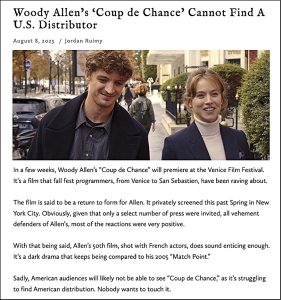
Poated by World of Reel‘s Jordan Ruimy last August:

Soon after opening on 9.25.21, the Academy Museum of Motion Pictures became known as an industry joke — a forum for unintentional, institutional, self-regarding satire.
Rather than offer in-depth exhibits and tributes exploring the origins, struggles and triumphs of the Hollywood film industry, the museum focused almost entirely upon apologies for all the cruel exploitations of women and people of color during its first 100 years (1915 to 2015). Hence the nicknames “Woke House” and “Apology House“.
This focus was so obsessive and self-flagellating that the museum completely ignored the industry’s Jewish founding fathers — Paramount’s Adolph Zuckor, MGM’s Louis B,. Mayer, Fox Film Corporation’s William Fox, Warner Brother’s Harry, Albert, Sam and Jack Warner (i.e., Polish jews), Columbia’s Harry and Jack Cohn, Universal’s Carl Laemmle.
This is about to be rectifed. A little more than three months hence the museum’s first permanent exhibit, “Hollywoodland: Jewish Founders and the Making of a Movie Capital“, will open (5.19.24).
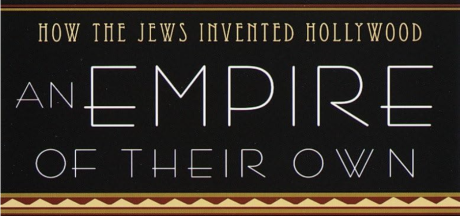
So it’s still a wokester apology house, except now the new apology is less sincere — i.e., “we’re not really sorry for ignoring the industry’s founders because they were white bastards who made the the lives of women miserable due to sexual exploitation and assault and POCs miserable due to under-employment, but now, after being pressured and dragging our feet for a couple of years, we’re opening the Jewish founders exhibit. We don’t like it but we have to do it so there it is.”
Posted on 10.9.21, or two and one-third years ago: After the Academy Museum I dropped by the Farmers’ Market. Within five minutes I was ordering a cup of Cookies ‘n’ Cream ice cream at Local Ice (formerly Gill’s ice cream stand, which opened in ’37). Four younger women (early 20s) were behind the counter. I was holding an Academy Museum brochure and placed it on the counter as I waited.
One of the women (a pretty brunette) beamed when she saw the brochure, and leaned forward slightly and said, “So what did you think of the museum?”
For three or four seconds I wondered if I should just say “oh, I really loved it…very handsome, beautiful displays” and so on. But of course the HE thing won out.
“Well, it’s kind of a mixed bag because it’s pretty woke,” I said, shrugging my shoulders and trying to softpedal my words. “It’s basically a huge apology museum,” I continued. “An apology for white males having run the film industry for 100 years. It’s basically a celebration of the inclusion moves made over the last few years on the part of non-white people and women are concerned, and it’s basically bullshit.”
When I said the word “women” the 20something brunette slightly twitched. She was apparently trying to suppress her discomfort that this older customer with red-tinted glasses seemed to be vaguely irked by the museum celebrating the progress of persons like herself. (Which I wasn’t conveying at all.) Plus her eyes had begun to harden. She wasn’t about to get into an argument with a customer but she clearly wanted to hear how wonderful and cleansing the museum was, and she didn’t want to hear my anti-wokey.
Posted on 12.30.21, previously paywalled: Almost all big-time gangsters go down in flames sooner or later, and almost always after a relatively short heyday — imprisoned, expelled from the U.S., blown away like Tony Montana or Tony Soprano, found stuffed inside a garbage can.
Gangsters rarely live to be old and gray-haired and surrounded by grandchildren. Okay, Vito Corleone did but that was fictional. Meyer Lansky made it to age 80 (cancer took him out) but he only had $57K in the bank at the end. Pablo Escobar was shot to death in the end, but he lasted as a kingpin for 17, 18 years — an exception to the rule.
If I was running Gangster Financial Services, my basic pitch would be this: “Sooner or later you’re going to have to lam it. You need to face the fact that you’re probably looking at five or six years at the top, perhaps a couple more, nine or ten at the outside. But sooner or later the law will indict you or rivals will have you killed.
“Smart gangsters understand that they need to start planning their escape early on. They need to start putting money away and building low-key homes in Vietnam or Eastern Europe or Belize or Paris or Rome, and having false passports and identity cards made and arrangements with good plastic surgeons, so when it’s time to go on the run, they do so on their own terms, and in relative comfort.
“We at Gangster Financial Services understand the game and how it works. Let us help you and your family plan for the inevitable, while you still can and before it’s too late. Oh, and by the way? No private zoos while you’re flush and at the top. Only idiots have Bengal Tigers and giraffes living on their property.”
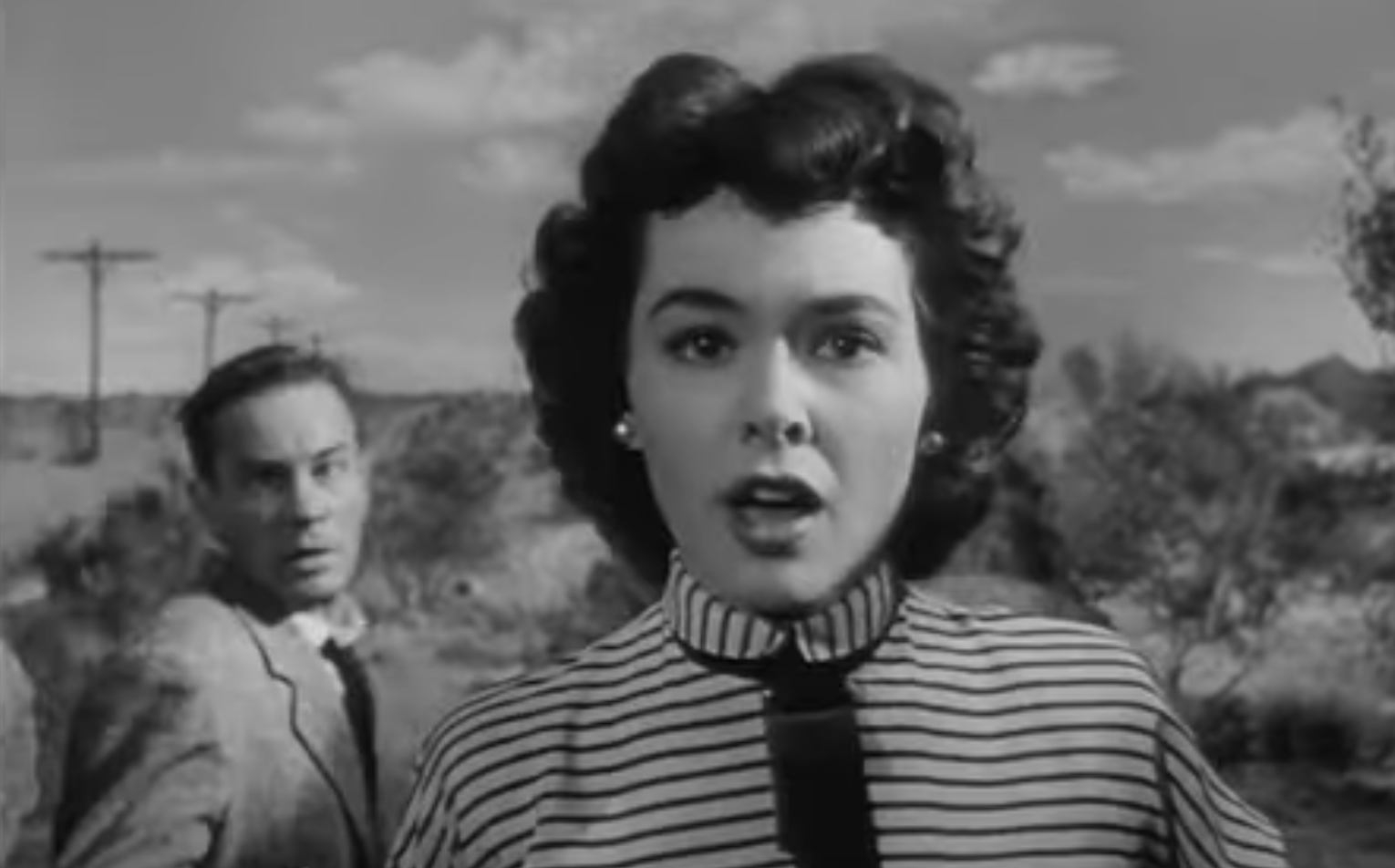
Last night I re-watched George Pal and Rudolph Mate’s When Worlds Collide (‘51), an ambitious if under-budgeted sci-fi disaster flick. Early on I was intrigued by (i.e., fantasizing about) 23 year-old costar Barbara Rush, whom I’d never paid much attention to (and who is still with us, by the way, at age 97).
She was unquestionably front and center during the ‘50s, but my most vivid memory of Rush is from Warren Beatty and Hal Ashby’s Shampoo (‘75).
There’s a scene in which Beatty’s Beverly Hills hairdresser (i.e., George Roundy) is trying to persuade a bank officer (George Furth) to give him a loan to start his own hair salon with. When asked about collateral, Roundy tries to explain that his business value is largely based upon celebrity client loyalty. “I have the heads…I do Barbara Rush,” he states. Alas, this isn’t enough for the bank officer.
Married to Jeffrey Hunter from ‘50 to ‘55, Rush was very fetching in her 20s, but augmented this with a certain interior, deep-drill quality that seemed rooted in good character and basic values. Call her the trustworthy, on-the-conservative-side, guilt-trippy type. This was especially evident in 1958’s The Young Lions and ‘59’s The Young Philadelphians.
It was this sense of duty and restraint plus a corresponding low-flame quality when it came to hints of sultry sensuousness that probably limited Rush’s appeal as she got into her 30s. Wikipage: “She was often cast as a willful woman of means or a polished, high-society doyenne.”


Before today I regarded Jacob Elordi as a tall, broad-shouldered, dishy-looking actor who may or may not have been a fellow of serious character or intestinal fortitude.
His two most recent performances were nothing to write home about — a Paul Bunyan-sized Elvis Presley in Sofia Coppola‘s Priscilla and a laid-back, to-the-manor born hunk in Emerald Fennel‘s Saltburn.
But after lightly roughing up Joshua Fox, a producer for Australia’s “The Kyle & Jackie O Show” after Fox good naturedly but idiotically asked Elordi for some dirty bathwater (a goof on Saltburn‘s Barry Keoghan slurping same)…after this episode was reported I said to myself, “This settles it…Elordi is now a man with his feet planted on terra firma.”
By which I meant he’s no longer just an actor looking for another job, another high-impact role…he is now his own poet, his own creation, the captain of his own ship…he’s now a dude who won’t take any shit from any douchebags and will most likely refuse to back down if this happens again.
Elordi is now a personality as well as a semi-tough guy…Frank Sinatra, Sean Penn, Robert Mitchum…that line of country. Hats off, stiff salute.”l
Elordi allegedly pushed Fox against a wall and then allegedly put his bands on Fox’s throat, but he didn’t hurt the guy. He was just making a point like Sinatra used to back in the old days when some asshole journalist or photographer had gotten on his nerves.
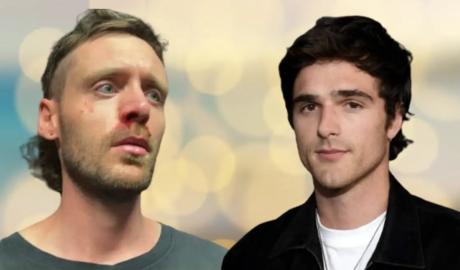
In a recording that was aired on the show, Fox can be heard introducing himself to Elordi before proceeding to give him a container. Here’s HE’s version of the conversation:
Fox: “Really random but I want to give you this…Jackie wants a birthday present.”
Elordi (reading from a piece of paper): “Jacob Elordi’s bath water?”
Fox: “She’s a big fan of [Saltburn.”
Elordi: “What am I supposed to do with this, put bath water in it?”
Fox: “Yeah, and then you could send it to the studio.”
Elordi: “Jesus, man…you’re kidding, right? God, why are there people like you on this planet?
Fox: “Seriously, it’s for Jackie O.”
Elordi: “You’re obviously goofing off like a 13 year-old but this isn’t even slightly amusing…not witty, not clever. It’s just fucking stupid. Wait, are you filming?”
Fox: “Yeah.”.
Elordi: “Can you not, man…please?”
Fox said he felt “intimidated” as Elordi got “in [his] face” and backed him against a wall. The actor’s security team was also present during the incident.
True Detective: Night Country, which I decided to stop watching last Sunday, is a relentlessly grim, noirish atmosphere puzzlebox series. Not as long or convoluted as the deeply despised Westworld series, but similiar in certain ways.
Matt of Sleaford, eight years ago: “Puzzlebox shows can be fun to chew on while they’re progressing. But the solution is almost always anticlimactic.”
Brenkilco, same post (11.28.16): “The problem with episodic TV narratives designed to blow minds is that the form and intention are at odds. A show [like Night Country] cannot by definition have a satisfying structure. It can only keep throwing elements into the mix until it collapses under the weight of its own intriguing but random complications.”