
The Howard Dean “yeeaaahhh!” scream is perfect.
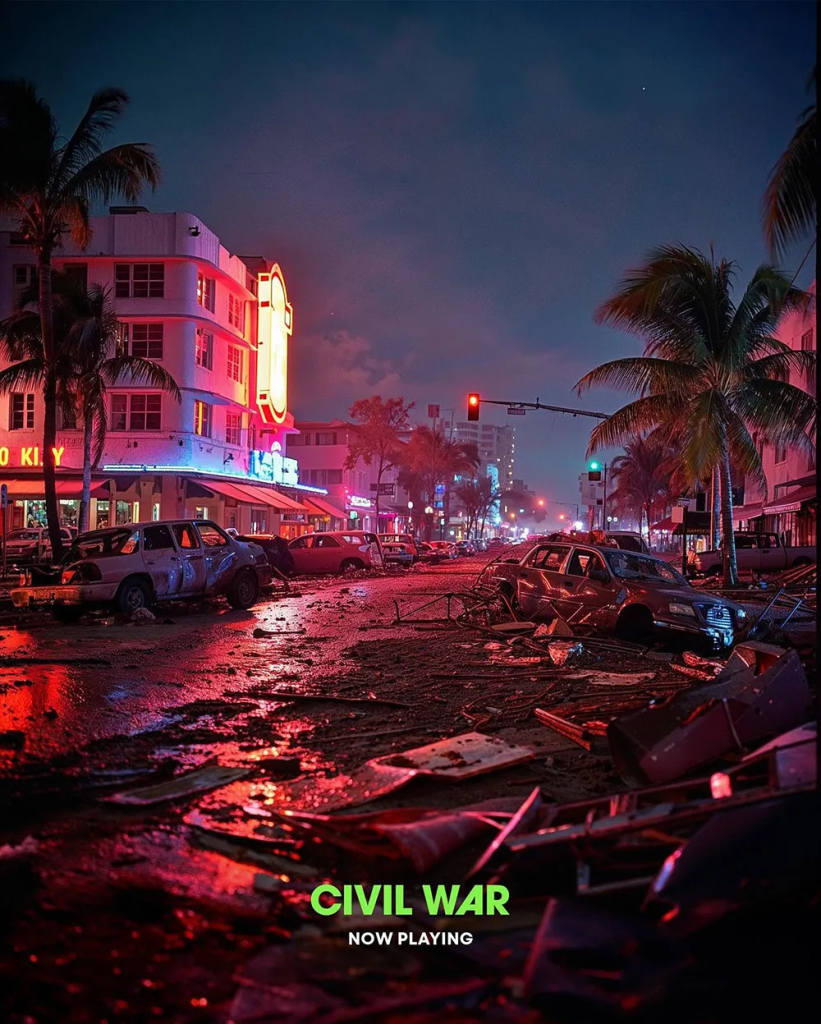
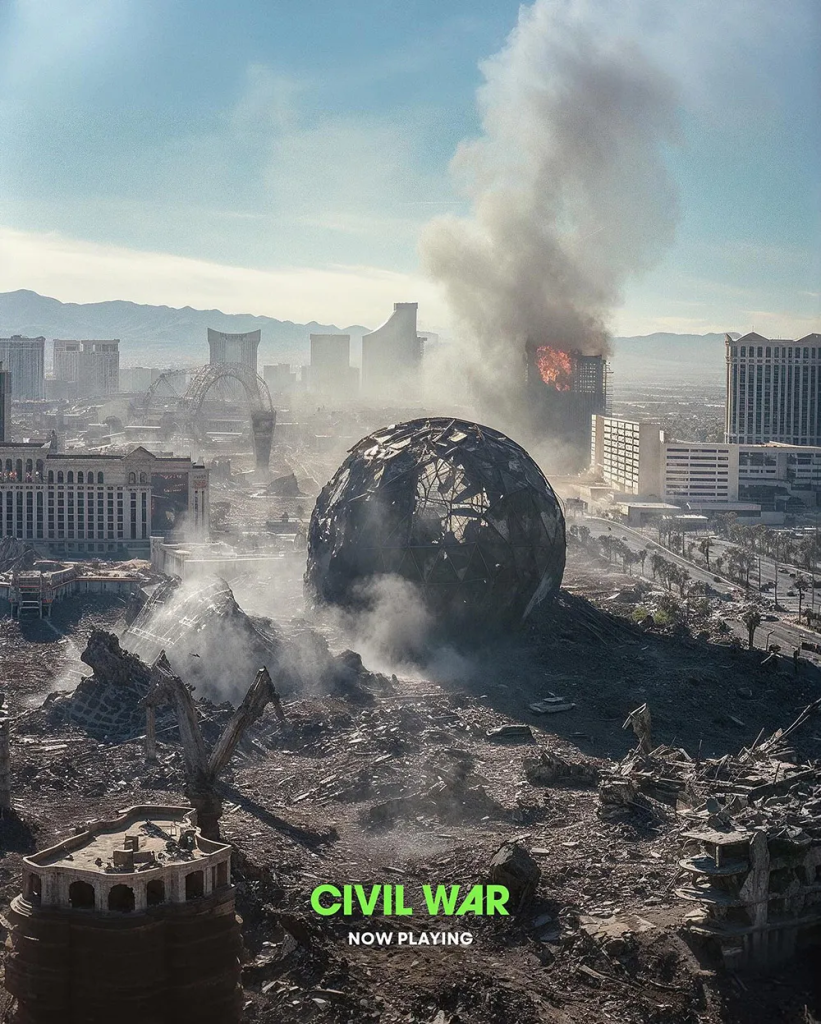
The only sensible thing to do with Trump's "Gettysburg, Wow" speech in Pennsylvania was to make a one-minute documentary film of it. These are all his real words. I added some "bing bongs" at the start. "Never fight uphill, me boys! Never fight uphill." #FunWithPhotoshop pic.twitter.com/xFQffyCa37
— Randall Stephens (@Randall_Stps) April 16, 2024
What’s the actual, no-bullshit reason for the Sundance Film Festival reportedly mulling the idea of pulling up stakes in Park City and relocating someplace else as of 2027?
Festival honcho Eugene Hernandez has offered a word-salad explanation that totally dodges whatever the actual situation might be.
Here’s the first half of Hernandez’s blah-dee-blah bullshit statement, as quoted by The Hollywood Reporter‘s Chris Gardner: “We are in a unique moment for our festival and our global film community, and with the contract up for renewal, this exploration allows us to responsibly consider how we [can] best continue [to] sustainably serve our community bullshit bullshit while maintaining the essence of the festival experience blah blah blah-dee-blah.”
Hernandez #2: “We are looking forward to conversations that center supporting artists and serving audiences as part of our mission and work at Sundance Institute blah blah blah blah blah, and are motivated by our commitment to ensure that the festival continues to thrive culturally, operationally, and financially as it has for four decades blah blah word-salad bullshit.”
HE admission: Hernandez’s statement didn’t actually include the “blah-dee-blah bullshit” stuff, but it may as well have.
Hey, Sundance Film Festival, are you listening? I’m shedding tears of joy over the news of your slow and inevitable demise. You’re essentially dead and nobody cares….in the words of the legendary J.J. Hunsecker, you’re a cookie filled with woke arsenic so get yourselves buried.
Okay, that’s a little too harsh. Let me try again. How about “you’re Frankie Pentangeli before he opened his veins and bled to death in a bathtub”? Does that work better?
Sundance will remain in Park City next January and in ’26, but they’re sniffing around for a new home. The festival isn’t decisively leaving Park City but something is prompting Hernandez and others to say “blah blah blah we’re happier and healthier than ever but we might leave,” etc.
If Sundance wants to extend its contract with Park City beyond ’26, the deadline is October 2024 — six months hence.
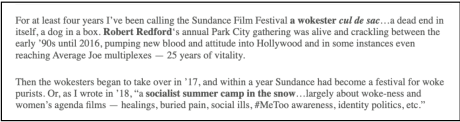
“Yes, Virginia…Sensitive Gargoyles Have Ruined Sundance,” posted on 12.27.21:
I thought he was too macho-growly in the ’70s and ’80s. These days I’m sensing more a wistful, melancholy poet thing. The lonely, put-upon Midwestern guy, having a bit of a tough time.
The section between 3:06 and 3:22 …heaven….”ooohh”
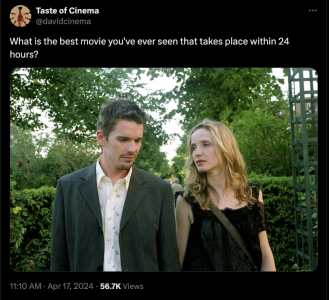
What are the best films in which the action occurs within two hours or less? (Which basically means movies told in real time.) HE picks are as follows:
1. Sidney Lumet‘s 12 Angry Men (’57) — 96 minutes
2. Stanley Kubrick‘s Dr. Strangelove (’64) — 94 minutes
3. Robert Wise‘s The Set-Up (’49) — 72 minutes
4. Richard Linklater‘s Before Sunset (’04) — 80 minutes
5. Fred Zinnemann‘s High Noon (’52) — 85 minutes
6. Steven Knight‘s Locke (’13) — 85 minutes
7. Joel Schumacher‘s Phone Booth (’02) — 81 minutes
8. Tom Tykwer‘s Run Lola Run (’98) — 81 minutes
9. Alfred Hitchcock‘s Rope (’48) — 80 minutes
10. Louis Malle‘s My Dinner with Andre (’81) — 110 minutes
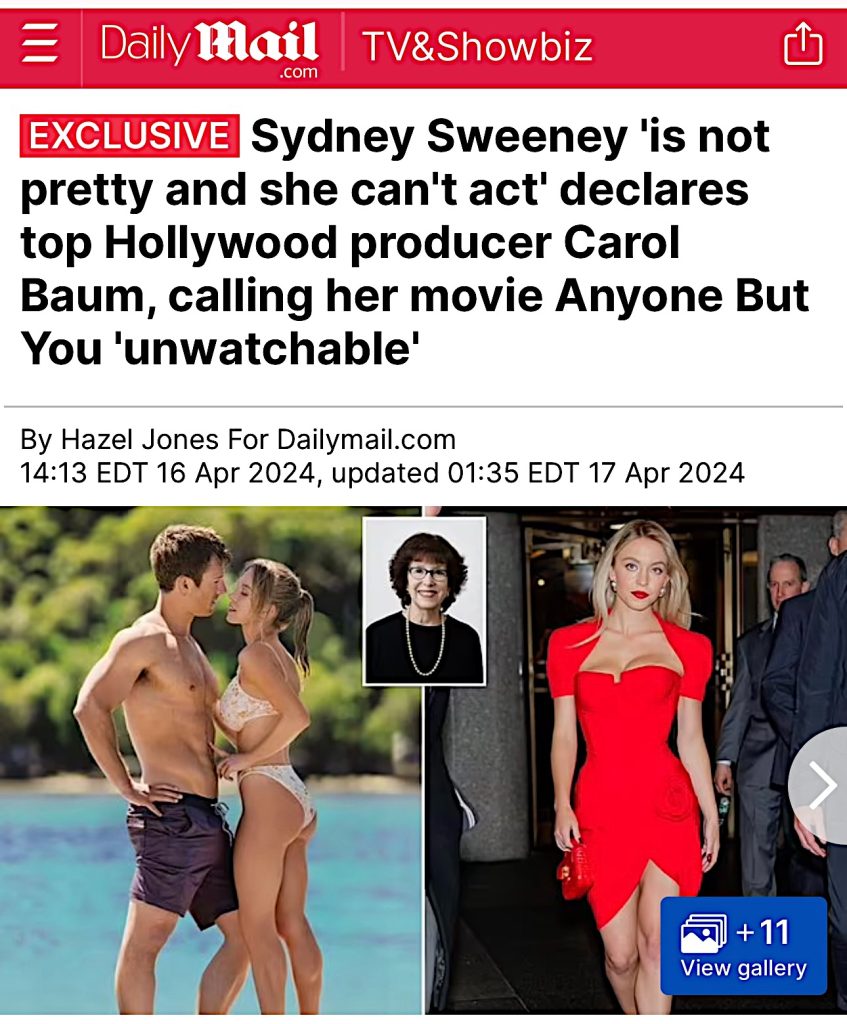
A 4.16 Daily Mail article tells me that as far as Sydney Sweeney is concerned, producer Carol Baum (Dead Ringers, Father of the Bride, The Good Girl) and Hollywood Elsewhere park their cars in the same garage.
It’s nice to be agreed with by persons of taste and accomplishment, but when Baum asked her USC students to explain Sweeney’s appeal not one of them had the courage to say “formidable rack”?
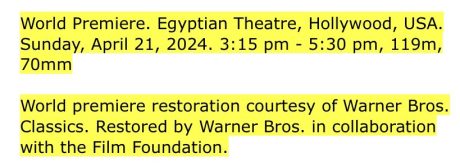
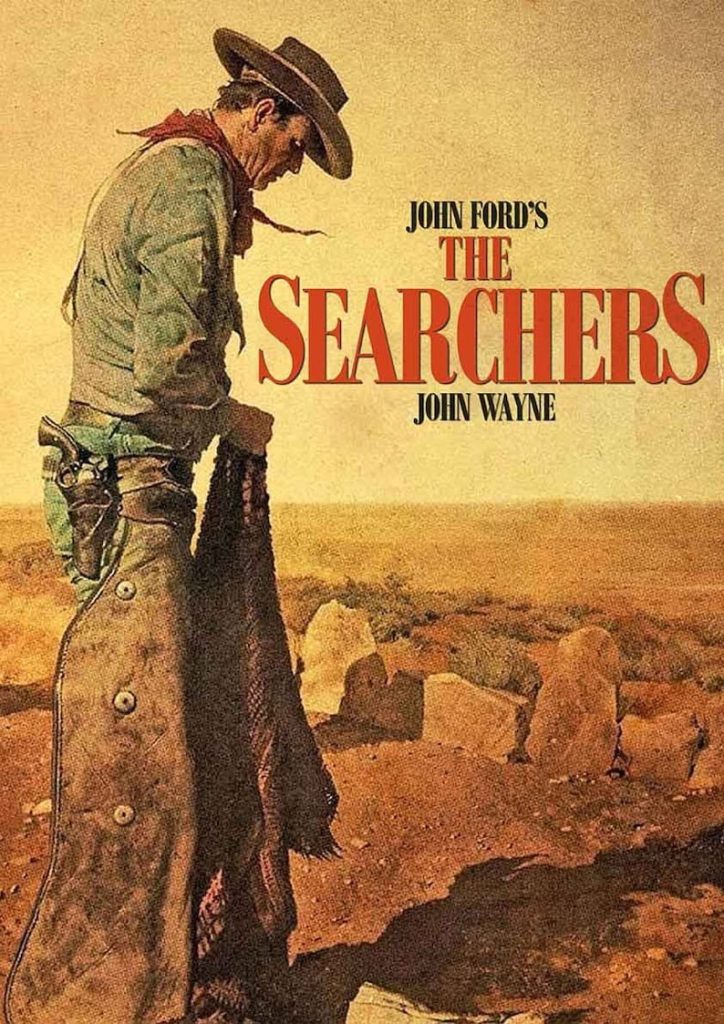
Warner Bros. and Martin Scorsese’s The Film Foundation have produced a 4K digital restoration of John Ford’s The Searchers, and in the process created a new 70mm print.
The latter will be screened five days hence — Sunday, 4.21, 3:15 pm — at Hollywood’s Egyptian, as a closing-day presentation from the TCM Classic Film Festival. Alexander Payne will offer a few thoughts.
No screenings for NYC film cognoscenti? Nothing planned for MoMA or FSLC’s Walter Reade? Or at the Film Forum or at Pleasantville’s Jacob Burns? Odd.
There’s just one problem. The Searchers is rife with problematic depictions of Native Americans. Wokesters certainly won’t approve. Don’t even speculate what Lily Gladstone might say.
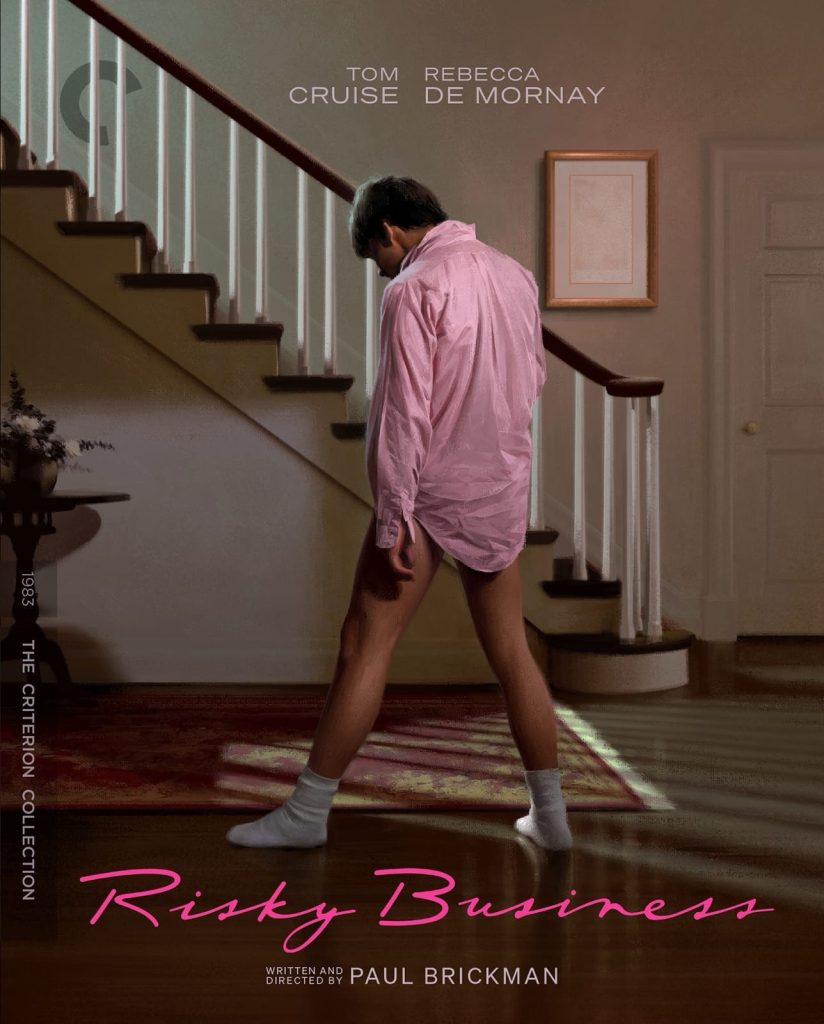
…that could been used for the forthcoming Criterion 4K Bluray, the Criterion guys chose the most rotely familiar (i.e., the dullest) and certainly the gayest.
I would have chosen a two-shot of Tom Cruise’s Joel Goodson and Joe Pantoliano’s Guido, the killer pimp. Or the car dealership guy saying “who’s the U-boat commander?” Or Cruise saying “what the fuck!” to Richard Masur’s moustachioed college-entrance guy.
I like the original theatrical cut — it’s perfect. You can have Paul Brickman’s director’s cut
“Paul Brickman‘s Risky Business reflected and in some ways defined the early ’80s zeitgeist (Reagan-era morality, go for the greenbacks, the receding of progressive ’70s culture).
“And it brought about an ungodly torrent of tits–and–zits comedies, so numerous and pernicious that they became a genre that forever tarnished the meaning of ‘mainstream Hollywood comedy.’ But Risky Business was a perfect brew.
“The Tom Cruise-Rebecca DeMornay sex scenes were legendary, the vibe of upper-middle-class entitlement was delivered with natural authority, Joe Pantoliano‘s Guido is arguably a more memorable character than his Ralph Cifaretto in The Sopranos, and the opening dream sequence is just as funny and on-target in its depiction of encroaching doom as Woody Allen‘s Bergmanesque train-car sequence at the beginning of Stardust Memories.
“I had an invite to a special Risky Business screening at the Beverly Hills Academy a week before the opening, but I blew it off because a girlfriend was visiting that night and things were hot and heavy at the time. I wound up catching it ten days later at a theatre in Westwood, and I remember saying to myself after it ended, ‘Wow, what I was thinking when I missed that screening?’
“I remember sitting at the long-ago-shuttered Joe Allen (Third Street across from Cedars Sinai) a month or two after Risky Business opened, and noticing Cruise and DeMornay sitting at a darkly lighted table together, apart from the crowd.
“HE’s all-time favorite sex scene is the one on the Chicago “L” between Cruise (by anyone’s measure an unlikely participant in this realm) and DeMornay. It’s perfect because like any transcendent sexual encounter it feels levitational — orchestrated, finely tuned, rhythmic, musical. It multiplies and compounds the sexual train metaphor that Alfred Hitchcock created in that last shot in North by Northwest, and it ends with that perfect (i.e., very subtle) electric train-track spark.”
Last night I saw Luca Guadagnino and Justin Kuritzkes‘ Challengers (Amazon, 4.26), and as far as “tennis pros engaged in romantic triangle” flicks go it’s fairly out there, man.
Challengers hasn’t been written and shot in my preferred style (like King Richard, my all-time favorite tennis movie) but I respect and admire the fact that Guadagnino, the director, has made a jumpy, flourishy, time-skotching, impressionistic, mostly hetero but also vaguely homoerotic film that…what’s the term, broadens your horizons? Challenges you and wakes you up? Makes a dent in your psyche?
It doesn’t do the usual thing and certainly pushes a few boundaries, but I like that for the most part. I certainly prefer films that try different strategies over ones that adhere to predictable ones.
So, putting this carefully, I didn’t love everything about it (which puts me in a minority) but I loved the verve, the effort, the invention, the ballsiness. I was irked here and there but I certainly wasn’t bored. All in all the audacity and impulsiveness of Challengers makes it Guadagnino’s best film since Call Me By Your Name. Really.
One of the less predictable aspects…,okay, a vaguely annoying thing is the hopping-around timeline, which I lost patience with around the halfway mark.
Another unusual thing is that the three main characters — Zendaya‘s Tashi Duncan, Mike Faist‘s Art Donaldson and Josh O’Connor‘s Patrick Zweig — aren’t especially charming or likable or even attractive. Not to me, at least.
Compelling or intriguing actors are supposed to turn you on or at least engage your interest or empathy. Or arouse your blood.
If you’re a straight male you should either want to be like a straight-male protagonist or two on the screen, and you should be thinking about possibly fucking the lead actress. I had no such thoughts during Challengers (sorry), but others may feel differently. It takes all sorts, etc.
The story is a little confusing but here goes: Duncan, a former tennis player sidelined by injury, is now coaching Donaldson, her husband of a few years and a hotshot tennis star who’s on some kind of losing streak. Duncan met Donaldson and Zweig 11 or 12 years earlier and was attracted to them both, which led to some heated hotel-room smooching all around. (No — the dudes didn’t fuck each other.) Duncan married Donaldson but now Zweig is back in the arena and looking to beat Donaldson in a big match, and so Duncan is looking to somehow influence Zweig’s attitude or psychology or something…shit, I’m losing the thread.
Zweig is a bad boy with an impulsive, unstructured approach to everything outside of tennis…a guy who likes to fuck for fucking’s sake and otherwise enjoys poking at situational hornet’s nests. I didn’t “like” Zweig but O’Connor, a sinewy, dark-haired sweat beast who played Prince Charles in The Crown, has something…he’s the best of the bunch.
Challengers also the sweatiest film I’ve seen ever. I felt dampened by Faist’s sweat droplets.