One of the reasons Evita works as well as it does (in my book it’s a great movie musical) is the editing, which really follows and fortifies the music. The late Gerry Hambling (1926-2013), a longtime collaborator with director Alan Parker, understands the cadence and discipline that goes into good cutting. Apply the Parker-Hambling aesthetic to the cinematography by Darius Khondji, and the result is just about perfect.
Month: February 2025
Hungry To See Franco’s “Dreams”
From David Rooney’s THR Berlinale review of Michel Franco‘s Dreams, which costars Jessica Chastain and Isaac Hernández:
“Franco’s story could easily have been the skeleton for a lurid erotic thriller about a possessive rich American woman claiming ownership of a Mexican boy toy a decade or more younger than her. But the director and his actors play it with neither sensationalism nor melodrama. Instead, it’s a laser-focused study of the shifting calibrations in an uneven power dynamic, in which Jennifer is unwilling to concede the upper hand, ultimately becoming ruthless when the tables are turned.
“When Fernando’s talent gets him a foot in the door at the prestigious San Francisco Ballet without her help, she’s rankled. Though not so much that she doesn’t resume the relationship and set him up as a teacher at the new studio. The desire between them is palpable when he returns to her home and is welcomed back with a steamy session on the stairs. But when first Jake and then her father figure out what’s going on, Jennifer takes steps to protect her position in both the family and the well-heeled arts community.
“The strict boundaries put in place by wealthy benefactors are evident in Michael’s cautionary chat with his daughter, carefully worded to address what he views as a distasteful situation: ‘I’m happy that you help immigrants. But there are limits. You know what I’m trying to say.’
“Dramatic events abruptly end Fernando’s ascent at SFB, landing him back in Mexico City, where a still intoxicated Jennifer soon follows. But the harmony between them is broken, notably after an eye-opening revelation that prompts Fernando to take drastic steps. That in turn leads to decisive retaliation from Jennifer, who does not respond well to humiliation.
“The escalating tension of that final act is as shocking and violent and viciously cold as anything in Franco’s filmography, which has seldom shied away from stark depictions of human cruelty — whether intimate in scale, like After Lucia, or encompassing explosive societal conflict, like New Order.
“As terrific as Chastain was in Memory, she’s arguably even better here playing a manipulative woman whose passion for Fernando is genuine — unbridled on the physical side and probably even sincere on a deeper emotional level, albeit with guardrails in place. It’s easy to see why the actress was eager to work with Franco again.
“She makes Jennifer’s impulsive final decision as startling as an execution sentence, though it strikes a blow that will cause more lasting pain. Her cut-glass cheekbones could draw blood.
“As an embodiment of a white person cushioned by money and privilege putting an upstart in his place, she’s chilling, even if she’s clearly also hurting herself.”
With Broccoli-Wilson Bought Off, Bond Loyalists Shudder With Apprehension
Other than the usual financial incentives, there’s one and only one reason to keep making semi-traditional James Bond films. That motive would be to trumpet a message of rogue defiance to the wokeys and woke go-alongers (Tomris Laffly, Justin Chang, Kathy Kennedy, Chalamet-like girlymen) that good old Bond shit — macho exceptionalism, subtle arrogance, shades of impudence and homicidal dispatch when necessary — still counts or matters on some level, at least in a nostalgic sense.
Do audiences of the mid 2020s have an active interest in seeing more Bond flicks? Good question.
25 Bondies have been released since 1962’s Dr. No. I happen to feel that Dr. No and From Russia With Love are still the best of the bunch — certainly the most freewheeling and least encumbered with the terrible burden of fortifying a major franchise. I regard the Daniel Craig Bonds as better than decent, but I’ve generally preferred the Mission: Impossible films overall. I wouldn’t be hugely distraught if the 007 franchise just gave it up and shut the fuck down. I’m not invested. I don’t really care anymore.
But if more Bond films are going to be made, as Amazon is apparently intending to do in the wake of having booted longtime Bond producers Barbara Broccoli and Michael G. Wilson off the bus with a lavish “go away” payment, they should be made with conviction and honest cynicism and maybe even a touch of reverence. No more apologies or equivocations. Own the Bond mythology like Mel Gibson owns Jesus of Nazareth.
This is highly unlikely, of course, with Amazon honcho Jennifer Salke, a feminist wokey who’s no fan of 007 (she is believed to have been the voice behind an incendiary quote — “I don’t think James Bond is a hero” — in a 12.19.24 Wall Street Journal article) and has allegedly not even seen any pre-Daniel Craig Bond films
It was announced earlier today that Amazon MGM Studios will gain creative control of the James Bond franchise, while Wilson and Broccoli will remain co-owners of the 60-year-old property.”
Eric Schwartzel and Jessica Toonkel‘s Wall Street Journal piece reported two months ago that a lack of movement on greenlighting a new Bond film had been caused by an “ideological split” between Salke on one side and Broccoli and Wilson on the other. I called it a “feminist wokey vs. semi-traditionalist Mexican standoff.”
Here’s what happened in the aftermath of that WSJ piece, says a guy wih an ear to the ground:
“Salke is an idiot, and she basically got herself into hot water over this having become a public spat. Her boss Jeff Bezos is a Bond junkie, however, and to get things moving he paid off Broccoli and Wilson with all the money in the world. Salke still gets to call the shots, but she’s bracketed by film pros and under more scrutiny from Bezos.”
Daily Mail, 12.20.24: “Broccoli has told friends that the people at Amazon are ‘fucking idiots.’ Salke is “reportedly demanding ideas for new Bond movies, although Broccoli has seemingly no interest in making them with the studio.”
Broccoli has told telling colleagues she doesn’t trust “temporary people to make permanent decisions”, according to Schwartzel and Toonkel.
Sick, Sedated, Exhausted
For the last two days I’ve been preparing for an unpleasant invasive procedure that I’m not going to describe. The 24-hours-before prep is awful. I don’t want to think about it, but the bitter-licorice-tasting liquid you have to drink is nauseating.
The procedure happened today around noon. I was out for 90 or 100 minutes, and the after-effect of the knock-out sedative is still with me, like a Percocet blanket. When I returned home at 2:30 pm, I just flopped and dropped off.
Plus for the last three or four days I’ve been coping with a cough, sneezing and a runny nose. My voice is significantly deeper and more nasally as we speak. I wish I could sound like this all the time. I almost sound like Lee Marvin in The Professionals.
My health, in short, is at a low ebb, although I did receive good news from the attending physician. Don’t ask.
Pitchforking As An Easy, Instant Default
In Tomris Laffly’s mind, Kevin Spacey should once again be hunted down by villagers and peppered with woke buckshot…condemned, hoisted, lashed and repeatedly dunked in a lake for longer and longer periods until he, like, drowns.
If Curtis Hanson had cast me as Detective Ed Exley in L.A. Confidential, and if, during filming, Kevin Spacey (i.e., Detective Jack Vincennes) had fallen into the habit of patting my ass or whatever, I would have eventually taken him aside, looked him in the eye and said in a friendly, no-big-deal way…
“Look, Kevin…you need to let this go…nobody’s offended and we’re both cool but, you know, you aren’t going to wind up fucking me in the ass. I’m an adult and so are you but stop with the discreet overtures, okay? I’m into fucking girls in the ass, kapeesh? You can handle it, bro. Just pounce on some other dude.”
And if I had paid Spacey a visit in Savannah while he was shooting Midnight in the Garden of Good and Evil a few months later, I would have re-explained things.
HE to Spacey: “I know it seems weird that I’m here in Savannah after I told you point blank that I’m not going to be your Crisco bitch, but the same deal still applies. No bending over and squealing like a pig, and I’m saying this as one who was approached at age 18 in the West Village by a 30something guy in a jacket and tie and asked ‘have you ever had your ass sucked?’ I said ‘no thanks’ then and I’m saying it again now. And it’s not a problem.”
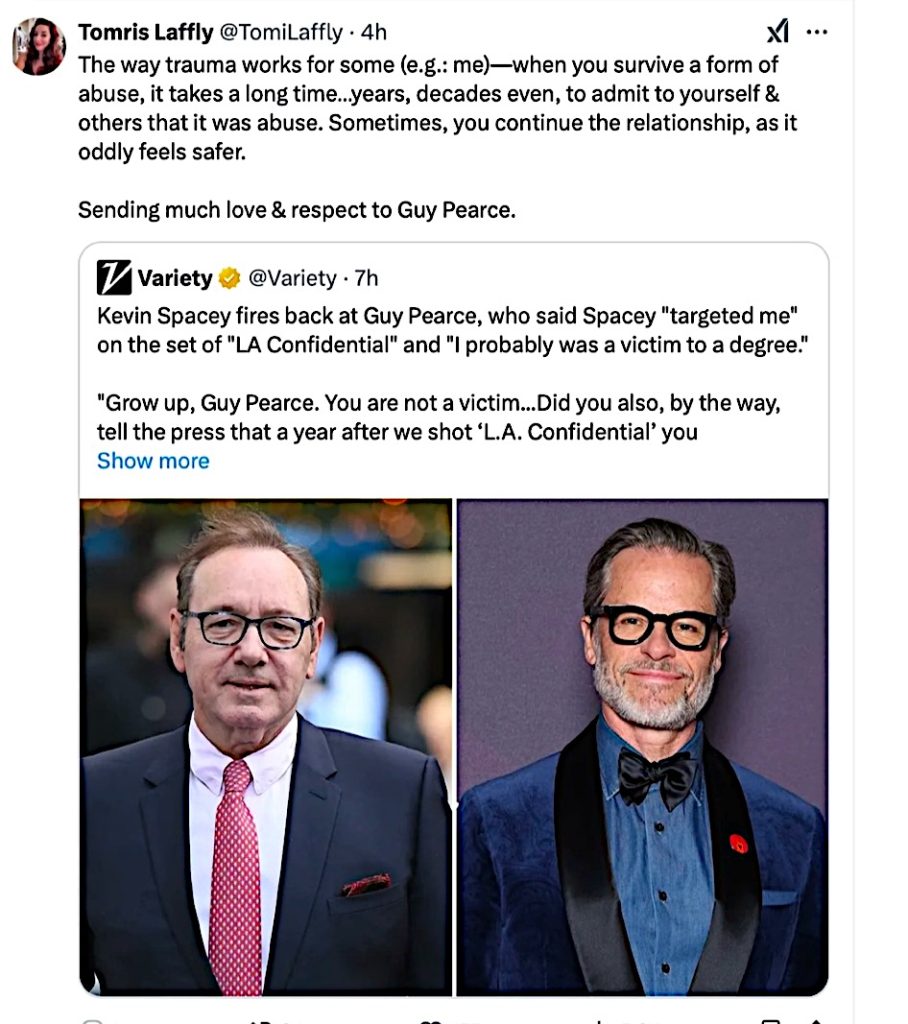
Laffly, deep down, pines for the Joe Biden era of instant cancellation and sending offenders straight to the guillotine. Five years (‘19 through ‘23) that sent jolts of fear through the systems of arrogant conquistadors all over…she would have that time again.
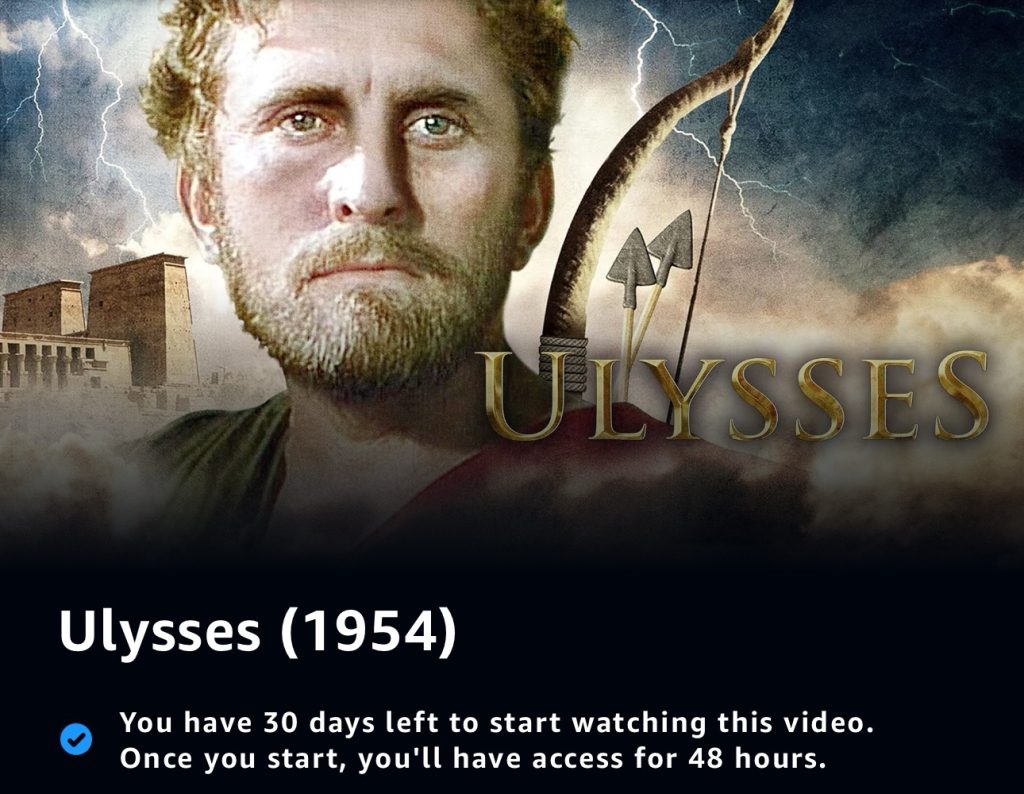
Giving “Ulysses” Another Chance
The Amazon rental is only in standard definition, but the aspect ratio is 1.37. Plus it’s spoken in Italian (the almost constantly bare-chested, loin–clothed Kirk Douglas is dubbed) with English subtitles.
But you know what? It’s an intelligent film —low-budgety but honorable — unmistakably better than the Steve Reeves Hercules films at the very least.
The story moves along, it’s well-paced, the dialogue (partially written by Ben Hecht and Irwin Shaw) is better than servicable and almost eloquent at times. It’s even haunting here and there…a world of gods and sirens and crude, man-eating giants.
Found unconscious and memory-less on a beach by Rosanna Podesta, Ulysses is immediately regarded as a noble fellow, and Douglas sells this by behaving with restraint and dignity, by radiating a certain inwardness. One senses a man of maturity, thought, consequence.
I knew early on that I’d slagged this film unfairly. It’s really not half bad. It’s regrettable that HD streaming isn’t an option — what I saw last night looked like 16mm.


Spacey Quickly Responds To Pearce
My first reaction to the Guy Pearce-Kevin Spacey thing was that I needed to listen again to Scott Feinberg‘s whole discussion with Pearce, but then again it’s all been transcribed.
Did the stuff about “handsy” Spacey come up in the wake of Scott and Guy discussing his Brutalist industrialist having sexually assaulted Adrien Brody?
Did one form of sexual aggression (dramatically performed) lead to another (actual real-deal), or am I misunderstanding?
We’ve all heard about Spacey’s fabled sexual aggression. But Pearce has weeped over…what, his recalling that Spacey wanted to sexually possess or dominate him during the L.A. Confidential shoot without having actually done so? Did “handsy” Spacey pat Pearce on the ass or something? Did Pearce feel menaced on some level? What actually happened?
Spacey responded earlier today:
@tmz #KevinSpacey is vehemently denying #GuyPearce's ♬ original sound – TMZ
Spacey: “We worked together a long time ago. If I did something then that upset you, you could have reached out to me. We could have had that conversation, but instead, you’ve decided to speak to the press, who are now, of course, coming after me, because they would like to know what my response is to the things that you said.
“You really want to know what my response is? Grow up.”
“I mean, did you tell the press that [you camet to visit me on the set of Midnight in the Garden of Good and Evil too, or does that not fit into the victim narrative you have going?
“I apologize that I didn’t get the message that you don’t like spending time with me. Maybe there was another reason, I don’t know, but that doesn’t make any sense. That you would have just been leading me on, right? But here you are now on a mission, some 28 years later, after I’ve been through hell and back.”
Matt Damon as 55-Year-Old Odysseus
…vs 38 year-old Kirk Douglas as the titular Ulysses, which was shot in 1954.
I’m sorry but an ancient adventure tale focusing on a rough-and-ready fellow in the prime of life (lae 30s) is obviously different if the central figure is creased and weathered and approaching the final chapter (60-plus). You can’t dispute this. You can’t deny the ironclad terms of the clock.
Damon will soon play Odysseus in Chris Nolan‘s The Odyssey (Universal, 7.26.26), which sounds hugely interesting and which will certainly rank as Nolan’s costliest film ($250 million).
71 years ago Douglas played the same Greek character (Ulysses is the Romanized or Latinized version of Odysseus) in a much more modestly budgeted film…basically a cheeseball popcorn flick aimed at the serfs and none-too-brights.
Douglas was age-appropriate for the role of a brawny, wandering adventurer, but the real-life Damon — face it — is too long of tooth. It would be one thing if Damon was 45, but he’s a decade past that.
The real-life Damon is now at an age where men have more or less figured things out and have put down roots and are nurturing families, And yet following the Trojan War Nolan’s old-guy Odysseus has failed to return to his wife and son for years, sailing the Aegean an infinitum, grappling with the Cyclops and the Sirens and going for the gusto and whatnot?
The time for that adventure-for-its-own-sake shit was 10 or 20 years ago, dude. Stand up, act your age and be a responsible man.

Who needs ten years to return home? A year or two, maybe, but not a full decade. Odysseus’s wife Penelope (apparently to be played by Anne Hathaway in Nolan’s film) had logical suppositions that would lead any reasonable woman to believe that her husband is dead. Who wouldn’t presume this after a couple of years?
What kind of wife shrugs her shoulders and says, “Ah, well…my husband has obviously been delayed on his way home, but I trust that he’ll return so I will wait and keep myself chaste until the glorious day of arrival.” Commendable but not when you’ve been waiting ten fucking years. That’s ridiculous.
What if Odysseus couldn’t find his way back until 12 years have passed? Or 15 or 20? How many years of absence are tolerable or understandable? I say no more than two. Okay, three max.
If I were Penelope I would say after four or five years, “All right, screw it…Odysseus has obviously drowned or been killed or has settled down with another wife somewhere. I guess it’s time to start thinking about finding a replacement husband. What am I supposed to do? Wait until I’m 50 or 55 years old?
“And someone younger this time. My husband had begun to slow down, erection-wise, before he left. God knows what he’ll be like in the sack when he returns. If I’m going to remarry I want a man with a phallus like a piece of petrified wood.”
And so, naturally, the word gets out and several suitors start hanging around Penelope…all of them looking to “make it happen”. But then Odysseus finally returns, and in a big thundering climax he and his son Telemachus murder all the guys who were hoping for a little Penelope action.
Dying would-be suitor, arrow in his chest, bleeding on the floor: “What the fuck, dude? You’ve been gone for ten years and you expected your wife to…what, just wait and wait and wait? If you had been among us and some other king of Ithaca had been absent for ten years, you know you’d be looking to win Penelope’s favor and maybe discreetly do her on the side when no one’s looking…you’d be acting no differently. So why have you and Telemachus killed so many of us? What have we done that is so awful? Nothing.”
Douglas’s version was mostly a pasta-and-tomato sauce costumer, produced by Dino de Laurentiis and Carlo Ponti. Whereas Chris Nolan’s The Odyssey will go for a deeper, classier tone, and it could even veer into the spooky.
Odysseus, Telemachus, Antinous, Nausicaa, Alcinous, Eurylochus, Hepatitis, Diabetes, Archimedes…I tend to devolve into a Woody allen mindset when contemplating anicent Greeks.
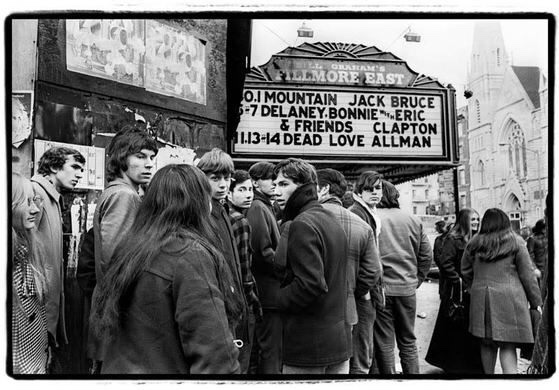
Smallish Live-Rock Venues Lasted For Roughly 4 Years (’68 to ’71)…Over a Half-Century Ago…Never To Return
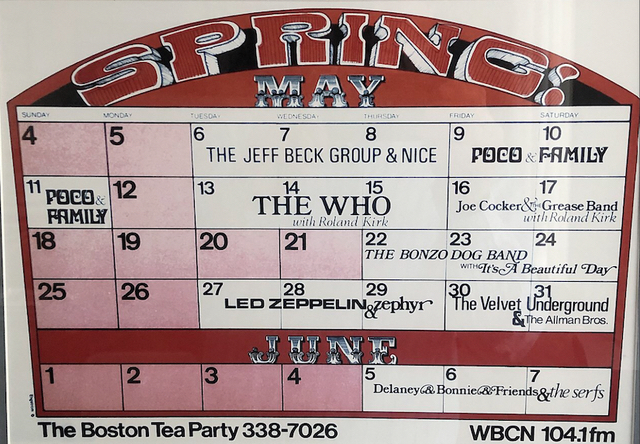
“Boston Tea Party (Preferred)“, posted on 1.4.21: The Boston Tea Party, which ran from early ’67 to early ’71, and was really cooking during ‘69 and ‘70, was arguably the most glorious, super-charged small venue for live rock bands ever…smaller than the two Fillmores and with one serious headliner after another, or at least part of the time.
The whole four-year schedule. Three-night bookings for the most part. During one two-night engagement in May ’69 they actually had the Allman Brothers open for the Velvet Underground.
The first BTP venue was at 53 Berkeley St, Boston, MA 02116. In July ’69 they moved to 15 Landsdowne Street, near Kenmore Square.
HE to seasoned rock journalist: “Big-arena concerts allegedly didn’t become a major thing until ‘71 or ‘72 or thereabouts. Small venues like the two Fillmores and the Boston Tea Party flourished during a certain window that began in ‘67 and ended around ‘71, which is when major groups began declining these venues because there was so much more dough in big arenas.
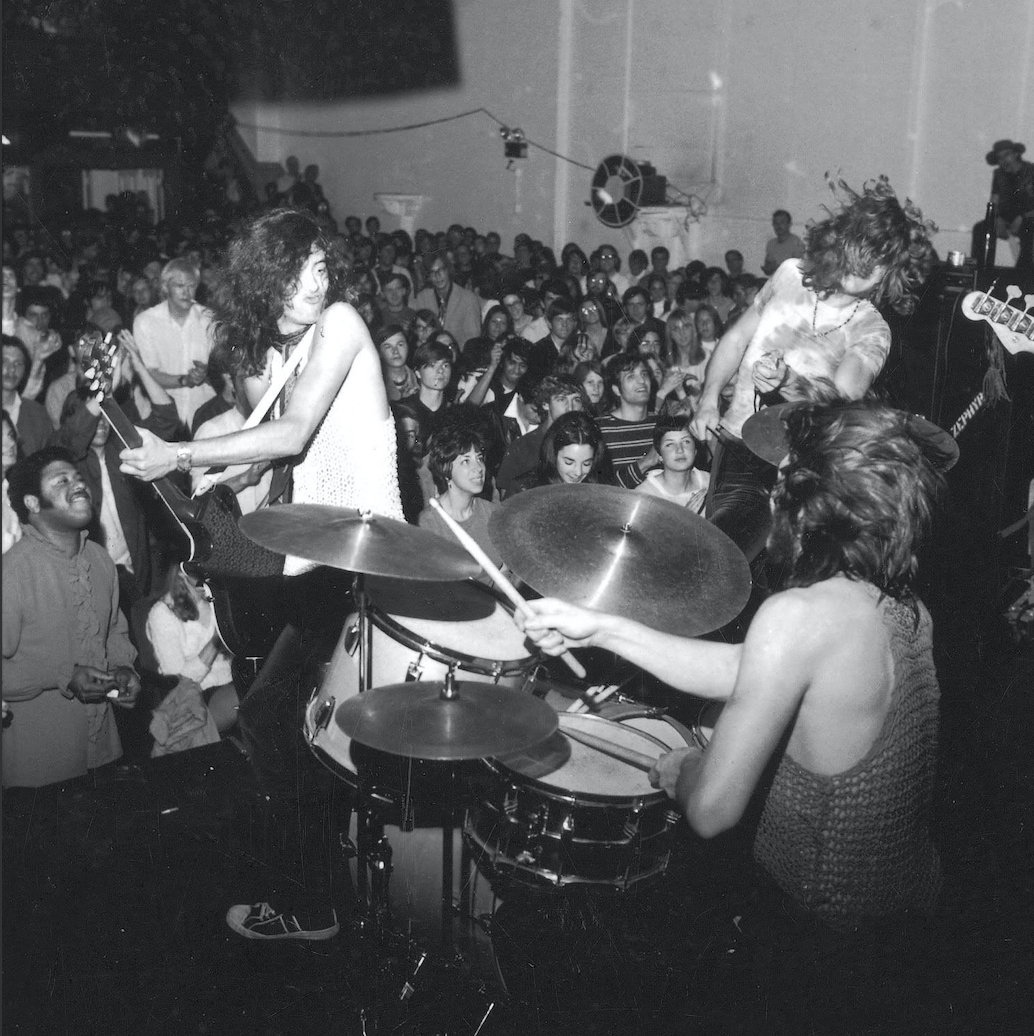
During Led Zeppelin’s January ’69 engagement
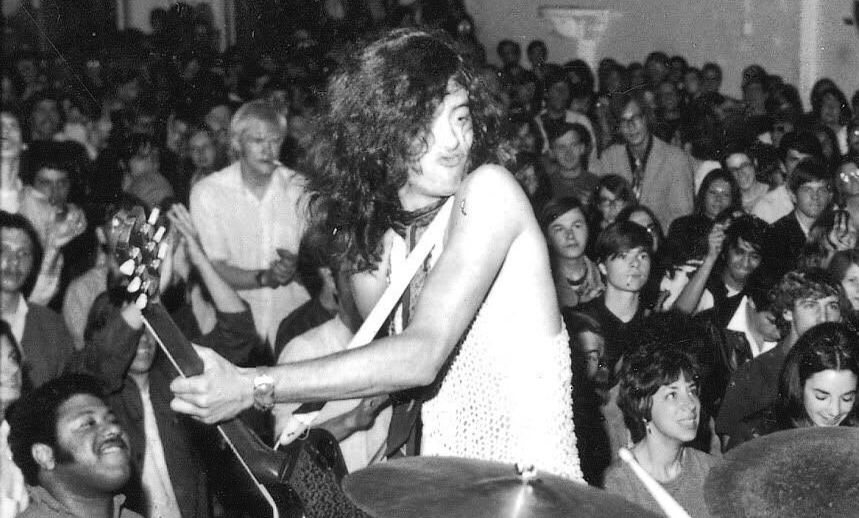
“Do I have this right? You were right in the thick of it back then.
“The golden era for the Tea Party was ‘69 and ‘70. My God, look at the acts they had! The BTP was the size of a typical high-school gymnasium. Maybe a tad smaller. I caught three or four shows at the Fillmore East but nothing compared with the sheer physical closeness of the Tea Party…you could get close enough to smell their sweat. It was glorious, tangible, alive.
Seasoned rock journalist to HE: “You’re pretty accurate with this. The big arena shows started around ’69 too, with the Rolling Stones and Led Zeppelin usually being the ones who pushed the envelope into stadiums later, around ’73.
“Tea Party was famously one of the hot places where the audience and band could [groove as one]. The Fillmores, of course. The Grande Ballroom in Detroit was also one of those small, hot places where the British bands would often play…bands like Jeff Beck Group and they’d blow the roof off. Santa Monica Civic on the West Coast was in between, a little bigger, but amazing for crowd/music/intimacy, like David Bowie’s first show there.
“Also one of the small rooms that bands loved was the Warehouse in New Orleans, home of many explosive small-room nights. The Allman Brothers Band would tear it up at a place like that. Basically, even through the mid-70’s, you might catch a big band playing one of those smaller places just to blow off steam and have a no-pressure gig or record something live with a smaller, great crowd.”
“The BTP closed it in early 1971 as the face of rock & roll was changing to larger venues. The Tea Party’s demise followed that of Philadelphia’s Electric Factory and shortly preceded the same for the two Fillmore’s.”
Boston Tea Party Freakout
The second Boston Tea Party (the one on 15 Lansdowne Street, just off Kenmore Square and across from Fenway Park) was in business only a year and a half — July 1969 to December 1970. But man, what a hallowed place, what a holy temple of purification.
I attended several ear-pounding, spirit-lifting sets inside that fabled venue, but my most vivid memory isn’t musical — it’s my LSD freakout episode…a psychedelic meltdown that led to my forsaking hallucinogens forever and eventually renouncing marijuana. Yes, even that.
I was living with a crew of upper-middle-class drug dealers…friends from Wilton who were moving huge amounts of weed, heavy amounts of LSD inside clear plastic bags, and Vietnamese heroin. We lived in a large basement apartment at 467 Commonwealth Ave., and we all felt happy and churning and generally delighted with everything. Plus we were fastidious and flush and wore Brooks Brothers shirts….we had it all down.
On New Years’ Eve (’69 into ’70) we all attended a Boston Tea Party featuring the Grateful Dead and The Proposition, a Cambridge-based improv comedy group that featured Jane Curtin.
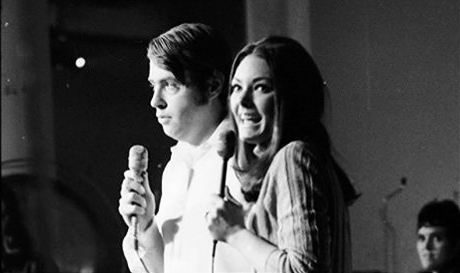
Except before walking over we all passed around a kind of rubber-lined goatskin container of Kool-Aid, which had been liberally spiked with LSD. Too liberally. It was soon apparent that the Kool-Aid was way more potent than anticipated, and roughly an hour into the Proposition set I began to feel increasingly anxious and creeped out, and then full-on paranoid.
I remember several details about the Curtin/Proposition performance as my psyche devolved into pudding. Curtin and and some schlumpy-looking guy played young married tourists from the Midwest who were experiencing Boston’s counter-culture scene for the first time, and feeling disoriented and a bit frightened.
Later in the set a comedy bit struck some kind of cosmic wowser chord, prompting a none-too-bright audience member to exclaim out loud, “Whoa, that’s heavy!” In response to which a Proposition performer looked at the guy and said “yeah, wow, man…too many tabs!”
That was me — too many ground-up tabs in the Kool-Aid had led me me into a place of, like, quaking disorientation. As in “uh-oh….uh-oh.” I began to feel as if I was standing next to a manhole-sized opening, and I knew that if I somehow fell into that hole I would lose my mind and never know sanity again.
Hunter S. Thompson knew this all too well. He called it “the fear.”
I begged a friend for help, and we wound up going back to the pad. He gave me some downers as well as an anal suppository It took a couple of hours but I eventually settled down. I knew after this horrific episode that I would never, ever drop acid again. (And I had tripped a good 15 or 20 times before, mind, and the Bhagavad Gita spirit had always prevailed.) And then a year or two later I discovered that pot highs had the potential of re-awakening “the fear” so I stopped that activity also.
From Thompson’s “Fear and Loathing in Las Vegas“:
“Good mescaline comes on slow. The first hour is all waiting, then about halfway through the second hour you start cursing the creep who burned you, because nothing is happening and then ZANG! Fiendish intensity, strange glow and vibrations…a very heavy gig in a place like the Circus Circus.
“’I hate to say this,’ said my attorney as we sat down at the Merry-Go-Round Bar on the second balcony, ‘but this place is getting to me. I think I’m getting The Fear.’
“’Nonsense,’ I said. ‘We came out here to find the American Dream, and now that we’re right in the vortex you want to quit.’ I grabbed his bicep and squeezed. “You must realize,’ I said, ‘that we’ve found the main nerve.’ ‘I know,’ he said. ‘That’s what gives me The Fear.’
“The ether was wearing off, the acid was long gone, but the mescaline was running strong. We were sitting at a small round gold formica table, moving in orbit around the bartender.
“’Look over there,’ I said. ‘Two women fucking a polar bear.’
“Please,” he said. “Don’t tell me those things. Not now.” He signaled the waitress for two more Wild Turkeys. “This is my last drink,” he said. “How much money can you lend me?” “Not much,” I said. “Why?” “I have to go,” he said. “Go?” “Yes. Leave the country. Tonight.” “Calm down,” I said. “You’ll be straight in a few hours.” “No,” he said. “This is serious.” “George Metesky was serious,” I said. “And you see what they did to him.” “Don’t fuck around!” he shouted. “One more hour in this town and I’ll kill somebody!”
I’ve Never Posted Anything Like This Before
But somehow Mikey Madison‘s lack of guardedness…her lack of deflection or evasion….got to me. I bought into the vibe. It felt genuine.
Guadagnino’s Sexual Accusation Meltdown Drama Will Stir Best Actress Talk for Julia Roberts
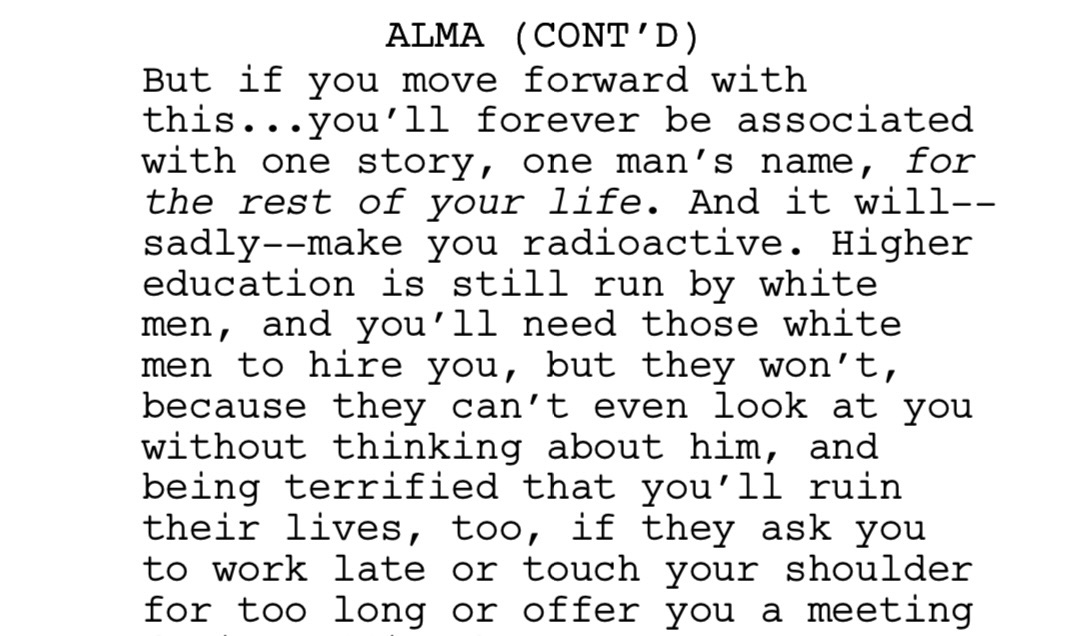
Yesterday I read an early draft of Nora Garrett‘s After The Hunt screenplay, a #MeToo rape accusation drama that feels like a splicing of Todd Field‘s TAR, David Mamet‘s Oleanna and Ruben Ostlund‘s The Square.
It’s the basis of an upcoming Luca Guadagnino film that MGM-Amazon will release on October 10th — a whipsmart, dialogue-driven, pressure-cooker thing with Julia Roberts toplining.
Strong supporting performances from Andrew Garfield, The Bear‘s Ayo Edebiri, Michael Stuhlbarg and Chloe Sevigny will presumably round things out.
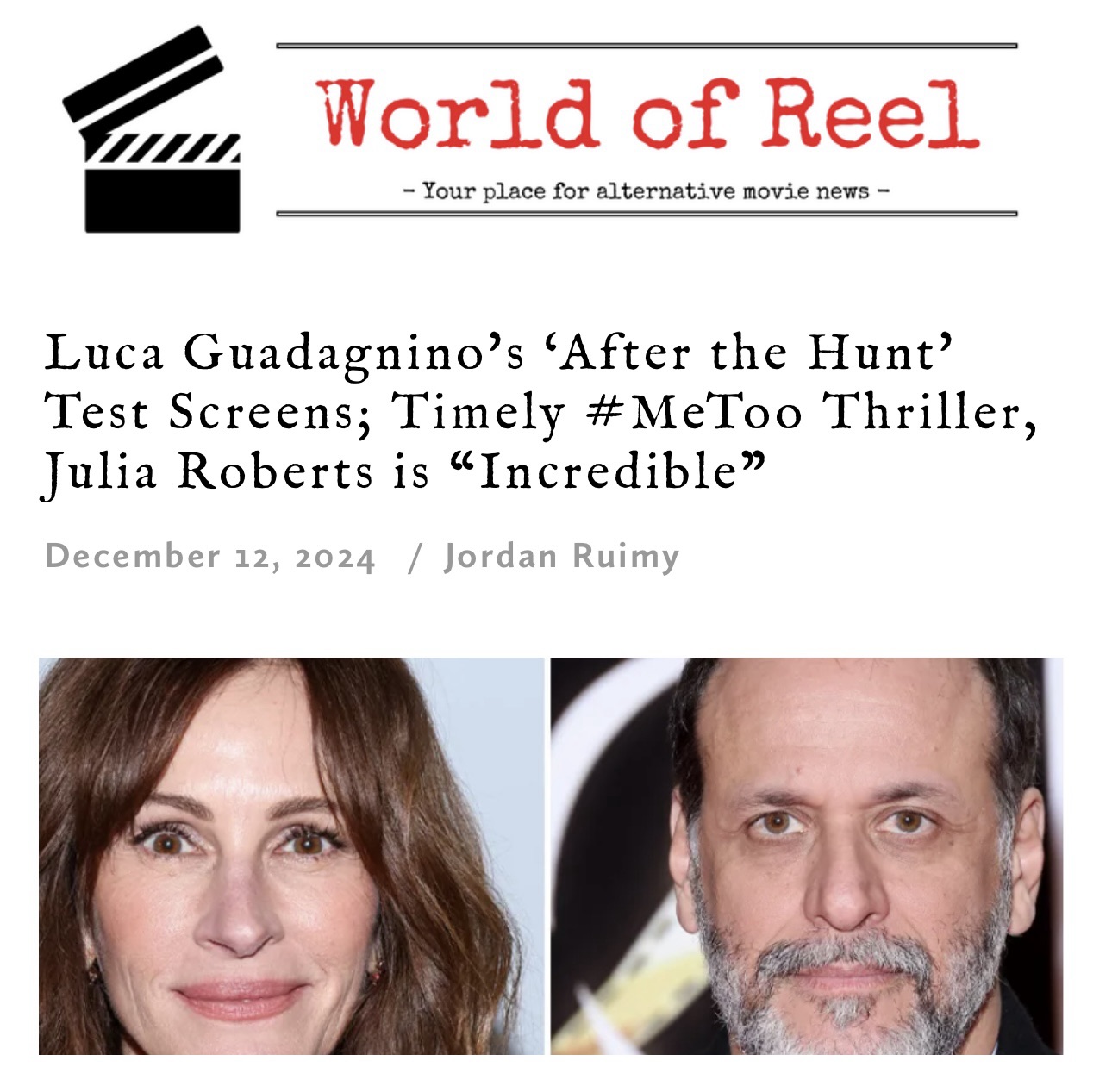
World of Reel‘s Jordan Ruimy recently reported that Hunt had test-screened in early December. He also sketched it out as one of those jarring, controversial, hot-button melodramas that stir the soup among educated audiences.
HE is guessing Hunt will debut six months hence at the Venice Film Festival.
Garrett’s page-turning screenplay (which a friend found on Reddit) vaguely summons the downswirling mood of Frank Perry‘s Diary of a Mad Housewife…if Perry’s 1970 film had been set in the realm of elite academia and concerned a middle-aged female professor (Roberts) on the brink of tenure.
Guadagnino (Queer, Challengers, Call Me By Your Name) made some changes to Garrett’s Swedish-flavored scenario before filming it last summer in London and Cambridge.
That’s as far as I’ll go description-wise, but the screenplay did plant expectations of Roberts’ performance possibly stirring convos about a Best Actress trophy. She’s playing one of those well-sculpted, sturm und drang roles that older actresses have always pined for.