I recall Keanu Reeves’ Siddartha sitting in the lotus position and offering a decent impression of a man experiencing satori. (I’ve known satori by way of LSD so don’t tell me.) But that’s all. I don’t recall the little blonde kid or Bridget Fonda or Chris Isaak…total blank. Due respect to the late Bernardo Bertolucci but Little Buddha played dodgeball with my perceptions.
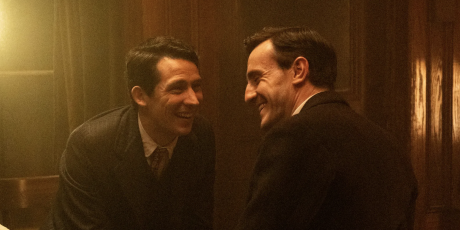
If Oliver Hermanus and Ben Shattuck‘s The History of Sound, a period queer romance bound for Cannes, turns out to be as good as Luca Guadagnino‘s Queer, I’ll be a satisfied viewer. But the Queer bar is a high one.
Paul Mescal‘s Lionel is the lead character (his POV dominates the narrative) with Josh O’Connor‘s David being secondary. 73 year-old Chris Cooper, of all people, plays an older version of Lionel. An odd call. The last time I checked Cooper didn’t have a hawk nose or a pointy chin.
I wasn’t thrown by the Queer sex scenes (even the chowing-down ones) because I really loved the performances by Daniel Craig and Drew Starkey, and because their intimate scenes were about delicacy, ambiguity and, now and then, open-hearted longing that I couldn’t help but believe and even relate to.
Vanity Fair‘s David Canfield: “[Mescal and O’Connor] sell a romantic connection that extends well beyond the bedroom. ‘There is a kind of real sense of companionship, and the joy and loss that comes with the presence and absence of that,’ Mescal says. ‘It’s not just about sex and the intensity of falling in love. It’s deeper than that.’
“In fact,” writes Canfield, “there isn’t much sex at all in The History of Sound” — honest sigh of relief! — “although the film carries a romantic sweep beginning to end.
Hermanus: “I didn’t want the sex of it to be the transgression, or the big idea, like, ‘Oh, it’s 1917, and these two men are taking the risk of being sexual’. Ben wrote it in a way where there was no hesitation, no moment of fear.
“For me, the sex scene” — just one? — “is when Lionel is walking around David’s apartment the morning after [their first encounter], and he’s smelling everything and sitting everywhere. He’s absorbing the energy of this person.”
The broadly mocked all-female Blue Origin flight (Aisha Bowe, Amanda Nguyen, Gayle King, Katy Perry, Kerianne Flynn and Lauren Sánchez) happened on 4.14.25, a.k.a. “the Empty Coke Bottle flight”. It reached a height between 62 and 65 kilometers, or just above the Kármán line.
The satirical Blonde Origin flight (three right-leaning women — Megyn Kelly, Megan Callahan, Sara Clemente) wasn’t a zero-gravity thing but a reduced gravity parabolic flight. Not on a rocket but aboard a Zero G jet flight, which took off on this particular day from LaGuardia airport.
The flight lasted 90 to 100 minutes and consisted of 15 parabolas, each of which simulates about 30 seconds of reduced gravity: one that simulates Martian gravity (one-third of Earth’s), two that simulate Lunar gravity (one-sixth of Earth’s), and 12 that simulate weightlessness. Each parabola begins with the aircraft climbing at a 45-degree angle at approximately 23,000 feet (7,000 m), peaks at 32,000 ft (9,800 m), and ends with the aircraft pointed down at a 30-degree angle.
As of three years ago, the price of a ZeroG flight for a single passenger began at $8,200.
Extended, real-deal zero gravity conditions begin at 160 kilometers above the earth’s surface.
I had this idea that playing celebrity name anagrams isn’t (or needn’t be) that hard. The idea is that you don’t just scramble letters around to spell something else — the something else has to offer some sort of comment about the character or the personality of the celebrity in question.
And I was wrong — it’s very hard to come up with a good one. Or at least one as good as that amusing Oscar Wilde anagram that Dick Cavett assembled decades ago — “O, I Screw A Lad.”
Let me tell you — it’s hard to come up with an anagram that adds up to anything, much less one that reflects a personal habit or profession or character trait.
I couldn’t scramble my own name (Jeffrey Wells) into anything clever. “Jeffy Sweller” alludes to having a big ego, but isn’t much. While positive-minded, “Swell Jeffrey” is also barely an anagram. Then I came up with “Yes, We Fell” but couldn’t figure what to do with “jfr.”
Let’s try another name — Barack Obama. I can’t manage anything better than Mack A. Barbora…meaningless.
Name anagrams are a bitch. I’ll settle at this point for any anagram that amounts to anything at all. Roman Castevet = Steven Marcato….something in that vein.
An HE reader suffering from acute spiritual toxicity as well as cancer of the anus wrote this morning with the following message: “The name of Lynn Ramsay ‘s 2011 psychodrama wasn’t Let’sTalkAboutKevin but WeNeedToTalkAboutKevin, you dementia-riddled jackass.”
HEreply: “Thanks, fixed.
“Dementia issues aside, WeNeedtoTalkAboutKevin is just too damn shit-piss long.
“My gut reaction when I first heard the title 14 years ago was ‘well, you may feel it’s important to talk about Kevin but I sure as shit don’t, especially with Lynne Ramsay at the helm and especially with that clearly demonic, warlock-eyed psycho, Ezra Miller, playing the titular character. So why don’t you and Kevin and everyone else in Kevin’s circle…why don’t you all go fuck yourselves?’
“Most movies with six-word titles tend to fail with Average Joes because six words (or five even) seem to indicate that the viewer will be in for a slog —a difficult or needlessly complex sit.
“One of the very few six-word-title movies to succeed was CloseEncountersoftheThirdKind, although nine out of ten people just called it CloseEncounters.
“How many people, honestly, even toyed with the idea of seeing Ramsay’s emotional torture flick, much less calling it something shorter? ‘Hey, honey, ya wanna see that psychotic fuckhead Kevin movie tonight?’
“How about seven words? Back in ‘65 nobody called RichardLester’s latest TheKnack (andHowToGetIt) — they just called it TheKnack.
“My favorite seven-word-title flick? Hands down, TheLonelinessoftheLong–DistanceRunner. Now, that was an intriguing long title! I’ve seen Tony Richardson’s 1962 film at least four or five times and have always enjoyed it much more than Wim Wenders‘ TheGoalie’sAnxietyatthePenalty Kick.”
Sentthismorning: “Scott — I read your Cannes ‘25projectionpiece yesterday, and have two questions
“(1) You wrote that Wes Anderson’s ThePhoenicianScheme is “said to be Anderson’s strongest work since TheGrandBudapestHotel”. Good to hear! And yet it’s commonly understood that Anderson films are always primarily about the visual style and signature that I call “WesWorld.” Which basically means dry, ironic scenarios about aloof characters with a minimum of emotionalism.
“TheGrandBudapestHotel connected because it conveyed an emotional lament about declining old-world Europe and the falling away of tradition. What, pray tell, is ThePheonicianScheme actually about thematically? A rich guy’s (Benicio del Toro) regret about not being a better dad to his daughter?
“(2) You described Lynne Ramsay’s We Need toTalkAboutKevin (2011) as ‘egregiously’ snubbed or overlooked in terms of award-season accolades. Well, in my view it was righteously snubbed. That movie was beautifully shot but FUCKING RANCID inside. I called Ezra Miller’s titular performance and in fact the entire film ‘emotionalratpoison.’
”It’s good to hear that J–Law has scored with a strong performance in Ramsay’s Die, MyLove, but how can I trust your aesthetic if we’re so far apart on Kevin?”
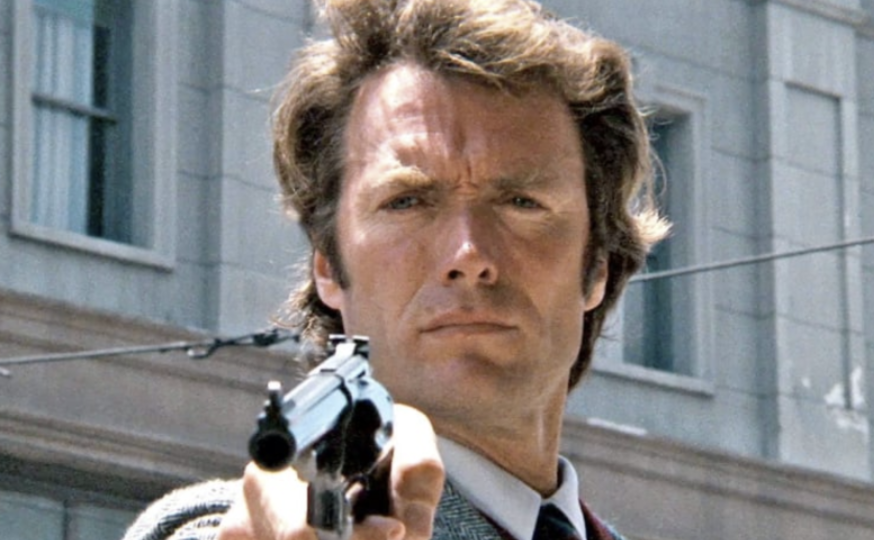
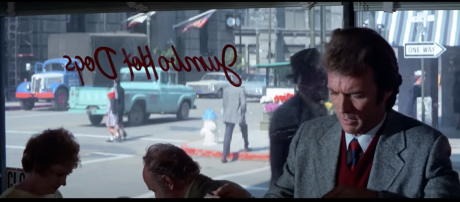
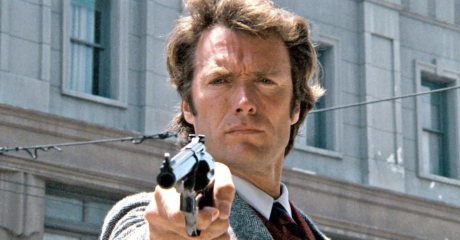
To go by the below trailer, the just-released 4K Dirty Harry Bluray is infected with orange-teal disease…the same virus that has all but ruined several Criterion Blurays.
When’s the last time you’ve noticed that red paint on a city curb (absolutely no parking) had a red-orange hue? When’s the last time that the top of a fire hydrant was painted glaring teal-turquoise? Or a pickup truck, for that matter? Look at that big truck with the intense light-blue cab and a red-orange front bumper…this is bullshit.
Another trait of this malignant color scheme is pinkish flesh tones.
These icky colors and tints are all over the new Dirty Harry. I’ll take the old 1971 colors, thanks. Fire-engine red curbs, I mean.
Obviously orange-teal fascism is spreading like cancer. It really has to be stopped. Some eccentrics actually seem to prefer orange-teal. They’re zombies. They’re not human.
Surprise below! The orange-red curb from before has reverted back to a more reddish color…what gives?
Natural flesh tones on Clint’s face in this somewhat older image (from ’22 — below) are not all that prominent on the Dirty Harry 4K.
But the trailer alone tells me that Halyna Hutchins‘ cinematography is of a fairly high order — arthousey, Days of Heaven-ish, beautifully lighted. The portions of Rust that were shot after Halyna’s tragic death were handled by dp Bianca Cline.
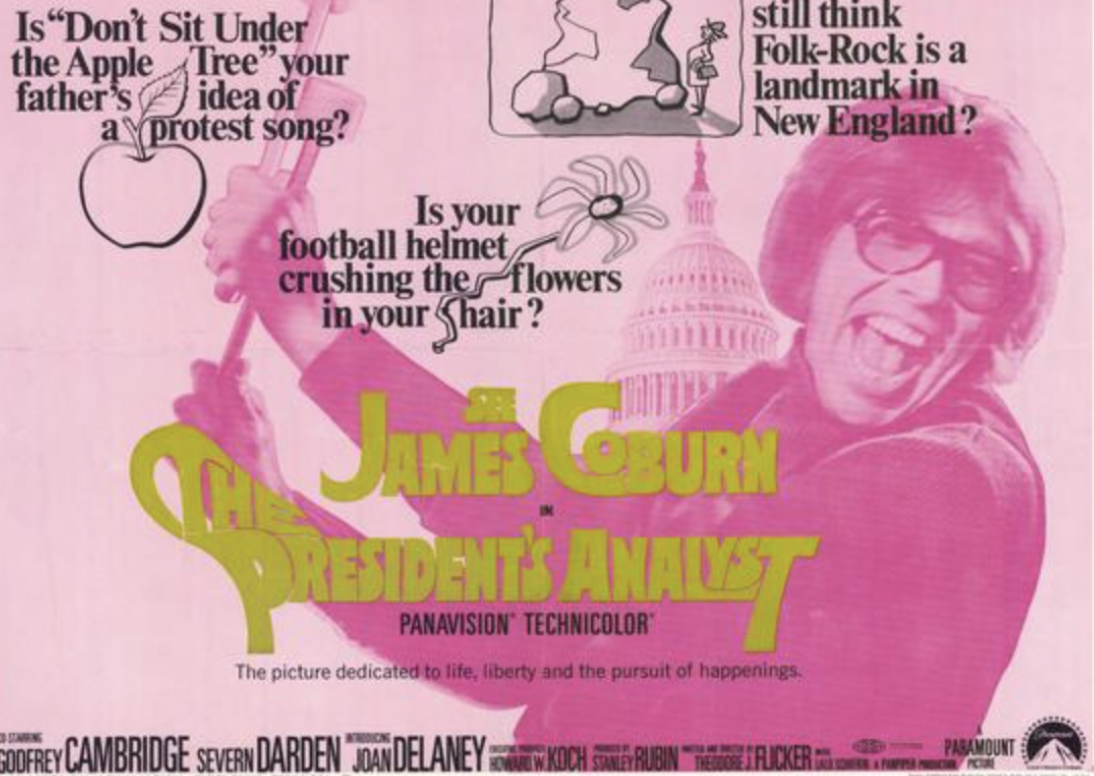
For decades I’ve harbored fond memories of The President’s Analyst (’67), a half-annoying, half-hippieish, half-psychedelic social satire that starred the smooth James Coburn and a comfortably laid-back Godfrey Cambridge.
So when I gave Analyst a re-watch the other night, I was surprised to discover that much of it (roughly 60%) isn’t especially good…unfunny, broadly played, overly brittle, vaguely irritating, shallow in a Man From U.N.C.L.E.-ish or Our Man Flint-y way. I was soon looking at my watch and figuring “okay, not as good as I remembered.”
But then it does a switch-up and becomes a whole different film…it goes all hippie-dippie-ish and rock-and-rolly and free love-celebrating, and is generally invested in a kind of “spread the joy and transcendence of LSD” attitude. And then it dives into a surreal but amusing plotline about the malevolence of TPC (The Phone Company) and the robots behind this malignant entity. It ends with Coburn and Cambridge shooting it out with TPC droids….hilarious!
Rarely has a mezzo-mezzo mainstream film (green-lighted by Paramount’s Robert Evans) completely uncorked itself and gone all loopy-doopey like The President’s Analyst did. I ended up up chuckling and mostly loving it. The last 40%, I mean.
The big switch happens right around the one-hour mark. It starts when Coburn’s Dr. Sidney Schaefer, running from would-be assassins of an international cast, ducks into the legendary Cafe Wha? on McDougal Street and hooks up with a rock band led by “Eve of Destruction“‘s Barry McGuire (89 and still with us!). Schaefer quickly becomes a splendor-in-the-grass lover of the attractive, hippie-chicky Snow White (Jill Banner).
From the moment that McGuire and Banner slip into the narrative and invite Coburn to join them on their magic travels, The President’s Analyst becomes a mid ’60s “turn on, tune in and drop out” mood piece…a capturing of what a lot of people were feeling and delving into and experimenting with in ’66 and ’67.
In this sense Analyst is almost as much of a mid ’60s cultural capturing as John Boorman‘s Catch Us If You Can (’65) and Michelangelo Antonioni‘s Blow-Up (’66).
And yet that first hour…whoa. And the one-sheet slogans were hideous.
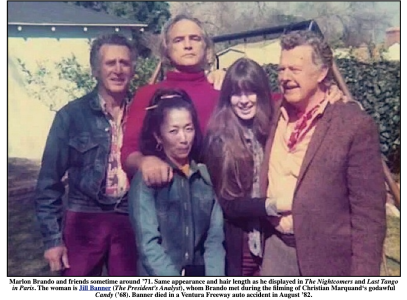
Poor, pixie-sized Banner was Marlon Brando‘s off-and-on girlfriend from roughly ’68 until her car-crash death in 1982, when she was only 35. She got slammed by a truck on the Ventura Freeway.
The career of Ted Flicker, director-writer of The President’s Analyst, went flat after someone slipped the Analyst script to J. Edgar Hoover‘s FBI, thereby tipping them off to the fact that Analyst would sharply satirize the bureau as well as the CIA. This led to Flicker and Evans being surveilled and harassed. The industry quickly got scared and dropped Flicker like a bad habit for a while. He later co-created Barney Miller. David Ewing‘s Ted Flicker: A Life in Three Acts screened in 2007 at the Santa Fe Film Festival. Flicker passed in 2014 at age 84.
Speaking as a mild-mannered, fair-minded, shoulder-shrugging film devotee, my feelings about this frightening TikTok video by “letsgofrightseeing” are roughly the same as the feelings held by many by elderly Cambodians about the terrorist regime of Pol Pot and the Khmer Rouge.
I’m serious — this woman is rhetorically, behaviorally and substantially no different than Pol Pot.
There are very few things that are lower on the cultural cinematic scale than hardcore horror fans (movies, fiction). Not elevated horror but the grindhouse / slaughterhouse mulchy kind. I’m not saying fans of this ghoulash are the equivalent of swamp slime, but they’re in that general ballpark. They’re here and “alive” in a general sense, but their souls are corroded. They’re like zombies in a way.