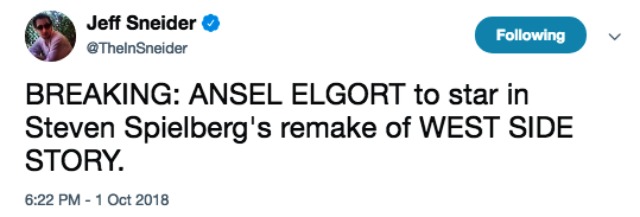
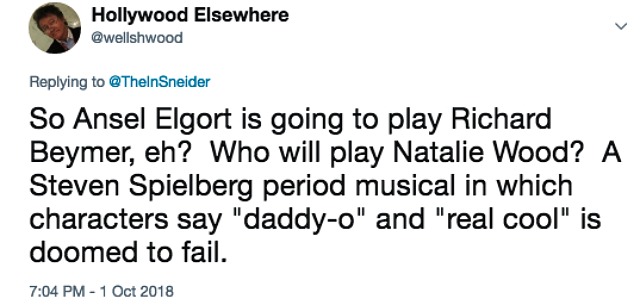
Mark my words — Steven Spielberg‘s West Side Story is going to be equally fascinating and horrible. I actually admire Spielberg having the balls to try and make this work. At least he’ll be stretching. On a certain level you have to respect that.

 Jeffrey Wells
 Mark my words — Steven Spielberg‘s West Side Story is going to be equally fascinating and horrible. I actually admire Spielberg having the balls to try and make this work. At least he’ll be stretching. On a certain level you have to respect that.
“The most revealing element of [last] Thursday’s hearing was not Judge Kavanaugh’s response to sexual assault allegations — his denial was already well known — but rather his manner of delivery.
“It is perhaps unfair to expect Judge Kavanaugh, facing serious allegations that he asserts have slandered and disgraced him, to slow-play his response. But there is no civil right to serve on the Supreme Court. The question is not what is fair to Judge Kavanaugh but rather what is constitutionally healthiest for the republic. Judicial confirmation hearings are auditions for serving as a judge. Judge Kavanaugh showed himself to be up to fighting when attacked, but less so to judging dispassionately.
“Judge Kavanaugh had a choice between accelerating the combat — clearly President Trump’s method — and declining to join while still defending his name. The latter course would have accomplished dual goals: refuting the accusations while acting like an occupant of the office to which he aspires.
“Perhaps the F.B.I. will uncover useful evidence about what happened 36 years ago. But to advise and consent to his nomination, the issue the Senate must resolve is not merely how Brett Kavanaugh behaved in 1982. It is how Judge Kavanaugh comported himself in 2018, on television. Whatever else we can say, he did not act like a justice of the highest court in the land.” –from “Judge Kavanaugh Is One Angry Man,” a 10.1 N.Y. Times opinion piece by Greg Weiner.
Brett Kavanaugh was allowed to be angry. Dr. Ford wasn’t. Women grow up hearing that being angry makes us unattractive. Well, today, I’m angry – and I own it. I plan to use that anger to take back the House, take back the Senate, & put Democrats in charge. Are you with me? pic.twitter.com/c9DebKTQEV
— Elizabeth Warren (@elizabethforma) September 30, 2018
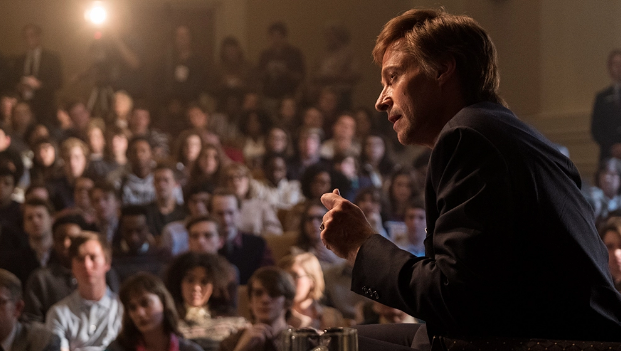
Will Hollywood Elsewhere attend the Hugh Jackman celebration in Santa Barbara on 11.19.18? I’d like to but we’ll see. The star of Jason Reitman‘s The Front Runner (Columbia, 11.6) will be the recipient of the 13th annual annual Kirk Douglas Award for Excellence in Film, which will be held as usual at the Ritz Carlton Bacara.
Some of us are aware of the moralistic undertow in Jackman’s performance as Democratic presidential candidate Gary Hart, and the fact that The Front Runner is a highly unusual film for its decision to present a canny, opportunistic infidel as a symbol of ethical decency — a politician with the usual egoistic flaws who nonetheless believes in governmental ideas and visions while keeping libidinal diversions in a box off to the side.
It also portrays the Miami Herald reporters and editors who made hay out of Hart’s mostly meaningless affair with campaign volunteer Donna Rice as…well, fellows who weren’t exactly advancing the cause of first-rate journalism.
It’s a movie that says “yeah, Gary cheated on his wife and so what? Because the real embarassment and the real mud came from what those journalistic bottom-feeders did to Hart and American political culture in the bargain.”
Out of 22 Gold Derby spitballers, why am I the only one who’s listed Jackman’s performance as one of the five most nominatable? I don’t know, but I can tell you for sure that most of the Gold Derby-ites are just following the pack mentality. On top of which a good portion of them probably haven’t seen The Front Runner…who knows?

Alexis Bloom‘s Divide and Conquer: The Story of Roger Ailes is a frightshow. It leaves you with a shudder and a realization that Ailes, drooling fiend that he may well have been, really was a Luciferian visionary and a dark genius who turned Red America into a Nation of Crazy.
He was the reigning Machiavellian author of big-lie rightwing media for 20 years, the Pied Piper of Rural Dumbshit-ism, the pugnacious fat man who primed the country for the arrival of Donald Trump…a hustler who dipped his paintbrush into an apothecary jar of his own fears and paranoia (and perhaps some festering resentment toward his mother for infecting him with hemophilia as a young child) and embraced anger and aggression as primal fuel and sticking it to the liberal media machine as his guiding mission.
How engrossing is Divide and Conquer? Very. How detailed, probing and well-organized? Same. How depressing is it? Oddly, it’s strangely engrossing because Ailes was a real surface-to-air missile and a deranged motherfucker whose generator was always humming. He was never a dull man, and neither is this documentary. How much does it tell you that you didn’t know? Not that much but I didn’t care. What a demonic and diseased reptile Ailes was…a cookie filled with arsenic.
This photo could’ve been taken in Singapore, Dubai, Shanghai, Bangkok, Mumbai, Abu Dhabi, Manila, Seoul or Saigon. Clusters of titanic, impersonal super-structures have defined the look of expanding cities everywhere, but especially in Asia and the Middle East. If you ask me they deliver a gloomy, soul-less vibe.
In fact this photo was snapped in NYC — from a building on 10th Avenue and 41st Street, looking south. Much of the western region of Manhattan in the 30s and 40s from 9th Avenue to the Hudson looks like this. Good for “growth” and taxes, but it feels depressing and impersonal.

You can’t have a guy who doesn’t sing as well as Elton John…you can’t have him sing the John-Taupin classics in an Elton John biopic. Not right, degrades the experience. Is this Taron Egerton‘s voice or someone else’s? Either way it doesn’t cut it. I didn’t have this reaction to Rami Malek‘s singing (or whomever) in the trailer for Bohemian Rhapsody. I didn’t have this reaction when I first heard Val Kilmer imitate Jim Morrison‘s crooning in Oliver Stone‘s The Doors.
Have you ever listened to Natalie Wood‘s actual singing for West Side Story, before they brought in Marni Nixon to dub her? She wasn’t bad but also not quite good enough. That’s what Egerton-or-whomever sounds like. The producers of Rocketman need to do a Marni Nixon on him — they need to dub in the real Elton. Seriously — this doesn’t work. If Elton John’s voice had sounded like Taron Egerton’s, he never would’ve made it big.
18 months ago in a piece called “Taxi Driver”: “The best gig of my life has been writing Hollywood Elsewhere for the last 12 and 2/3 years, and especially since I adopted the several-posts-per-day format in April ’06. The second best was tapping out two columns per week for Mr. Showbiz, Reel.com and Kevin Smith‘s Movie Poop Shoot (’98 to ’04). General entertainment journalism for major publications (Entertainment Weekly, People, Los Angeles Times, N.Y. Times), which I did from ’78 to ’98, ranks third. But my fourth all-time favorite job was driving for Checker Cab in Boston. Seriously — the only non-writing gig I ever really liked.”
I didn’t want to over-complicate that paragraph, but there was another non-writing job I really loved. That was working as a celebrity-spotter at Cannon Film premieres and after-parties in 1986 and ’87. I would rank it right below driving for Checker Cab. It was so easy and so satisfying.
[Click through to full story on HE-plus]

White House spokesperson Kellyanne Conway speaking to CNN’s Jake Tapper earlier today: “I feel very empathetic, frankly, for victims of sexual assault and sexual harassment and rape. I’m a victim of sexual assault. [But] I don’t expect Judge Kavanaugh or Jake Tapper or Jeff Flake or anybody to be held responsible for that. You have to be responsible for your own conduct.”
HE response: I’m very sorry to hear this happened to Conway, but the person who assaulted her obviously needs to be held accountable for his behavior. Conway seems to be saying that victims of sexual assault need to take responsibility for allowing sexual assault to happen to them. Or something like that. She seems to be twisting herself into a pretzel in order to support the Lindsey Graham attitude about what happened to poor Christine Blasey Ford.
[Click through to full story on HE-plus]

From “Loathsome Jack Is Dryer, More Meditative Than Expected,” filed from Cannes on 5.15.18: “I’m not saying Lars von Trier‘s The House That Jack Built isn’t repellent in more ways than you can shake a stick at. It’s an odious, ice-cold exercise in homicidal perversity, and one for the record books at that. It should probably be avoided by anyone with a weak stomach or…oh, hell, by anyone who feels that films should exude some form of love or worship or celebration, which probably covers 99% of the moviegoing public.
“I was expecting a diseased horror-murder tale so excessive that it might make me physically sick or prompt me to walk out or get into a fight with one of the security guys. It didn’t do that. It turned out to be more of a meditative guilt confessional — about LVT more or less admitting that he may not be a good enough artist to deliver worthy, lasting art, and that all he really knows how to do is shock and agitate. (That’s what I got from it, at least.) I’m not saying it’s a better film than I expected, but it’s dryer and more meditative and not as heinous as I feared.

“Portions of Jack are awful to sit through and the overall tone may be an equivalent to the professionally distanced, carefully maintained mindset of a psychological counselor in a hospital for the criminally insane. But for all the innate ugliness and sadistic cruelty on-screen, Von Trier is basically analyzing himself by way of Matt Dillon‘s Jack, a serial killer based in the Pacific Northwest, and casting a cold eye upon his shortcomings as a filmmaker.
“Dillon is a would-be architect but is only gifted enough to be an engineer, he gradually admits. This is Von Trier talking about himself, of course — admitting to his audience that he’s ‘not quite Ivy League’, and that after shooting his wad on Breaking The Waves, The Idiots, Dancer in the Dark and Dogville that all he really knows how to do now is make shock-and-appall movies like this, Antichrist, the two Nymphomaniac films and so on.
I’m not saying Jack gets a pass, but at least LVT has tried to make it into something more thoughtful and meditative than just a series of clinical, cold-blood episodes showing recreations of this and that method of murder. It’s ugly and rancid, but about more than just that.”
IFC Films apparently intends to release The House That Jack Built on 12.28.
We’ve all seen Hollywood depictions of Wall Street animal culture (The Wolf of Wall Street, Wall Street, Boiler Room), and somehow a gleeful, Ike Turner-like Don Cheadle bouncing around an office environment in an all-violet outfit and a modified Afro seems like an outlier. My first reaction was “huh?” Who wants to watch a series about the 1987 stock-market collapse? What is there left to say about greed in downtown Manhattan?
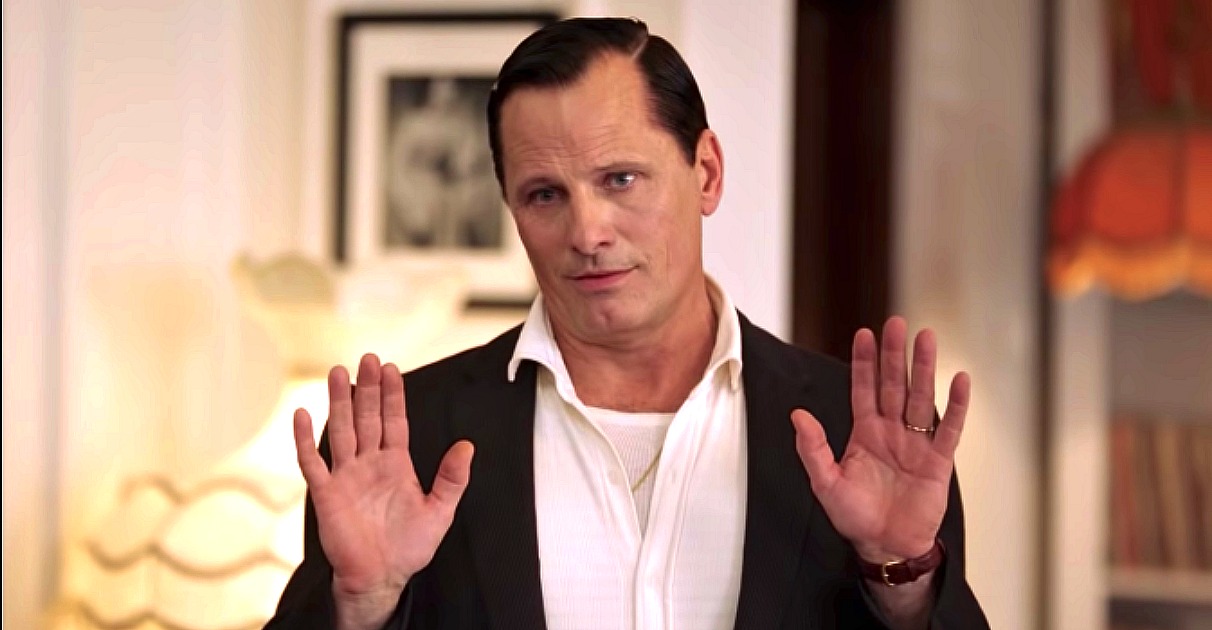
I’ve thought and thought about it, and there’s no way award-season handicappers can argue that Viggo Mortensen‘s Sopranos-styled performance in Peter Farrelly‘s Green Book isn’t the current Best Actor champ. Odds-wise, I mean. Or destiny-wise.
Not that anyone is arguing against Viggo, but you get my drift. His amiable goombah guy — a nicely shaded, carefully measured performance that conveys an emotional journey that you can’t help but admire — reaches out and touches. It hits the classic sweet spot. No other performance so far is on this level. Please tell me how I’m mistaken.
Bradley Cooper‘s Kris Kristofferson-like performance as a drawlin’ drunk in A Star Is Born is pretty good, I have to admit. He’ll almost certainly be nominated….right, Bobby Peru?
But Hugh Jackman‘s Gary Hart in The Front Runner is, I feel, more formidable. Watching him play a considerate, highly principled guy who didn’t do anything all that bad or who at least feels that infidelity is a private matter…to watch this decent guy get taken down for no reason other than the fact that tabloid scandals drive ratings and sell newspapers is just tragic. I can’t get his performance out of my mind.
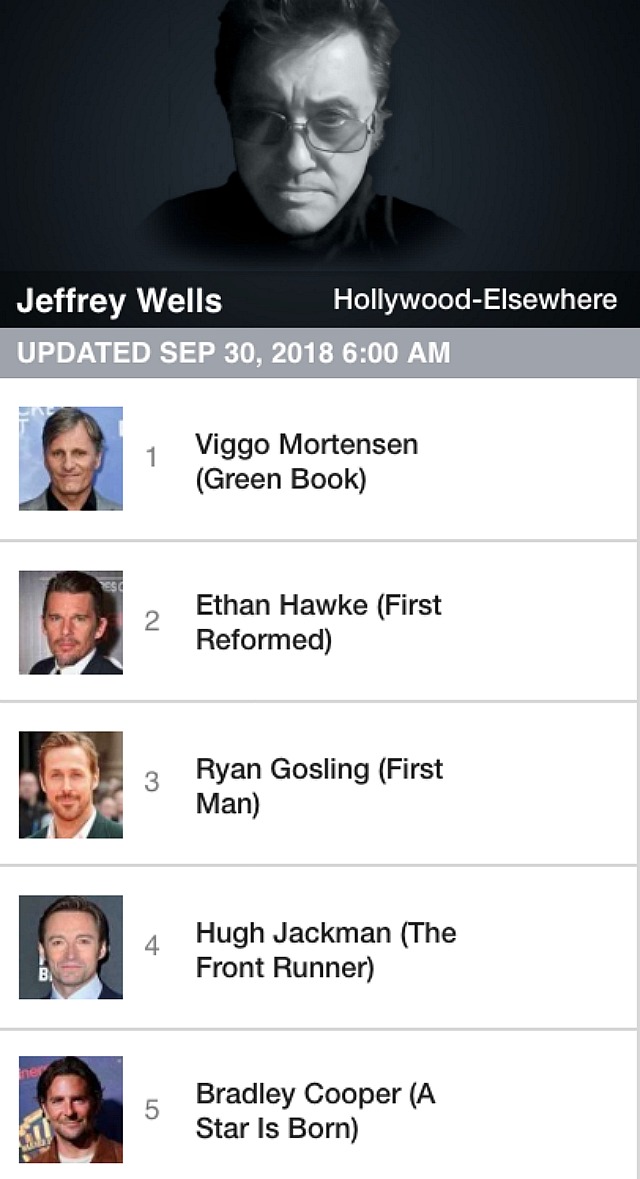
And what has happened, by the way, to general Gold Derby support for Ethan Hawke‘s career-peak performance in Paul Schrader‘s First Reformed? It’s an absolute scandal that he’s not on each and every spitballer’s top-five Best Actor chart right now, as opposed to just lists from Claudia Puig, Timothy Gray, Chris Rosen, ESPN’s Adnan Virk and myself.
As we speak, 17 Gold Derby handicappers are blowing Hawke off. Not because his masterful performance as a small-town minister isn’t a primal, conflicted, straight-from-the-gut vessel of anguish and longed-for redemption, but because A24 released First Reformed last May. By the tired-thinking standards of your go-along, follow-along prognosticator, this means that Hawke isn’t really in the game — respected but an awards-season also-ran. Not because of the quality of performance, but because of A24’s release strategy. Which is absolute bullshit. Shame on those 17.
A lot of people are behind the idea of Willem Dafoe‘s performance as Vincent Van Gogh in Julian Schnabel‘s At Eternity’s Gate. I am among them, but who’s actually seen the film? It played at the Venice Film Festival, will screen at the New York Film Festival on 10.12, and will open on 11.16.
Others are excited about Christian Bale‘s unseen performance as Dick Cheney in Adam McKay‘s Vice, which won’t open until 12.25. My gut is telling me that fat Bale playing a real-life Satan is not going to be nominated for anything. Not in this climate. You don’t get nominated for gaining weight and wearing great make-up. It may be that Bale’s actual performance will turn out to be the real deal, but I’m holding off on Bale for now.
