The Heat Is Gone

There was less of a pulse prior to yesterday’s 6 pm screening of Meera Menon‘s Equity than I’d felt during Sundance Film Festival screenings over the previous five days. “Everyone goes home on Tuesday,” an entertainment attorney explained. The buyers, she meant, plus much of the talent plus the party/entourage crowd. “Really? I thought they all went home on Wednesday,” I said, “but whatever.” Today things are barely percolating. You can definitely feel the absence of juice. But a downshifted festival has its advantages — more seats, less crowded buses, more of a devoted cineaste atmosphere.


Park City Marriott — Wednesday, 1.27, 11:20 am.

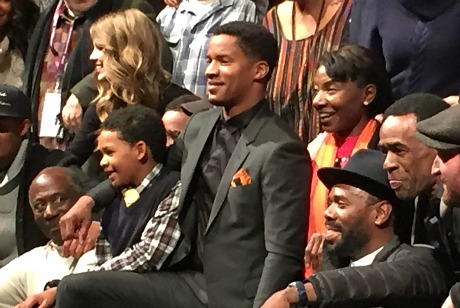
Nate Parker and The Birth of a Nation team on Eccles stage following Monday evening’s premiere screening.

Bedroom in HE’s 1-bedroom abode at Park City Regency.

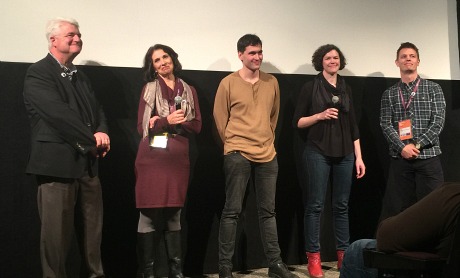
Jim director Brian Oakes (far right) with (l. to r.) John Foley, Diane Foley (parents), French journalist who shared cell with James Foley (can’t pinpoint his name), former Syrian-coverage colleague of Foley’s (her name could be Manu Brabo or Clare Gillis…you tell me). Pic taken following Monday afternoon’s screening at Library.

Read more

Due Respect But Later

Sundance reactions to Louis Black and Karen Bernstein’s Richard Linklater: Dream is Destiny have been entirely favorable. The Hollywood Reporter‘s John DeFore called the doc “one of the most enriching and enjoyable about a filmmaker in recent memory.” Well and good, but when a publicist friend asked yesterday if I’d seen it I responded candidly. Linklater is definitely one of my favorite artists in this business, I said, but why is it worth my time during this super-busy festival to watch a kiss-ass portrait of the guy? I don’t need a sum-up tribute piece and neither, I would think, does Linklater. He’s nowhere near the end of his career — he’s in the thick of it and going great guns. I’ll watch it on cable when it pops a couple of months hence.

“If The Goal Is To End Big Money’s Chokehold On Our Democracy, The Choice This Election Is No Choice At All”

“The other day Bill Clinton attacked Bernie Sanders’ proposal for a single-payer health plan as unfeasible and a ‘recipe for gridlock.’ Yet these days, nothing of any significance is feasible and every bold idea is a recipe for gridlock. This election [must be] about changing the parameters of what’s feasible and ending the choke hold of big money on our political system.

“I’ve known Hillary Clinton since she was 19 years old, and have nothing but respect for her. In my view, she’s the most qualified candidate for president of the political system we now have. But Bernie Sanders is the most qualified candidate to create the political system we should have, because he’s leading a political movement for change.” — from Robert Reich’s Salon piece, posted today (1.27), titled “Bernie Is Our Only Hope For Real Political Change.”

Define “Visible”

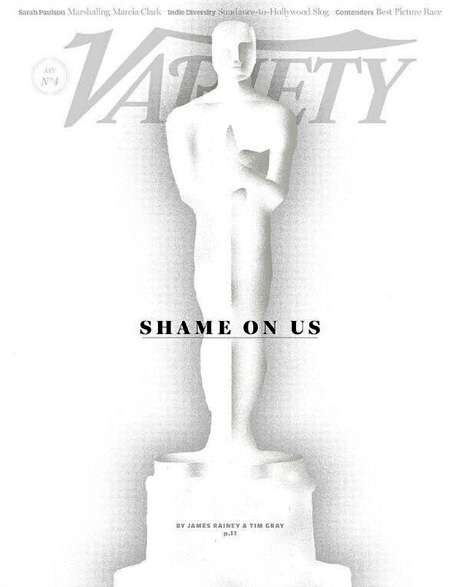
“A Los Angeles Times study of the 5,765 Academy members concluded that 94 percent are Caucasian (77 percent male), 2 percent are black, and less than 2 percent are Latino. The average age is 62, with only 14 percent younger than 50. Looking at this pasty gray demographic, one can’t help but wonder whether or not they saw the lovely little coming-of-age film Dope, or were at all interested in the powerful N.W.A biopic Straight Outta Compton, or cared about Spike Lee’s insightful Chi-Raq, or marveled at Samuel L. Jackson’s mesmerizing performance in The Hateful Eight. Why Concussion‘s Will Smith was ignored is still a head-scratcher. Maybe they thought his previous two nominations were enough.” — from Kareem Abdul-Jabbar‘s 1.27 Hollywood Reporter guest column titled “Why Black People Are ‘Invisible’ to Oscar Voters.”

HE to Abdul-Jabbar: (1) My Sundance review of Dope, posted on 1.26.15, called it “smartly assembled exploitation crap — a fleet, Tarantino-like hodgepodge of fantasy bullshit in the vein of a New Line Cinema release from the ’90s (i.e., House Party), and adapted to the general sensibility of 2015…nothing is soft or subtle or indirect.” (2) HE on Compton, posted 7.31.15: “A tight, satisfying, straight-ahead telling of the N.W.A. saga from ’86 to ’95 (roots, breakout, success, conflict and falling apart, concluding with the death of Easy E.), and quite an indictment of police racism and brutality to boot. Deals tough straight cards.” (3) I never saw Chi-Raq. (4) Jackson delivered his usual ballsy-loquacious Tarantino thing in The Hateful Eight — okay as far as it goes but rote, familiar. (5) From my 11.11.15 Concussion review: “Smith delivers a better-than-decent performance, nicely augmented by what sounded to my white-ass ears like a believable Nigerian accent, but at best he’s a mild Best Actor threat. If he gets nominated, fine…but the film isn’t good enough to bounce him into contention.”

Are You Now Or Have You Ever Been…?

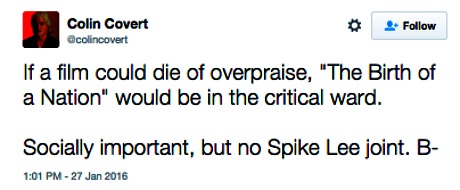
Are you now or have you ever been a reviewer with a suppressed racial bias that you don’t even know you have? Will you now atone for this by pledging full & absolute allegiance to the New Order, and more particularly to Nate Parker‘s The Birth of a Nation and the Sundance cominterm that has recently praised it to the heavens? Will you pledge here and now to do cartwheels in the lobby the next time you see a politically significant African-American film? Join us now and we’ll forgive you. But we also want you to give us names of other reviewers with a suppressed racial bias. It’s for their own good as well as your own. We already have a lot of their names so you’ll mainly be confirming.

Kohn Mans Up, Resists Sundance Birth Love

“While Steve McQueen‘s 12 Years a Slave was a more sophisticated, artful means of reckoning with slavery’s past, The Birth of a Nation plays like a formulaic but undeniably pointed corrective to mainstream American cinema. Its landmark Sundance deal — $17.5 million plunked down by Fox Searchlight — speaks directly to the embarrassing market gap for black history in the movies. Produced outside the system (by an actor infuriated by the dearth of substantial black roles, no less) and now grandfathered into it, the narrative surrounding Birth of a Nation holds more power than the actual film. Repurposing the title of D.W. Griffith‘s infamously racist silent epic, Parker’s Birth of a Nation is a sturdy, halfway decent piece of filmmaking.” — from Eric Kohn’s 1.26 Indiewire review.

Brave Life, Horrible Death

I’m conflicted about Brian OakesJim: The James Foley Story, which I saw earlier today at the Park City Library. Foley was the freelance American journalist who was covering the Syrian conflict when he was captured by ISIS on 11.22.12 and then decapitated — which was posted on video — by the late “Jihadi John” (i.e., Muhammad Jassim Abdulkarim Olayan al-Dhafiri) on 8.19.14. Oakes is a New Hampshire-based filmmaker who was Foley’s childhood friend and had the family’s cooperation, etc. And that’s a problem, I’m afraid.

As you might expect, the doc is worshipful — Foley was a great fellow, a ballsy adventurer, clever, resourceful, generous of heart. I’m sorry to say this but two hours of adoration can wear you down a bit. Was there anything about Foley that was lacking or imperfect? Most likely but the doc won’t go there. It would have been more interesting to know a little more.

Foley’s story is passed along by family (parents, two or three brothers, a sister, friends and fellow journalists). Foley was imprisoned for nearly two years by ISIS before he was killed, and as much as I hate to say this the film loses vitality and feels claustrophobic when this awful period of captivity is described by Foley’s former journalist cellmates.

Read more

The Terror

The reign of terror in post-revolutionary France happened over a ten-month period (September 1793 to July 1794), and was marked by mass executions of “enemies of the revolution.” I don’t want to go out on a crazy limb but a distant cousin of this mentality is alive and well in Park City right now, and thriving among the general community of p.c. goose-steppers who are excited/delighted by the love shown for Nate Parker‘s The Birth of a Nation. Over the last 12 hours or so it’s been hinted a few times that my being a Birth disser (at least as far as the over-praise is concerned) isn’t good for my social, political or financial health, and that I should think about getting with the program.
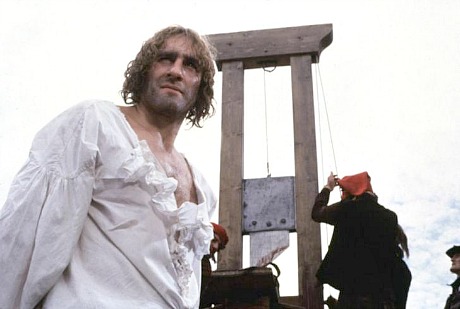
The elite Sundance festivalgoer support of this film is an expression of liberal enlightenment as well as a pushback against the OscarsSoWhite mentality that has caused to much recent consternation. I’m mentioning the “terror” analogy because, as noted, I’ve heard from a few descendants of Maximilien Robespierres over the last 16 hours, or since I posted my negative review of Parker’s film. These people have hinted that my critique is possibly racist in origin (“What’s your real agenda, Jeff?”), and that I’m saying the wrong thing at the wrong time, and that there must be something wrong with me not to want to join in celebrating this wonderful, Oscar-bound film, and do I want to risk missing out on a Phase One campaign buy from Fox Searchlight?

Steven Gaydos: “Of all the movies Jeff Wells has seen at festivals, all the politically correct tomes targeted to the ‘hipsters’ in attendance, all the overreactions to so-so pics and all of the rapturous sonnets to cinema that are far too generous to what’s on the screen, somehow THIS film made by an African-American about the African-American experience is the epic affront to his sensibilities, the bridge too far, and ‘one of the biggest self-congratulatory circle jerks and politically correct wank-offs in the history of the Sundance Film Festival.” Phew! That’s a tough honor to achieve. So glad the militia crowd is supporting your tough ‘stance’ on this clickbait Alamo.”

Sasha Stone: “When people say ‘thank you for fighting against the tide’ I wonder what they really mean by that.” Me: “Will you STOP with your bullshit racial-attitude baiting? You’re no different than the glee club that rose to its feet last night at the Eccles and went mad with delight.”

Read more

Academy Letter Addresses Veteran-Member Concerns

Last night Academy members received the following from Academy official Lorenza Muñoz, titled “FREQUENTLY ASKED QUESTIONS
 for current Academy members about the new rules”:

Q: Why is the Academy excluding older members from voting?
A: We’re not excluding older members. Everyone will retain membership.


Q: But won’t older members lose their opportunity to vote for the Oscars?
A: These rules are not about age. In fact, under the new rules many veteran Academy members will retain voting rights.


Q: I thought you had to work in the last ten years in order to vote.
A: Working in the last ten years is one way to ensure you have voting privileges. Another way is to have been nominated for an Oscar. And a third way is to show that since you were admitted as a member you’ve worked in motion pictures during three ten-year periods. This means that the longer your career, the more likely you’ll qualify for voting.


Q: So we have to have worked for thirty years to keep the vote?
A: No. Let’s say you were admitted to the Academy in 1980 and you worked on one film in 1989. That covers you for your first ten years. Then you worked once in the ’90s, which covers you for your second ten-year term, and once again in 2001 for your third ten-year term. That’s only a twelve-year period, but you have worked in the three ten-year terms of your membership, so you’d qualify as an active member with voting status.


Q: Do these ten-year terms have to be consecutive?
A: No, they do not.


Read more

Sidney Lumet’s The Morning After

It shouldn’t take a genius to read between the lines of Todd McCarthy‘s Hollywood Reporter review of The Birth of a Nation, which premiered in Park City yesterday afternoon. Keep in mind that every reviewer filing for a major outlet knew they had to write very carefully lest they be perceived as having a blockage of some kind.

Toward the end of his review McCarthy notes that The Birth of a Nation “offers up more than enough in terms of intelligence, insight, historical research and religious nuance as to not at all be considered a missed opportunity.” Parker did pretty well considering, he’s saying. The film has issues here and there but it’s not half bad.

“Far more of the essentials made it into the film than not,” McCarthy goes on. “Its makers’ dedication and minute attention are constantly felt and the subject matter is still rare enough onscreen as to be welcome and needed, as it will be the next time and the time after that.” Translation: Parker will be refining his abilities as he goes along and may quite possibly make a truly world-class film down the road.

We’ve all seen Sundance films before where the audience reacts more to the subject matter or a film’s political position, so what happened yesterday is no surprise.

Read more