Geffen Briefly Speaks

I’ve seen Susan Lacy‘s Inventing David Geffen, an “American Masters” documentary that will air on PBS on 11.20.12. It’s a somewhat candid backrub piece that pretty much allows the 69 year-old supermogul to tell his life story the way he wants it told. Which feels okay as you’re watching it, I guess. It doesn’t excite but doesn’t offend either. And I watched it twice in a row, which says something.
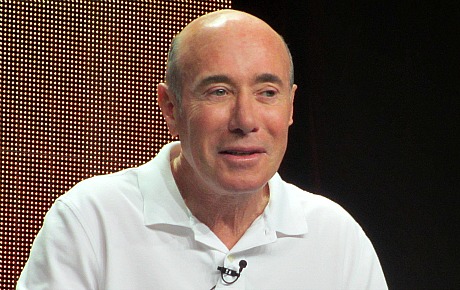

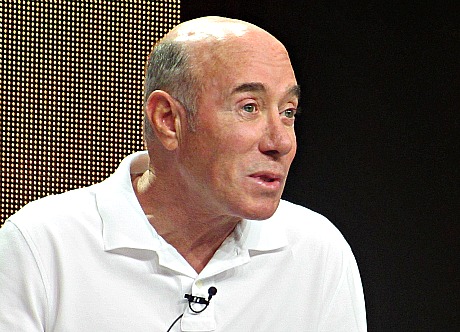
David Geffen during Sunday’s PBS-arranged q & a at the Beverly Hilton hotel.

Lacy includes an occasional blunt comment (one-time litigant Neil Young shares a few choice phrases) about Geffen’s combative nature and scrappy business dealings so as to give a feeling that the doc doesn’t “flatter,” but it mostly does flatter in a sense because it underlines how an awful lot of people are scared of Geffen, and therefore respectful. They all kiss the ring.

Lacy’s doc is an engrossing sit because Geffen is a fascinating player, full of emotionality (some of it angry and combative) and contradictions and humor and fierce will. As a columnist I love rich hardballers (Geffen is worth over $5 billion) who are tough and know all the angles and how to play everything to their advantage, but Lacy’s doc is not about that territory. Not really. Inventing David Geffen is an agreeable thing, nostalgic for the ’60s and ’70s, flavorful and amusing at times and “honest” as far as it goes but basically friendly and affectionate. Lacy obviously likes Geffen, and after watching her film it’s hard not to feel the same. He’s a kick, he’s been around, he’s lived it, he knows everyone.

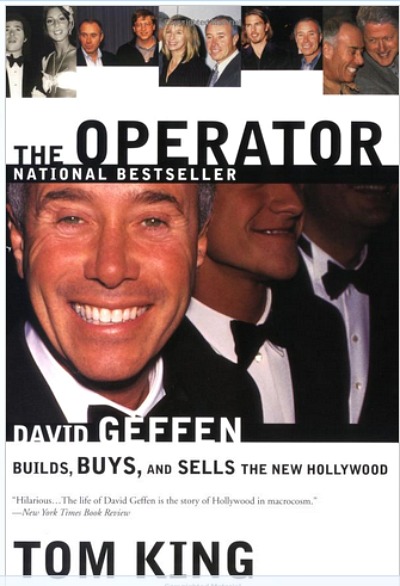
But if after seeing this film you want a less varnished portrait that’s probably closer to the real deal, dust off the late Tom King‘s 2001 biography — “The Operator: David Geffen Builds, Buys and Sells The New Hollywood.” Now that had real juice and adrenalin and aroma and nerve, you bet. Geffen hated it, calling it a hatchet job and conniving and agenda-driven, but if you read Lisa DePaulo‘s June 2001 New York article about how King and Geffen’s relationship began amiably with a written agreement to give King access and then deteriorated and got worse and worse until everything was poison, it’s hard to accept Geffen’s view that King just set out to trash him with little regard for truth or fairness or appropriate journalistic standards.

In any event Geffen attended a PBS press event Sunday at the Beverly Hilton to help promote Lacy’s doc. Most if not all of the journalists present had been given a DVD screener so it was all (a) questions about this and that and (b) the notoriously guarded and press-shy Geffen answering them as briefly and curtly as possible. Here’s an mp3 of the discussion. Here‘s how Deadline covered it. And here are my favorite quotes and exchanges:

“I’m not involved in DreamWorks at all,” Geffen said early on. I asked if that meant that he hasn’t seen Steven Spielberg‘s Lincoln, and he said he hasn’t “but I hear it’s wonderful.” I asked if he knows how long it is, and he said, “I have no idea.”
“Failure is a great motivator,” Geffen said at the start of the session. (He could have said “there’s no success like failure, and failure is no success at all” but that’s taken.)

“Why were you driven?,” a journalist asked him. Geffen smirked and said, “Meet my mother.”

Asked to talk about Jewish background and how Judaism and the culture of Jewish guilt may have influenced him early on, Geffen said this: “My mother came to America from Palestine in 1931. My father met her in Palestine. They were socialists, really. I was Bar Mitzahed but we didn’t have much of a religious life. Does that not answer your question?” The journalist asked again about childhood influences and Geffen said, “Everybody’s childhood is an influence about what happens in their future, don’t you think?”

A journalist asked what Geffen might do if he was trying to get into the music business today (or words to that effect) and he said, “I’d kill myself.” What he meant is that he couldn’t abide what he sees as a lack of spirituality in today’s business. “When I was a kid all my peers wanted to play guitar and be in a band,” he said. “Today if you re growing up today your’e not as focused on the music business as much as being a programmer…that’s where success seems to lie.”

Would he try to get into the movie business today? How would he play his cards today if he was just starting out? “It’s very hard to get into the movie business, then and now,” he said. “It’s a very tough bullseye to hit. To get a job in the entertainment business is difficult. I found it difficult personally.”

Putting together $1.8 billion to finance DreamWorks, which he did in the space of two weeks back in ’94, “would be impossible today,” he said.

“You find yourself getting old and bald…”

After Geffen was mistakenly diagnosed as HIV-positive in the early (or was it the mid?) ’80s, “I just stopped working,” he said. “Here I am, I thought. I’d been working all my life and made all this money and didn’t have any fun really. Didn’t get high. So I’m gonna get high and get laid. People were dropping like flies in the ’80s. A very scary period of time. I like working. I’ve always worked, always enjoyed, always thought it was fun going to the office.

“Has anyone ever said no to David Geffen?,” he was asked. “Of course, there were many,” he said. “I wanted REM. I can’t think of which ones.”

And then came the best quote of the day: “It’s not about the ones who say no,” Geffen said, “[but] about the ones who say yes. Your life isn’t made up of people who aren’t in it.”

Asked about this reported interest in buying either the NY Times or LA Times, Geffen said he “was not looking to be a newspaper owner as an investment…I was going to buy the NY Times out of my foundation and make it a non-profit. Because I think the NY Times is essential. A very important newspaper. It’s very hary hard to survive as regional or logcal newspaper todaty. The NY Times and the Wall Street Journal are national newspapers.”
A journalist said that “a few years ago Carly Simon outed you as the guy she wrote about…” and right away Geffen cut him off. “That’s simply not true,” he said. “I’m not saying I’m not vain, but I’m not her vain. I thought the same thing about that as I thought about my marrying Keanu Reeves, whom I’ve never met.”

He said he’d “had no input into this film, honestly,” referring to Lacy’s doc. “I had nothing to do with the makeup of those questions. I wanted to tell the story as accurately as I can. I had no idea what this was gonna be. I didn’t think I was a good candidate for this thing. But I was happy with it.

“I’m proud of all the things I’ve done,” he said. “I [see] this film and I think, “wow, you did have all that.” I don’t think about the past. I think about what I’m doing now. I really don’t reflect on my career. I don’t like to talk about myself. I avoid it as much as possible. When I saw the film, I thought ‘wow’…I was impressed.”

A journalist asked what gets him up in the morning. “Whatever I’m gonna do,” he replied. “I like talking to interesting people. Reading great books. I can read four or five books a week. I don’t carry a cell phone. I’ve never texted anyone in my life. I’ve never [used] an ATM machine…or whatever it is.”

“Was that your key to success, being the smartest man in the room?,” a woman asked. “I never thought I was the smartest man in the room,” Geffen answered. “I really did very poorly in school. I thought I was dumb. I think other people thought I was dumb too. I had any number of jobs I was fired from, between high school and when I got to the William Morris Agency [in ’64]. And I got to WMA and I was delivering mail, and I heard the agents talking on the phone [in their offices] and thought to myself, ‘Oh, they’re bullshitting on the phone. I can do that.'”

By the way: Tom King, whom I knew slightly and liked as far as it went, died at age 39 in mid April 2003. Here’s the L.A. Times obit. Here’s a link with my own response to his passing.)
Sunday and Rosemary Do Lunch

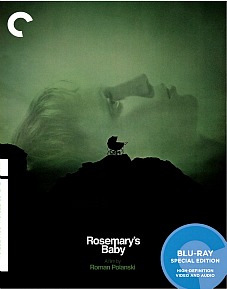
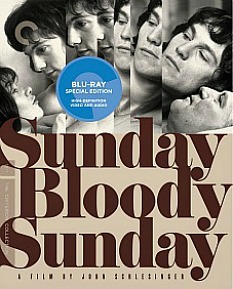
Last Wednesday I had lunch with two upcoming Criterion Blurays — Sunday Bloody Sunday (out 10.23) and Rosemary’s Baby (out 10.30). They met me at Le Pain Quotidien at 12:30 pm. We chose a quiet table and ordered tomato and mozzarella salads and lemonade all around.

Hollywood Elsewhere: Thanks for coming, fellas. I know you’ve been busy recently.

Rosemary’s Baby Bluray: Not at all, Jeff. Thanks for the invite.

Sunday Bloody Sunday Bluray: Good to be here.

HE: So when you guys were movies back in the prehistoric celluloid days, you came out within…what, three years of each other?

RM Bluray: I came out on June 12, 1968 and Sunday was almost exactly…

SBS Bluray: I think it was almost exactly three years later, on July 1, 1971 in England. And in early September of ’71 in the States.

HE: Have you guys met before this?

RB Bluray: Never. But why would we? (to SBS Bluray) You good?

SBS Bluray: I’m good. As I’m sure you are. It’s gratifying to be getting some new attention after 40-odd years.

HE: You guys never played as a double-bill somewhere? At the Carnegie Hall or Bleecker Street Cinema or the Thalia back in the ’70s?

SBS Bluray: Not to my recollection.

RB Bluray: Maybe we did. Who remembers? [Laughter]

HE: In any case, for those who aren’t up to speed I’d like to review some basics. Sunday, you were produced and shot in England but released by major distributors in every country. I think United Artists released you in the U.S., if I’m not mistaken?

SBS Bluray: Correct.

HE: And Rosemary, you were shot in the U.S. and released by Paramount.

RB Bluray: Right.

HE: And being non-Scope films, you were both projected in the same flat format in the same theatres in both the U.S. and England, presumably with the same lenses and aperture plates and yaddah-yaddah. Same all around.

RB Bluray: Presumably.

SBS Bluray: Okay…I see where you’re going with this.

HE: Where am I going?

SBS Bluray: We came out in roughly the same era, and we’re both being released as Criterion Blurays in October, both of us mastered by the same Criterion technicians and creatives, and yet I’m being issued with a 1.66 aspect ratio.

RB Bluray: Oh, God…!

SBS Bluray: And Rosemary’s Baby is coming out at 1.85. [Melodramatically] Why is that?

HE: Okay, how come?

SBS Bluray: Because I was produced and shot in England, a country that was rolling with 1.66 at the time. It’s a gesture to British theatrical tradition.

HE: But your director, the late John Schlesinger, was operating in the same theatrical and commercial realm as Roman Polanski, the director of Rosemary’s Baby.

RB Bluray: Sure.

HE: Schlesinger was British but he was very much a part of the U.S. film industry. He’d directed Midnight Cowboy in ’68, of course. And both Schlesinger and Polanski, who’d come from Poland but was a British resident in the mid ’60s when he made Repulsion and who understood the system they had…they both knew that the lion’s share of their support and funding came from the U.S. film industry so there were no illusions about how most people — Americans, I mean — would see their films, which was within a 1.85 aspect ratio.

SBS Bluray: John knew that. Of course he did. But being a British-born filmmaker, he composed me so I’d look good at 1.66 as well as 1.85.

HE: As I’m sure Polanski did with Rosemary. He knew there were two systems. So why, then, has Criterion chosen to show you, Sunday, with a 1.66 aspect ratio when the reality was that very few if any viewers in the U.S. saw you at 1.66. To hear it from Bob Furmanek and Bob Harris and others, 1.85 was the absolute rule in the U.S. going back to the ’50s. So why haven’t you been Furmaneked, Sunday? Don’t get me wrong…

RB Bluray: [Amused] Yeah, what is this?

HE: I love that you’re coming out at 1.66. Really.

RB Bluray: But how come Criterion has given you more height than me?

HE: Because Polanski told them you’re coming out at 1.85. He ordered it.

RB Bluray: Then why did he approve Repulsion at 1.66? Just because he shot it in England? Presumably Criterion is bringing out Sunday at 1.66 for the same reason, because it was shot in England. But who cares at this point? That was forty odd years ago.

HE: We all live in a 16 x 9 world these days. When it comes to rectangular images and aspect ratios, I mean. Thank God some people have held the line with 1.66 here and there and 1.33 or 1.37 in the case of pre-1953 films , but it’s all very, very abitrary.

Best Ever

I bought these Bruno Magli (Magli is pronounced “Mahlee”) shoes 12 years ago in Venice, Italy. They’re the highest-qualilty shoes I’ve ever owned, and easily the most uncomfortable. They feel like they’re made of wood. It would be agony to wear them more than five or six hours at a stretch. But I’d rather suffer with a pair of beautiful shoes than walk around in super-comfortable shoes that look atrocious.

Messenger

I took a nap yesterday morning, and a voice spoke to me as I slept. It was probably the same voice that spoke to Howard Beale in Network and Jean Seberg‘s Joan of Arc in Otto Preminger‘s Saint Joan and…okay, Kevin Spacey‘s John Doe in Se7en, if you want to be egalitarian and snarky and Glenn Kenny-ish about it. It was a message about the next Batman film, and it contained two urgent orders.

One, forget “Batman” — the next Batman movie should be all about Joseph Gordon Levitt‘s John Blake. Levitt’s rock-solid performance as this special-duty police officer is one of the best things about The Dark Knight Rises. JGL’s steady focus, intelligence, confidence and matter-of-factness convinced that he’s the guy from here on. Forget the brooding Bruce Wayne and Alfred and the mansion and all the rest of that mythology. It’s over and done with anyway. That couple enjoying cappucino and a salad in Florence existed only in Alfred’s head…as Alfred explained at the very beginning. Autopilot bullshit.

And secondly, the next Batman villian has to be played by Tom Cruise. I think that Cruise has crossed over into that territory. The straw that broke the camel’s back of his positive-image with the public was that report that Cruise wanted to subject his daughter Siri to a Scientology mind-control bootcamp indoctrination (a.k.a. “Sea Org”) — a call that apparently resulted (at least partly) in Katie Holmes filing for divorce. That’s when I said to myself, “This guy is a kind of monster…what kind of fiend thingks about brainwashing his kid? He’s just like Leif Erickson wanting to lead David MacLean (Jimmy Hunt) out to that sand pit in Invaders From Mars.”

PBS Press Day

I’ll be attending a PBS press event at the Beverly Hilton hotel today. Several shows will be discussed from 10 am to 6 pm and then a dinner and presentation to follow. I love PBS programming plus I haven’t taken part in a TV junket in ages so this should be novel and stimulating.

A discussion of PBS 2012 Election Coverage will kick things off at 10:15 am with Gwen Ifill, Judy Woodruff, Raney Aronson, Maria Hinojosa and PBS senior vp John Wilson participating. Then a buffet luncheon at 12:15 pm. At 12:45 pm Ken BurnsThe Dust Bowl, a doc about the most socially devastating weather disaster of the 1930s, will be discussed. At 2:30 pm a press conference about Half The Sky will commence with America Ferrara, Diane Lane, Meg Ryan and Nicholas Kristof. At 3:45 pm a discussion of Inventing David Geffen, a doc that will premiere on American Masters on 11.20, will happen with Geffen and filmmaker Susan Lacy participating.

And that might be it for me.

Specs Appeal

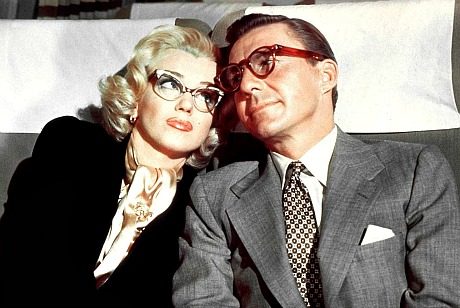
I decided sometime during eighth grade that attractive women looked hotter when they wore glasses, especially the black-rimmed kind. Then I saw that scene in How To Marry A Millionaire when David Wayne convinces Marilyn Monroe that she looks sexier wth glasses than without, and I knew just what he meant. Flash forward a few decades to Thursday, 7.19.12, when I saw Tony Gilroy‘s The Bourne Legacy and decided that Rachel Wiesz looks extra-double super-fetching because of the black-rimmed glasses she wears now and then in her role as a scientist.


Marilyn Monroe, David Wayne in How To Marry A Millionaire.

I’ve been watching Weisz for 15-plus years and it’s been “okay, fine, whatever” as far as her looks are concerned. She’s beautiful, of course, but we’ve known that for years so I don’t melt into my seat or turn into jello every time she appears on-screen. It’s almost like she’s my sister or my ex-wife or something. But when she put on those glasses in Legacy it was suddenly “whoa…wait a minute.”

But after searching online this afternoon I wasn’t able to find a single still of Weisz wearing those glasses in any scene from The Bourne Legacy…not one. That means she or her publicist either (a) told the unit photographer they didn’t want any taken with the glasses or (b) killed all glases shots upon submission. In other words, Weisz is apparently just as convinced that she looks like hell with her Bourne glasses as Monroe’s character was convinced she looked like hell with her glasses in How To Marry A Millionaire.

There’s no talking to women about how they look really good in a certain way if they themselves haven’t come to this conclusion first, so this is the end of it. The only men that women will even think about trusting as far as what to wear or what attitude to project or how to wear their hair or whatever are gay guys, or more particularly gay hair stylists or fashion designers. The opinion of straight guys means absolutely zip.


Rachel Weisz, director-writer Tony Gilroy during filming The Bourne Legacy.

Dodge City

Because of the dominance and dictatorship of the National Rifle Association, “we have laws no one wants — not cops, not the military, not even most gun owners themselves — except the NRA,” writes The Daily Beast‘s Michael Tomasky.

“Democrats went gun-shy in the 2000s. By 2008, Barack Obama had little to say about gun control, even trying to disavow his signature on a 1996 document signed by some Illinois legislators backing a ban on all handguns. In 2009, there were 65 pro-gun Democrats on Capitol Hill. The lobby owns the GOP, well, lock, stock, and barrel.

“Earlier this year, the Indiana state house passed — with NRA backing — a bill spelling out when citizens could kill police officers. Some prominent military leaders wanted military personnel to be able to discuss gun safety with troops as a way of trying to stem military suicides, many of which are committed with personally owned guns. The NRA was having none of it.

“And so it’s no surprise that Obama and Mitt Romney (who once supported waiting periods and the assault weapons ban) produced mealy-mouthed statements on Friday that didn’t even include the word ‘gun’. Many Democrats from urban districts will continue to oppose the NRA. But the party will continue to quake, shooting after shooting after shooting, bodies upon bodies upon bodies.

“So this will happen again. And again, and again. In fact, as I said above, we are likely headed for a day in this country like the following. At a movie theater, in a mall, at a commuter rail platform, in a restaurant — some glory-seeker opens fire. Most people duck and scatter, but a decent percentage of them produce their pieces. The gunman goes down like Warren Beatty in Bonnie and Clyde, but, since ‘most people’ aren’t marksmen, maybe a few other people do too, and maybe, oh, a three year old.

“But hey. There’s always a spoilage factor. Rights are sacred. From their cold, dead hands…”

Taibbi Libor

Rolling Stone‘s Matt Taibbi said in a 7.19 “Democracy Now!” interview that Average Joes were screwed by the Libor scandal because lower interest rates almost certainly led to major cuts in state and local government spending.

“If you live in a town that had a budget crisis, that had to lay off firemen or teachers or policemen, or couldn’t provide services or textbooks in their schools, you know, that might be due to this,” Taibbi said. “Basically, every city and town in America, to say nothing of the rest of the world, has investments that are pegged to Libor.”

Sixteen gangsta banks, including Bank of America, JPMorgan Chase, and Citigroup, are facing possible prosecution for allegedly rigging the Libor, a defining kingshit interest rate that banks agree to and use to lend money to each other. Hundreds of trillions of dollars in loans and derivatives were set by Libor. It is believed that its manipulation possibly cost some cities and states many, many millions.

Purge A’Comin’

Every couple of years Hollywood Elsewhere enforces a Stalinist purge of the most belligerent and infuriating right-wingers, who hang around this place like rats. The first big one was in ’08, and then another one happened in September ’09. I’m thinking about another purge today because of some truly appalling rightwing, NRA-supporting sentiments heard in the wake of last night’s massacre in Aurora. I’m asking for readers to please identify those righties whom they feel have given the greatest offense. The whackings will happen this weekend.