The Visitor

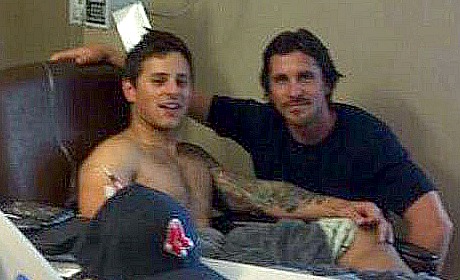
This afternoon The Dark Knight Rises star Christian Bale visited a hospital in Auroroa, Colorado to console and cheer recovering victims of last Thursday night’s shooting attack. Nice gesture. Curiously, a Warner Bros. spokesperson reportedly told TMZ that Bale “is there as himself, not representing Warner Brothers.”


Christian Bale visiting shooing victim Carey Rottman earlier this afternoon in Aurora, Colorado.

Warner Bros. Publicist #1: “You guys see this? About Christian?”

Warner Bros. Publicist #2: “What?”

Warner Bros. Publicist #1: “He’s in a hospital in Aurora. Visiting the gunshot victims.”

Warner Bros. Publicist #3: “No! Right now?”

Warner Bros. Publicist #1 : “Yes, really.” (Holds up laptop) “Look.”

Warner Bros. Publicist #2: “Wow, that’s so cool! Such a good guy.”

Warner Bros. Publicist #1: “So what do we say when somebody calls?”

Warner Bros. Publicist #3: “Tell them we had nothing to do with it.”

Warner Bros. Publicist #1: “What?”

Warner Bros. Publicist #3: “Warner Bros, is giving the victims a substantial sum to help alleviate their suffering. That’s our end of it. Christian is in Colorado on his own, representing himself. We need to make that clear.”

Warner Bros. Publicist #1: “I just…well…okay”

Warner Bros. Publicist #3: “You don’t agree?”

Warner Bros. Publicist #2: “I think we should give him a little support, y’know? Show a little heart. Tell people how much we admire him for doing this.”

Warner Bros. Publicist #3: “And what, God forbid, if he says something about the NRA while there? What if…you know, he gets into an argument or an altercation of some kind? It’s happened before.”

Warner Bros. Publicist #1: “What could happen?”

Warner Bros. Publicist #1: “Come on…he’s a sweetheart!”

Warner Bros. Publicist #3: “He’s an actor. An adult, a professional and a parent, yes, but an actor all the same. He’s not corporate. He’s there on his own. That’s what we have to say. Why take chances?”

Minor Wrongo

Three days ago I posted a riff about Rachel Wiesz looking “extra-double super-fetching” in The Bourne Legacy “because of the black-rimmed glasses she wears now and then in her role as a scientist.” Well, I sat down yesterday with Bourne director-writer Tony Gilroy, and he said that while Weisz may indeed look fetching in glasses, she only wears them in a couple of scenes. My use of the term “now and then” was therefore inaccurate. The explanation, I suppose, is that Weisz’s bespectacled appearance made enough of an impression to distract or disorient as far as the frequency of same.

From Now On

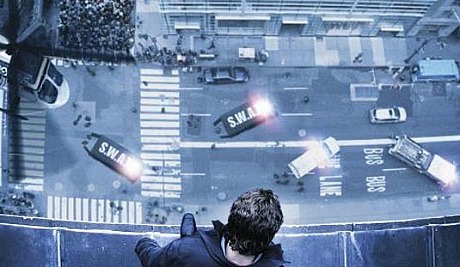
In this morning’s Toronto Film Festival riff I included a riff about office-building jumping. And I just want to double-post it because today begins an earnest, never-say-die, balls-out campaign to put an end to office-building jumping in big-studio movies of a sci-fi, action-y, futuresque or comic-book-based attitude or slant. From here on nobody jumps off a skyscraper…no one. Unless they’re Spider-Man, that is. Batman can’t do it, Tom Cruise can’t do it, villains can’t do it…shutdown.

Hundreds of whore screenwriters churning out video-game plots for corporations are probably gulping right now, but leaping off tall buildings has become an industry joke and somebody needs to say “enough.” This isn’t as important as a moviegoer class-action lawsuit against the NRA, but it has a place in the scheme.

Sprawling Ambition

Well, there goes my idea of an exclusive 2012 New York Film festival debut of Roger Michell‘s Hyde Park on Hudson (Focus, 12.7) because of the political-and-cultural FDR-NY connection…forget it. Because it was announced this morning that Hyde Park is debuting at the 2012 Toronto Film Festival. Will NYFF honcho Scott Foundas accept sloppy seconds?

I’m sitting here and sifting through the first batch of Toronto Film Festival selections as we speak. They were announced this morning at a Toronto press conference.

Where’s Paul Thomas Anderson‘s The Master? I don’t see any Master here. Does this indicate a Scott Foundas-engineered North American exclusivity coup of some kind?

Terrence Malick‘s unsold and possibly troubled To The Wonder, which has been imagined as a space-case Oklahoma love story occuring in the mind of a gifted but undisciplined wackadoodle director, will also turn up in Toronto following its Venice Film Festival premiere.

Joe Wright‘s Anna Karenina will pig out and go crazy with 2012 TIFF exposure.

David O. Russell‘s The Silver Linings Playbook will also play Toronto so there’s another debut that Foundas can’t have. If I were Scott I would get on the stick and land (a) Steven Spielberg‘s Lincoln as the NYFF’s closing-night attraction, (b) Robert Zemeckis‘s Flight and (c) Robert Lorenz and Clint Eastwood‘s Trouble With The Curve.

And Juan Antonio Bayona‘s much-awaited The Impossible will also play Toronto. Will this be the absolute first-anywhere debut, or will this Asian tsunami disaster drama peek out first in Telluride?

And don’t give me any of that “oh, wow!…oh, joy!…Looper in Toronto!” jazz. Rian Johnson‘s sci-fi crime actioner starring Joseph-Gordon Levitt and Bruce Willis is said to be pretty good but watch out for Johnson — the quietly oppressive Brick convinced me that he’ll be a problem for many, many years to come. Besides, Looper opens on 9.28, or two weeks before it plays Toronto…big deal.

Does anyone jump off a skyscraper in Looper? Isn’t it contractually assured that in every big-studio sci-fi, comic-book-based or futuristic actioner a significant character HAS TO JUMP OFF A BUILDING? That may be so but I’m telling you right now that any and all building-jumpings are hereby verboten, and any film that includes one henceforth will suffer the consequences.

Pablo Larrain‘s No, one of the surprise hits of the Cannes Film festival two months ago, will have its major North American exposure at Toronto.

The TIFF Galas and Special Presentations include Ben Affleck‘s Argo (a kind of double-header for Affleck when you add in the Malick), the mind-bending. German-financed, Wachowski/Tom Tykwer Cloud Atlas, Derek Cianfrance‘s The Place Beyond The Pines, Billy Bob Thornton‘s Jayne Mansfield’s Car (which played in Berlin), Robert Redford‘s The Company You Keep (a Lem Dobbs-written thriller about a former ’60s radical on the run after a journalist exposes his identity), Stephen Chobosky‘s The Perks Of Being A Wallflower (a Mr. Mudd production) and David AyersEnd of Watch.

Nicholas Winding Refn‘s Only God Forgives was teased in Cannes (I saw the footage at the Salles du Soixantieme) so where is it?

I don’t have Clue #1 about Noah Baumbach‘s Frances Ha…nothing. But it’ll be in Toronto.

There will also be Stuart Blumberg‘s Thanks For Sharing, Liz GarbusLove, Marilyn (what?), Shola Lynch‘s Free Angela And All Political Prisoners, Deepa Mehta‘s Midnight Children, Mike Newell‘s Great Expectations (Dickens), Rubba Radda‘s Inescapable (sounds too much like The Impossible), Sergio Castellitto‘s Twice Born, Gauri Shinde‘s English Vinglish, Mira Nair‘s The Reluctant Fundamentalist (with Kate effing Hudson?…get outta here), Nikolai Arcel‘s A Royal Affair, Hur Jin-Ho‘s Dangerous Liaisons, Hideki Takeuchi‘s Thermae Romae (too obscure sounding, cross it off), it off), Stuart Blumberg‘s Thanks For Sharing, Robert Puccini and Shari Spring Berman‘s Imogene, Yaron Zilberman‘s A Late Quartet, Joss Whedon‘s Much Ado About Nothing (a growth movie that we’re all going to have to sit through), Nenad Cicin-Sain‘s The Time Being, and Josh Boone‘s Writers.

Other slush-pile contenders include Ramin Bahrani‘s At Any Price, Maiken Baird‘s Venus And Serena, Neil Jordan‘s Byzantium, Dustin Hoffman‘s Quartet, Sally Potter‘s Ginger And Rosa, Ben Timlett, Bill Jones and Jeff Simpson‘s A Liar’s Autobiography, Laurent Cantet‘s Foxfire, Francois Ozon‘s In The House (with Kristin Scott Thomas), Margarethe von Trotta‘s Hannah Arendt, Andrew Adamson‘s Mr. Pip, Costa-GavrasCapital, Ziad Doueiri‘s The Attack, Eran RiklisZaytoun, Baltasar Kormakur‘s The Deep, Nishikawa Miwa‘s Dreams For Sale, Lu Chuan‘s The Last Supper, Chen Kaige‘s Caught In The Web, Marco Bellochhio‘s Dormant Beauty, Ana Piterbarg‘s Everybody Has A Plan, and Joachim Roenning and Espen Sandberg‘s Kon-Tiki.

Not to mention Matteo Garrone‘s Reality (seen and respected but also dismissed in Cannes). Stephane Brize‘s A Few Hours Of Spring, Thomas Vinterberg‘s The Hunt, Ariel Vromen‘s The Iceman, Cate Shortland‘s Lore, Takeshi Kitano‘s Outrage Beypmd and Jacques Audiard‘s excellent Rust And Bone.

The Balcony Scene

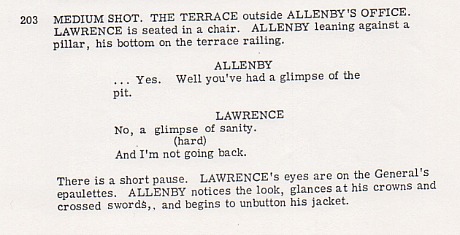
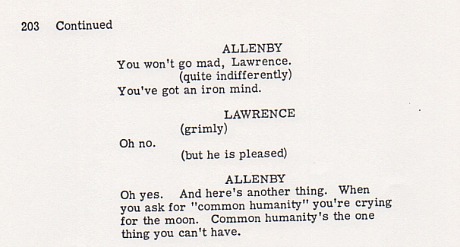
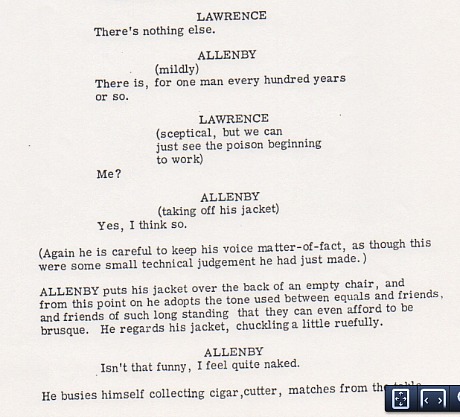
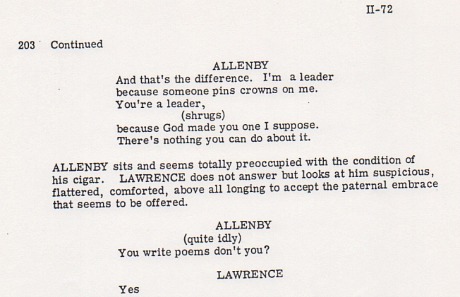
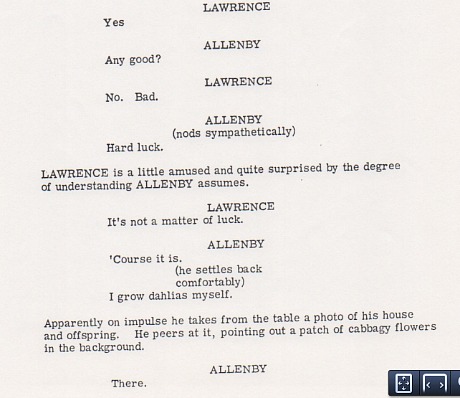
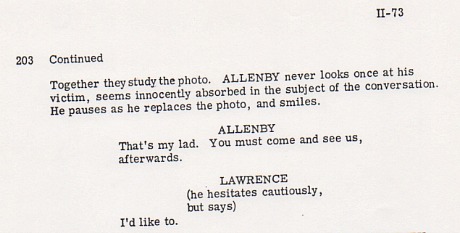
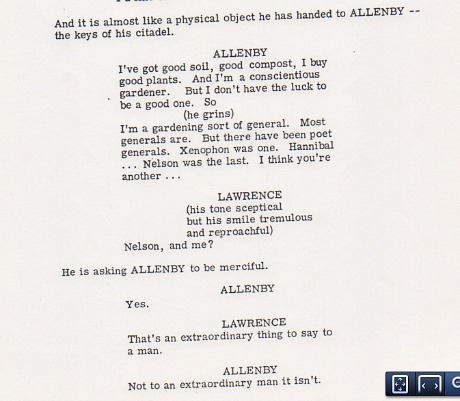
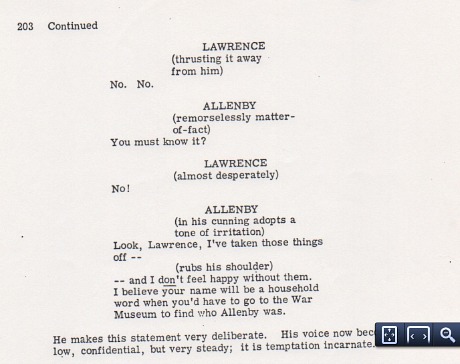
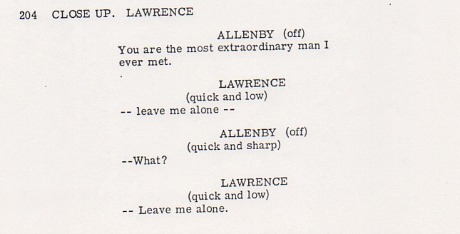
The Lawrence of Arabia “balcony scene,” in which Jack Hawkins (Gen. Alllenby) emotionally manipulates Major Lawrence (Peter O’Toole), will be included as an extra on the forthcoming Lawrence Bluray. I’ve pasted the scene’s pages, taken from Robert Bolt‘s screenplay, after the jump. The following excerpt from a 2000 interview with original Lawrence restoration director Robert Harris, conducted by Geoff McNeal, offers some background:

Harris: “When we were completing the cut, we attempted to put together a balcony scene in reel 11B, in which Allenby works to get Lawrence to go back to Arabia. The scene had been hacked in the shorter version. David [Lean] wanted it in. [Screenwriter Robert] Bolt felt it was the finest scene he had ever written, which is saying a great deal. David directed the looping of dialogue in London with Peter and, lending his voice to the Jack Hawkins character, Charles Gray. We had requested that the studio check the voices on a few actors and select the best for the roll. They simply took the first on the list, which was Gray — a fine actor [who] sounded nothing like Hawkins.*

“When we put together the scene, it was obvious that Gray’s voice didn’t work. At precisely this time, David had to leave for the Cannes Film Festival, [and Columbia chief] Dawn Steel wanted to see the film before he left and we went about recutting the scene once again for a special screening. It was a horrific decision and something that I should have fought at the time, but didn’t. David wanted the Allenby lines revoiced and put back at some time in the future. [But] the cutting room was shut down and it never happened. I’ve been trying to get the extended scene reinstated ever since. It adds layers to the film which are unbelievably rich. Their feeling, and one cannot find ultimate fault with their position, is that David allowed the film to be screened in 1989 without the additional footage, thereby accepting it as ‘his’ cut.”

…and you all know the rest. Hawkins/Allenby says “that’s a feeble thing to say” and so on.

“Cruel and Deadly Hoax”

“I suggest that all moviesgoers join in a class action suit against the National Rifle Association. The 100 million moviegoers should be entitled to at least $20 each for the harm caused to them by this incident. The National Rifle Association should be sued for at least $2 billion for enabling the Colorado movie massacre.

“The NRA has fought consistently to prevent gun control laws that could have averted this tragedy. The facts are clear and overwhelming that gun control works. One has only to look at the countries that have strong gun control laws to see that they have much lower violent death rates and no massacres. The link between gun control and lower violent death rates is as scientifically proven as the link between smoking and cancer. Any reasonable jury when presented with the facts would understand this and see the connection.” — Notes to Aphrodite‘s Jay Raskin, posted a day or two ago.

Respect for Frank Pierson

I love the back-and-forth energy between Al Pacino and Charles Durning in this scene from Dog Day Afternoon. Although I suspect, knowing Pacino, that it was at least somewhat improvised, credit for most of the dialogue, I’m presuming, has to go to Frank Pierson, who won an Oscar for the DDA screenplay, and who died today at age 87. He was working right up to the end — his last credit was for Mad Men. Good fellow.

Pierson was a director-writer, but his best work was on the page. I’d like to be generous but the two best films he directed — A Star Is Born and King of the Gypsies — weren’t all that good. His best scripts were for Cat Ballou (’65), Cool Hand Luke (’67), The Looking-Glass War (’69), Dog Day Afternoon (’75) and Presumed Innocent (’90).

Market Value

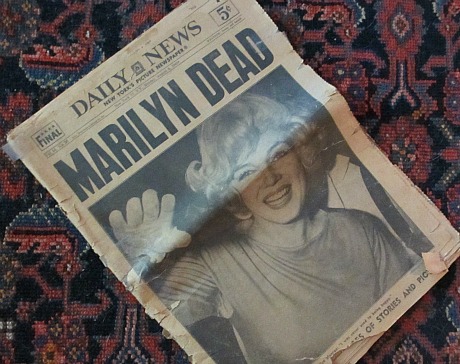
We’re less than two weeks away from the 50th anniversary of the 8.5.62 death of Marilyn Monroe, and I’m in possession of an 8.6.62 copy of the N.Y. Daily News that headlines her death. The whole thing, 48 pages worth. With a story about JFK urging tough drug laws and the N.Y. Yankees losing to the White Sox in the 13th inning and everything else that was considered news that day.

The paper it’s printed on feels like it could disintegrate in your hands, like something lifted out of an Egyptian tomb. It’s not even amber or yellowish any more — it’s brown.

I’ll never sell it but I wonder what it’s worth to serious Marilyn fans? A couple of hundred? More?

High Noon Hater

You can just smell the contempt in Dave Kehr‘s N.Y. Times review of Olive Films’ recently released Bluray of Fred Zinneman‘s High Noon. And who woulda thunk that Kehr, a brainy, tweedly-deedly Manhattan critic who knows from scholastic film culture like no one’s business, would side with Howard Hawks and John Wayne on the matter of Marshall Will Kane’s pleas for help from the citizens of Hadleyville?

Hawks and Wayne are famed for having expressed disgust that Kane would ask for special deputies to help him fight the Frank Miller gang after the noon train arrives. They thought this was unmanly and contemptible, and their eventual response was Rio Bravo, a 1959 western that was roughly about the same situation (i.e., bad guys coming to town to shoot it out) but was basically about homies sticking together and looking out for each other.

“Whatever message it was meant to convey, High Noon was always a sort of meta-western, conceived by a group of filmmakers who had little or no previous experience with the genre,” Kehr writes. Let me explain to Kehr what High Noon is meant to convey. It’s meant to convey that fair-weather friends are a dime a dozen, that most people are cowards or at the very least don’t mean what they say, and that when the chips are down there’s only person you can really count on — yourself. Got it?

Gary Cooper, who won an Oscar for his performance as Kane, “never seems quite right for the role,” says Kehr, particularly “as he goes door to door begging the terrified citizens to help him stand up to the vengeful outlaw (Ian MacDonald) returning on the noon train. At one point he even puts his head down on his desk and seems to cry.”

Are you feeling that Wayne attitude? Are you sensing that Hawks snarly-tude? This, apparently, is what your hardcore Rio Bravo fan thinks like, deep down. Real men are real men, and not only do they they not reveal that they’re scared, they just plum flat-out never feel scared, period.

“With Marlon Brando or Montgomery Clift, Kane’s vulnerability might have registered with some dramatic and thematic force,” Kehr writes, “[but] Cooper retreats into a rigid self-consciousness.” Bullshit — he’s obviously sweating and fretting his way through this ordeal, holding on and manning up as best he can.

I agree with Kehr that High Noon‘s “vague critique of western machismo remains one of the film’s few identifiably liberal elements (one other being the Katy Jurado character, a Mexican woman who has suffered from discrimination). Foreman’s portrait of the townspeople as trembling cowards hardly seems designed to exalt the masses.

But Kehr is all wet when he tries to draw a link between High Noon and the Korean War and the threat of atomic annihilation, to wit: “What convinces in High Noon is the film’s sense of social malaise, of a community drained of coherence and conviction in the face of overwhelming fear — certainly a plausible portrait of a country in which, according to a Gallup poll in September 1951, about half the respondents believed that the Korean conflict represented the beginning of an atomically charged World War III.”

Dead, Gone, Buried

The straight-to-DVD-or-Netflix movie is one thing, but what do you call a film that’s apparently so dead it doesn’t even rate the video bin? How can a film be so bad that its producers don’t want to even earn at least some lunch and subway-pass money from this or that video platform? I understand write-offs but what’s the point of throwing a movie into a ten-foot-deep hole and covering it up with dirt?


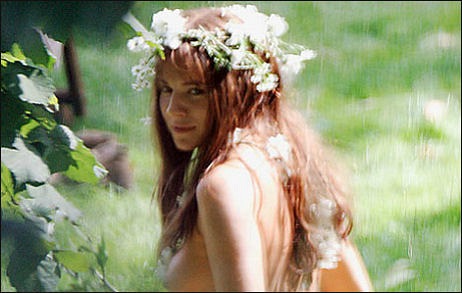
Sienna Miller during filming of Beeban Kidron’s Hippie Hippie Shake

Case in point: Beeban Kidron‘s Hippie Hippie Shake, a piece-of-shit adaptation of Richard Neville‘s memoir about running Oz, the famed London counter-culture weekly, in the late ’60s. Shot in late ’07 and then gradually and sluggishly abandoned by distributors (including Universal), it’s not purchasable or rentable anywhere. I tried to watch it on Yidio.com and Lovefilm.com…nothing happened.

Don’t those nude scenes of Sienna Miller matter to anyone?

I think it’s because ’60s hippie movies always put out some kind of impossible-to-stomach, go-away-and-stay-away atmosphere. Four and a half years ago I wrote that “I’d love to see this Tim Bevan-Eric Fellner production do it right, but haven’t hippie films always been a problem? Isn’t there some kind of curse upon any film trying to reenact or reconstitute that old love beads-slash-Bhagavad Gita-slash-Moody Blues vibe? Isn’t there something immensely difficult if not impossible in trying to make that incense-and-peppermints chemistry seem palatable by the standards of 21st Century culture?”

Three years ago I wrote that “the rep of this poor misbegotten film has gone from intriguing to worrisome to there-must-be-something-wrong to massive fartbomb.”

Roughly 18 months ago Sydney Morning Herald reporters Gary Maddox and Steve Meacham wrote that “more than three years after the film was shot in England, rumours that Hippie Hippie Shake has turned out dismally have proved to be accurate. After a promised release failed to eventuate last year, the British production company, Working Title, has confirmed it will not reach cinemas. A distribution source said: ”There are cases where movies just come out really…badly.”

And yet in late ’08 two reviews were posted that said Hippie Hippie Shake was at least watchable — one from British blogger Matt Robinson and another from AICN’s “Harry Palmer.”

It Was Holmes All Along

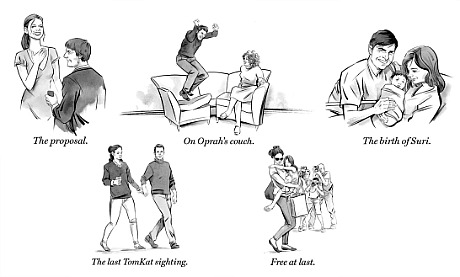
Benjamin Wallace‘s chatty, sometimes brazenly phrased Vulture piece about the dissolution of TomKat (“An Inquiry Into The Very Public Private Marriage of Katie Holmes and Tom Cruise“) comes to the conclusion that apart from the venal Scientology element, the possibly-straight Cruise isn’t as much to blame for the breakup as much as Holmes’ feelings of being “trapped in someone else’s movie.


Illustrations by New York‘s Kagan McLeod.

“Promised above-the-title billing, [Holmes] never managed to move beyond a supporting role,” Wallace writes. “Where at 26 she found Cruise’s monster life ‘exciting,’ at 33 it just made her feel smaller. And it doesn’t require any overt or conscious cynicism on Holmes’s part, or mean she wasn’t genuinely smitten with Cruise when they wed, for her also to have expected the union to be a boon to her career.

“Marrying Cruise had done wonders for Nicole Kidman, who not only became massively more famous but whose acting career took off while she and Cruise were still together. And Holmes, who already had a hit TV series to her name and a $1 million role in Batman Begins at the time of her wedding, was starting ahead of where Kidman had. Indeed, marrying Cruise did make Holmes a lot more famous — there she was on the cover of Harper’s Bazaar, styled by Victoria Beckham — but it also, because of Cruise’s bizarreries, drove her Q rating downward. When her character was reprised in the next Batman movie, The Dark Knight, Holmes was passed over for Maggie Gyllenhaal.

“She got parts in mostly small movies, but they bombed at the box office. The Times called Holmes the ‘weakest link’ in Mad Money, and for her work in the Adam Sandler comedy Jack & Jill, she was nominated for Worst Supporting Actress at the 2011 Golden Raspberry Awards (her second nomination; she had received the first for Batman Begins).

“At the same time, unfavorable comparisons between her and fellow Dawson’s Creek alumna Michelle Williams became painfully inescapable. As Williams became a figure of sympathy because of her husband (the late Heath Ledger), Holmes became a joke because of hers. Holmes is said (scout’s honor!) to have been enraged by Williams’s success. While Holmes was playing Jackie O. in a mini-series that ended up airing on Reelz — that’s Channel 238 in the Time Warner NY cable system, if you’re wondering — Williams was playing JFK’s sometime-mistress Marilyn Monroe, in a feature film, en route to a third Oscar nomination.

“But Scientology, or rather its terrible reputation, offered a way out. Holmes, unable to get the kinds of roles she wanted, realized she could cast herself in the part of a lifetime. Like Truman in The Truman Show, she finally grasped her ontological status as a character in a fiction, and that self-awareness propelled her out of the story and crashing through the fourth wall. She knew a good third-act twist when she saw one.

“‘It’s not like she ever had a huge career to begin with. She was a rising star. Now she will have a huge career,’ says an editor at a leading celebrity magazine. Holmes, emerging from a seven-year, one-on-one apprenticeship with the world’s most famous action hero, simply rewrote the script.”

“Or maybe she didn’t. But what a story.”