Two Stood Together

Except for the reaction of Marshall Fine and to a lesser extent Variety‘s Justin Chang, The Dark Knight Rises is knocking ’em dead over at Rotten Tomatoes and Metacritic so far. All the bowling pins are toppling over and going “baaahhllkk!”

In a review that echoes the (d) comment in this 7.11 reaction riff, Variety‘s Justin Chang has, make no mistake, gone mostly thumbs up on Christopher Nolan‘s nearly three-hour epic, but he also states that The Dark Knight (’08) was better.

“While The Dark Knight Rises raises the dramatic stakes considerably, at least in terms of its potential body count, it doesn’t have its predecessor’s breathless sense of menace or its demonic showmanship, and with the exception of one audacious sleight-of-hand twist, the story can at times seem more complicated than intricate, especially in its reliance on portentous exposition and geographically far-flung flashbacks.

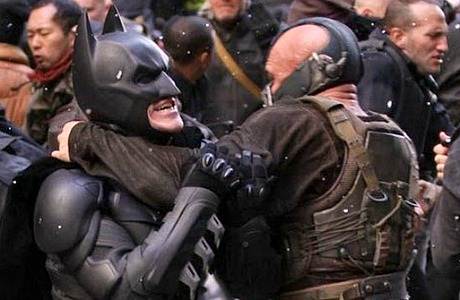
“Perhaps inevitably, one also feels the absence of a villain as indelible as Heath Ledger‘s Joker, although Hardy does make Bane a creature of distinct malevolence with his baroque speech patterns and rumbling bass tones, provoking a sort of lower-register duet when pitted against Batman’s own voice-distorted growl (the sound mix rendered their dialogue mostly if not entirely intelligible at the screening attended).

So, yes, The Dark Knight Rises never quite matches the brilliance of The Dark Knight, and yet “this hugely ambitious action-drama nonetheless retains the moral urgency and serious-minded pulp instincts that have made the Warners franchise a beacon of integrity in an increasingly comicbook-driven Hollywood universe,” Chang concludes.

In Fine’s view, The Dark Knight Rises is the “weakest” Batman film in Nolan’s trilogy.

“Where Batman Begins (’05) had a mythic feel that remade the origin story in an exciting new way (away from the flat-footed cartoonishness of the Tim Burton/Joel Schumacher entries), The Dark Knight felt like an overreach — an attempt to tell too many stories in one long movie. But it won over the critics, mostly because of a sizzling performance by Heath Ledger, who died before the movie was released (and who was given a posthumous Oscar).

“Now comes The Dark Knight Rises, bringing in the Bane character (played, with my condolences, by Tom Hardy) and Catwoman (Anne Hathaway, one of the movie’s few highlights). Nolan gets so caught up in creating an epic adventure that he hammers the ‘epic’ and neglects a crucial component: adventure.”

I won’t be seeing The Dark Knight Rises until tomorrow night, but at least I’ll be seeing it in IMAX, which is more than you can say for the critics who saw it Friday or the ones seeing it this afternoon. This time I’m glad to be at the end of the train, in the caboose. Which is where Warner Bros. always puts me when it comes to screenings.

Best Comic-Con Thing That Happened…?

Smell that breeze? Can you feel it on your face? It’s coming from the Pacific, and it might have something to do (although it would be pure speculation on my part) with the ending of Comic-Con in San Diego. Let it go, right? Render unto Caesar (or some substitute entity of your choice) the things which are Caesar’s, and unto God the things that are God’s. At the very least Comic-Con is a highly enjoyable gathering of the geeks, if you’re part of that crowd…bon ami, hail fellow, hoist the brewskis. I get that, fine. No biggie and no worries, but it’s kinda nice that it’s over.

So the only real excitement came from the presentation of Neil Blomkamp‘s Elysium…do I have that right? Or was it the opportunity to get Henry Cavill‘s autograph?

Feinberg on Holm

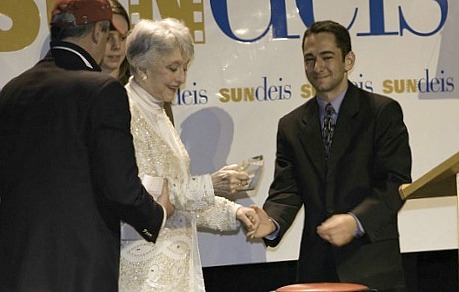
“The last time that I saw Celeste Holm was at a party at Lincoln Center following the world premiere of Steven Spielberg‘s War Horse. My date was my mom, who had met Celeste when she came to my college film festival years before, and who joined me in marveling that, even at the age of 94 and wheelchair-bound, she was still getting out and about. What a lust for life!

“That night, while most of the guests rushed past the quiet old woman in the wheelchair in order to get a word or a picture with the stars of the moment, I pulled aside a few friends and introduced them to someone who would be remembered long after the vast majority of the others had been forgotten. It was a privilege to know her.” — from Scott Feinberg‘s remembrance of Ms. Holm, posted earler today following her death.

To Stuff A Shirt…Or Not

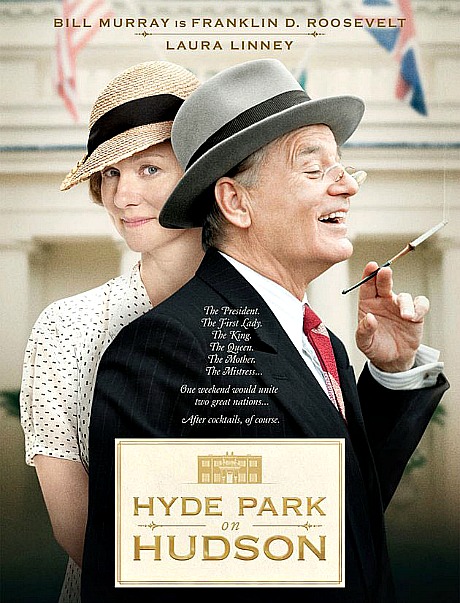
For whatever reason I didn’t pay much attention to this trailer for Roger Michell‘s Hyde Park on Hudson (Focus, 12.7) when it posted six or seven weeks ago. I don’t know what the film will finally feel like, but the trailer suggests a jaunty, slightly comedic attitude. It feels broad. And I’m not quite sure about Bill Murray‘s grasp of Franklin D. Roosevelt‘s voice — it feels off. I don’t know. I want to like it. I hope the film is better than it seems.

I know, I know — Laura Linney for Best Actress! But I’m also looking forward to Olivia Williams‘ performance as Eleanor.

Eyefuls

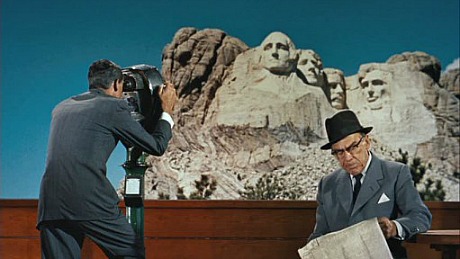
Tomorrow night I’ll be at Sony Studios for a presentation of 22 “gigantic” backdrops, sponsored by the Art Director’s Guild and created by JC Backings and used for classic films as North by Northwest, Singin’ in the Rain and The Sound of Music. The backdrops (some 60 feet wide and 24 feet high) will presumably occupy at least a few of sound stages. The press release says they’ll “represent a wide cross section of genres and techniques used by artisans for more than 75 years,” meaning they’re duplicates of the originals, I gather.

The evening will celebrate the ADG’s 75th anniversary. Members of IATSE Local 800 will attend. There will be a special appearance by scenic painter Karen L. Maness, co-writer of ADG’s next large-format publication, “The Art of the Hollywood Backdrop.”

Explanation

The swoony ComicCon fanboys didn’t say boo about Peter Jackson‘s 48 frame per second turn-tail during yesterday’s Hobbit panel in Hall H, but TheWrap‘s Sharon Waxman brought it up, at least.


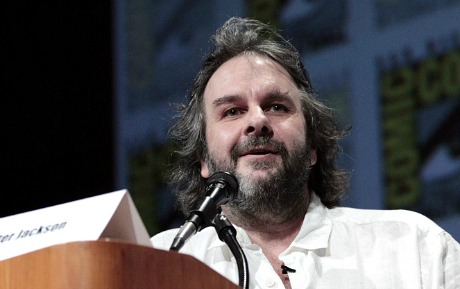
Hobbit director Peter Jackson during yesterday’s Comic-Con panel discussion in Hall H.

11 or 12 minutes’ worth of The Hobbit: An Unexpected Journey had just been screened, but in the standard 24 fps format. Waxman writes that Jackson “didn’t even mention 3D or show the higher-resolution 48 frames-per-second footage that was shown to theatrical exhibitors in April.”

“Like anything, you’ve got to get used to it,” Jacxkson told the crowd yesterday. “You don’t know whether you like it or not until you can be immersed in it for two hours. That’s how it should be judged — not in a convention hall, in an environment that is not the cinema.”

For what it’s worth I’ve heard that Warner Bros. tech guys ran a test projection of Jackson’s 48 fps Hobbit footage inside Hall H, and that they weren’t satisfied with it. If this really happened and this alleged dissatisfaction was a key factor in the decision not to show the 48 fps reel, I don’t know why Warner Bros. didn’t just say that. This I would’ve understood.

“Forty-eight frames is terrific,” Jackson told the crowd. “I think it’s going to change the way things are made. It’s a terrific advancement, giving people an immersive experience that they can’t get off their iPads and to get people back to the cinemas. We are living in an age where teenagers are not going to the movies.”

But “I didn’t want people to sit there and watch 10 minutes of film and all they write about is 48 frames.”

Jackson elaborated in a 7.15 interview the The Huffington Post‘s Mike Ryan, who began by asking if Jackson was “disappointed by the internet reaction” to the 48 fps footage shown during Cinemacon in Las Vegas.

“Yeah…I mean, disappointed, I guess, is one way [of putting it]. I wasn’t surprised in the sense that my experience with 48 frames ?? and I’ve seen hours and hours and hours of it, obviously ?? is that it’s something that becomes a real joy to watch, but it takes you a while.

“It’s like watching a movie where the flicker and the strobing and the motion blur what we’ve been used to seeing all of our lives — I mean, all our lives in the cinema — suddenly that just disappears. It goes. And you’ve got this incredibly vivid, realistic-looking image. And you’ve got sharpness because there’s no motion blur, so everything is much sharper. And plus we’re shooting with cameras that are 5K cameras, so they’re super sharp.

“So you sit there and you think, ‘Wow, this is different.’ The first few minutes, you think, ‘Wow, this is really different.’ It’s cool, but it’s different. And at the end of two hours, or two and a half hours, you think, ‘That was cool. It was a great way to watch the movie.’

“Now, what I learned from the CinemaCon experience is don’t run a seven or eight or ten minute reel where the total focus is going to be on the 48 frames. I mean, that was a disappointing thing at CinemaCon. Forty-eight frames I’m not worried about, because when this movie comes out and people see it at 48 frames, they’re actually going to get the experience that I’ve had for the last 18 months. I’m a film guy, I’ve grown up all my life going to the movies, and I think 48 frames is great. So I’ve got to believe I’m not stupid. I have to believe it.

When Ryan says he’d been hoping to see the 48 fps version at Comic-Con, Jackson says, “I
know, but Hall H, a big convention center…that’s not the way to judge it. It’s an important thing to judge, because the industry may or may not want to adopt high frame rates, and I think it has to be taken very seriously. And I think the only logical thing to do is to let people see a feature-length narrative film at 48 frames. I’ve no doubt whatsoever that people are going to enjoy it.

“But the disappointing thing with CinemaCon is that no one talked about the [content of the] footage. The first time we ever screened The Hobbit, all the stories were the 48 frames stories. And then the negative guys, the guys that say this doesn’t look like film — the guys who are in love with the technology of 1927 — are sort of sitting there saying, ‘But it doesn’t look like cinema. This is not what we’re used to seeing in the films.” And those stories rush around the world and no one talked about the footage.

“So I’m not going to go to Comic-Con with 12 minutes of footage and have the same reaction. I don’t want people to write about 48 frames. Forty-eight frames can be written about in December. When people can actually watch a full-length narrative film, everyone can go to town on 48 frames, because that’s the form that you’ve got to see it in. And if you hate it, you hate it. And if you like it, you like it. [But] I think most people will [like it].”

Reply

Early this morning HE reader “gazer” wrote that yesterday’s riff about (a) alleged buyer reactions to Terrence Malick‘s To The Wonder and (b) my judgments about Sarah Green and Nick Gonda‘s apparent tendencies as Malick’s producers (“Malick’s Enablers Doing Him No Favors“) boil down to my “essentially trying to lobotomize a filmmaker who rubs [me] the wrong way.” I wrote a response an hour ago:

Wells to gazer: Malick doesn’t rub me that aversely. He’s always been a very special, obviously gifted filmmaker-poet-dreamer-painter. Most people understand that. His personality and spiritual worldview are part of the threadwork of everything he’s done, and he’s influenced others here and there. Badlands and Days of Heaven are mesmerizing works. But more to the point, they’re disciplined…unlike, in my view, the films he’s made since he returned 14 years ago from his J.D. Salinger-like withdrawal with The Thin Red Line.

I read Malick’s fascinating draft of The Thin Red Line script in ’96. It was quite different than the 1998 film that he shot and cut together — compressed, tightly threaded, far less meditative. The New World gets better and better every time I see it — I watched the longest director’s cut on Bluray a year or so ago and was really taken away by the primeval Jamestown portion, although I still felt and do feel unsatisfied and even irked when Colin Farrell abruptly disappears and Christian Bale shows up and Pocahantas travels to England and suddenly dies. And I thought that the first hour or so of The Tree of Life was sad and moving and detestable and quietly mind-blowing, but that the center didn’t hold and it kind of spaced itself out and lost the thread, whatever that thread may have been. (I’m forgetting now.)

My point is that Malick’s method of shooting and particularly editing strikes me as random and swirly and catch-as-catch-can, and in a strange way almost forced. He shoots what he shoots and then he tosses the lettuce leaves into the air and grabs a leaf here and there and eliminates Sean Penn‘s Tree of Life character or Adrien Brody‘s Thin Red Line character (“Fife”) when the mood strikes, and then he picks some strands of pollen fibre out of the air and weaves them through the lettuce leaves and throws it all together into some kind of swoony patchwork ball of yarn or free-association mescaline trip — an impressionist fever dream by a guy who’s looking to rewrite the manual.

Which is very brave and exciting on his part, and at the same time bothersome, depending on my mood when I’m watching one of his more recent films. I basically feel/believe that the Malick of the ’70s was a much more interesting and transporting director than the one who re-emerged with The Thin Red Line — that’s all. I’m not dismissing him out of hand or saying that he rubs me the wrong way….although he actually kind of does at times. But he also amazes and delights me from time to time.

Do The Math

During this afternoon’s Django Unchanged panel at Comic-Con, Quentin Tarantino explained what Empire‘s James White calls an “intriguing link” between Jamie Foxx‘s Django and ’70s blaxploitation cinema. According to QT, Broomhilda Von Shaft (Kerry Washington) and Django “will eventually have a baby, and that baby will have a baby…and then John Shaft will be born! Our hero and heroine are the Great, Great, Great Grandparents of Shaft.”

If John Shaft, who was around 30 in 1972, was born in 1940 or thereabouts, then his dad was born around 1915 or so, and Shaft’s grandfather would have been born, say, around 1885 or 1890, and his great-grandfather was born around 1860 or 1865. His great-great grandfather could have been born in in 1835 or 1840, and his great-great-great grandfather — the son of Django and Broomihilda, according to Tarantino — would have been born around 1815 or 1820. Isn’t Django Unchained set sometime just before the Civl War, or in the 1850s? Or have I got that wrong?

Malick Enablers Doing Him No Favors

According to a 7.10 posting by terrencemalick.org’s Paul Maher. Jr., Terrence Malick‘s To The Wonder — an Oklahoma-set romantic drama he shot in late 2010 with Ben Affleck, Rachel McAdams, Olga Kurylenko, Rachel Weisz, Jessica Chastain and Javier Bardem — has scared away distributors, who have presumedly been shown the film in its entirety or in portions.

In other words, the same buyers who were going “what the eff is this?” after seeing The Tree of Life are again throwing up their hands and muttering to themselves in the general vein of “here we go again,” “life is too short,” “Jesus H. Christ” and “not me, babe.”

As Maher puts it, “Possibly the difficulties of The Tree of Life and its polarizing effect on the box office may be an underlying issue.”

Maher’s source is either closely affiliated with or working for Film Nation, and of the female persuasion. I’m listening to Maher because he’s a Malick fan, and like any webmaster running a kiss-ass website his default tendency is to praise Malick and otherwise shine favorable lights upon his accomplishments.

Not only is To The Wonder not being released in this country any time soon (although it may open in Europe a few months hence), but “the possibility of any trailer or publicity-related material coming out in the fall of 2012 is still vague, possibly unlikely,” Maher writes. He also reports that “when asked for any kind of teaser image or information, I was told [by my FilmNation source] that there still is nothing in the public domain that they could release.”

What the eff does that mean?

Malick taking two years to cut a film together is SOP (Days of Heaven was in the editing room from ’76 to ’78) but he can’t be moved to even issue a selection of still images from To The Wonder? Or allow a one-sheet to be created? Or put together an appetite-whetting teaser of some kind?

I’ve been saying for years that Malick needs a tough ballsy producer who isn’t afraid to get in his face and read him the riot act and goad him into adhering to a semi-reasonable editing deadline (i.e., between a year and eighteen months, let’s say) and perhaps even influence the shaping of his films in a way that won’t flagrantly agitate the thick-fingered vulgarians in the distribution business, at least to the point that they’ll make semi-serious bids on his finished films, which has not apparently happened on To The Wonder, per Maher.

The fact that To The Wonder is allegedly homeless nearly two years after principal photography is the proof in the pudding. Terrence Malick needs an intervention. He needs a strong partner and counsel who can save him from himself.

More to the point, the indications are overwhelming that Sarah Green and Nick Gonda, Malick’s producers on (a) To The Wonder, (b) the film formerly known as Lawless and (c) Knight of Cups, do not believe in the tough-love approach used by Bert Schneider, Malick’s producer on Days of Heaven. Malick’s endless dithering and dilly-dallying indicates that Green and Gonda are not forcing the issue and have decided to serve him in a passive, whatever-Terry-wants sort of way. They appear to be hand-holders, friends, toadies, facilitators, go-alongers, enablers.

In a 5.18.12 interview with The Hollywood Reporter‘s Pamela McClintock, FilmNation’s Glen Basner said he “hit it off with Sarah Green and Nick Gonda, two of the producers of [To The Wonder]. We were very like-minded people and maintained a friendly relationship. They were looking to make his next movie more outside the system, allowing Terry to have a process that works best for him, and we devised a way to finance the movie that met all of those needs.”

In other words, Malick says “jump” and Green and Gonda say “how high?”

In a 12.13.11 obit, I praised Schneider as “the last producer to semi-successfully micro-manage Terrence Malick and keep him from his own self-indulgent tendencies by somehow persuading him to keep Days of Heaven down to a managable 94 minutes.

“After Heaven, Malick never made a lean, well-honed movie again. When he returned to filmmaking in the ’90s it was all pretty photography and leaves and alligators and voice-over and scrapping dialogue and expansive running times. Mister, we could use a man like Bert Schneider again.

“An avowed leftie, Schneider was a renowned, down-to-business producer of late 1960s and ’70s classics such as Easy Rider (which Schneider reportedly honed into shape when director Dennis Hopper‘s undisciplined editing became problematic), Five Easy Pieces and The Last Picture Show. He also won a Best Documentary Oscar in 1975 for Hearts and Minds.

In his landmark book ‘Easy Riders, Raging Bulls,’ Peter Biskind called Schneider ‘the eminence grise of the American New Wave.’

From Wiki’s account of the post-production of Days of Heaven:

“After the production finished principal photography in ’76, the editing process took over two years to complete. Malick had a difficult time shaping the film and getting the pieces to go together. Schneider reportedly showed some footage to director Richard Brooks, who was considering Gere for a role in Looking for Mr. Goodbar.

“According to Schneider, the editing for Days of Heaven took so long that ‘Brooks cast Gere, shot, edited and released Looking for Mr. Goodbar while Malick was still editing.’

“A breakthrough came when Malick experimented with voice-overs from Linda Manz‘s character, similar to what he had done with Sissy Spacek in Badlands. According to editor Billy Weber, Malick jettisoned much of the film’s dialogue, replacing it with Manz’s voice-over, which served as an oblique commentary on the story.

“After a year, Malick had to call the actors to Los Angeles to shoot inserts of shots that were necessary but had not been filmed in Alberta. The finished film thus includes close-ups of Shephard that were shot under a freeway overpass. The underwater shot of Gere’s falling face down into the river was shot in a large aquarium in Sissy Spacek‘s living room.

“Meanwhile, Schneider was upset with Malick. He had confronted Malick numerous times about missed deadlines and broken promises. Due to further cost overruns, he had to ask Paramount for more money, which he preferred not to do.”

As I wrote on 6.29.11, “Terrence Malick’s 10.1.96 draft of The Thin Red Line was tight and true and straight to the point, and it had no alligators sinking into swamps or shots of tree branches or pretty leaves or that South Sea native AWOL section or any of that languid and meditative ‘why is there such strife in our hearts?’ stuff.” Why didn’t Malick shoot the down-to-it script he wrote? I wouldn’t know, but one reason, surely, is that his producers didn’t say boo when he decided to throw in the alligators and the tree leaves and all but jettison Adrien Brody‘s performance.

Terrence Malick, in short, has been enabled to death by his friends and supporters. He’s a fascinating, highly educated sea captain-auteur who has always followed his heart and has taken his three-masted schooner around the world to exotic and illuminating destinations, but he has almost always been impractical and unreasonable, and he’s been known to allow his canvas sails to become ripped and tattered. He’s almost like a kindly, gentle-mannered version of Captain Ahab — a man tasked with delivering oil to the people of New Bedford but who has other business to take care of. That “other business” has resulted in some great filmmaking, but Malick needs a strong Starbuck in his life.

Chalk on Blackboard

How hard is it to sing on-key? For many people, it can’t be done. I’ve sat in restaurants and listened to people absolutely murder the “Happy Birthday” tune — and singing “Happy Birthday” is about as easy as it gets. It’s not just hitting notes — you also have to slide into them, sustain them. Wake me up at 4 in the morning and I’ll sing “Your Smiling Face” perfectly in terms of phrasing and hitting notes. Same thing with “Be-Bop Baby.”

Good Fellow

America is “turning into Tsarist Russia,” Avengers director Joss Whedon said today during a Comic-Con panel. “We are watching capitalism destroy itself right now, [and] we’re creating a country of serfs.”

“We have people trying to create structures and preserve the structures that will help the middle and working class, and people [are] calling them socialists,” Whedon went on. “It’s not Republican or Democrat, conservative or liberal…it’s some people with some sense of dignity and people who have gone off the reservation.”