Paperboy Crashes

Two and a half hours after it finished screening in the Grand Palais, Lee DanielsThe Paperboy is being primarily spoken of as the Nicole Kidman-pees-on-Zac Efron flick. Her line before she does so — “If anyone’s gonna pee on him, it’s gonna be me” — is also tweeting around.
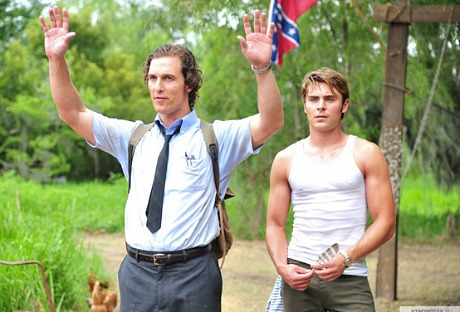

Matthew McConaughey, Zac Efron in Lee Daniels’ The Paperboy.

In other words, the press gang at Cannes thought The Paperboy was mostly a joke. Which is what Daniels apparently intended on some level — to flavor or season it with foolery. I love it when referenced goof humor is thrown into a drama, but the film has to be believable in the usual ways — you have to accept the bedrock reality of the story and characters — but almost all of The Paperboy reeks of fake. Bits and flourishes are pasted on and thrown at the wall. The result is something sloppy, inept and — sorry — appalling.

Defenders (like Guy Lodge) have called it a camp classic and…whatever, an instant midnight movie for stoners. I actually think it might find some traction in this vein. But most reactions have been mocking and derisive. The response at the end of the 8:30 press screening went beyond boos. A guy somewhere to my right got a case of the giggles around the two-thirds mark and couldn’t stop…”Hoo-hoo-hoo…oh-hee-hee-hee!”

Daily Telegraph critic Robbie Coll called it “the first bona fide fiasco of the festival. So bad it has to be seen to be believed. Transcendentally shambolic.” MSN’s James Rocchi said “it makes A Time To Kill look like To Kill A Mockingbird.”

You might have read that the subject of The Paperboy, set in a Florida backwater in 1969, is about a pair of Miami Times reporters (Matthew McConaughey, David Oyelowo) and McConaughey’s younger brother (Efron) trying to get a redneck, alligator-skinning cracker (John Cusack) off death row at the request of a local Barbie Doll floozy (Kidman) who’s fallen in love with Cusack and is convinced of his innocence.

Ostensibly, yeah, but the actual subjects are sex, racism, Efron’s bod, Kidman’s character’s saucy sexuality, repressed homosexuality, Southern drawls, medicinal peeing and oh, yes — sex.

Some of the plot points in Pete Dexter’s 1995 novel have been changed. Kidman relentlessly flirts with and then finally schtupps Efron in the film, but has it off with Oyelowo’s character, Yardley, in the book. And Yardley fabricates parts of his Miami Times story, which the film bypasses, or so I recall. But The Paperboy is mainly about what Daniels wanted to get into and particularly the people he’s known in his life.

“All these people [in the film] are people who live in my head, my world and my existence,” he said this morning.

The peeing scene happens when Efron is badly stung by jellyfish during a swim in the Gulf of Mexico. Three girls come to his aid as he stumbles out of the water and suggest the peeing remedy (the acids in urine work as an antidote to jellyfish poison), but then Kidman comes over and angrily shoves them away and says her famous line.

Dexter’s book invented the pen-pal love affair between Kidman’s Charlotte and Cusack’s Hillary Van Wetter, but, as I said this morning, “Kidman’s girly-girl might enjoy a sexual dalliance with a Deliverance-style redneck stallion, as played by Cusack. But not marry — no way.” Girly girls like their lives to be nice and pretty and pink and tidy, and Cusack lives in a swamp in a skunky old shack. Doesn’t wash.

And to get to Cusack’s shack, which he shares with his father and other family members, McConaughey and Efron have to boat through a swamp and then wade through thigh-deep water. The shack isn’t directly accessible by motorboats with a pier in front? When the family goes to buy groceries and other necessities they have to carry their shopping bags and whatnot through swamp water?

Efron is a sexually repressed kid (or so says Kidman’s Charlotte) who doesn’t have any girlfriends. Because, you know, he’s not good looking enough to score. Right.

The story is narrated by a maid (Macy Gray, the most likable, dignified and straight-talking character) who works for Efron’s family, but her character isn’t privy to a lot of what we’re shown and yet she’s in on every detail, including when and where Kidman and Efron have it off. Her narration is cloying and at times painful

The movie is full of little “what?” moments like these. I was physically flinching at some of them.

Pedro Almodovar wanted to make a Paperboy movie but “opted out if it,” Daniels said in the press conference.

The $12.5 million film was shot in Los Angeles and New Orleans, it says here. And Kidman had to do her own makeup, she said this morning. She did a good job. And her performance is spirited. Give her that.
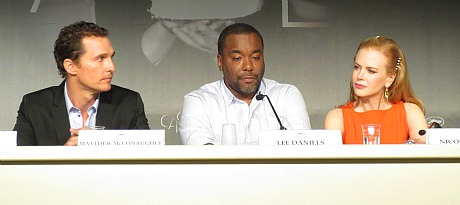

(l. to r.) Matthew McConaughey, Lee Daniels and Nicole Kidman during this morning’s Paperboy press conference inside Cannes’ Grand Palais.

Critics and Sex

A producer who’s been around forever (and whom I’ve known for a couple of decades) said something interesting at tonight’s On The Road after-party: “Whenever there’s strong sexuality in a film, you always lose about 30% of the critics.” He may have meant precisely that, but I don’t think he was saying that this 30% hates any film with strong sexuality. I think he meant that pronounced sex scenes tend to diminish their enthusiasm, either somewhat or significantly. Thoughts?

Problematic

I need to find a staunch Carlos Reygadas fan who caught tonight’s screening of Post Tenebras Lux, as I did, who could maybe share his or her interpretations. (Is Manohla around?) There’s an undercurrent of dread throughout, but mostly it lacks connective tissue. Three scenes of abrupt violence (especially the final one) are…well, I suppose the term is “noteworthy.” And it contains a truly strange, Hieronymous Bosch-like orgy scene in a Turkish bath sex club. And a moving deathbed soliloquy (although there’s no clue that the speaker is dying when he delivers it). But otherwise I found it slow, lumpy, indulgent and mystifying. Don’t get me started on the soccer game footage. Social rot and demonic behavior are the subjects, but it doesn’t tie together.

Hors d’Oeuvres

Last night Deadline‘s Nancy Tartaglione reported that clips from a few unseen, keenly awaited films will happen tomorrow (Thursday) in Cannes at the Salle du Soixentieme. Footage from Juan Antonio Bayona‘s The Impossible, the Asian tsunami movie starring Ewan McGregor and Naomi Watts, may be included in the presentation. (The Lionsgate/Summit release was shown in its entirely to elite journos in Los Angeles a couple of weeks ago.)

Tribute

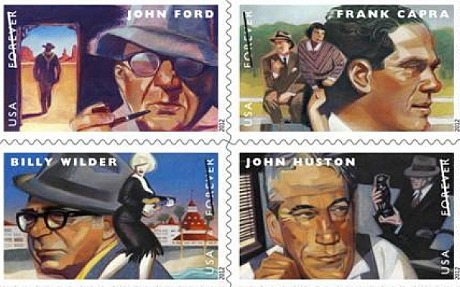
Good on the USPS for putting these out, but when was the last time anyone bought or used a stamp? I’m honestly having trouble trying to remember when I last did, but it must be two or three years, and perhaps longer. Packages, yes. FedEx and UPS, sure. But…?

Surreal Adventures, Games, Inhabitings

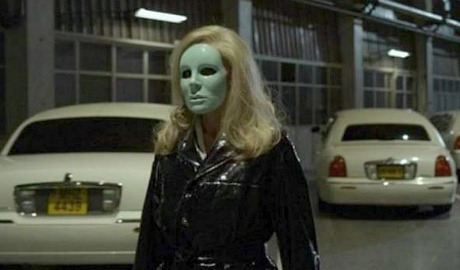
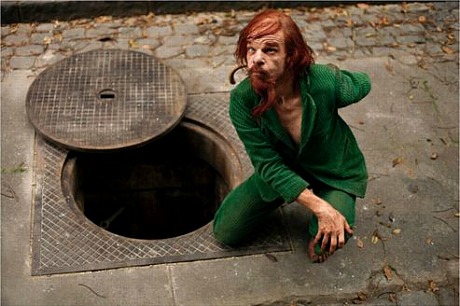
I got out of the noon showing of Leos Carax‘s Holy Motors about 100 minutes ago…holy moley! Holy Paris, holy Trip City, holy nocturne, holy inferno, holy freedom, holy holy, roly poly, put on the wackazoid. Holy white stretch limo. Holy wigs and fake beards and long nails and spirit gum. And holy Denis Lavant, Eva Mendez, Kylie Minogue and Michel Piccoli! Dali/Bunuel/Lynch/Carax live large. Welcome to Holy Nuttervile in the best, most spirit-releasing sense of that term.

If only an American filmmaker was this mad, this imaginative, this unchained, this willing to leap. I wonder if any American has it in him or her to create something like this. If he or she did, Americans would probably say “what the fuck?” and stay away in droves. It’s in the realm but well beyond anything David Lynch has ever done. It’s so perfect to have seen this in Cannes, and to be among a crowd clapping and cheering on their feet, and then to come onto a street filled with sun and warmth.

It’s basically a dreamscape movie about a possibly wealthy guy named Oscar (Lavant) whose job it is to tool around Paris in a big white limo and pretend to be other people, complete with first-rate makeup and latex and wigs and you-name-it. It’s the inner life of a mad director (i.e., Carax) who’s letting his imagination run wild. Who pays Oscar or why he would be rich doing this kind of thing, or why he goes home to a small white condo and has two chimpanzees for children instead of the two or three human kids he waves goodbye to in the beginning…forget all that. This movie is about playtime. Anything can, will and does happen, and reality has nothing to do with it. And yet it feels grounded in the stuff. It’s “loony” but believable. And very handsomely shot.

Oscar’s first pretend is an old, bent-over crone panhandler, begging for coins with a cup. Actually that’s the third pretend, come to think. His first appearance is in pajamas, getting out of bed and looking out a large picture window at an airport runway, and then finding his way into a theatre full of people with a naked toddler walking down the aisle. And then he’s a super-rich businessman with a big white modernist home and the kids on an outdoor balcony. And then comes the old crone. And then he’s a lithe actor wearing a mo-cap suit and doing a kind of battle dance with a Darth Maul sword and a machine gun, and then an erotic dance with a lycra Lady in Red.

And then he’s a deformed, snag-nailed Rasputin figure who worms his way into the sight lines of some fashion-maggers shooting Mendez in what looks like Pere Lachaise, and then he kidnaps her and carries her to his lair like Quasimodo carrying Esmeralda. And then he’s a bald-headed, moustachied assassin with a switch knife. And then a tired, middle-class dad picking up his daughter from a party. And then Keir Dullea at the very end of 2001, under sheets on a large bed in pajamas only white-haired and with no black monolith. And that’s only part of it.


Densi Lavant in one of many guises in Holy Motors.

The only Carax films I’d seen until today were Boy Meets Girl (’84) and Lovers on the Bridge (’91). Yeah, I know — shame on me for not seeing Pola X (’99), but I will soon correct that oversight.

I love Peter Bradshaw‘s description, up today: “A great big pole-vault over the barrier of normality by someone who feels that the possibilities of cinema have not been exhausted by conventional realist drama.”

Rank, Joyous, Brilliant, Crackling

Walter SallesOn The Road is masterful and rich and lusty, meditative and sensual and adventurous and lamenting all at once. It has Bernardo Bertolucci‘s “nostalgia for the present” except the present is 1949 to 1951 — it feels completely alive in that time. No hazy gauze, no bop nostalgia. Beautifully shot and cut, excitingly performed and deeply felt.

It’s much, much better than I thought it would be given the long shoot and…I forget how long it’s been in post but it feels like ages. It’s so full of life and serene and mirthful in so many different ways. I was stirred and delighted and never less than fully engrossed as I watched it, and it’s great to finally run into a film that really hits it, and then hits it again and again. This is a big surprise. I don’t care what the Guy Lodge gang is saying — it’s certainly a major contender for the Palme d’Or.

On The Road, yes, is episodic and roaming…how could it not be? The book is the book is the book. But like Salles’ The Motorcycle Diaries, it works. The choices, the moods, the shaping, the recapturing of an America and a world that no longer exists. Every shot and every cut is so precise and dead to rights.

I’m in the press conference room right now, tapping this out in my seat in the front row with Walter Salles, Garett Hedlund, Kristen Stewart, Sam Riley, Kirsten Dunst, Viggo Mortensen and others due to arrive in about ten minutes so this review can’t last, and there’s Holy Motors at noon so I can’t even stay for much of the q & a. But at least I’ve tapped out a decent first paragraph. I have to stand up now and get my place with all the photographers milling around…later.

Gatsby Whirlpool

This isn’t the same reel that played at Cinemacon, but it’s fairly similar to it. I repeat: this is looking more and more like one of the most intriguing awards-season headliners. The 1920s have been removed from that feeling of veiled sepia antiquity — they feel electric, refreshed, wild. And although the CG still looks a wee bit primitive in the final New York City cut, the idea of glimpsing the Manhattan of 90 years ago has my pulse racing. Plus the actors all seem in fine form.

Read more