
…to behave this rebelliously in a dry, cool, fuck-it, smart-ass way in many, many years…Hollywood doesn’t even allow them to be moderately approvable cyphers. They have to be selfish, malignant takers and abusers…full stop.
 Jeffrey Wells
“Don’t Jinx The Knicks Run”
…you fat egoistic fuck. If the Knicks lose it’ll be totally your fault…period. Mess with the juju at your own peril.
Marshall Fine: “At some point in the game, they’ll show Trump on the Jumbotron and the crowd will boo him lustily. The finals are on ABC, which has been having FCC troubles because of Kimmel and The View. Will ABC have the courage to broadcast the boos? Or, like NBC w/the US Tennis Open last fall, will they mute the sound so the boos don’t go out over the airwaves, to protect the sensitivities of Fearless Leader and his followers?”
Humdrum Statement of Fact
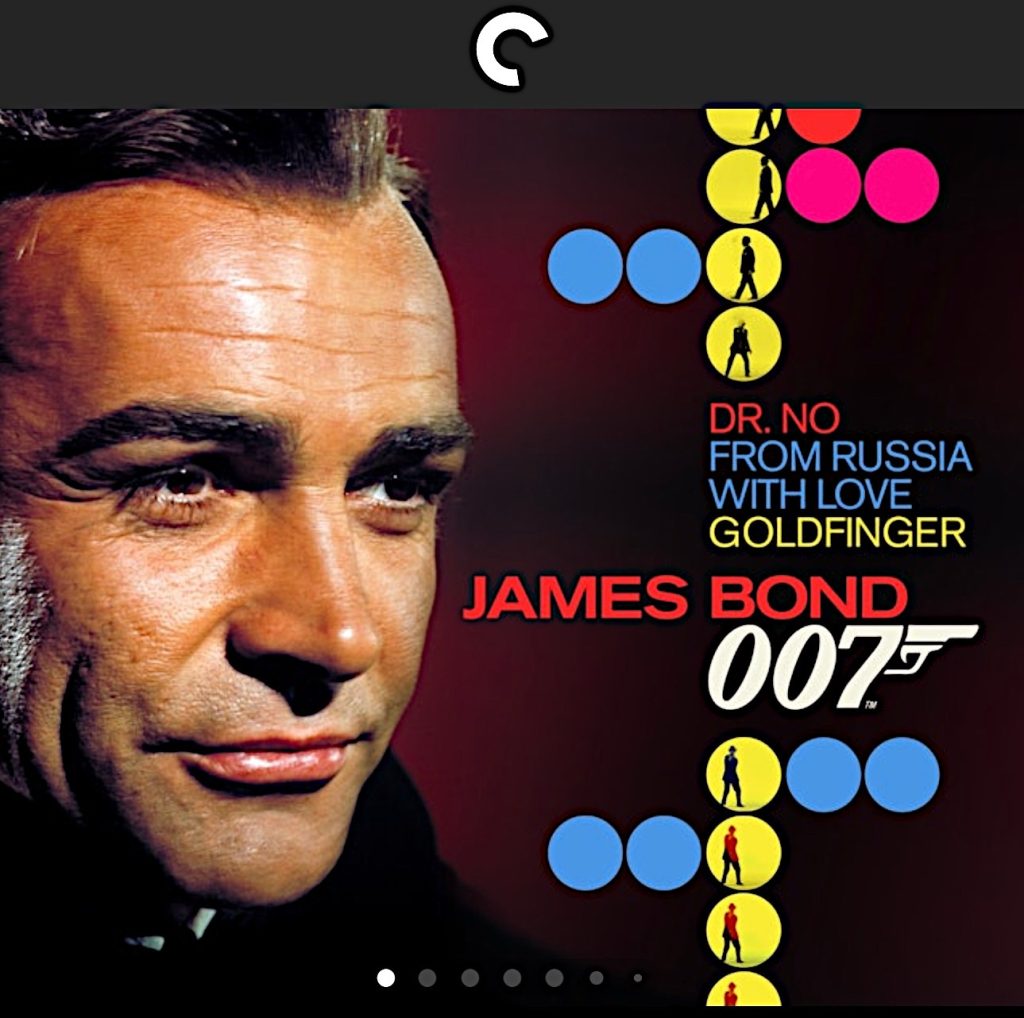
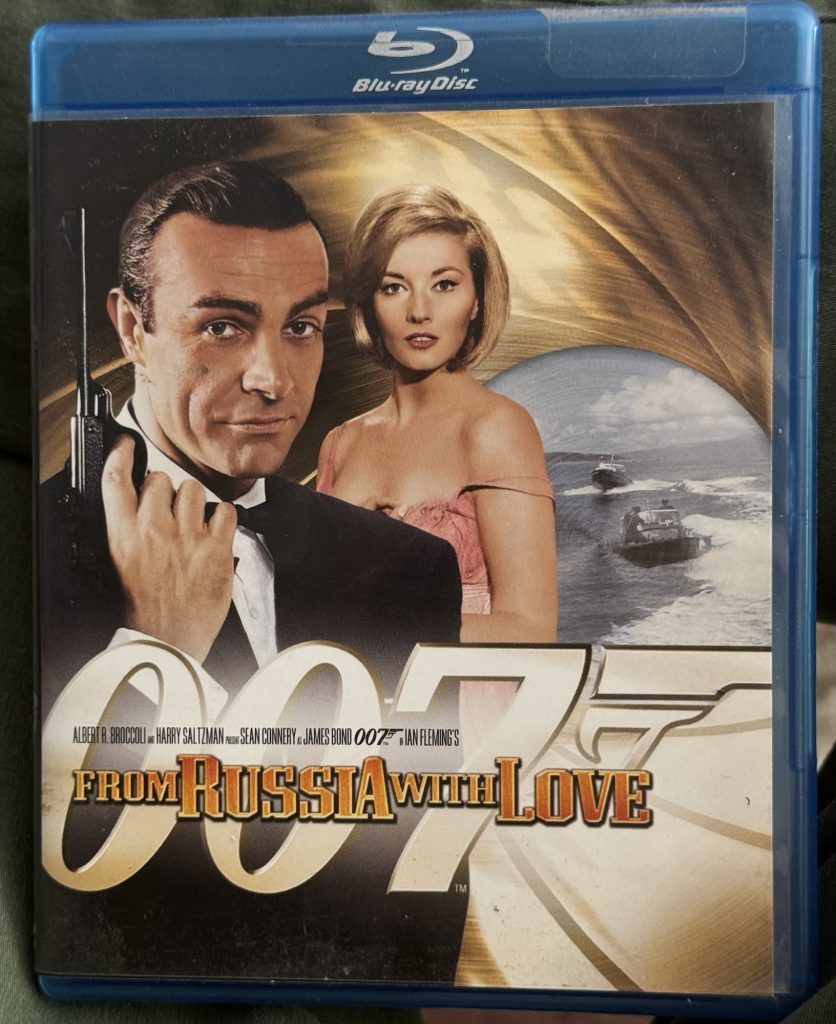
A night or two ago I happened to watch about 20 minutes’ worth of From Russia With Love via HD Criterion streaming. It looked a tiny bit soft, and even flirted with fuzzy here and there. Criterion is doing it no favors.
Tonight I re-watched this 1963 Terence Young film via Bluray, and it was almost astonishing how much sharper, razor specific, bountifully colored and more richly textured it was. I’m not saying anything new here, but there’s just no comparing Bluray and streaming. Physical media forever.
From Russia With Love was the last film JFK saw at the White House (the evening of 11.20.63…a Wednesday).
Spielberg’s Aliens Can’t Help But Underwhelm
I don’t see how Steven Spielberg‘s Disclosure Day (Universal, 6.12) is going to blow that many minds.
Daniel Kellner (the jug-eared Josh O’Connor) wants the entire world to know that non-humans have been hanging out and more or less hiding (forcibly hidden?) on earth for decades, and decides to go full whistleblower. He finds a spiritual ally in weather reporter Margaret Fairchild (Emily Blunt), who’s been inexplicably tuning into alien hum signals and aural sub-currents.
Naturally the shadowy, glum-faced Noah Scanlon (Colin Firth), the CEO of Wardex Corporation and prime architect of the cover-up of alien sub-habitation all along, wants this earth-shaking news suppressed…business as usual. Colman Domingo‘s Hugo Wakefield, a Wardex defector, is a big advocate for disclosure blah blah.
It goes without saying that Daniel and Margaret, like Richard Dreyfuss and Melinda Dillon in the nearly half-century-old Close Encounters, don’t become romantically involved. Mr. Jug Ears is putting it to Jane Blankenship (Eve Hewson), a former nun. And Margaret’s “partner” is a dude named Jackson (Wyatt Russell).
Are the aliens cousins of the original Kanamits, who 65 years ago were looking to “serve man”? That would be the most enjoyable scenario, of course, but you know this won’t happen.
Give me one good reason why visiting aliens would be kept under wraps or imprisoned or disguised or whatever the deal is. What’s the point, Colin and other powers-that-be? To prevent everyday humans from experiencing “cultural shock and disorientation”? What are aliens going to convey at the end of the long dreary day? The scientific means to produce greater amounts of food? That they’re spiritual emissaries from some holy faraway place who are looking to turn us on in a Timothy Leary way? Mass illumination?
Okay, so there are other civilizations out there just like ours…big deal.
Wait…Daniel and Margaret finally realize they’re aliens themselves, their memories having been somehow suppressed or wiped clean by Wardex when they were kids. Right? Will it also be revealed that Dario Amodei is an alien? (I’m just winging it here.)
He-Man Went Limp and Soft At The Plexes
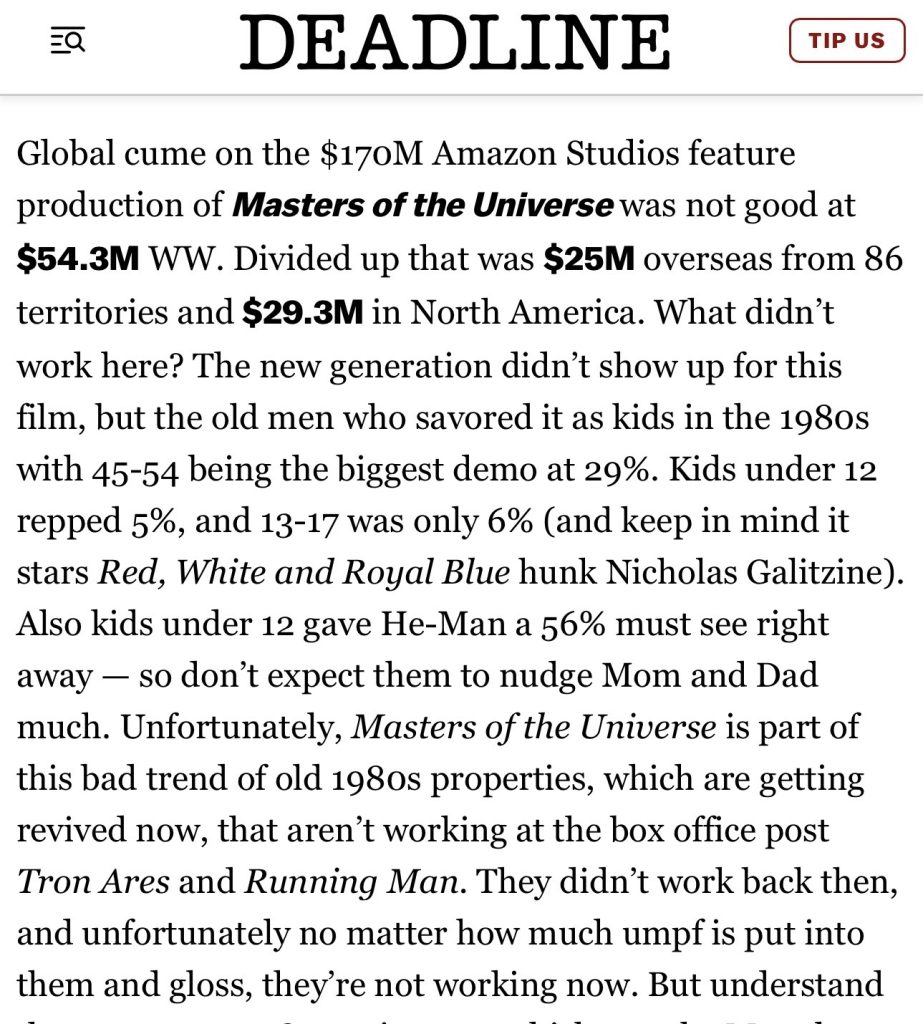
In the view of Deadline’s Anthony D’Alessandro, young fellas who were fans of the Masters of the Universe action figures and animated series in the 1980s…these guys, born in the early to mid ‘70s, are now wheezing, over–the–hill “old men.”
These totally pathetic, beard-stubbled, pot-bellied geezers, burping and belching and farting and scratching their sweaty balls and probably pissing in their pants half the time, repped the largest demo that saw Masters of the Universe this weekend.
Alas, the MGM/Amazon release sorta kinda died domestically with a lousy $29.3M.
Pelley’s Tears of Rage and Lament
The 60 Minutes way of looking at power and politics has always been cautiously rebellious or at least iconoclastic in a decorous sort of way. They’ve almost always represented the proverbial elite liberal Manhattan newsroom view of things. (Which I’ve mostly agreed with over the decades so no problem.) All hail Al Pacino‘s Lowell Bergman!
But in this sense 60 Minutes has always had its own thumb on the proverbial scale. The show has always espoused a branded 60 Minutes attitude or mentality.
That said, I don’t think Bari Weiss is the devil, or that she’s out to Trumpify or smother this show in any appalling way. She wants to modify the elitism and the entrenched upscale midtown Manhattan narrative, but she’s no Trump stooge.
Bill Maher last Friday: “I watch 60 Minutes every week. I have since I was a kid. If I hadn’t heard all the buzz in the media about the recent rancor, would I ever notice that [the show] was in any way different? I don’t think I would. [And] I don’t feel that Scott Pelley is a national treasure. I never liked him…sorry, I just never did. And companies change hands all the time. I feel like we see everything through such a partisan lens.”
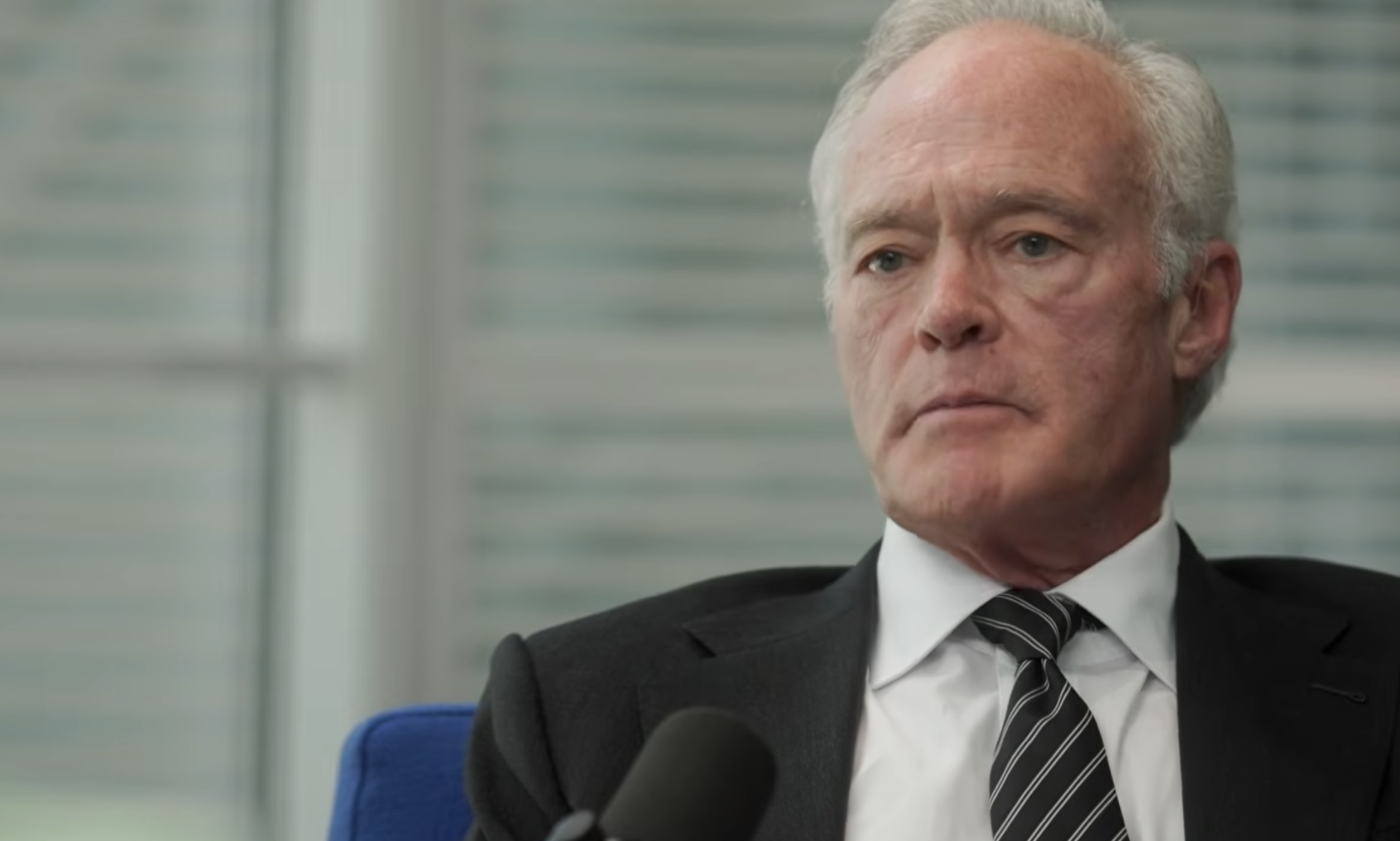
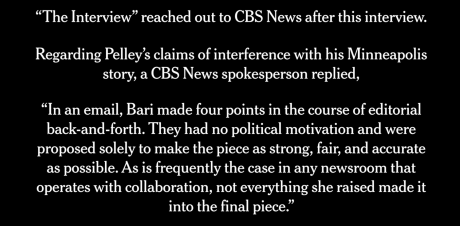
Fired 60 Minutes correspondent Scott Pelley to N.Y. Times‘ Lulu Garcia-Navarro: “My impression at the time [of the postponement of the CECOT El Salvador prison segment] was that Bari Weiss was representing…that she was putting a thumb on the scale on behalf of the [Trump] administration….just constantly looking out for the views of the president, which we had reported but it was never enough…for the first time in my career, the balance was off.
“But the inexperience and incompetence was the bigger problem.”
Garcia-Navaro: “Do you think Bari Weiss needs to be removed?”
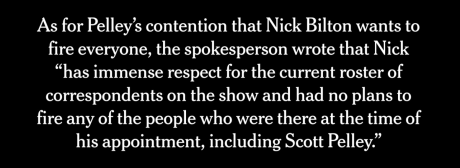
Pelley: “Oh, gosh, yes! She brings an ideology into [this situation] that is just anathema [to 60 Minutes culture], and a subtle political bias that I’ve never seen before. There is no democracy without journalism. It cannot be done. It is possible to land this plane. But right now, in my view, CBS News is on fire.”
Panahi’s Next Film Is Hereby Guaranteed to Collect Another Palme d’Or
Press release received this morning from Mansour Jahani, an independent and international film journalist: “Jafar Panahi, the Iranian director whose most recent film, It Was Just An Accident, won the Palme d’Or at the 2025 Cannes Film Festival, was sentenced to one year of imprisonment and a two-year ban on leaving the country for the crime of propaganda against the Islamic Republic of Iran.
“Branch 26 of the Islamic Revolutionary Court of Tehran, headed by Judge Iman Afshari, has rejected the appeal and confirmed the absentia sentence.”
Panahi’s lawyer Mostafa Nili: “According to the initial verdict, Jafar Panahi was sentenced to one year in prison on charges of propaganda against the Islamic Republic of Iran. He was also banned from leaving the country for two years and banned from membership in political and social groups and organizations.”
“The evidence for this verdict, as stated in the indictment, includes the following: making an underground and problematic film against the government, supporting some security convicts including Fatemeh Sepehri, Raheleh Rahemipour, Hossein Ronaghi, Mohammad Nourizad, Mehdi Mahmoudian, Abolfazl Ghadiani, and… Supporting the protests, supporting the slogan ‘Women, Life, Freedom’, signing and publishing a statement about the truckers’ strike, blackening the situation in the country, and republishing a clip featuring the singing of the anthem ‘O Iran’ in protest against the issuance and execution of death sentences.”
It goes without saying (I hope) that HE deplores this repressive sentence.
The Wokester Executioners’ Song
In a nine-day-old New Yorker piece titled “Backrooms, Obsession, and Hollywood’s Zoomer-Horror Renaissance”, Justin Chang celebrates the bottom-of-the-barrel cinematic taste buds of audiences (mainly Zoomers) who’ve made these two recently-released horror films into box-office legends.
Is it a good thing that Obsession and Backrooms have caught on and made so much dough? Yes, of course — any theatrical hit these days is good for the goose and the gander.
But what do these twin successes say about 2026 movie culture in general as well as the aesthetic or spiritual lives of the under-45 set?
They say that (a) a certain kind of subversive, high-octane element has risen out of YouTube (a good thing), but also that (b) Obsession fans, a group of whom I sat with in a theatre a few days ago, aren’t especially hip or discerning. Some of them, no offense, sounded to me like under-educated serfs. A couple of dudes sitting behind me sounded like outright mongrels.
And I love this Chang sentence that appears at the top of paragraph #11:

Uhhm, Justin? The vast majority of dramas released in this country within the past two or three years (as well as a healthy percentage of those shown during last month’s Cannes Film Festival) highlighted white male cisgender villains…dudes “whose unexamined selfishness turns out to have horrific consequences for others.”
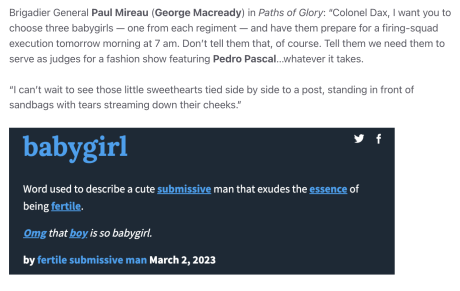
Straight white males are the reigning dramatic ogres of our age…objects of untethered mass loathing…clobbered recipients of ultra-negative judgments from an urban wokester generation that celebrates, in some circles at least, the babygirl aesthetic.

A John Lithgow quote from Jesse Green‘s three-month-old N.Y. Times profile of the 80-year-old actor…a compassionate, fair-minded thought if I’ve ever heard one:
“Good people are capable of bad things.”
What Lithgow meant when he said “bad” was behavior, thoughts or tossed-off twitter posts that elite know-it-alls regard as coarse or questionable or unsavory.
Is there one aspect of the woke-mob philosophy that even briefly considers this viewpoint? No, there is not. During their tyrannical reign of peak terror (2018 to 2024), wokeys believed in dunking the witch in the pond until dead…period.
I somehow missed, by the way, Lithgow’s admission in his 2011 book, “Drama,” that in 1977 he revelled in a year-long affair with Liv Ullmann. (It happened when they were costarring in a B’way revival of Anna Christie.) Lithgow was 32 and married; Ullman was 38 or 39. Imagine the acrobatic throbbing! Imagine the unhooked pots and pans clattering on the kitchen floor!
Carville Is Dead-On About Platner

Carville transcript: “[Maine Senate candidate] Graham Platner is fucked up, he’s been shot at, he’s a veteran, he’s a little bit weird, he’s an oysterman.
“Maybe we need a combat veteran right on that Senate floor who is fucked up [instead of] his opponent, and I can hardly say her name without the utter contempt dripping, Susan Collins, whose spine reminds me of a blueberry jelly from Maine.
“If you believe, as I do, that the country is in imminent peril — I mean imminent peril — who is most likely to slow this criminal in charge? Susan ‘Blueberry Jelly’ Collins, or five-degrees-off-dead-center Graham Platner? I think it’s Graham Platner.”
Slowboat Parking Structure Attendant at JFK’s Terminal 4 (Delta, KLM)
The other day I was obliged to briefly leave my vehicle inside the concrete parking structure adjacent to JFK’s Terminal 4. The entrance gates will pass you through if you have a plastic EZ Pass device, but the scanner couldn’t read mine (I tried for a full minute…nothing…faulty tech) so I pushed a button and got through with a paper ticket.
When I was attempting to exit the structure there were four or five drivers who were logjammed at the gates because two drivers in the front of a pair of exit lanes were having trouble getting out. (More faulty tech.) People were annoyed and honking, but I saw no parking attendants.
And then suddenly two young male attendants appeared. I rolled down my window and said, “What’s with the gates? I tried using my EZ Pass and the gate wouldn’t rise…I was forced to pay.” One of the guys said, “You probably didn’t scan it right.”
I asked, “Why don’t you go down and help those people who can’t get out?” The bros didn’t seem interested in offering any immediate service (one of them half-chuckled) but at that very moment I noticed a third parking attendant — an overweight woman of color — duck-walking to the exit gates. There was obvious driver frustration galore but this chick refused to move with the slightest amount of haste. She didn’t run, slow-jog, speed-march or even walk with a purposeful stride…she waddled her way down there.
If I was a Terminal 4 parking attendant I would have definitely hurried down to the gates, if for no other reason than to offer a theatrical gesture that would convey to the angry drivers that I feel their pain and will be down there tout suite…”sorry for the trouble, guys…I’m comin’, I’m comin’…we’ll figure this out.” But this chick could have been pushing a food cart through the produce section of a supermarket. In so doing she was basically saying, body-language-wise, “I’m not an Olympics runner…I’ll be there when I get there…hold your horses.”
Okay, I take it all back. The parking attendant girl ran like the wind to help the trapped drivers. She was down there in a flash, in the blink of an eyelash. She was like a fat Supergirl.
Remember The Zarem!

This morning I was re-listening to Andrew Goldman’s 2017 podcast conversation with the late, legendary Bobby Zarem, whom I knew quite well and worked with in the ’80s and ’90s, and whom I always found fascinating and exciting to be with. Just click on the big red box below.
“Infinite Thanks to Bobby Zarem“, posted on 9.26.21:
Bobby Zarem, the whipsmart, highly-charged, occasionally volatile New York publicist who “conceived” the “I Love N.Y.” campaign and represented a cavalcade of big Hollywood clients (Sylvester Stallone, Jack Nicholson, Eddie Murphy, Alan Alda, Cher, Dustin Hoffman, Michael Caine, Sophia Loren, Arnold Schwarzenegger, Pee-Wee Herman) during his ’70s and ’80s heyday, and whom I dealt with as a Manhattan-based journalist from the late ’70s to ’83 and worked for in Los Angeles in ’85 and ’86….poor Bobby died today in his home town of Savannah.
Lung cancer got him. Zarem was 84. I somehow can’t imagine Bobby being in heaven or in hell. I kinda see him hovering over Savannah now, but without angel wings. That town is full of ghosts.
Somewhere along the way Zarem picked up the name “super-flack.” He certainly seemed to earn that title during his peak period. To me he became a p.r. legend when he was chased down a street by protestors during the shooting of Fort Apache, The Bronx, somewhere near City Hall. That’s when Zarem, already noted for his colorful manner and being a mainstay at Elaine’s and whatnot, seemed to become a brand…an embodiment of the spirit of rough-and-tumble, pre-corporate, pre-Giuliani Manhattan…the vaguely odorous city captured by Sidney Lumet‘s Prince of the City, but which no longer exists.
Bobby was a character…a tireless, Yale-educated, quintessential Manhattan operator…hustler, gadfly, human locomotive, idea man.

It’s not as if Zarem was often angry or arguing. He was primarily a charmer and an enthusiast. But when he got angry he was amazing. I remember being deeply impressed by his ability to tear people’s heads off without degenerating into sputtering incoherence. When Bobby was pissed he became a kind of dinosaur, a force of nature — the back of his neck and face would turn almost cherry red — but he was always lucid and razor-tongued.
I remember saying to myself once, “Wow, I wish I could be that intellectually commanding when I get angry.” But I could never manage it, which is one reason why I’ve always turned it down.
Zarem was driven, neurotic, larger than life, meticulous, a bundle of nerves, occasionally volcanic and every inch a New Yorker. He was a magnificent schmoozer. His hair wasn’t as frizzy as that of Larry Fine of the Three Stooges, but I sometimes regarded him as Fine-like, if you could re-imagine Fine as the smartest stooge to ever walk the earth.
Here’s a rundown of things I’m thankful to Zarem about…things that happened or were made possible by his largesse or whim:
(a) By working with and for Zarem I savored occasionally glancing, sometimes fascinating face-time with Sylvester Stallone, Jack Nicholson, Jane and Peter Fonda, Mick Jagger and Keith Richards, Kirk Douglas, Andy Vajna and Mario Kassar, Pee-Wee Herman…more names and faces than I can actually recall off the top.
(b) I became one of Douglas’s flirtations back in ’82 after an Elaine’s luncheon thrown by Zarem on behalf of the yet-to-shoot Eddie Macon’s Run. I was subsequently flown to Laredo to report on the shooting of that film for the New York Post. Universal publicity conveyed a certain disappointment that my article didn’t mention Eddie Macon’s Run more often, and that I spent too many paragraphs talking about Douglas’s career. Bobby dutifully called to inform me of their disappointment, adding that “this isn’t the end of the world.”
Douglas talked about anything and everything during our chats, and I remember his being fairly wide-open with his impressions about Stanley Kubrick (i.e., “Stanley the prick”), with whom he’d famously partnered on Paths of Glory and Spartacus. I told him I half-loved the foyer freakout scene with Lana Turner in The Bad and the Beautiful. And much of The Devil’s Disciple. And almost all of Champion. And every frame of Paths of Glory and Lust for Life and Lonely Are The Brave.
For The Fourth or Fifth Time…
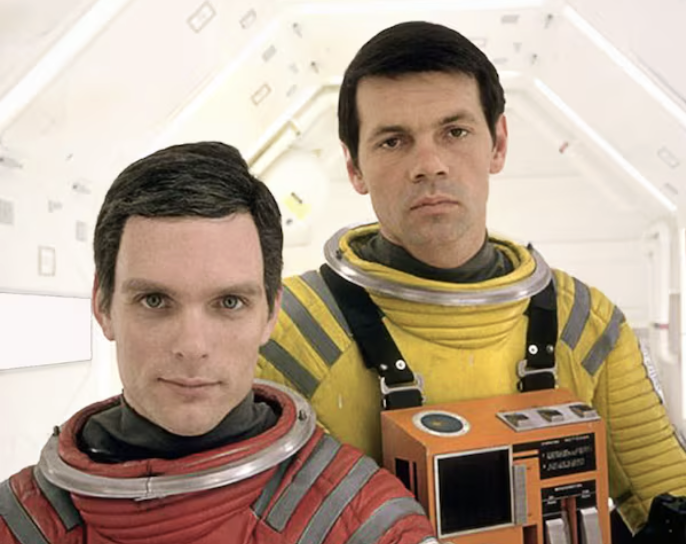
..because for decades I’ve been constantly irked by people saying that 2001: A Space Odyssey “is great but it doesn’t really tell you what’s going on…not really.”
It’s a God movie, dingleberries…a “shaggy God story,” as John Simon wrote way back when…Stanley Kubrick even decided to help out the slowboats just before the stargate sequence by having the floating monolith and the Jupiter moons form a crucifix…in so doing Kubrick was essentially saying “do you get it now, geniuses?”
Posted on 9.3.24: The mysterious black monolith that suddenly appears before the tribe of lesser “Dawn of Man” apes (i.e., the ones who lost access to the dirty-water pond because a tribe of tougher, snarlier apes kicked them out)…the monolith is a cosmic blessing, a civilization-saver…a bringer of deliverance, transcendence, possibility.
Now hear this: the alien life forms who sent the monolith are basically conducting a massive scientific experiment by attempting to spawn intelligence on our planet…the monolith is a bringer of intelligent initiative and awareness and technological potential…an explorational sentinel sent by aliens of incalculable intelligence, the purpose being to trigger and awaken the lesser apes to evolutionary advancement and put them on the road to eventually becoming intelligent human beings.
In the 21st Century present, the very same monolith (or a close cousin of the one that fiddled with the apes) has been found buried under the surface of the moon. Once sunlight hits it, a piercing radio signal is generated…a signal aimed at the hugely insubstantial gas planet of Jupiter, easily one of the most disappointing planets in our solar system.
Light hitting the no-longer-buried monolith informs the super-intelligent aliens that humans have advanced to a certain noteworthy point in their evolution.
All the HAL vs. Dave and Frank stuff aboard the Discovery is the only plotty part of the film, and was basically generated by Stanley-the-misanthrope…look at how Bowman and Poole allow HAL to read their lips…idiots!..plus all in all artificial intelligence is just as capable of hubris and ruthlessness and self-destruction as the humans who created it.
The finale is wonderful, of course, and the basic thing that Keir Dullea‘s Dave Bowman seems to know deep down is that the glorious monolith represents damn near everything…it’s the fountain of eternity and the central engine of life…continuity, God, essence, worship, wonder and infinite expansion.