
HE reader Joe Branham has just pointed out an especially insipid quote from Media By Numbers president Paul Dergarabedian in a just-posted CNN story about the $76.5 million earned this weekend by I Am Legend, which ranks as the largest December opening ever and a “personal best” for star Will Smith. “It’s no wonder Will Smith feels so lonely,” Degarabedian remarked. “Everyone else on earth is in the movie theater.” He sometimes makes me want to scratch the paint off walls with my fingernails, this guy. I’ve been coping with this for years.
 Jeffrey Wells
Huckabee and Norris
“When Chuck Norris does a push-up, he’s actually pushing the earth down.” — Republican presidential hopeful Mike Huckabee in a recently-released spot with the star of Invasion U.S.A.
“Once” coming to DVD
“It’s unique but gently lulling. It’s about struggle and want and uncertainty, but with a kind of easy Dublin glide-along attitude that makes it all go down easy. It’s all about spirit, songs and smiles, lots of guitar strumming, a sprinkling of hurt and sadness and disappointment and — this is atypical — no sex, and not even a Claude Lelouch-style kiss-and-hug at the finale. But it works at the end — it feels whole, together, self-levitated.”
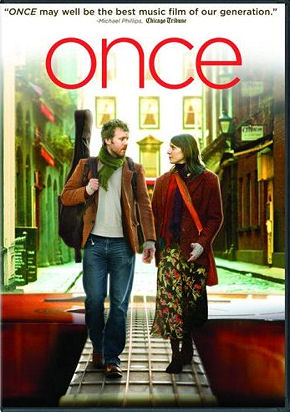
I wrote this 11 months ago about seeing Once at the ’07 Sundance Film Festival, and on Tuesday it’s finally out on DVD. Everyone’s read and heard enough about this amazing little film by now, but this 11.26 review by DVD Talk‘s Preston Jones is a better-written appraisal than anything I’ve read in months.
“Once is as electrifying as I’d hoped it would be, a tour-de-force synthesis of original music, almost instinctual acting and a keen eye for the often unpleasant realities of love. Not to damn with faint praise, but Once is one of the best films of 2007 and almost certainly, one of the best films of this decade.
“Once isn’t a showy Hollywood vehicle, dolled up with lavish sets and opulent costumes; rather, it’s nearly a film from the Cassavetes school, outfitted with an absorbing, fantastic soundtrack — a stark look at the formative stages of an artist’s career and the sacrifices that are necessary in order to take that crucial next step.
“Most astonishingly, you feel none of this weight — Carney keeps the plot flowing smoothly, leaving much of the exposition to his actors’ expressive visages — Once glides along, delivering a bittersweet coda to this tale of unrequited love, one final high-wire trick in a movie that will leave you teary-eyed and breathless at its dexterity. An astonishing, unforgettable masterpiece.”
“Wilson” issue raised again
I’ve gotten into this deballed Charlie Wilson’s War story twice now — on 11.29 and 12.13 — but now N.Y. Times writer Richard Berke has jumped in with what reads like a well-reported story along the same lines.
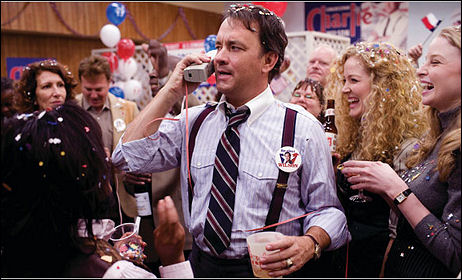
“The Charlie Wilson on the screen is more honorable and less reckless than the real one,” he writes. “Left on the cutting-room floor was a scene of Wilson in a drunk-driving accident. And the movie doesn’t depict some of the book’s wackier moments. There is no mention of Wilson’s dispute with the Pentagon after he sought to bring Annelise (Sweetums) Ilschenko, a former Miss U.S.A.- World, on a Defense Intelligence Agency plane in Pakistan. And though a memorable belly-dancing scene remains, it ignores the part where the dancer brandishes a sword at the Egyptian defense minister, taking aim at his groin.
“Even Wilson, who at 74 underwent hear-transplant surgery in September, emerging from quarantine for the first time to attend the premiere on Monday night in Los Angeles, said, “They were kind to me.”
AFI’s Ten Best of ’07
6:56 pm re-phrasing: The American Film Institute brand has been sullied through over-marketing and a general watering-down. Call it the Christmas influence, but earlier this afternoon I chose to be compassionate by regarding their list of top ten 2007 films as non-alphabetical because it made them seem more decisive. The AFI, the word “integrity” and the phrase “semblance of original thinking”…whoda thunk it?
Plus it seemed agreeable at the moment that somebody, somewhere had put Sidney Lumet‘s Before the Devil Knows You’re Dead in the #1 position and that Judd Apatow’s Knocked Up would rank in the fifth-place slot.
It seemed like a nice thing, in other words, to bend over backwards and grant the AFI a toughness of mind and purpose that they probably never had to begin with. But since nobody got it, I had to rewrite and spell it out.
Dead Dog Coverup
Mark Halperin‘s “The Page” is a very tight, clean and comprehensive one-stop shopping site for the latest campaign turns. And by the way — I dare anyone to say they read this headline — “Huckabee Accused of Dead Dog Cover-Up” — without at least a slight smirk.
Campaign turnabout
When exactly did the campaign of Hillary Clinton begin to sputter and sink and Barack Obama‘s start to surge? I’m as amazed as anyone else that this change has kicked in over the last two or three weeks, but what was the event trigger? The notion that Obama might actually win in New Hampshire…I’m almost afraid that saying the words will jinx things. It’s not in the least bit settled, but suddenly it’s not insane to imagine next year’s race being between Obama and Mike Huckabee.
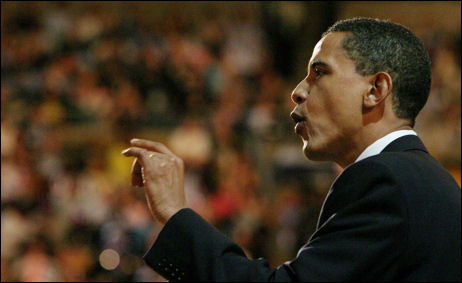
Could it be that average Democratic voters are finally catching up to where Andrew Sullivan was at nearly a year ago when he talked about his Hillary Clinton “cooties” problem?
“The campaign of Mr. Obama, which slogged uncertainly through a period in the late summer and fall, alarming contributors who feared that he might have missed his moment, is now brimming with confidence,” reports the N.Y. Times‘ Jeff Zeleny. “His speeches are noticeably crisper, his poise is more consistent and many supporters say they no longer must rely upon a leap of faith to envision him winning the nomination.”
“The Orphanage”
I wrote last May that Juan Antonio Bayona‘s The Orphanage (Picturehouse, 12.28) “is the creepiest sophisticated ghost story/thriller to come along since Alejandro Amenabar‘s The Others, and deserves a ranking alongside other haunted-by-small-children classics as Jack Clayton‘s The Innocents and Nicolas Roeg‘s Don’t Look Now. It also recalls Robert Wise‘s The Haunting, although the ghosts in that 1961 film were all over 21.”

In a 12.24 posting, Newsweek‘s David Ansen has now chimed in along similar lines:
“Movies like the Saw series and the Hostel franchise frighten by assault [and have] driven away a lot of horror-loving adults. Don’t we need and deserve a good fright, too? A little terror, properly applied, is a kind of exorcism, yanking into daylight those primal demons that we stuff away in the back drawers of our psyches. A great horror movie is like a good shrink — and a lot cheaper, too. It purges us through petrification.
“That horror movie, thankfully, has arrived. It’s called The Orphanage, and it is seriously scary.
“This little Spanish ghost movie — made by a gifted young filmmaker named Juan Antonio Bayona and produced by Mexico’s Guillermo del Toro, the man behind last year’s Oscar-winning Pan’s Labyrinth — remixes many familiar horror-movie tropes: a haunted house that was once an orphanage, a sickly child with imaginary friends, a spiritualist contacting the dead, a grieving mother (played to the hilt by Belin Rueda of The Sea Inside) whose sanity appears suspect to everyone but herself.
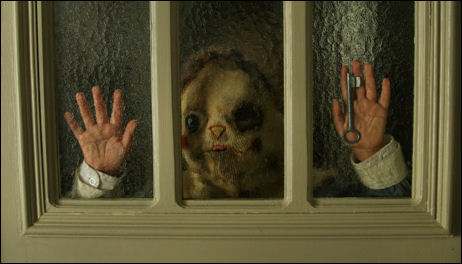
“Though it bears a strong relation to such films as The Others and The Innocents, it feels freshly imagined. The shivers of dread The Orphanage conjures up rely neither on gore nor on special effects: the sight of a child standing in a hallway wearing a grotesquely disturbing burlap mask freaked me out more profoundly than any severed limbs in em>Saw.
“The less you know of the plot, the better. Let’s just say that Sergio Sanchez‘s richly ambiguous screenplay allows you to interpret what you are watching on both a supernatural and a psychological level, and either way is equally unnerving. The small screening-room crowd I watched the movie with was a pretty sophisticated bunch — but not for long. Forty minutes in, our defenses had been shredded. We were alone with our fears, but we quivered as one.”
Xmas movies
Christmas is a vibe about caring, giving, compassion for the lessers. The spirit of this holiday may not be a tangible reality until you find yourself giving five bucks to a guy begging for gas money (as I did last night — he was probably a practiced con artist) or your car is stuck in a snowstorm and two guys jump out of their cars to give you a push (which happened to me three nights ago), but when real life comes up short a semblance of this is somewhat evident in this and that film.

Few films capture this better than John Ford‘s The Grapes of Wrath. Yes, I’m thinking again of that diner scene I wrote about a week ago. Other films with genuine humanitarian compassion: Joseph Losey‘s The Boy with the Green Hair, Todd Browning‘s Freaks, Peter Davis‘s The War at Home.
The only bona fide Christmas film that exudes a portion of this is the 1951 British-made Scrooge (a.k.a., A Christmas Carol) with Alistair Sim.
True Christmas spirit is less evident in the standard holiday classics — It’s a Wonderful Life, Miracle on 34th Street, A Christmas Story, Home Alone — that movie authorities bring up each and every year.
I tried re-watching It’s a Wonderful Life (i.e, the latest restored DVD) a few weeks ago, and found it very hard to stay with. I needed time-outs, pauses, walks around the block. Talk about a film that is chock-full of treacly speed bumps. Is there a more toxic poison than yellowed sentimentality? I hate — hate — the way those bank examiners begin singing “Hark, the Harald Angels Sing” with everyone else at George Bailey’s home at the very end. It is time to shut this movie down and keep it down.
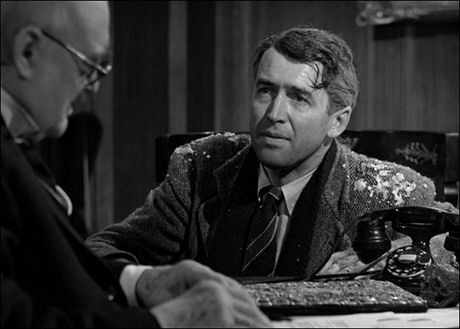
It’s a Wonderful Life‘s popularity is due to its touching central theme, which says that no one with friends is a failure. That’s a true statement if you’re talking about real friends and not just good-time, fair-weather drinking buddies, which are easier to come by. I’ve known many people in my life whose definitions of friendship are on the flexible side. A fair-sized percentage of those who believe that this 1946 Frank Capra film is touched by greatness are, I suspect, among this group.
I’ve always hated Bob Clark‘s A Christmas Story. (Wait…am I allowed to say this?) A Miracle on 34th Street is a passable thing, at least as far as Edmund Gwenn‘s Kris Kringle is concerned. I know that I’ve found it less offensive than It’s a Wonderful Life over the years. I probably need to see it again.
Thanks to George Prager for supplying this glorious SNL piece about the “lost ending” of It’s a Wonderful Life. Perfect…hits the spot.
Burr,. Morris, “Juno”
Boston Globe critics Ty Burr and Wesley Morris do a video assessment of Jason Reitman‘s Juno…without once mentioning the name “Jason Reitman.” Burr predicts that star Ellen Page and screenwriter Diablo Cody will be nominated for Best Actress and Best Original Screenplay, respectively…which no one disagrees with.
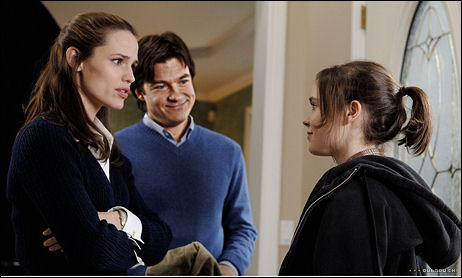
Jennifer Garner, Jason Bateman and Ellen Page in Fox Searchlight’s Juno
One of them repeats, however, the pretty-much-dismissed notion that this smart and likable pregnancy dramedy is this year’s Little Miss Sunshine. It’s not — it’s this year’s Juno. Which is fine as far as it goes. I was okay with Juno. I admired and was moved by some of it, but…
The difference is that Little Miss Sunshine is (a) better written (i.e., less arch in the beginning) , (b) has better “money” or payoff scenes (there is no equal in Juno to the Sunshine scene when Paul Dano loses it over realizing he’s color-blind, then calming down when Abigail Breslin gives him a hug) and (c) has a more touching and universal theme (this or that family member may be nuts or struggling or a flat-out loser, but the lucky ones will always have kin standing by).
What does Juno finally say? That it’s better to have a steady committed partner if you’re pregnant? That it’s better to be mature than immature? That it’s a good idea for teenagers to practice birth control?
Ellen Page is great but miscast
Ellen Page‘s Juno performance is highly likable and sympathetic. You’re with her from the get-go because of her indefatigable spunk and pizazz. But the first time I saw Juno (at the Toronto Film Festival), I had a thought that wouldn’t leave me alone. It’s going to sound a little oddball but here it is. My first thought was “how and why did Page’s character get pregnant?”
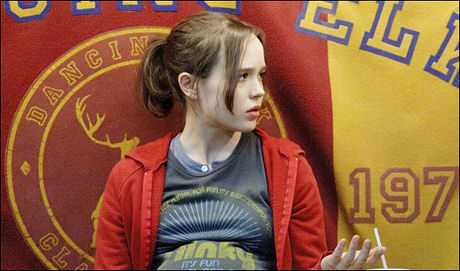
More to the point, why did director Jason Reitman cast an actress based on her sass and spirit, but with no regard for the fact that in the real world a young woman who looks like Page — midget-sized, scrawny, looking like a feisty 11 year-old with absolutely nothing about her that says “alluring breeding-age female” — most likely wouldn’t exactly be fighting off the attentions of hormonally-crazed teenage boys, including nice-guy dweebs like Michael Cera‘s character?
Unfortunate pregnancies happen to young girls of all shapes and sizes — obviously, sadly — but I kept saying to myself (and I’m writing this having once been 16 and 17 years old) that Page is the super-bright girl you want for a good friend — someone you can talk to at 12:30 ayem on a school night when you’re depressed or in trouble or enthusing over a band you just heard. But she’s not what any teenaged boy would call a hot package. She’s got the soul and the wit and the attitude of a Dorothy Parker (and the value that comes with such a person is priceless), but Juno is about an accidental breeder, and certain qualities need to be evident for this to happen in most circumstances.
Every time I’ve seen a too-young pregnant girl in real life I’ve quietly remarked to myself for this or that reason, “Too bad, but I can sorta see how that happened.” I’m just saying it didn’t quite calculate when I first laid eyes on Page. I’ve been sitting on this impression for three months now, and didn’t express it because I knew people would call me a dog. But it’s a fair thing to say, I think. Page is great on her own, but she doesn’t seem right for the role. Or rather, she’s right in every way except physically.
Remembe to say “woot!”
I need to remember to say “woot!” the next time I want to say “yaay!”