A pair of Tom Hanks features originally intended for theatrical have been sold to Apple streaming — Aaron Schneider‘s Greyhound (7.10.20) and Miguel Sapochnik‘s forthcoming Finch (11.5.21), a dystopian drama formerly known as BIOS.
Hanks plays the titular character, an ailing inventor who builds an android (voiced by Caleb Landry Jones) to accompany him and his dog on a cross-country journey.
Wait…what’s that gentle xylophone tune that begins playing at the :33 mark? Recognize it? I sure do, thanks to two previous films.
Late Sunday night I was sent an inferior quality screen-shot video of the the teaser for Paul Thomas Anderson’s Licorice Pizza(UA Releasing, 11.26).
It was captured from a theatre seat at an Alamo theatre. The teaser has also been shown at London’s PrinceCharlescinema, Quentin Tarantino’s New Bev and other film-buff-friendly houses. No time code but it runs around 120 seconds. Maybe a bit longer.
Why exactly would Bradley Cooper’s Jon Peters, dressed in white, smash some car windows with a golf club or bat, and then shout and celebrate this aggression? Guess I’ll find out.
The film has been described as a ‘70s San Fernando Valley thing, focusing on the TV industry with a partial focus on Peters and L.A. City Council member Joel Wachs (Benny Safdie), etc. Plus a smiling Sean Penn in a slick gray business suit. And it’s been noted that Cooper (son of PhillipSeymour) Hoffman and rock musician AlanaHaim are a significant part of the mix.
The Licorice Pizza teaser announces, in fact, that the film is less about Peters or Wachs or Penn’s character, and more about an apparent lovestory between Hoffman and Haim. Initial attraction, flirtation, awkward sexual stuff, warmth, smiles.
My first reaction was “really?” I don’t know much about Hoffman, 18, or Haim, 29, and have never felt any kind of rapport with either of them.
It seems to me that if you’re a major-league director making a supposedly important film about a couple of love-struck kids (even though Haim is pushing 30), you can go with one unknown as long as you pair him/her with a skilled name-brand actor, but you can’t have two unknowns carrying the film because no one will care all that much. I mean, movies deal in familiar faces and personalities for a reason…right? (A David Bowie song helps to some extent.)
I might give a damn or even care a great deal about these two when I start watching the actual film, but my first honest reaction was “the movie rests on their shoulders?”
There’s a snippet between Hoffman’s character and and Cooper / Peters in which Peters mentions his “girlfriend” Barbra Streisand, followed by a back and forth about how to pronounce the second syllable of her last name. I always thought one pronounces it as “Streisund” — not “StreiSAND.”
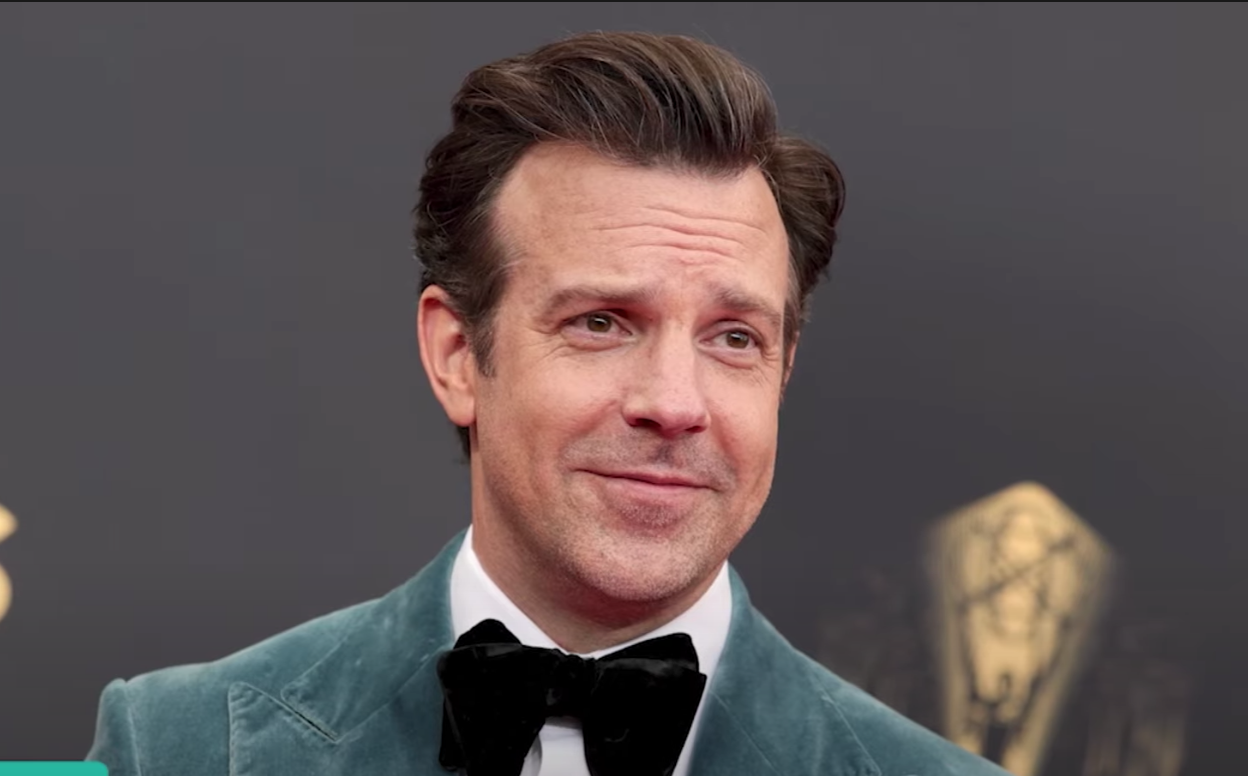
Congrats to Ted Lasso‘s Jason Sudeikis for having won a 2021 Emmy for Best Lead Actor, Comedy. Speaking as a Lasso latecomer, I have to say that I’m not a fan of his Midwestern yokel accent. An American football coach hired to coach a British soccer team, Lasso is regarded as a primitive if not a simpleton. Sudeikis should have played Lasso with his own natural speaking voice — that would’ve sufficed. The accent is irksome.
Like lemmings and barking seals, entertainment commentators and columnists have been celebrating Kenneth Branagh‘s Belfast, the winner of TIFF’s audience award and therefore a locked-down Best Picture nominee…joy and rapture and confetti in the air! Is HE the only outlet saying “wait a minute, hold on, it isn’t that great”?
HE to Phantom, a guy who wants very much to love Belfast and who thinks I’ve been cruel toward Branagh’s film: “I know this will upset you, but there really are people out there — nice, friendly, good-hearted people — who are just too easily taken in by emotionally pandering movies. It’s just the way it is out there.”
Billy Casper to HE: “Emotionally pandering movies? Like Green Book, you mean?”
HE to Casper: “Green Book captures emotional moments and assembles the elements just so. It’s much craftier than and delivers way above the level of Belfast.”
Casper to HE: “But other people believe that Belfast renders emotional moments and delivers just so. It’s bizarre that, after everything that happened in the 2018 campaign, you’re going to appropriate the Guy Lodge playbook. You’ve become the oppressor…sad.”
Phantom to HE: “I am fully aware of the type who is ‘too easily taken in by emotionally pandering movies’ but guess what — that doesn’t make them any less smart or any less discerning. Your insult was condescending, ignorant, unfair, unwarranted. I know this will upset you but films are still subjective. It won’t make you any less or any more if you love / hate any of them.”
HE to Phantom: “No — Belfast pours on the emotional syrup and charm and attempts at poignancy, and — this is key — without the necessary restraint and finesse. Branagh doesn’t trust his audience to tally the meaningful moments and emotional sink-ins on their own and arrive at a possibly profound finale. He keeps nudging and trying to neck-massage you to death. You can spot his scheme right away.
“The color introduction, for example, is designed to engage and comfort those viewers who have a slight problem with black and white. Branagh seems to be saying ‘we’re going with monochrome cinematography to convey a sense of the past, even though we know some of you aren’t that charmed by it. So before we begin the story here’s a segment that shows you what the city of Belfast is like today, and in robust, luminous color. Nice, huh? Okay, now that you’ve immersed yourself…’
“Within the first five minutes there’s a shot of young Jude Hill reacting to neighborhood political violence, and Branagh overcooks it — poor Hill has been goaded to explicitly convey shock and fear and to hold that look on his face. Kids (I was once eight years old) generally tend to be more startled and oddly excited when it comes to big turbulent traumas, but Hill’s expression relentlessly says “oh, my God!…this is so scary and threatening and terrifying!” On top of which Branagh doubles down by shooting Hill with a relentless 360 degree shot, around and around. The movie has just begun and the overkill is already in full throttle mode.”
Jordan Ruimy: “The movie lost me at the very start. It felt so overcooked and deliberately manipulated by Branagh.”
You’re watching this trailer for Stephen Karam‘s The Humans (A24, 11.24), an adaptation of his own 2016 Tony award-winning, one-act play, and waiting for the default conveyance…obviously a family ensemble piece but what’s the angle, the basic shot? And it never comes.
So you read two or three reviews, and this ensemble piece is described as some kind of metaphorical, supernatural creepshow, set in a pre-war Chinatown apartment.
The players are Beanie Feldstein, Richard Jenkins, Jayne Houdyshell, Amy Schumer, Steven Yeun and June Squibb.
Straight question, fair to ask: Does anyone find it palatable that Feldstein and Yeun are a romantic couple? If you were a guy who looked like South Korea’s answer to Brad Pitt, would you get into a serious relationship with someone of Feldstein’s league? Do birds of a feather not flock together?
The Guardian‘s Benjamin Lee: “Karam treats his family drama like it’s a horror [and] the new home becomes a haunted house of sorts, and like the very best examples within genre fiction, it brings the fears of the characters simmering to the surface, [and] there’s not one false note among his ensemble.
“There are references to a culture shift, an age gap, a difference in class and religion but Karam never positions his drama as the one We Need Right Now. It’s of a time and a place but comfortably, quietly, confidently so. There’s something both reassuring and terrifying about it all, the family’s resilient warmth and togetherness providing comfort as the existential horror of what it all amounts to chills us simultaneously.”
Come again?
Jordan Ruimy: “It’s overdirected. A coldly detached story more interested in stylized framing than the characters it depicts.”
In Pablo Larrain‘s Spencer (Neon, 11.5), Kristen Stewart‘s performance as Diana, Princess of Wales, has won raves from nearly everyone, and will most likely result in a Best Actress nomination.
Likewise, some believe that Steven Knight‘s screenplay might also lasso a trophy or two. And yet Spencer contains a line that I absolutely abhor.
In a reference to her fame and striking blue eyes and aura of royal glamour, Diana remarks that “beauty is useless, beauty is clothing.”
That is one of the most full-of-shit lines I’ve ever heard in a film…hell, in my entire life on this planet.
We all understand that good looks won’t do much for a person unless accompanied by sufficient smarts, social skills, a healthy lifestyle and some sort of gift or ability that can be understood and appreciated in the marketplace. But when you’re young and just starting out in whatever field (and even after you’ve gotten going), good looks are a golden passport, and they always have been. They open doors, turn people on, pave the way.
Diana became Prince Charles‘ bride because of her looks plus all the other alluring qualities. But definitely because of her looks. I mean no disrespect when I say that Charles would have never proposed if Diana had looked like, say, the quietly attractive Sally Hawkins.
If Paul McCartney had looked like Gerry Marsden (of Gerry and the Pacemakers) and John Lennon had looked like Ed Sheeran, the Beatles would have had a much tougher time of it…okay?
I really hate having to explain this, much less argue it, but there are some out there who seem to sincerely believe that looks aren’t necessarily a ticket to ride. They’re actually offended by the notion that attractiveness matters.
Five years ago IndieWire‘s David Ehrlichshrieked like a p.c. banshee when I tweeted to Jessica Chastain that an aspiring film critic not only needs to be talented, tenacious and willing to eat shit, but that it would “help” if he/she is “fetching.”
Ehrlich was appalled that anyone would even suggest that an attractive appearance might have something to do with how you’re received in mixed company or by potential employers. I called him a delusional little bitch, of course.
Bill Maher on 5.4.18: “News flash: People just like the physically attractive better. Sorry. The taller candidate usually wins the election. Studies show that the better-looking person, all things being equal, usually gets the job. Even babies prefer to look at attractive faces.”
As most HE readers know, I got “Scarlet Letter”-ed last March when Critics Choice honchos Joey Berlin and John DeSimio booted me out of their organization after being pressured by hysterical wokesters after I posted a sentence written by someone other than myself — a statement which sat on HE for an hour or less before I took it down.
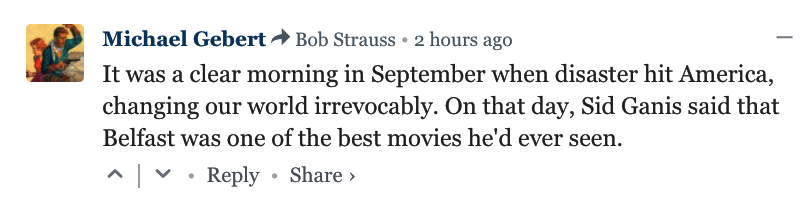
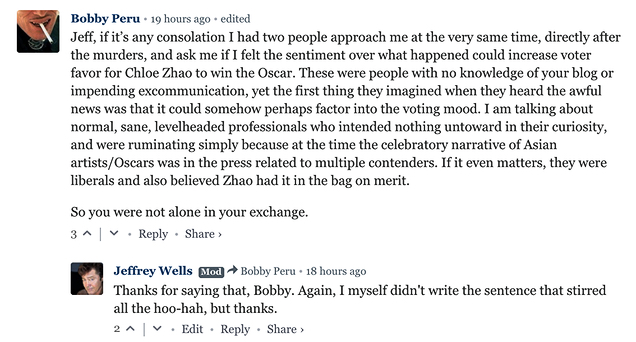
The sentence alluded to the Atlanta massage parlor killings (the victims of which were Asian woman, although Robert Aaron Long‘s motivation wasn’t racial as much as an “intersection of gender-based violence, misogyny and xenophobia,” according to state Rep. Bee Nguyen) and how this tragedy might have affected Oscar voter sentiments.
The sentence read as follows: “If there was one millionth of a chance in hell that Chloé Zhao and Nomadland weren’t going to win Oscars, the Atlanta massage parlor killings just snuffed out that chance.” Not my thought and or a view I believed in or cared about, but for one fleeting moment I thought “wow, that’s a hot-button statement that readers might want to kick around.” Throw him to the wolves!
Certain publicists who didn’t like me to begin with for my bluntly worded opinions seized upon the CCA eviction as an excuse to take me off their screening invite lists, etc. Six weeks ago I wrote Joey Berlin and John DeSimioa letter about this incident and gave them what-for.
Even though it’s barely hobbling along as we speak, The Eyes of Tammy Faye is certain to be a topic of discussion for the next few weeks and perhaps beyond because of (a) the likelihood of star-producer Jessica Chastain landing a Best Actress nomination, and (b) it’s likely to become a big favorite with gay audiences.
Southern Friendo: “Actors love big showy performances so they’ll vote for her and she will push the ‘I’ve been working on this for 10 years’ button
HE: “I didn’t hate it but I was waaay ahead of it.”
Southern Friendo: “An actress who produces her own movie that has her ‘tour de force’ performance — actors eat that shit up. They’re gonna back her. If Renee Zellweger can win for a moderately bad and kinda dull movie, Jessica Chastain can win for this absolutely.”
HE: “I guess.”
Southern Friendo: “You guess? Did you know since the year 2000, there’s always been an Oscar-winning actor/actress playing a real person except for 2016? That’s a pretty good percentage.”
HE: “Really?”
Southern Friendo: “Yes.”
HE: “Oscar-winning, not nominated?”
Southern Friendo: “Yes, verified. Except for 2016, one of the 4 acting winners (lead/supporting) has been a real person performance, based on a real-person narrative. And in 2016, there were no less than 7 real-person portrayals. Since 2000, 35% of the acting nominees are based on real people, or about 7 out of 20 nominees/winners every year.”
HE: “Thanks for calculating this.”
Southern Friendo: “That should read nominees/winners. It’s why biopics are catnip to actors, and why Jessica C. will be nominated for Tammy Faye and may even win.”
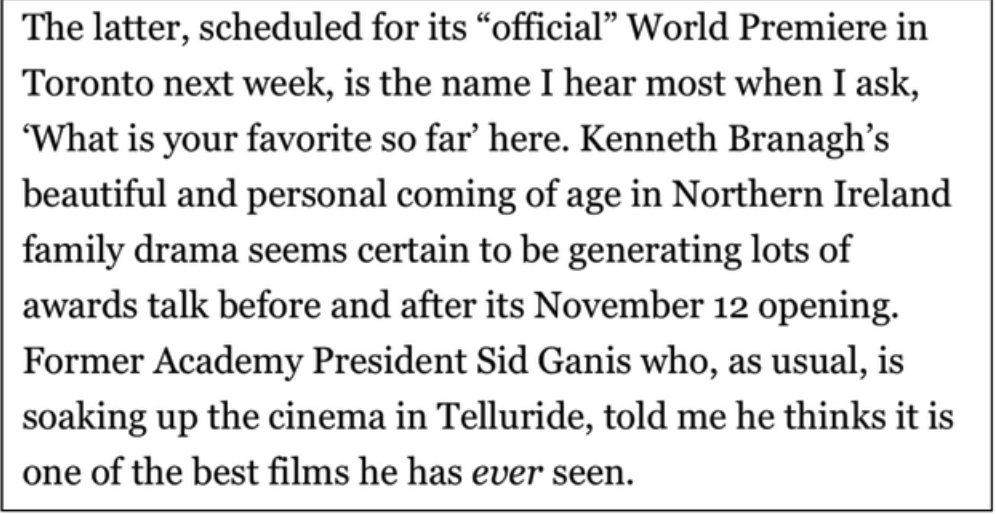
After Kenneth Branagh‘s Belfast was first screened at the Telluride Film Festival, it was immediately apparent that your smarter, more discerning viewers were notwonover while the softer, emotionally susceptible, easy-lay types were jumpingupanddown.
It therefore comes as no surprise that Branagh’s black-and-white period film has won the People’s Choice Award at the Toronto International Film Festival.
The top three contenders for the trophy were Belfast, Jane Campion‘s The Power of the Dog and Shasha Nakhai‘s Scarborough. Gripping and well-crafted as it is, Campion’s film is too morose and misery–driven to win a popularity contest, and not that many people had even heard of Scarborough.
Belfast won, God help us, because it delivers the warm emotional porridge. Yes, this means that Belfast will snag a Best Picture Oscar nomination. But then we knew that.
Jordan Ruimy:
“Branagh basically took the Roma blueprint and made it more accessible for the mainstream by injecting some Jojo Rabbit whimsy into its frames. A meticulously evil/genius plan that might pay off come Oscar night.”
Just a reminder that while the Toronto Film Festival wasn’t able to land King Richard, the Indianapolis Film Festival somehow managed it.
Oscar contenders "Belfast," "King Richard," "The Power of the Dog" and "Spencer" will be screened at the Indianapolis film festival.https://t.co/EgzKNSzLIT
From Anne Applebaum‘s “The New Puritans,” published in The Atlantic on 8.31.21: “For the moral crime of adultery, Hester Prynne must wear a scarlet A pinned to her dress for the rest of her life. On the outskirts of Boston, she lives in exile. No one will socialize with her — not even those who have quietly committed similar sins, among them the father of her child, the saintly village preacher. The scarlet letter has ‘the effect of a spell, taking her out of the ordinary relations with humanity, and enclosing her in a sphere by herself.’ ”
“We read that story with a certain self-satisfaction,” Applebaumobserves. “Such an old-fashioned tale! [For] we now live in a land governed by the rule of law; we have procedures designed to prevent the meting-out of unfair punishment. Scarlet letters are a thing of the past.
“Except, of course, they aren’t. Right here in America, right now, it is possible to meet people who have lost everything — jobs, money, friends, colleagues — after violating no laws, and sometimes no workplace rules either. Instead, they have broken (or are accused of having broken) social codes having to do with race, sex, personal behavior, or even acceptable humor, which may not have existed five years ago or maybe five months ago. Some have made egregious errors of judgment. Some have done nothing at all. It is not always easy to tell.”
As most HE readers know, I got “Scarlet Letter”-ed last March when Critics Choice honchos Joey Berlin and John DeSimio booted me out of their organization after being pressured by hysterical wokesters after I posted a sentence written by someone other than myself — a sentence which sat on HE for an hour or less before I took it down.
This eviction gave certain publicists an excuse to take me off their screening invite lists, etc. Six weeks ago I wrote Joey and John a letter about this incident. I was going to keep it private but what do I have to lose by sharing it at this point?
HE to Joey Berlin and John DeSimio of Critics Choice Association (CCA) — sent on 8.6.21.
Happy Midsummer Night’s Dream and best to your families.
I was just wondering if you guys know or care what your decision to boot me out of Critics Choice last March….a cowardly move which was ABSOLUTELY NOT over “a pattern of offensive, insensitive and unprofessional behavior,” as you told the trades (neither of you ever said a damn thing to me about any alleged issues ever, and I mean not so much as a single email or text) but over a single short paragraph in a post THAT I DIDN’T EVEN WRITE (did you even know that?) and that I took down less than an hour later…
I was just wondering if you have any idea what that hysterically overblown and thoroughly minor-in-the eyes-of-God episode did to the fortunes of Hollywood Elsewhere? Maybe you do have an idea. Maybe you don’t give a shit, or maybe you’ve chuckled about it over drinks.
I was never that attached to the fortunes (soaring or otherwise) of the Critics Choice Association. I was happy to nominate and vote and attend the annual Barker Hangar shebang, but I ate and slept pretty well before I became a member. It really wasn’t that big a deal to me, but you guys sure as hell poisoned the well when you booted me out.
Tell me truthfully, man to man…have either of you ever had a hand in a decision that helped to damage a fellow journalist’s career? Have you ever lowered the boom on someone and brought serious trauma into their life? Let’s assume you guys don’t do this on a regular basis and let me ask a question — why did you LIE about the particulars when you cut me loose? You know I didn’t cause any grief for CCA before this one dumb thing, and yet you claimed otherwise.
I regret to note that Clint Eastwood‘s Cry Macho (HB0 Max), an amiable road movie about an old white guy (Clint) and a Mexican teenager (Eduardo Minett) on a long journey, is a little too familiar and laid-back and maybe even too meditative for its own good. And it’s weirdly written and clumsily handled here and there.
On the other hand it’s about values and warmth and home-cooked tacos and treating horses and other animals with kindness and slow dancing in the cantina. It’s a nice movie, an okay one…it’s mostly fine. I know — I just said it’s under-energized, and now I’m saying it’s mildly okay. Who am I? What am I? I don’t know what to feel or think about this film, but I wish it had been more than just another “getting to know and like you” road movie. Tougher or craftier or plottier…something.
And the theme that eventually seeps through during the second half of Clint’s film, about macho behavior being over-rated and all…I’m sorry but this feels like a so-whatter. The machismo or toxic-male factor has been pretty much debunked, deballed and pushed aside for the last…what, 20 or 25 or 30 years? Sensitivity, listening to people, offering them basic respect, turning the other cheek if at all possible…that’s been the basic rule for some time now, or at least where I live.
Yes, Cry Macho is minor Eastwood. It doesn’t gun the motor — it cruises. You could even say it idles at times. But it’s a gentle and elegant film in some respects, particularly during the second act when Clint’s Mike Milo and the kid, travelling from Mexico to a big ranch in Texas owned by Minett’s dad (Dwight Yoakum), stay for a few days at a little cantina and horse-stable business run by 50ish Marta (Natalia Traven), who takes a shine to the 80ish Mike. (Let’s be generous and accept the notion that he’s younger than the actual Clint and might be able to…uhm, well, “perform”.)
There’s no avoiding the fact that Clint’s voice sounds frail and a bit weak. The guy was 89 or 90 when they shot the film, and he doesn’t look or sound much younger. Was it only 13 years ago when Gran Torino came out and people were saying “wow, Clint’s getting old but he’s still a tough and gritty old bird.” Eastwood was 78 or so when he made that excellent film. And here we are in 2021. Time marches on and cuts no one a break.
Except in the world of Cry Macho. There’s a scene early on when Clint is visiting Minett’s mother at her Mexico City home. She’s clearly a bad egg, but the movie suddenly loses its mind when she suddenly comes on to him…an alcoholic 40something femme fatale suddenly wants an 80ish geezer to fuck her? Then he turns her down and she feels insulted? What’s going on here?
Later on the kid and his pet rooster, Macho, stow away in Clint’s SUV and Clint doesn’t spot him? Kinda ridiculous.
Remember that scene in The Vikings when Tony Curtis‘s hunting bird attacks Kirk Douglas and does some serious damage? And the scene in Once Upon A Time in Hollywood when Brad Pitt‘s fat ugly dog attacks Charles “Tex” Watson and saves the day? A Mexican bad guy suffers a similar fate, only in this instance the attacking animal is Macho, who’s been toughened by cockfighting in Mexico City.
I kinda like that now and then Clint prefers to camp on the ground and shit outdoors rather than crash in a motel. Then again Yoakum has given him a bundle of travel money by so why camp? He’s against showers and pillows and mattresses?