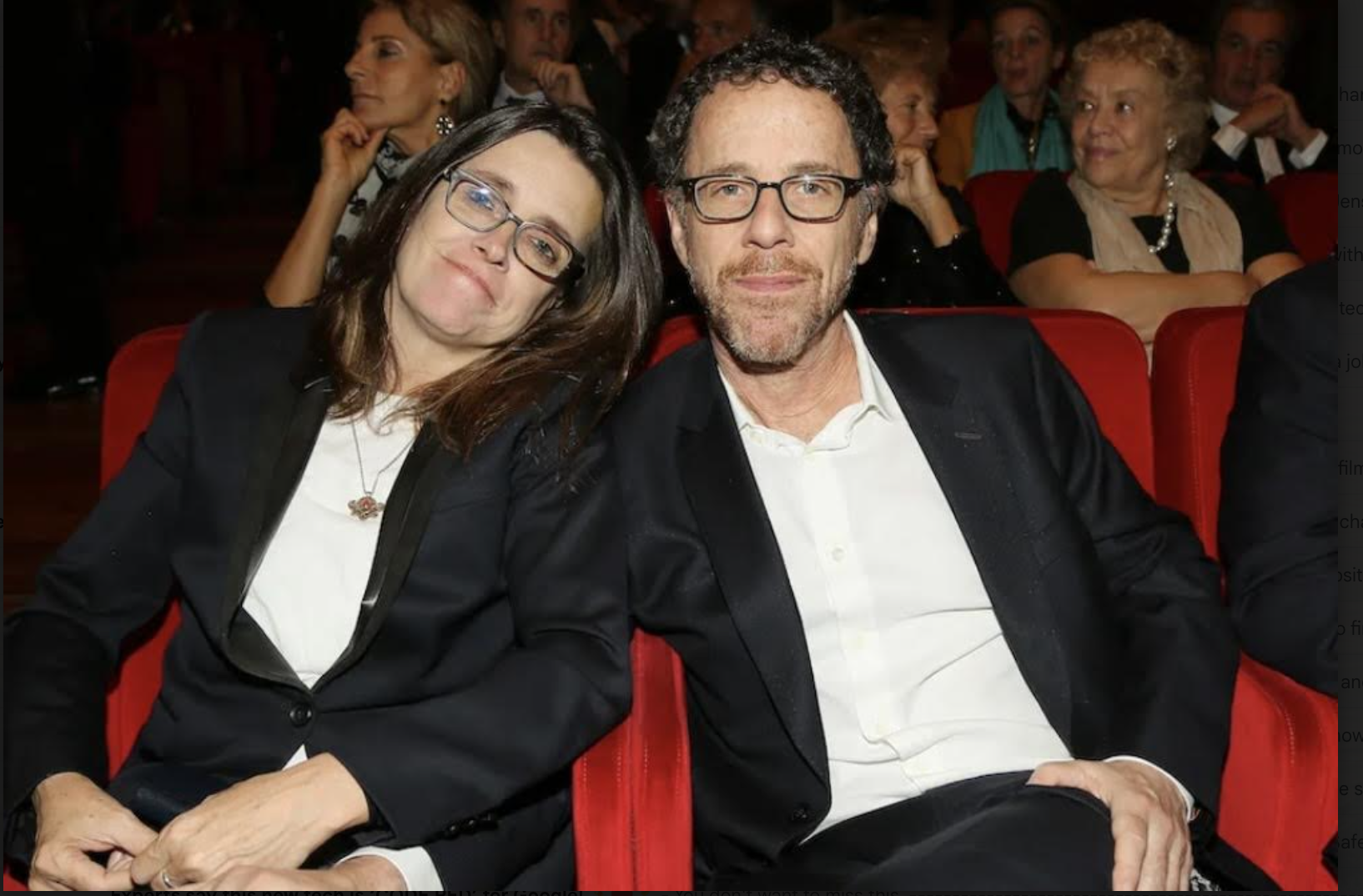
The famous and deeply respected Ethan Coen is the director of Drive-Away Dolls (Focus Features, 9.22), a kind of goofball, arch-attitude lesbian road comedy that the 65-year-old Coen cowrote with his wife, Tricia Cooke. Tricia has edited or co-edited many Coen brothers films over the decades. Married since 1990, Ethan and Tricia reside in Manhattan and have two children — daughter Dusty and son Buster Jacob.
Forgive my ignorance but I’ve been under the impression that queer means unregenerately queer (we’re no longer allowed to use the word “gay”) without any ifs, ands or buts. I would’ve thought that a woman who’s been married to a straight guy for 33 years and who presumably resides with him, and who’s also raised two kids with him, and yet whose primary emotional or sexual allegiance is to women would be described as bisexual or bi. Or is Trish a recently avowed queer person who used to be bi until she changed her mind or something?
Sorry but I’ve never heard of a queer woman with her matrimonial and maternal particulars. Maybe someone can help me out.
I saw Dominik Moll‘s The Night of the 12th (Film Movement, 5.19) last night at the delightful New Plaza Cinema (35 W. 67th Street, NYC) — a modest but dedicated arthouse for discerning adults. I was so happy to be sitting in the front row of a theatre where I belonged, a Film Forum- or Thalia-like shoebox…whistle-clean, air-conditioned comfort, ample leg room and surrounded by older folks not eating popcorn.
The film is a mostly fascinating, vaguely haunting, Zodiac-like police investigation drama that won six Cesar awards (Best Picture, Best Director, Best Adaptation, Best Supporting Actor, Most Promising Actor, Best Sound) last February.
It’s a shame, I feel, that almost no one in this country is going to pay the slightest amount of attention. It’ll eventually stream, of course, but it probably won’t attract anyone outside Francophiles and the fans of grim police procedurals, mainly because it doesn’t do the thing that most people want from such films, which is the third-act delivery of some form of justice or at least clarity.
Night is about a cold case — a prolonged and frustrating and ultimately fruitless investigation of a savage murder of a young girl in Grenoble, France…frustrating and fruitless unless you tune into the film’s forlorn wavelength, which is about something more than just whodunit.
It’s based on a fact-based 2020 novel by Pauline Guéna.
The victim is Clara (Lulu Cotton-Frapier), a beautiful, blonde-haired 21 year-old student who lives with her parents. After leaving a party in the wee hours and while walking down a moonlit street, she’s approached by a hooded wacko and set aflame — a horrible sight. The film is about two Grenoble detectives, played by Yohan (Bastien Bouillon) and Marceau (Bouli Lanners), as they interview and investigate several potential killers whom the casually promiscuous Clara had been sexual with at different times.
All of these guys are scumbags of one sort of another, and you start to wonder why she didn’t have at least one male friend or lover who wasn’t an animal. The digging goes on and on, but no paydirt.
The essence of The Night of the 12th is militant feminism mixed with intense grief. It’s saying there’s a subset of appallingly callous young men out there today…aloof, cruel, thoughtless dogs who sniff and mount out of raw instinct, and this, boiled down, is what killed poor Clara.
Last month in Cannes Martin Scorsese said that Killers of the Flower Moon wasn’t a whodunit but “a who-didn’t-do-it?”
Same with Night — Yohan concludes at the end that “all men” killed Clara, and so among the Cesar voters and the guilty-feeling industry fellows who felt an allegiance with their feminist collaborators… this water-table sentiment, an adjunct of the Roman Polanski-hating faction, is presumably what led to The Night of the 12th‘s big sweep.
By this measure Night isn’t about a “cold case” — it’s a kind of hot-flush case that points in all kinds of directions to all kinds of potential young-feral-dog killers…a limitless (in a sense) roster of bad guys.
In order to make this point about “all men” being at fault, the film necessarily can’t allow the Grenoble detectives to finally nab a single killer.
But of course, Clara’s curious attraction to bad boys and her generally impulsive nature was at the very least a significant factor in her fate. She was obviously flirting with this kind of snorting louche male for a deep-seated reason of some kind. Clara could have theoretically been a cautious or even withdrawn type, barely experienced in sex and sensuality and perhaps even prudish, and she still might have been torched by a sicko. But you’re not going to tell me that “playing with bad boys” wasn’t central factor.
Sensible women choose their lovers sensibly, and Clara didn’t roll that way. If you don’t use common sense in your romantic life, sooner or later the bad stuff will rub off.
So where did the bad-boy fetish come from? In The Limey (’99) we understood why Terrence Stamp’s daughter Jenny was attracted to dangerous men, but Clara’s dad (Matthieu Rozé) is a moderate mousey type and her mom (Charline Paul) is a diligent homemaker. So how and why did she develop the appetite?
The screenwriters (Moll and Gilles Marchand) don’t even toy with this emotional dynamic as they don’t subscribe to a belief that Clara might have flown too close to the flame. They seemingly believe that Clara was 100% innocent of any dangerous behavior by way of skunky boyfriends. I think that’s a dishonest attitude, and so I didn’t finally buy what the film was saying.
I saw the film with mostly older singles and straight couples, but there were at least two female pairs who were kind of sniffling and crushed at the end — the same emotional vibe I felt among women after a Toronto screening of Boys Don’t Cry.
If it weren’t for his raspy, croaky, strangled-cat voice and what I regard as totally fruit-loopy anti-vaccine convictions (“I’m not anti-vaccine, but I am pro-science”), Robert F. Kennedy, Jr. would be a guy I could and would vote for. His concern for the environment warrants respect and admiration, and he currently has a 49% favorability rating — not a dismissable statistic. But the voice is impossible. I’m sorry but c’mon.
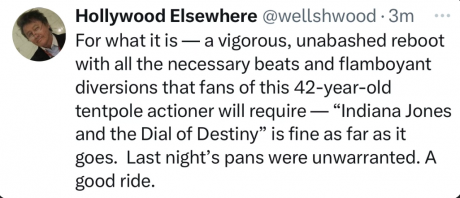
Were it not for the crazy-ass ending of Indiana Jones and the Dial of Destiny (Disney, 6.30), I would be standing with the half-and-halfers, saying “yeah, not great but not bad” and so on.
But the mescaline-fueled ending is so wackazoid that it kicks the entire film up to another level. So if you factor this in Indy 5 becomes a “yeah, okay…not half bad!” instead of just a “whatevs, passable, good enough.”
Guaranteed — you haver never seen a crazier ending of a major tentpole film in your life.
Here’s the most relevant portion of my 5.19.23 review, filed from Cannes:
Indiana Jones and the Dial of Destiny is a mega-budget serving of silly, rousing, formulaic, high-energy, fuck-all Hollywood wankery. If you pay to see it with that understanding in mind, it’s “fun” as far it goes, largely, I would say, because it also feels oddly classy…a well-ordered, deliciously well-cut exercise in which Mangold does a better-than-decent job of imitating Spielberg’s psychology, discipline, camera placements, cutting style, easy-to-follow plotting and generally pleasing performances.
The pans that broke last night were written by soreheads. It is what it is, and it delivers the hand-me-down goods in a way that very few will find bothersome or underwhelming.
In his 5.18 review, Irish Times critic Donald Clarke writes that “nobody with a brain in their heads will compare Dial of Destiny favorably to the first three films.” He’s right about that, but it’s definitely better than 2008’s Indiana Jones and the Kingdom of the Crystal Skull. That may not sound like much, I realize, but at least it has this distinction.
The plot is basically another “Indiana Jones vs. frosty, cold-blooded Nazi fiends in search of a priceless archeological artifact” thing. Ford is steady, restrained and solemnly earnest in a gruff (okay, grumpy-ass) sort of way. Mads Mikkelsen is the chief German baddy-waddy, Phoebe Waller-Bridge is Indy’s younger half & partner in adventure and derring-do, Ethann Isidore is the new “Short Round” (the spunky Temple of Doom character, played by a young Ke Huy Quan) and so on.
One minor HE complaint: Waller-Bridge’s feisty-grifter character, Helena Shaw, is said to be the daughter of Toby Jones‘ Basil Shaw. There is, of course, no way on God’s good, green, chromosonal earth that the short, pudgy, gnome-like Jones (who stands 5’5″) could be the biological dad of the leggy, wafer-thin PWB (who stands just under 5’10”). No way in hell. I bought the crazy ending in a “is this really happening?” sort of way, but not this.
Putin has vowed “decisive actions” to suppress Prigozhin’s coup, whose forces have “claimed control of the southern Russian city of Rostov-on-Don and are moving north toward Moscow,” according to N.Y. Times reporters Victoria Kim and Anton Troianovski.
In a brief address to the nation, Putin called Prigozhin’s rebellion “treasonous” and “a stab in the back of our country and our people.” Prigozhin — a longtime Putin ally and fierce critic of Moscow’s military leadership, who has helped lead Russia’s assault on eastern Ukraine — rejected the treason charge of treason and said, in an audio message, that his forces were “patriots of our motherland.”
In short (and please correct if I’m wrong), Prigozhin believes that Putin’s waging of the war in Ukraine hasn’t been savage enough. My reasoning is telling me that if his coup succeeds (which at the very least will be dramatically satisfying) things will get a lot tougher for Ukraine.
N.Y. Times: “’We’re blockading the city of Rostov and going to Moscow,’ Mr. Prigozhin said in a video that surfaced early Saturday, verified by The New York Times, showing him in the company of armed men in the courtyard of the headquarters, asking for the chief of the General Staff of the Russian military and the Russian defense minister, Sergei K. Shoigu.”
Peter Boghossian, 56, is a sensible-minded American philosopher and pedagogist. He was a philosophy professor at Portland State University for a decade. As an academic who despises faith-based fanaticism (his focus is atheism, critical thinking, pedagogy, scientific skepticism and the Socratic method), Boghossian is not only deeply appalled by wokesters but also by faith-driven Republicans and evangelicals. At the very, very least, the man embodies “parrhesia” — he isn’t cowed by the Stalinists, and has the balls to say what he truly and sensibly believes.
No Hard Feeings (Sony, currently playing) is a casually coarse sex comedy about an “inappropriate age gap” relationship between Maddie (Jennifer Lawrence), a 32 year-old Montauk bartender in a financial hole, and Percy (Andrew Barth Feldman), an introverted 19-year-old who’s about to become a Princeton freshman.
Percy’s helicopter parents (Matthew Broderick, Laura Benanti) are concerned about his lack of outgoingness plus the fact that he’s still a virgin, so they place an ad in Craigslist that says “looking for a 20something woman who can pull our son out of his shell” — the implication being that they want this woman to sexually initiate the lad and generally prepare him for the social pressures of college.
Except the initial Craig’s List ad is way too explicit and detailed for an ad written by helicopter parents who want the whole thing kept on the down low — they don’t want their son to have so much as an inkling that they’re looking to hire a sexual tutor, etc. So right away it’s not believable.
If JLaw’s Maddie wanted to successfully seduce this kid, she might have taken a moment to size him up and determine if he’s the kind of raunchy-minded, ready-to-fuck kid who would playfully respond to “may I hold your Weiner?” or whatever the hell she says to him in the pet store.
Percy is a quiet, soulful type with a subdued sex drive — that’s obvious from the get-go. He’s congealed and too inwardly directed, but he’s not stupid. If I were in his shoes (I didn’t get lucky for the first time until I was 19) I would be immediately suspicious as to why this 30ish woman is so behaving so aggressively, like Gwen Verdon’s “Lola” behaves with Tab Hunter when she performs “Whatever Lola Wants” in Damn Yankees.
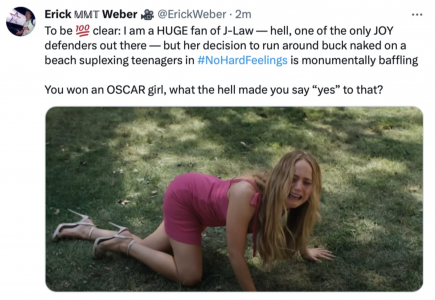
And JLaws’s “full frontal nudity” looks digitally muddy — it’s not real on some level, though I’m unsure in which way. Portions of her bod appear to have been “washed” in some way. And why don’t we see a moonlit shot of her running into the surf from Percy’s point of view (hence no shot of her ass)? For an allegedly bawdy movie you naturally expect to see this shot, but they don’t show it. I may be wrong but I don’t think so.
Proceeding on the assumption that you can’t go wrong by praising a gentle, understated emotional film by a female South Korean director-writer (i.e., the general rule being to always tip toward (a) non-white ethnicity or (b) anything gay or trans), a plurality of critics have chosen Celine Song‘s Past Lives as the best film of 2023, according to a 6.23 poll from World of Reel‘s Jordan Ruimy.
The other faves in Ruimy’s poll (and in this order): Spider-Man: Across the Spider-Verse, Air, John Wick: Chapter 4 (WHAT??), Asteroid City (whores), Blackberry (approved), R.M.N. (approved), Showing Up, Beau is Afraid (approved), Pacification (who?), You Hurt My Feelings (not bad), Tori & Lokita (decent film but critics are always obliged to bow down to the Dardennes), De Humani Corporis Fabrica, How to Blow Up A Pipeline, The Eight Mountains, Guardians of the Galaxy Vol. 3, Are You There God, It’s Me Margaret, Dungeons and Dragons, Me3gan, Infinity Pool.
1. Tran Anh Hung’s The Pot au Feu
2. Guy Ritchie‘s The Covenant
3. Christian Mungiu‘s R.M.N.
4. Eric Gravel‘s Full Time
5. Jonathan Glazer‘s The Zone of Interest
6. Martin Scorsese‘s Killers of the Flower Moon
7. Matt Johnson‘s Blackberry
8. Ari Aster‘s Beau Is Afraid
9. Ben Affleck‘s Air
10. Celine Song‘s Past Lives
11. Jean-Stephen Sauvaire’s Black Flies.
12. Steven Soderbergh‘s Magic Mike’s Last Dance
Ethan Coen‘s Drive Away Dolls (Focus Features, 9.22) seems like a harmlessly broad innocents-in-jeopardy road comedy. Innocent lesbians, that is, which Ethan had to commit to, given the times and the culture. The only alternate option would have been to focus on a gay or trans couple. The original title was Drive Away Dykes.
It seem like an apparent riff on a No Country-like chase plot among some dumbshit lower-class types, written and performed in the usual deadpan Coen style.
A youngish couple inclined toward despair and glumness (Margaret Qualley with a yokel accent + Geraldine Viswanathan, a good actress with a last name that no one will be able to spell much less pronounce) accidentally get hold of a MacGuffin suitcase (money, drugs, whatevs) and it’s off to the races.
The rotund Beanie Feldstein is the sardonic cop (i.e., a philosophical perspective stand-in for Tommy Lee Jones?) who’s keeping tabs, following the situation. The mere presence of Pedro Pascal, who has a significant role in just about every damn film being made or released these days, is driving me crazy. Further deadpan humor from Colman Domingo, Bill Camp, Matt Damon, etc.
“The guys at OceanGate” (particularly CEO Stockton Rush, who died on 6.18 along with the other four passengers) “didn’t remember the lesson of the Titanic,” he said, and that “the arrogance and the hubris” that doomed Titanic is exactly what doomed the Titan five days ago and actually long before that.
No sugar-coating or pussy-footing — the accountability for this tragic accident is on Rush.
Cameron had not only been confidentially persuaded but knew “in his bones” last Monday, he says, that the Titan had almost certainly experienced a catastrophic implosion. He stayed silent while strongly suspecting that the truth would eventually come out.
Cameron didn’t address this, but the likelihood of the bodies of the five Titan passengers being recovered is almost certainly nil. Concern for the families of the deceased is presently discouraging anyone from acknowledging that the term “bodies” is probablv inapplicable in this situation.
The people who knew (or had been confidentially told by trusted sources) what had almost certainly happened apparently decided en masse to commit to a kind of spiritual narrative or theatrical passion play based on hope — a less than 1% chance that the Titan might still be intact and that the five men might still be alive and perhaps stranded on the ocean floor. They all decided to “play along” as an emotional gesture to the families. Nobody wanted to sound heartless by acknowledging the likelihood that the five men were almost certainly dead and most likely fish food. It was decided that maintaining a kind of hope vigil was the more humane and compassionate way to go.