…to fully examine who was primarily at fault in a ski-slope collision that happened seven years ago (2.26.16)? Alleged victim Terry Sanderson, now 76, waited almost three years to sue Gwyneth Paltrow for $3.1 million, claiming she wham-slammed into him on a Deer Valley ski slope, breaking four ribs and knocking him cold before “bolting” down the hill.
On 11.26.12, IndieWire‘s Oliver Lyttletonfiled the following: “One of cinema’s most enduring urban legends is that Ronald Reagan was originally cast as Rick in the project. In fact, it was never true, but there is at least fair basis for the rumors. Reagan was named, along with Ann Sheridan (AngelsWithDirtyFaces) and Dennis Morgan (River’s End) in a studio press release as taking the lead roles in the project in early 1942.
“But in fact, none were actually involved. Having been called up to active army duty after Pearl Harbor, Reagan had been ruled out. He was, however, seemingly mentioned by publicists along with Sheridan and Morgan in an attempt to keep their names out there. George Raft also famously turned the project down, but again, the truth of that is in doubt.
“The studio’s records suggest that Bogart had always been producer Hal Wallis‘ first choice for the part, though Jack Warner may have preferred Raft. There were other actors considered for other parts, though. Hedy Lamarr — who also starred in “Algiers” — was mentioned for the role of Ilsa, but MGM wouldn’t release her from her contract (Lamarr went on to play the role in a 1944 radio adaptation opposite Alan Ladd as Rick). French actress Michele Morgan (Le Quaid des brumes) did test for the part, but RKO wanted a whopping $55,000 to loan her to Warners, so the studio went for Bergman as David O. Selznick was asking half as much money for her, so long as Warners would lend him Olivia de Haviland in exchange.”
Pretty mucb every panting admirer of John Wick: Chapter Four is aroused by the logistics of making it…magnificent visual dynamic, breathtaking Parisian backdrops, magnificent set dressings, brilliant choreographic energy, a relentless violent ballet, etc.
None of them are addressing what the film actually is…what it’s saying…what it actually amountsto.
A highly unusual and disturbing thing happened in bucolic Wilton on the morning of Tuesday, 3.21, or five days ago. A 39 year-old married guy was stabbed to death by a 31 year-old nutbag neighbor. The victim’s name was Arinzechukwu “Red” Ukachukwu (tough pronounce), and the killer was and is Sebastian Andrews, a 31 year-old guy who was living with his father and an older brother on Wilton’s Indian Hill Road.
The victim and his wife, Alisha Lager, bought their home “after the pandemic,” according to a toothless story by Hearst Media Group’s Peter Yankowski. Lager is left to care for their two-year-old son.
I found an attractive, magic-hour photo of the couple on Lager’s Facebook page. The victim, the assailant and Lager — all Millennials.
Yankowski: “Born on 1.12.84, Ukachukwu was a creative entrepreneur, musician and a tech wizard. He was raised in Brooklyn by parents who were active in the Nigerian community. He attended private schools and then Fiorello H. LaGuardia High School of Music & Art and Performing Arts. In 2005 he graduated from the University of Albany with a degree in economics.”
Fox61’s Matt Caronreported that at last Wednesday’s hearing Andrews asked to speak and was advised by his attorney, Kevin Black, not to say anything. The state’s attorney said that “there appears to be some sort of psychological issue involved.”
The arrest warrant reports that Andrews alleged that he found Ukachukwu “trespassing on [his father’s] property several times.” This appears to be an unsubstantiated claim.
Compounded with the “psychological issue,” facts suggests that the killing was some kind of bizarre racial hate crime, perhaps in a vein vaguely similar to the 2020 killing of Ahmaud Arbery. Who stabs a neighbor with a kitchen knife and then drags his body into a garage and then takes a shower and calmly waits for the cops to arrive?
The crime was reported by Andrews’ father, who saw the killing happen in real time. Nobody has spoken to him, nor has anyone explored if his now-jailed son had some kind of social media history. I poked around and found nothing.
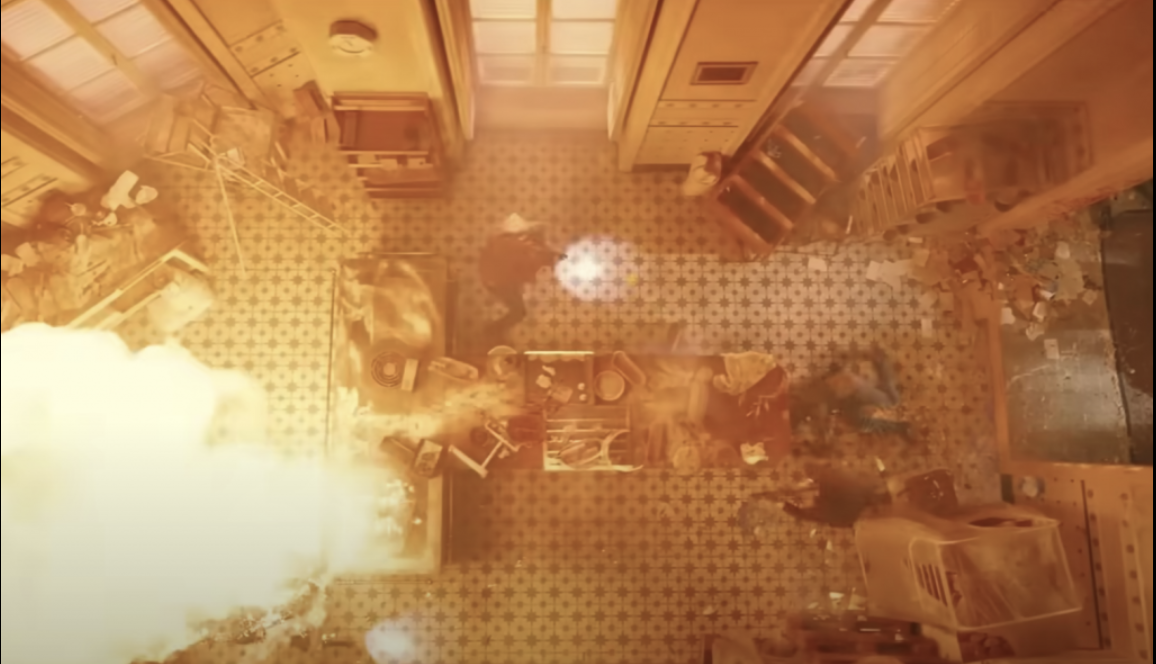
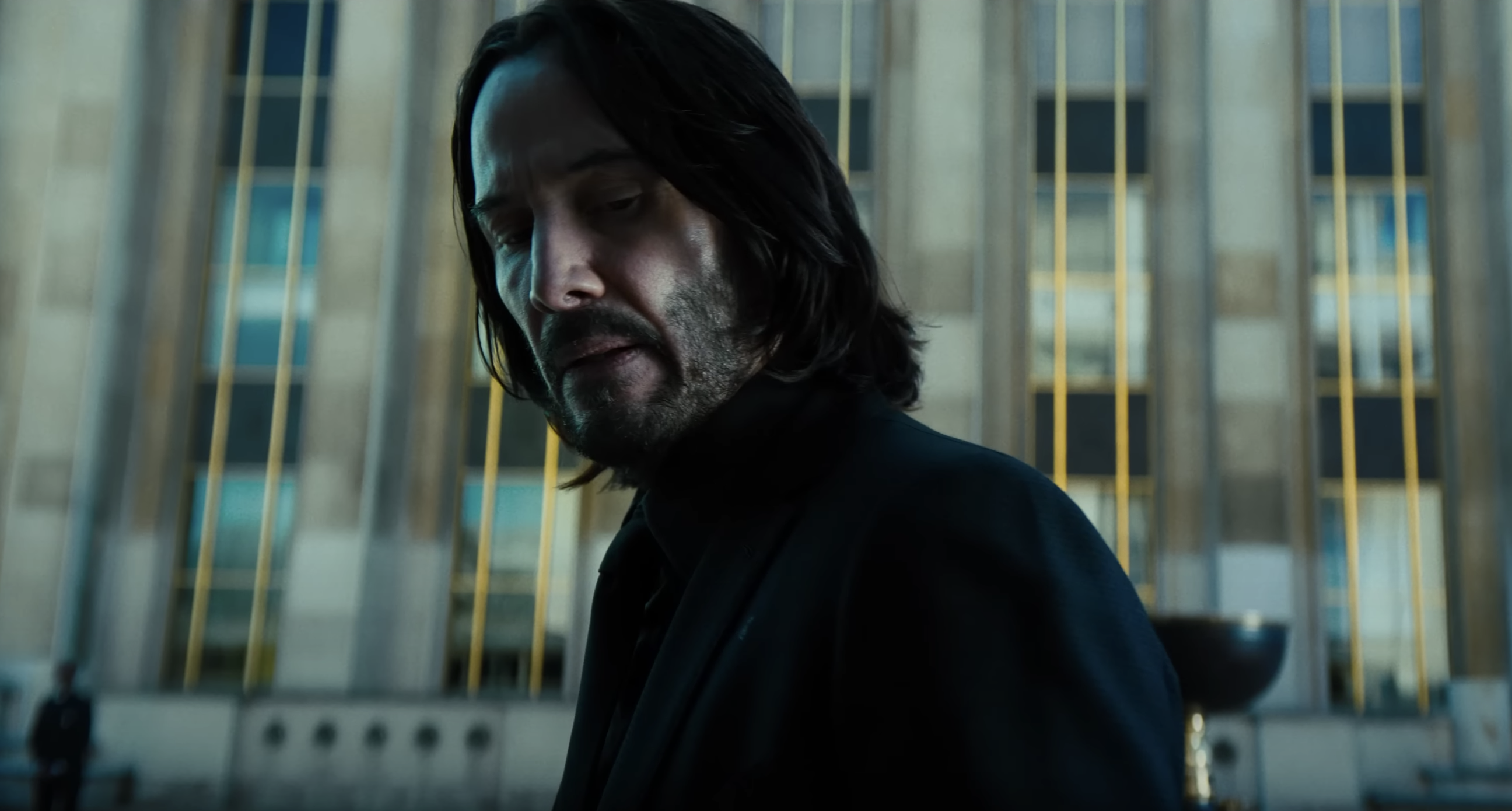
In yesterday’s pan of the revolting and deplorable John Wick: Chapter Four, I should have mentioned my grudging respect for an extended, uncut overhead shot of Keanu Reeves going from room to room and blasting bad guys at every turn with the camera constantly maintaining its God’s-eye viewpoint.
In a 3.25 interview with TheWrap‘s Scott Mendelson, dp DanLaustsen (totally unpronouncable) explains that the scene utilized a set built on one of the Studio Babelsberg sound stages.
Laustsen: “It’s one crane shot and one spider cam shot where we are starting on the stairs and flying around. We did in eight or ten takes. The light must be outside the set. We see the whole set. That’s the challenge when your shots are wide and the entire set is in view.”
John Wick 4’s god’s-eye gunfight has been called the “Hotline Miami” scene but I was surprised to see Chad name an even more obscure indie game as inspiration
HONG KONG MASSACRE is Hotline Miami x John Woo, and JW4 beautifully adopts its top-down look & gargantuan muzzle flashes pic.twitter.com/hGU3A47icE
Until last night I somehow didn’t realize that there’s a real possibility that TikTok might be forced to sell, at least as far as this country or North America is concerned. I thought it was just political sturm und drang. I didn’t think anything would actually happen.
Jonathan Majors (aka Kang the Conqueror) has stepped into a pile of domestic dogshit, and it doesn’t look good. The 33 year-old actor was popped this morning in Manhattan on charges of assault, strangulation, and harassment after a reported altercation with a woman.
NYC police statement given to IndieWire: “On Saturday, March 25, 2023, at approximately 11:14 hours, police responded to 911 call inside of an apartment located in the vicinity of West 22nd Street and 8th Avenue, within the confines of the 10th Precinct. A preliminary investigation determined that a 33-year-old male was involved in a domestic dispute with a 30 year-old female. The victim informed police she was assaulted. Officers placed the 33-year-old male into custody without incident. The victim sustained minor injuries to her head and neck and was removed to an area hospital in stable condition.”
An industry rep told IndieWire that Majors “has done nothing wrong…we look forward to clearing his name and clearing this up.”
The “rules” of high-powered action films over the last 20-plus years is that there are no rules. Life is worthless, death is immaterial, nothing matters, nothing sticks and everything’s everything, baby. You can globe-hop at will and stage big set pieces and start fires and blast everything to bits and nobody blinks an eye…explode at will, kill dozens or hundreds of guys, jump out of three-story buildings, get hit by speeding cars, get shot two or three or eighteen times yourself…it’s all a bullshit cartoon. There are no humans with recognizable characteristics…no behavior that makes a lick of sense.
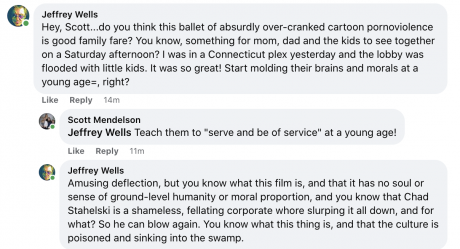
This is the cold, cynical, sick-fuck, android travel-porn world of Chad Stahelski, a former stunt man and a soulless visual composer, and the godforsaken John Wick: Chapter Four, which I just suffered through for 169 minutes. And the theatre lobby is like fucking Disneyland…family fun for dads, kids, moms, little girls. It’s surreal, sickening.
I saw Wick 4 because I was feeling good about life and I needed to re-pollute my soul…because I needed an injection of green Stahelski poison coursing through my veins. And because I wanted to revel in the Paris portions of this insane, rancid, ugly-ass film, which take up the last…oh, 45 or 50 minutes. And because I wanted to cheer the death of Keanu Reeves‘ John Wick, and I don’t mean an action-film tentpole death that doesn’t really mean anything (like the “death” of 007 in No Time To Die, which ended with a credit crawl pledge that said “James Bond will return”) but a real, honest-to-God, stick-him-in-the-ground death that doesn’t allow for rebirths or reboots. Because I half-liked the first Wick but have hated the expanding insanity that followed.
That’s why I caught a 3 pm show on Saturday, 3.25. As to whether or not my expectations were satisfied…I can’t answer that.
Filming started in June 2021, initially in Berlin and Paris before moving on to Osaka and New York City. They wrapped in October of that year.
The varied Paris locations are grand and beautiful, and scene to scene it’s all handsomely lighted and designed and shot with appropriate pictorial panache. I sat there like an Egyptian sphinx. I had my phone on the whole time, and when the boredom became too much you’d better believe I checked my texts and did some research.
I was pleased and comforted that Stahelski covered all the diverse casting bases…a studly Anglo-Hawaiian lead (Reeves), three Asian actors (Donnie Yen, Hiroyuki Sanada, Rina Sawayama), a young Swedish evil guy (the ice-cold Bill Skarsgård, aka “Pennywise”), three black dudes (Shamier Anderson, Lance Reddick, Laurence Fishburne), an action star in a fat suit who says “you shot me in the ass!” (Scott Adkins), a Chilean guy (Marko Zaror) and an aging British smoothie (Ian McShane).
Wick 4 is the first action film I’ve seen in which the guns don’t appear to shoot actual bullets. They shoot “ding” bullets, which is to say bullets that aren’t as lethal or damaging as they usually are. I’m not saying they’re high-powered beebee pellets, but some guys need to be shot three and four times before they go down for the count. Either way Reeves doesn’t have to worry because he never gets shot until…I’d better not say.
Posted on HE 11 1/2 years ago: “In 1987 Lethal Weapon used a funny jumping-off-a-building gag. Ragged-edge cop Mel Gibson is sent to the top of a four-story building to talk an unstable guy out of making a suicide leap. Gibson winds up cuffing himself to the guy and jumping off the building, and they’re both falling to their deaths…not. They land on one of those huge inflated tent-sized bags…whomp!…that cops and firemen use to save people. All is well.
“Flash forward to another jumping-off-a-building scene in Brad Bird and Tom Cruise‘s Mission: impossible 4 — Ghost Protocol (’11), which I saw last night. An American operative is being chased over a rooftop by baddies in Budapest. He fires some rounds, kills a couple of guys, and then escapes by leaping off the building, continuing to shoot as he falls four or five stories to the pavement below. He’s saved, however, when he lands on a modest air mattress that’s about one-tenth the size of Lethal Weapon‘s tent-sized bag.
“Where did this miracle air mattress come from? We’re not told. In what physical realm does a guy leap backwards four stories onto an air mattress that’s a little bit larger than a king-sized bed and live? I’ll tell you what realm. The realm of Mission: Impossible 4 — Ghost Protocol and its brethren.
Almost exactly nine years ago it was reported that Michael Bay would be direccting a remake of Alfred Hitchcock‘s The Birds (’63). I didn’t think that was a good idea. The Bay part, I mean. It sounded like a desecration waiting to happen.
But if someone with an austere, highly disciplined aesthetic were to take a fresh crack at Daphne du Maurier’s 1952 short story, something fascinating could result. Perhaps more than that.
The first rule of remakes (or adaptations for that matter) is to always start with something that wasn’t all that good to begin with — something pulpy that needs an upgrade or a deepening of some kind.
Hitchcock’s Birds definitely qualifies. Take away five scenes — the first, very brief gull attack upon Tippi Hedren, the finches attacking through the fireplace, Jessica Tandy discovering the body of her farmer neighbor with his eyes pecked out, the Bodega Bay diner scene (“It’s the end of the world”), Hedren being attacked in the upstairs bedroom — and you’re left with a fairly mediocre film. Stiff, stilted, constipated. Hedren’s brittleness is oppressive — there’s no chance that Melanie Daniels did anything “wild” in Rome, much less jumped naked into a fountain. The kids are such awful actors (Veronica Cartwright excepted) that you’re rooting for the birds during the Bodega Bay School attack scene. Get ’em!
I would love it if Ari Aster, Robert Eggers, David Fincher or Michael Haneke wanted to give it a go.
“Musical Score As Strong Supporting Character,” posted on 6.17.19: “I’ve always enjoyed big movie symphonies of the ’50s and ’60s because their composers — most of them classically trained and European-born — didn’t just write scores but created non-verbal, highly charged musical characters.
“They didn’t watch the film in the seat beside you or guide you along as most scores tend to do — they acted as a combination of a Greek musical chorus and a highly willful and assertive supporting character.
“These ‘characters’ had as much to say about the story and underlying themes as the director, producers, writers or actors. And sometimes more so. They didn’t musically fortify or underline the action — they were the action.
“If the composers of these scores — in this instance Rosza — were allowed to share their true feelings they would confide the following before the film begins: “Not to take anything away from what the director, writers and actors are conveying but I, the composer, have my own passionate convictions about what this film is about, and you might want to give my input as much weight and consideration as anyone else’s. In fact, fuck those guys…half the time they don’t know what they’re doing but I always know…I’m always in command, always waist-deep and carried away by the current.”
A decade ago I wrote the following about Rosza in a piece called “Hungarian Genius“: “Rosza sometimes let his costume-epic scores become slightly over-heated, but when orgiastic, big-screen, reach-for-the-heavens emotion was called for, no one did it better. He may have been first and foremost a craftsman, but Rosza really had soul.
“Listen to the overture and main title music of King of Kings, and all kinds of haunting associations and recollections about the life of Yeshua and his New Testament teachings (or at the least, grandiose Hollywood movies about same) start swirling around in your head. And then watch Nicholas Ray’s stiff, strangely constipated film (which Rosza described in his autobiography as ‘nonsensical Biblical ghoulash’) and it’s obvious that Rosza came closer to capturing the spiritual essence of Christ’s story better than anyone else on the team (Ray, screenwriter Phillip Yordan, producer Samuel Bronston).”