“They do what they wanna do, say what they wanna say, live how they wanna live, play how they wanna play, dance how they wanna dance, kick and they slap a friend…the Addams Fam-uhl-LEE!”
The kids (three-year-old Jett, two-year-old Dylan) and I used to sing “Addams Groove” in the car. Doesn’t feel like 31 years ago. When did David Spade do that M.C. Hammer bit on one of his SNL “Hollywood Minute” segments? Can’t find it on YouTube.
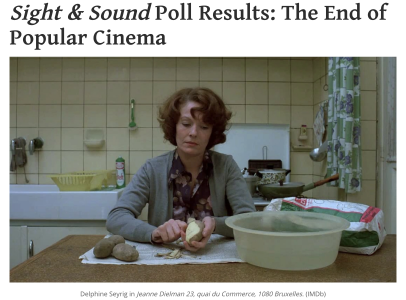
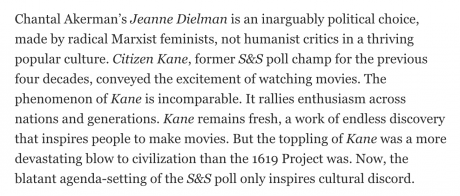
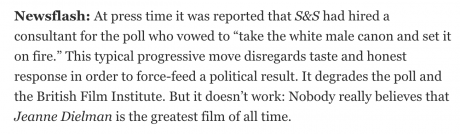
Thoughts about the ruinous Sight & Sound poll of 2022 have been repeatedly posted here, but please read Armond White‘s 12.7 condemnation piece.
“The film-loving tradition of Britain’s Sight and Sound magazine, especially its international poll on ‘The Greatest Films of All Time’, is over,” White declares. “[By] announcing the decennial poll’s latest results — Jeanne Dielman tops the list now, as Vertigo did in 2012 — S&S has ruined its trustworthiness [and] is no longer a reliable consensus, as the poll has fragmented film culture into political sects.”
I was planning on taking a couple of Connecticut friendos to a showing of Sam Mendes‘ Empire of Light (Seachlight, 12.9) this weekend, except it’s primarily playing in Manhattan so I guess not. Empire won’t open wide until 12.23.
Searchlight is doing a gradual roll-out due to the usual concerns. Empire was critically roughed up during Telluride ‘22, and the current critic aggregate ratings — 45% on Rotten Tomatoes, 53% on Metacritic — have probably lowered audience interest.
Which means, of course, that it’s not very good…right? Wrong. Empire of Light is a bull’s-eye everything movie — delicate, mesmerizing, perfectly timed and balanced and calculated just so.
Set in an English seaside town (Margate) in the early ’80s, it’s a bittersweet, humanistic, somewhat gauzy tale of a short-lived May-October affair as well as a nostalgic recollection of movies and the exhibition business as they existed 40-plus years ago. Exactingly directed and written by Mendes in what I believe is his finest effort yet, pic contains yet another brilliant performance by the great Olivia Colman and an exciting mainstream-cinema debut from the obviously talented (and very good-looking) Michael Ward.
I haven’t yet seen Avatar 2: The Way of Water, but screw it…Empire of Light is HE’s choice for the absolute Best Film of 2022. Seriously, no question.
I also honestly believe that the Empire of Light haters (including IndieWire‘s David Ehrlich, L.A Times‘ Justin Chang, The Telegraph‘s Tim Robey, The Globe and Mail‘s Barry Hertz) have done their readers a huge disservice. They’ve brought a terrible, brutal blight upon a film that they know is a first-class effort — as wise, particular and well-honed as they come.
The haters have shat upon on a film that many significant others are convinced is rich and fulfilling…they’ve crapped all over it because Mendes had the chutzpah (or the temerity?) to cast the young, Jamaican-born Ward as Stephen, a 20-something theatre employee who falls into a brief, tender affair with Colman’s emotionally unstable, far-side-of-40 Hillary…because a 2022 white filmmaker is not allowed to present a character of color according to the values of bygone eras….because woke presentism requires that black characters have to be strong, firm and formidable and that no racist hate can be visited upon them …and because it’s simply not cool, the haters seem to feel, for Ward’s character to engage in sexual congress (however brief) with an older, mentally unstable woman.
I know what this film is and how well it works, and I think the Empire of Light haters should be ashamed of themselves.
The thing that sparks or drives deep-down feelings when it comes to yay-nay reviews of films…that thing is often not honestly expressed or admitted to. The fact that nobody (except Barry Hertz) has expressed anger about the racial thing…about what some seem to believe is a manipulative and opportunistic attempt on Mendes’ part to use an affair between Colman and Ward to punch up some kind of contemporary current…the apparent fact is that the haters feel that Mendes’ film is sending out the wrong 2022 message. Don’t show us how bad things were 40 years ago for people of color; show us how much better things are today.
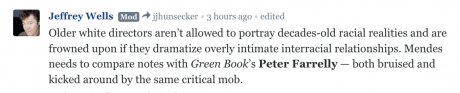
Green Book was attacked by the same crowd for telling its tale according to the social standards and values of 1962. The wokesters wanted it told and interpreted according to 2018 standards, and they went ballistic trying to kill it for that. It’s the same deal here.
It’s one thing for a critic to say that Empire of Light isn’t his or her cup of tea….that’s fine. But many of these critics are looking to kill Mendes’ film. They want it shunned and stomped upon, and that, to me, suggests that something else is going on. Either way the Searchlight people can hear the growling and smell the drops of blood.
Wokesters see themselves as white-knight defenders and protectors of BIPOCs and LGBTQs and all marginalized groups, and as infantile and obstinate as this sounds, I believe they hate this film because they simply don’t want to see Ward’s character becoming intimate with an unbalanced, Lithium-medicating white woman in her late 40s. Nor do they want to watch Stephen dodge the assaults of racist, Thatcher-era skinheads and cranky old codgers who resent his presence as a ticket-taker. Mendes is too good of a filmmaker to play the presentism game.
Before seeing Empire of Light I had trouble believing that such an affair, however discreet or short-lived, was likely between two such characters in 1980 England, especially with the National Front goons running around. I was in London in December 1980 and I felt it. I saw skinheads on the Underground and read the anti-immigrant graffiti and felt the vibe to some extent, but guess what? The movie sells it anyway. I was charmed into accepting the terms.
Because of Colman and Ward and the rest of the cast (especially TanyaMoodie as Stephen’s mom)…because of Mendes’ writing and direction and Roger Deakins‘s cinematography, and the soothing musical score by Trent Reznor and Atticus Ross as well as the general aura of sublime, on-target realism…somehow it works. All of it. I believed every character, every situation.
Okay, every now and then it feels a bit emotionally forced or a touch on-the-nose. But not to any wounding extent. Because I was willing to forgive. It goes like that when you really like a film.
I was thinking last night about Artists Equity, the film production company headed by Ben Affleck and Matt Damon. And before you knew it I was on the couch and re-watching Good Will Hunting (’97), which they began writing together** around ’94. On 3.23.98 Ben and Matt won the Best Original Screenplay Oscar, during the 70th Oscar ceremony.
I was still a little bit surprised by how good the script is. I was saying to myself “Jesus, what happened to this kind of screenwriting for theatrical features?” I didn’t actually say that, but I felt a little bit stirred by the fact that Ben and Matt are at least going to try to deliver this kind of material to theatres again.
Imagine that you took this video of a smallish ape doing parallel bars on a rope bridge somewhere in Central America, and that you’re posting the video on TikTok. The action speaks for itself, but a thought occurs: “Maybe some viewers won’t understand that in a monkey-infested jungle this kind of thing can occur. Maybe it’ll help if I add a caption that underlines the obvious?”
And so you type “this was a crazy moment caught on camera”. Which means that it’s no longer a crazy moment now that it’s on TikTok, right? It was only crazy while it happened. And if I don’t explain that a camera was involved, people might…well, what would they think? Better to remove all doubt.
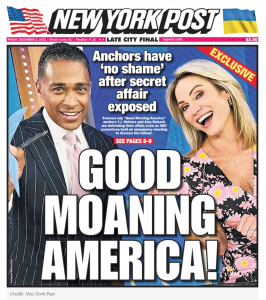
Presumably the moronic media hounding of Good Morning America 3 co-hosts TJ Holmes and Amy Robach is drawing to a close.
Adult coworkers having an affair is not a “scandal” unless they’re cheating on their respective mates, and these two weren’t or at least aren’t. (Both are getting divorced from their previous spouses.) And it was totally ridiculous for ABC news honchos to temporarily pull them off the air.
But before the story evaporates I want to give credit to the N.Y Post for that rude, infantile and rather funny banner headline that surfaced five days ago — a headline in the realm of BRIDE OF JACKOSTEIN, SAM SLEEPS and HEADLESS BODY IN TOPLESS BAR.
All kinds of dark grief (rage, resentment, nihilism, despair, revenge-fixation) can be found in John Lennon‘s “I’llCryInstead,” a rockabilly tune that was written and recorded in ’64. This is a guy who’s been seriously hurt by abandonment and has major issues with rejection. Talk about raw and ragged.
My only quibble is with the line “I’ve got a chip on my shoulder that’s bigger than my feet.” Lyricists can’t compare a searingly negative attitude (a single, stand-alone, everyone-can-go-fuck-themselves “chip”) with a pair of male feet. Different realms, man. HE alternate: “I’ve got a chip on my shoulder that’s weighin’ on my soul / I don’t know if I can take it any more.”
The idea of hiding your feelings when the pain is too great…I was there a couple of times in my mid teens. And of course, “You’ve Got To Hide Your Love Away,” a ’65 Lennon tune, explored this feeling in a Dylanesque way.
Author and musician John Kruth has described “I’ll Cry Instead” as one of Lennon’s “stalker songs”, alongside his other 1964 compositions “You Can’t Do That” and “No Reply”, dealing in themes of separation and uncontrollable jealousy.
Never forget the golden rule of first-look screenings of ambitious CG-rich spectacles — never trust the fanboys. Always, always, always wait for the sourpusses to have their say. If the frown-liners are won over, then you can be fairly sure.
Okay, let’s admit it…it’s probably gonna win the Best Picture Oscar.
James Cameron's #AvatarTheWayOfWater is a monumental filmmaking achievement striking a great balance between technical & emotional. The 48fps 3D experience features some of the most jaw-dropping immersion I’ve ever seen. Felt like a kid again watching T2 for 1st time. Astounding. pic.twitter.com/cfiMADJzU4
AVATAR: THE WAY OF WATER: Yeah never bet against James Cameron. Trying to spare hyperbole, but I’ve never seen anything like this from a technical, visual standpoint. It’s overwhelming. Maybe too overwhelming. Sometimes I’d miss plot points because I’m staring at a Pandora fish
Happy to say #AvatarTheWayOfWater is phenomenal! Bigger, better & more emotional than #Avatar, the film is visually breathtaking, visceral & incredibly engrossing. The story, the spectacle, the spirituality, the beauty – this is moviemaking & storytelling at its absolute finest. pic.twitter.com/RicnpDghrx
AVATAR: THE WAY OF WATER introduces a new water culture on Pandora that is technically wondrous. James Cameron’s dialogue still struggles but his storytelling soars as he emotionally invests us in the new characters & creatures. A sincere, stunning epic that was worth the wait. pic.twitter.com/ZUqdJ4Nawd
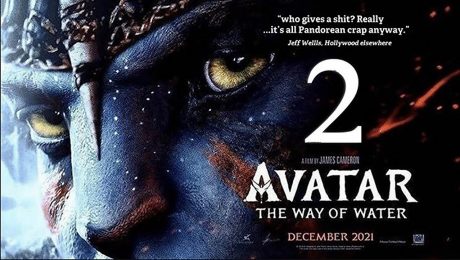
While grateful to HE follower “Iain” for the amusing artwork, I’ve asked for three fixes. One, Capitalize the “w” in “who.” Two, he’s got the date wrong — it reads “December 2021.” And three, my last name is spelled Wells, not “Wellls.”
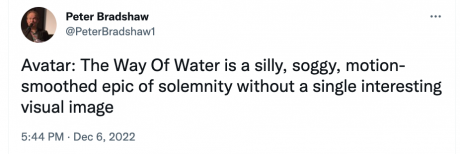
I’m aware that the HE quote is a minority opinion, Peter Bradshaw‘s tweet notwithstanding.
I saw episode 6 (“Abductions”) of The White Lotus last night. The final episode (“Arrivederci”) airs on Sunday, 12.11. And I know one thing. Somehow or some way, I want someone to slap the shit out of Will Sharpe‘s Ethan Spiller character. The wealthy pissant husband of Aubrey Plaza‘s Harper Spiller, Ethan is a downer — always frowning or guilt-tripped or convulsed, disturbed by one thing or another, a drag to hang out with. Every time the camera gazes upon this little shit, I want to punch his lights out. Please…I’m not asking for much. Everyone wants this to happen.
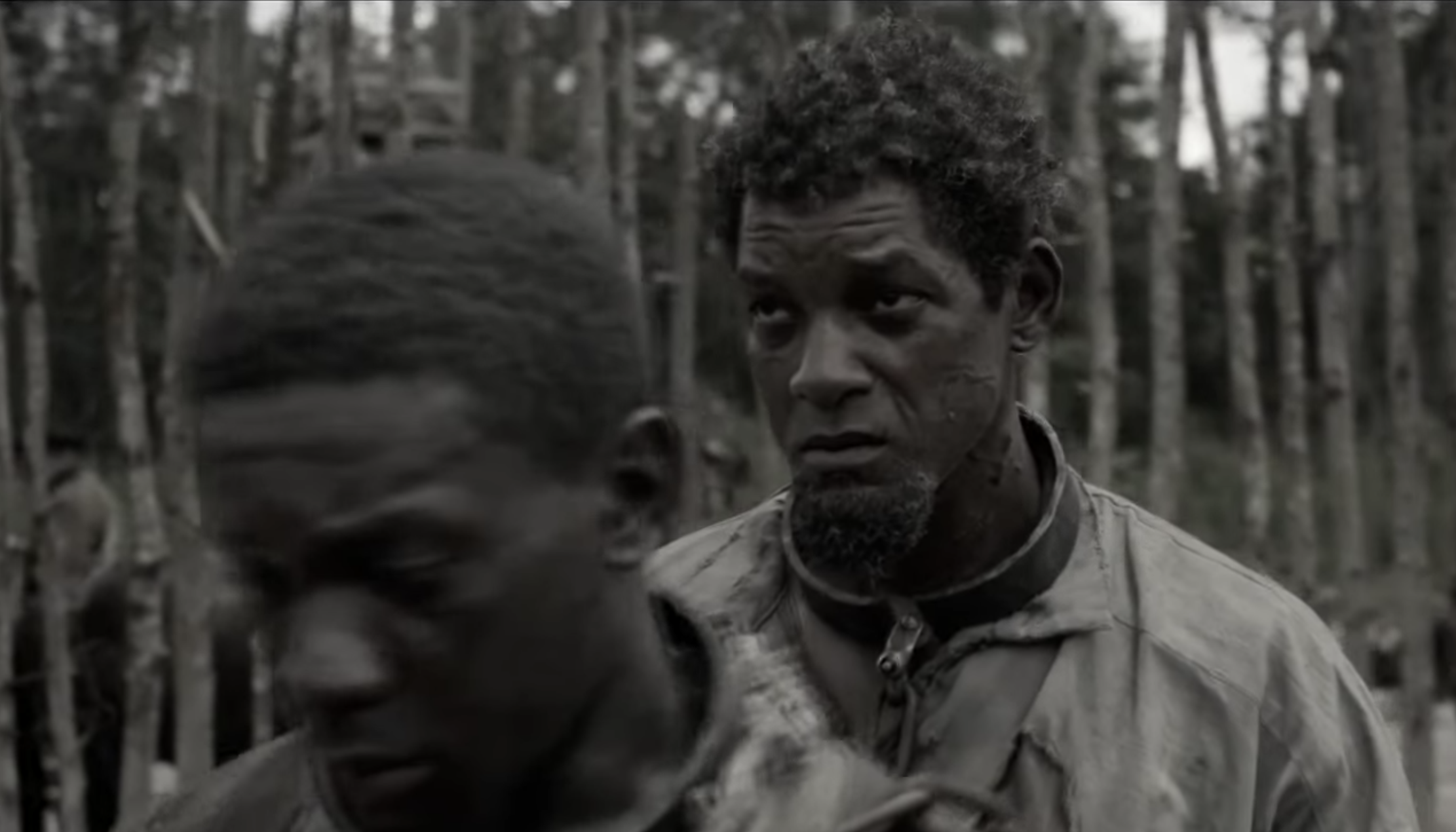
Antoine Fuqua‘s Emancipation begins streaming on Apple+ three days hence (12.9), and I’ll tell you straight and true that it didn’t make me feel miserable. Nor did I find it boring. A fair amount of it is “believable” as far as that concept goes. And Will Smith‘s performance as Peter, a Louisiana slave who escapes from a work camp by running, splashing, wading and rowing his way across endless miles of swamp, is very commendable — there isn’t a single thing that Smith does or says that feels phony or pushed or sentimentalized or…okay, Smith’s Peter is a little Hollywoody.
Smith grew (or pasted on) a chin beard and dropped several pounds to remind us that slaves were almost certainly never well-fed.
There is, however, a thing that’s missing from this 132-minute action film, and that’s any sense of surprise. Nothing happens that you don’t expect to see, or that you don’t see coming from a mile away. Each and every white slave driver (including the top-dog psychopath, played by Ben Foster) is cruel, vicious and repellent as hell. Not to mention bearded and smelly-looking and afflicted with bad teeth (and almost certainly halitosis).
A surprise would have been for one white scumbag to be a little less evil than the others, perhaps a tiny bit guilt-ridden or even briefly, momentarily decent in his treatment of the slaves. But no — every single slaver is pure reprehensible scum. Which they were, of course, but you know what I’m saying…trying for a little originality or the unexpected is always appreciated.
A film such as this (based on fact but fueled by an expected catharsis in which the runaway good guy prevails at the end) is basically about rooting for the gruesome deaths of the scurvy white guys. There’s a slave revolt moment (Spartacus rebranded) that I especially enjoyed. Ditto the third-act moment when Smith murders the black collaborator (a replay of the climactic scene in Django Unchained when Jamie Foxx kills Samuel L. Jackson‘s Uncle Tom. I was puzzled by a scene in which Smith’s left-behind wife Dodienne (Charmaine Bingwa) mutilates herself with a cotton gin, but we’ll let that go.
The basic idea behind Emancipation is “how would it be if it wasn’t Peter but the Philadelphia-born Will Smith suffering as a slave in 1860s Louisiana, and if Smith, being a hot-shot movie star in the guise of a slave, was smarter and tougher and more tenacious than anyone else in the film”…so tough and tenacious that he fights off an alligator while underwater and then kills this growling beast with a sharp knife, just like John Wayne killed that Native American warrior in the first act of Red River.”
But let’s understand that Smith’s bad-ass slave is a satisfying heroic figure — a guy you’re glad to hang with. You don’t want him to die or get captured, and you definitely want him to fight and kill the psychopathic Foster in the third act. You want him, in short, to be Sylvester Stallone in First Blood, and he occasionally rises to that occasion.
But again, there are no surprises. I decided during the film’s first third, at which point I knew that Emancipation would be rife with cliches, that Ben Foster should be attacked by a gator while taking a poop, and then dragged into deep water and drowned and then eaten. Or, failing that, if he could get bitten by a cottonmouth snake and thereby weakened by the venom, leaving him no choice but to lie down in order to gradually gather his strength and is then attacked by a gator and dragged underwater. That would wake you right up — for a venal white character to die not for the sins of racism and cruelty, but because he was unlucky in a damp and dangerous environment.
But at the end of the day I didn’t feel too much hurt from Emancipation. Lots of white-guy hate, but how can anyone say it’s not justified in this context? Justified but not that interesting. But if you watch it with your expectations suitably lowered…if you remind yourself that Fuqua is a genre guy — basically a proficient hack — and there’s no way this film is going to knock anyone out…if you watch it with these understandings, it isn’t all that bad of a sit.
Sidenote: I tried reviewing Emancipation late last week and it just wouldn’t come. I don’t think I cared enough one way or another.
I did, however, admire Robert Richardson‘s desaturated, bordering-on-monochrome color scheme. It would have been ballsier to go with straight black-and-white, of course, but Fuqua doesn’t have that kind of integrity.
I’m out of the Covid woods with a totally normal temperature, but I’m not completely clean and safe to be around (not 100%). The wiser, more sensible thing to do, obviously, is to blow off today’s Avatar 2 screening in Manhattan. (AMC 42nd Street, 1 pm.)
Two days ago my mantra was “oh, Lord, please don’t let it be a wokefest.” Now it’s “oh, Lord, please don’t let the bad guys feel too rote, and please save us from too much of a CG overlay…a semblance of organic reality is absolutely required.”