Blue Suede Vibe

Yesterday Deadline‘s Michael Fleming reported that four contenders were recently screen-tested for the Elvis Presley role in Baz Luhrmann‘s biopic about the relationship between Presley and Colonel Tom Parker (to be played by Tom Hanks).

I’ll tell you right now that three of them aren’t right. Ansel Elgort (Baby Driver, West Side Story) is way too tall and just doesn’t feel like a fit. (Elvis wasn’t a basketball player.) The 32 year-old Miles Teller doesn’t resemble Presley even a little bit, and couldn’t hope to convince as the young Elvis, who began to catch on at age 20 in 1955. And Harry Styles (Dunkirk) bears no resemblance at all.

The 28 year-old Austin Butler (The Dead Don’t Die, the grubby and psychotic Tex Watson in Quentin Tarantino’s Once Upon a Time In Hollywood) seems the most interesting possibility among the four.

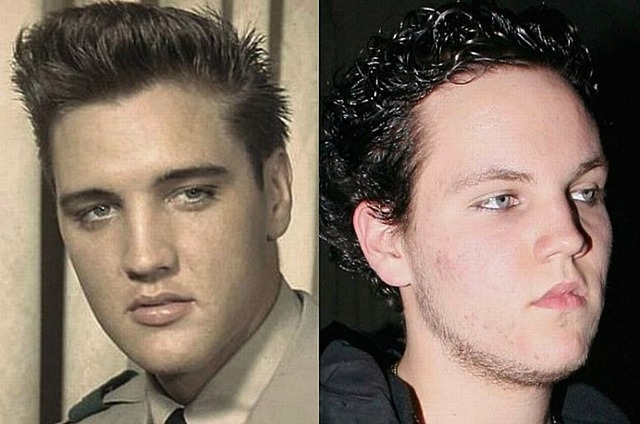
You know who could theoretically rock the role, at least in terms of genetic follow-through? Elvis’s 26-year-old grandson Benjamin Keough, who’s nearly a dead ringer. I’ve no idea if Keough can act or sing or anything, but he’s a chip off the old block.

My all-time favorite Elvis? Kurt Russell in John Carpenter‘s Elvis, a 1979 made-for-TV flick that was well above average.


(l.) G.I. Blues Elvis in ’60; Benjamin Keough.

Membership Assessments

In a 7.1 Hollywood Reporter piece about the hundreds of newly invited members of the Academy of Motion Pictures Art & Sciences, Scott Feinberg says the following about the two main Roma women, Marina de Tavira and Yalitza Aparicio:

“Most would agree that it makes sense to invite people who did excellent enough work to garner Oscar nominations or wins during the most recent awards season. This year, such courtesy was extended to Roma supporting actress nominee Marina de Tavira but not, a bit oddly, to lead actress nominee Yalitza Aparicio, who was eligible for an invite, despite this being her first film role, because of her nom.”

HE to Feinberg: “I’m sure that you and I suspect the same thing. The Academy regards Marina as a serious working actress (screen and stage roles), but they suspect that Yalitza’s performance in Roma was probably a one-off. She was chosen by Alfonso Cuaron because she looked right (those earnest eyes, that aura of innocence and simplicity) and could behave in the right way, which is to say plainly and minimally in the absence of honed acting skills.

“The odds of Yalitza starring or even costarring in another film are…well, who knows? I think it’s fair to say at this stage that she’s more of a ‘type’ than a performer. Her Wikipage reports that she’s “currently enrolled in EF international school in New York City to learn English.”

Svetlana’s Taormina Blastoff

Congrats to HE’s own Svetlana Cvetko on the big, swanky Taormina Film Festival debut of Show Me What You’ve Got, a black-and-white menage a trois love story set in Los Angeles and Italy. Directed, shot and co-written by Svetlana (along with producer David Scott Smith).

The screening happened Tuesday night (7.2, 6 pm). Congrats also to Svetlana for having just been invited to become a member of the Academy. Well deserved.

Jett and I visited this ancient Sicilian town in 2010.

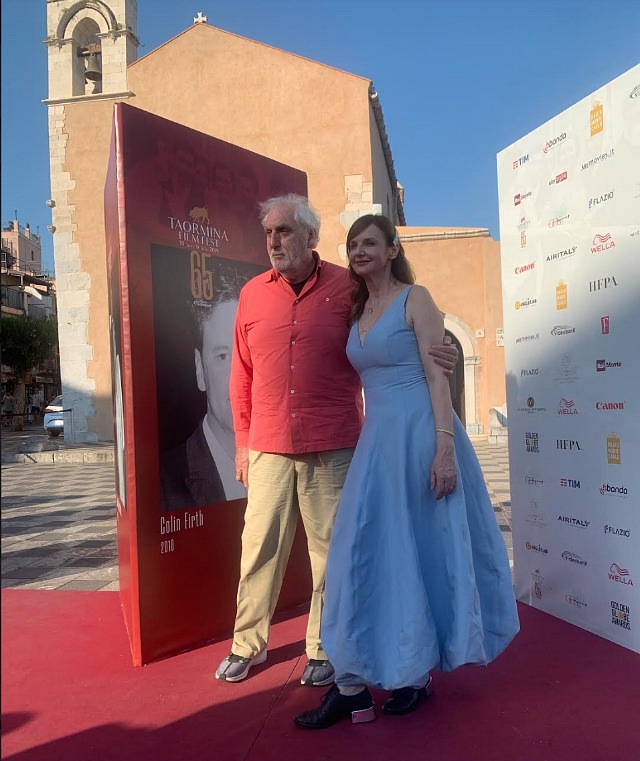
Show Me What You’ve Got director-cowriter Svetlana Cvetko with executive producer Phillip Noyce prior to Tuesday evening’s screening.
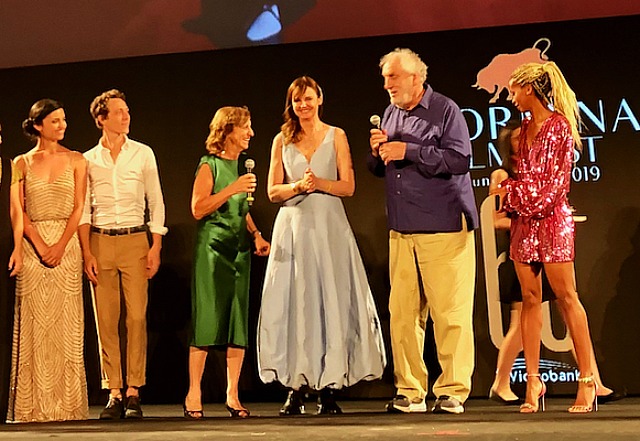
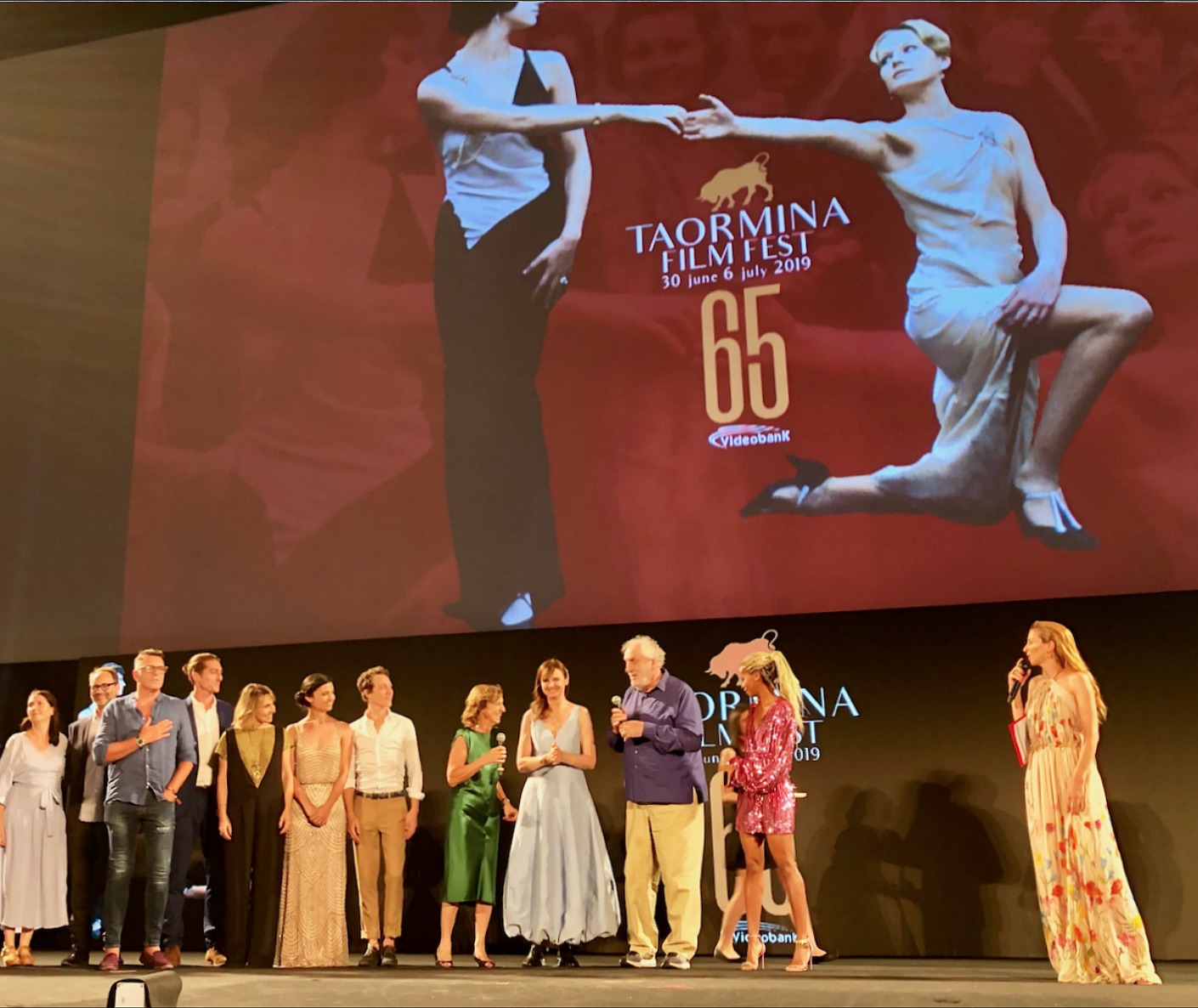
Show Me What You’ve Got director-cowriter Svetlana Cvetko (center) basks in post-screening applause with executive producer Phillip Noyce to her left.

Read more

Son of Horny Ape

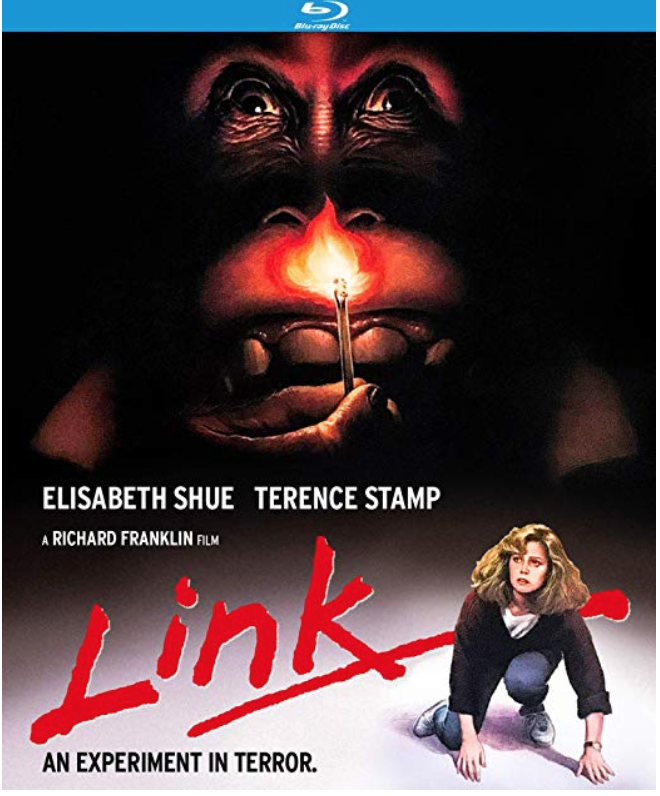
16 months ago I posted about Richard Franklin‘s Link (’86), which is hands down one of my all-time favorite monkey movies. I’m re-posting because I somehow missed the fact that the Kino Bluray came out a month and half ago. I’ve just ordered it. A “4K restoration” with audio commentary by film historian Lee Gambin and film critic Jarret Gahan, deleted workprint scenes, an audio interview with director Richard Franklin.

3.18.18: Nobody remembers Richard Franklin‘s Link (’86), but it was a witty, better-than-decent genre thriller with a nice sense of tongue-in-cheek humor, and shot with a great deal of discipline. Clever, dry, smarthouse. And nobody saw it.

Shot in Scotland in ’85, Link was basically about a watchful, intelligent and increasingly dangerous chimpanzee who develops a sexual obsession for a junior zoologist played by young Elizabeth Shue (who was 22 or 23 during filming).

A Thorn EMI production that was acquired by Cannon, Link costarred Terrence Stamp, was fairly well written by Everett De Roche, and was very carefully composed. Franklin (who died young in ’07) shot it with a kind of Alfred Hitchcockian style and language.

I wrote the Cannon press notes and in so doing interviewed Franklin. The then-39-year-old director worked very hard, he told me, to put Link together just so. Franklin made no secret of the fact that he was a lifelong Hitchcock devotee.

Boilerplate: “Jane, an American zoology student, takes a summer job at the lonely cliff-top home of a professor who is exploring the link between man and ape. Soon after her arrival he vanishes, leaving her to care for his three chimps: Voodoo, a savage female; the affectionate, child-like Imp; and Link, a circus ape trained as the perfect servant and companion.

“A disturbing role reversal takes place in the relationship between master and servant and Jane becomes a prisoner in a simian house of horror. In her attempts to escape she’s up against an adversary with several times her physical strength, and the instincts of a bloodthirsty killer.”

I helped out with Link screenings at Cannon headquarters on San Vicente Blvd., and I remember playing The Kinks “Ape Man” (a portion of which is heard in the film) as a kind of overture for invited guests.

Terrence Stamp, who starred in Link, told me during a Limey interview in ’99 that Franklin was very tough on film crews.

Read more

Zappy “Current War” Is Mandatory Viewing

A little more than two years after its debut at the 2017 Toronto Film Festival, Thomas Gomez-Rejon‘s The Current War (101 Studios, 10.4) is finally set to open commercially.

But don’t wait for streaming. It may sound hackneyed to say this, but Chung Chung-hoon‘s striking, ultra-widescreen compositions really need to be appreciated on a large screen. The bigger, the better.

The film was originally scheduled to be released on 12.22.17 by The Weinstein Company, and then the sexual abuse allegations against Harvey Weinstein shut the whole project down. After 18 months of hibernation and reflection, The Current War was acquired last April by 101 Studios for $3 million. Gomez-Rejon has added five additional scenes and trimmed ten minutes from the runtime. It will open later this month (7.26) in the UK but not stateside until October.

Original 9.10.17 HE review: “The Current War is an eccentric, visually unconventional period drama — that much is certain. 

The movie is basically an AC/DC thing — the battle between direct vs. alternating currents of electricity in the late 1880s and early 1890s, or a stab at creating compelling drama out of a battle of opposing modes and strategies for providing electricity to the public. 

This in itself, especially in an era of increasingly downscale if not submental approaches to mass entertainment, is highly eccentric. But the tone of inspirational strangeness doesn’t end there.

The DC team was led by genius inventor Thomas A. Edison (Benedict Cumberbatch) while the AC approach was steamrolled by engineer-businessman George Westinghouse (Michael Shannon) with a late-inning assist from genius Serbian inventor Nikola Tesla (Nicholas Hoult).

This is fine as far as histrionic line readings, personality conflicts and eccentric facial-hair appearances are concerned, but an especially striking visual style from South Korean dp Chung Hoon-Chung (It, The Handmaiden, Me and Earl and the Dying Girl) compounds the fascination.

In an attempt to reflect the unusual, headstrong mentalities of Edison and Westinghouse, Gomez-Rejon and Chung have gone with a kind of early ’60s Cinerama approach to visual composition — widescreen images, wide-angle lenses and a frequent decision to avoid conventional close-ups and medium shots in favor of what has to be called striking if not bizarre avant-garde framings in which the actors are presented as smallish figures against dynamically broad images and vast painterly landscapes.

The look of The Current War, in short, closely resembles the extreme wide-angle compositions in 1962’s How The West Was Won.

Read more

Let Me Guess

When you’re rehashing an Agatha Christie whodunit that could just as well be called “Who Killed The Haughty, Flinty Patriarch During His 85th Birthday Party?”, there aren’t that many ways to go. As the various members of the rich Thrombey family are all cynical, hard-edged, “who gives a shit?” types, it can probably be assumed…naaah, let’s not. But what are we to think when the Hercule Poirot-ish detective (Daniel Craig‘s “Benoit Blanc”) announces that no one can leave the family mansion as one of them is the murderer? My first thought, naturally, was “they all did it simultaneously” but director-writer Rian Johnson wouldn’t dare. Would he?

Christopher Plummer plays the elderly dead Thrombey; the living descendants and their spouses are played by Chris Evans, Jamie Lee Curtis, Toni Collette, Don Johnson, Michael Shannon, Katherine Langford, Jaeden Martell. Sidenote #1: Craig is looking a bit creased and weathered. Sidenote #2: All hail Lakeith Stanfield, but not so much his moustache.

Joe’s Post-Debate Backslide

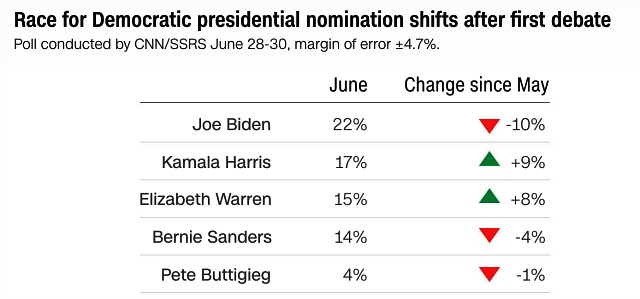
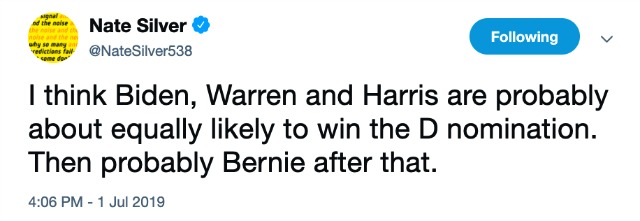
Among the Democrats and Democratic-leaning independents polled last weekend for CNN, roughly one in five prefers the amiably liberal Joe Biden as the 2020 Democratic nominee. Slightly more than 20% — that’s all.

Kamala Harris is running second at 17% while 29% prefer the more emphatically progressive Elizabeth Warren (15%) or Bernie Sanders (14%). Combine Harris, Warren and Sanders’ percentages (46%) with Pete Buttigieg‘s 4% and you’ve got 50% of Democrats preferring someone other than Biden.

Typewriter Joe has dropped 10 points since the last CNN poll in May; Harris is enjoying a 9-point increase; Warren is up by 8 points. The usual usuals comprise the Joe team — black voters (36%), older voters (34%) and moderate and conservative Democrats (31%).

“Cold Case” Approaching

Park City posting on 1.29.19: “Mads Brugger‘s Cold Case Hammarskjöld (Magnolia, 8.16) is one of the most original-feeling investigative docs I’ve ever seen.

“It begins as an investigation into the 1961 plane-crash death of UN General Secretary Dag Hammarskjöld, which happened, we gradually learn, at the hands of colonialist bad guys. The film is about how Brugger, who casts himself as a kind of whimsical, not-quite-Hercule-Poirot-level investigator, and colleague Goran Bjorkdahl gradually uncover what happened.”

Cold Case Hammarskjöld “represents a sideways shuffle approach to discovering long-buried bones and nightmares. It is, in fact, an eccentric film, and yet the things it discovers are real and beyond ugly. It’s the mixture of curious whimsy and malevolent apartheid schemings that gives Cold Case Hammarskjöld a tone of spooky weirdness.

“Suffice that Brugger comes to believe (and in fact persuades) that Hammarskjold’s plane was shot down by Belgian-British mercenary pilot Jan van Risseghem, who was apparently doing the bidding of some ugly fellow who were angered by Hammarskjöld’s sympathy for African nativist independence movements.” — posted from Park City on 1.29.19.

She Who Gets Slapped

Meryl Streep to Nicole Kidman: “Whadaya call that? Foreplay?”

Later: “I’m worried about the boys. Because you seem unwell, erratic. You hit me. You snapped. I think you need to take some real time to heal, and while you do that, I think Max and Josh should reside with me. You’re a mess, Celeste. And until you’re better, we need to think about protecting the well-being of our boys. They’re at risk here. They’re at risk in your care.”

Although Streep’s Mary Louise character is being presented as a needling, malevolent presence (which she is as far as the fate of the “Monterey Five” is concerned), she’s the only character on Big Little Lies whose company I enjoy.

Del Amo Effect

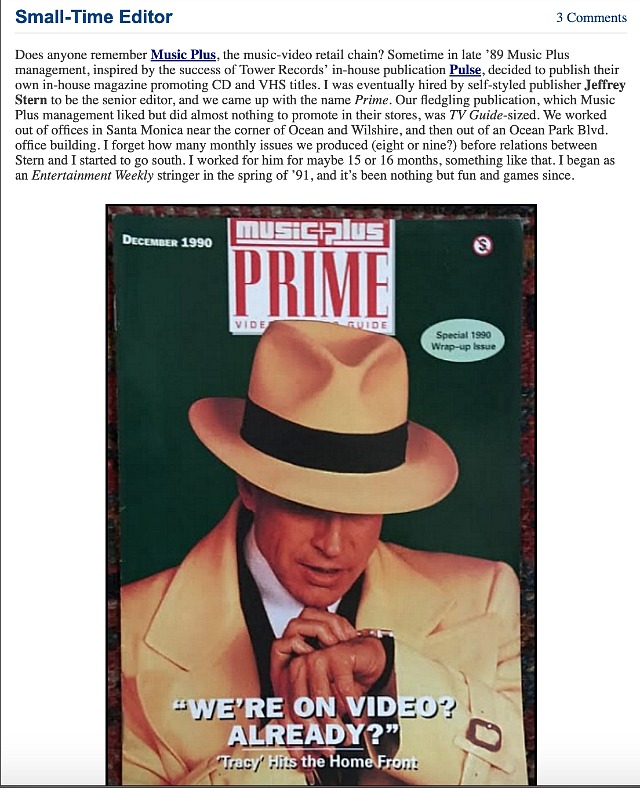
Between late ’89 and early ’91 I was senior editor of Prime, a Music Plus-founded monthly that promoted CD and VHS titles. In early ’90 we decided we needed an art director for our TV Guide-sized publication. I interviewed six or seven people. My favorite applicant was a youngish, dark-haired, prim-looking woman whose name escapes. I “liked” her graphic design samples — not brilliant but they had a certain elan and consistency. She looked a bit like Tulsi Gabbard does now. Not a top-tier X-factor creative, in my view, but what could I expect given the modest salary we were offering?

I told my boss, Jeffrey Stern, and an assistant editor, Jake Stihl, that she seemed like the best of the lot. Having reviewed her “book” and resume and sized her up to a certain degree, they told me they agreed. All signs favoring. But a day or two later I had a follow-up phoner with Tulsi, and she told me she lived directly opposite the Del Amo Fashion Center in Torrance.

That jolted me some. I thought about it again after we hung up. I couldn’t get Del Amo out of my head. The next day I decided that Tulsi wasn’t a good fit. Stern and Stihl, taken aback if not open-mouthed, asked why. I knew my reasoning would sound odd to them, but I did my best:

“Because a person who really believes in creativity, which is to say someone living a little bit on the edge and always looking for inspiration of whatever sort, be it atmospheric or cultural or spiritual…a person who’s seriously invested in some kind of artistic pursuit and wants to be in a good position to pick up signals about whatever the next thing might be…that person would never live opposite the Del Amo Shopping Center,” I said.

“Jeff…c’mon,” Stern said. “Her stuff is good.”

“Hear me out,” I replied. “I like Tulsi and recognize that she’s at least moderately talented, but it really bothers me that she chose to live in what I feel is a toxic environment. Deliberately. The vibes that come out of Del Amo are oppressively bland. Mega-malls inspire passivity. They’re about trying to lull people into a state of submission in the same way that Las Vegas, Cancun and Disneyland do.

“It would be one thing if Tulsi lived a mile or so from Del Amo…fine. But directly opposite it? Graphic artists worth their salt live near the beach or in Koreatown or Silver Lake or Studio City or Venice or Burbank or Van Nuys…any one of dozens of Los Angeles towns wouldn’t prompt a raised eyebrow in this context. And yet Tulsi chose to inhale those Del Amo vibes on 24-7 basis, and that tells me that on some level that her ideas will be less than they should or could be.

“I’m sorry but something in my gut is genuinely unsettled about this. I would honestly feel better about hiring her if she was homeless and living in her van. To me Del Amo is poison.”

This was eight years before Quentin Tarantino‘s Jackie Brown, of course. That 1998 film lent a vague aura of mock-ironic coolness upon Del Amo, I guess. Maybe I’m just projecting.

16% POC Membership Ain’t Hay

Of the 842 new members invited to join the Academy of Motion Picture Arts and Sciences, half are women and 29% are people of color. The Academy has thereby doubled the percentage of nonwhite members over the last four years. In 2015, people of color accounted for 8% of Academy members. In 2019, that percentage has doubled. As it stands, the Academy counts 8,946 active members. The total membership including retired members is 9,794.

Quality, Not Quantity

In a view from a spring research screening, it is claimed that Marielle Heller‘s A Beautiful Day in the Neighborhood (Sony, 11.22) “works when it focuses on Tom Hanks as Fred Rogers. He’s undeniably charming and infectiously heartwarming as the TV icon. He nails the spirit and voice of Rogers, and the physical resemblance is close enough.”

Not a surprising opinion as pretty much everyone agreed that Hanks was perfectly cast, and that inhabiting Rogers wouldn’t involve much of a stretch.

The viewer also asserts, however, that Hanks’ performance “will be regarded as supporting since he’s absent throughout the majority of the third act, due to a focus on Matthew Rhys‘ journalist character and his relationship with his dying dad.”

Be that as it may, a lead actor is rarely defined by his/her amount of screen time , but the degree to which he/she dominates the narrative. Remember that Anthony Hopkins‘ Best Actor Oscar for The Silence of the Lambs resulted from only 16 minutes of screen time.

“Either way, Hanks could finally be looking at his first Oscar nomination in almost 20 years,” the guy goes on. “The film is emotional and could be in the running for a Best Picture nomination if there are no issues over the size of the Rogers role. I’d also keep an eye on Marielle Heller for Best Director. Her direction keeps the movie enchanting even when the script runs into some dicey passages, and it’s time for another female director nomination.”