Revisiting Schlondorff Epic

Brad Anderson‘s Beirut (Bleecker Street, 4.11) is a gripping, finely crafted adult war drama of the highest order — exactly the kind of smart, disciplined thriller (91% Rotten Tomatoes rating) that I live for.

Set in Lebanon’s war-torn capital in the early ’80s, it’s about a former U.S. diplomat (Jon Hamm) returning to Beirut to help save a kidnapped friend from way back. All kinds of danger, intrigue, suspicion. My idea of a truly satisfying, adult-level war drama. Hamm savors his meatiest, best-written role since his Don Draper days in Mad Men, and gives the best big-screen performance of his life. Really.

Earlier today I was speaking with Beirut’s producer-writer Tony Gilroy, the legendary director-screenwriter (Michael Clayton, Duplicity, The Bourne Legacy) who arguably saved Rogue One from disaster by coming in with a big rewrite and then directing new portions.

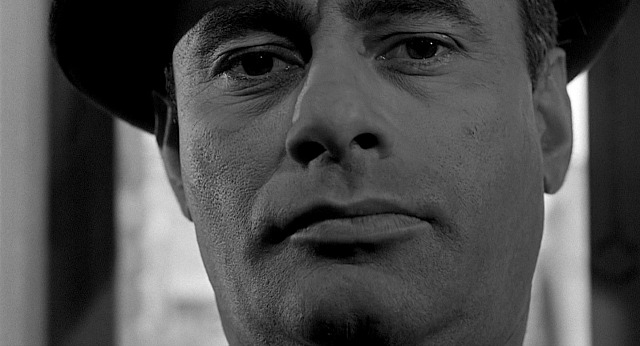
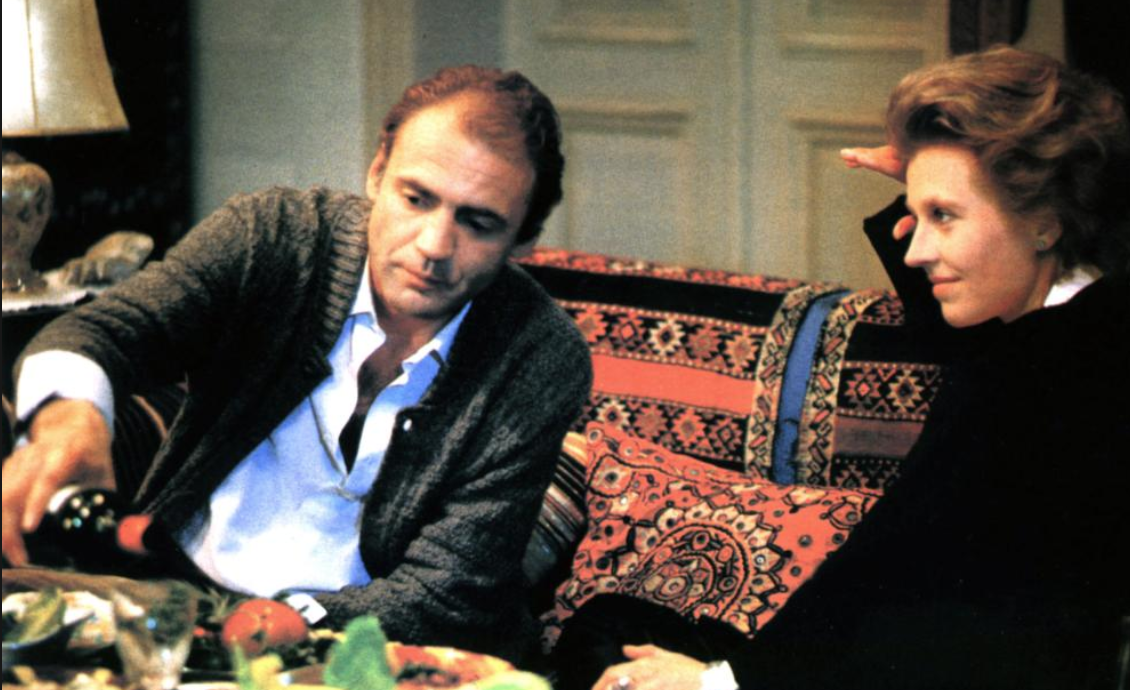
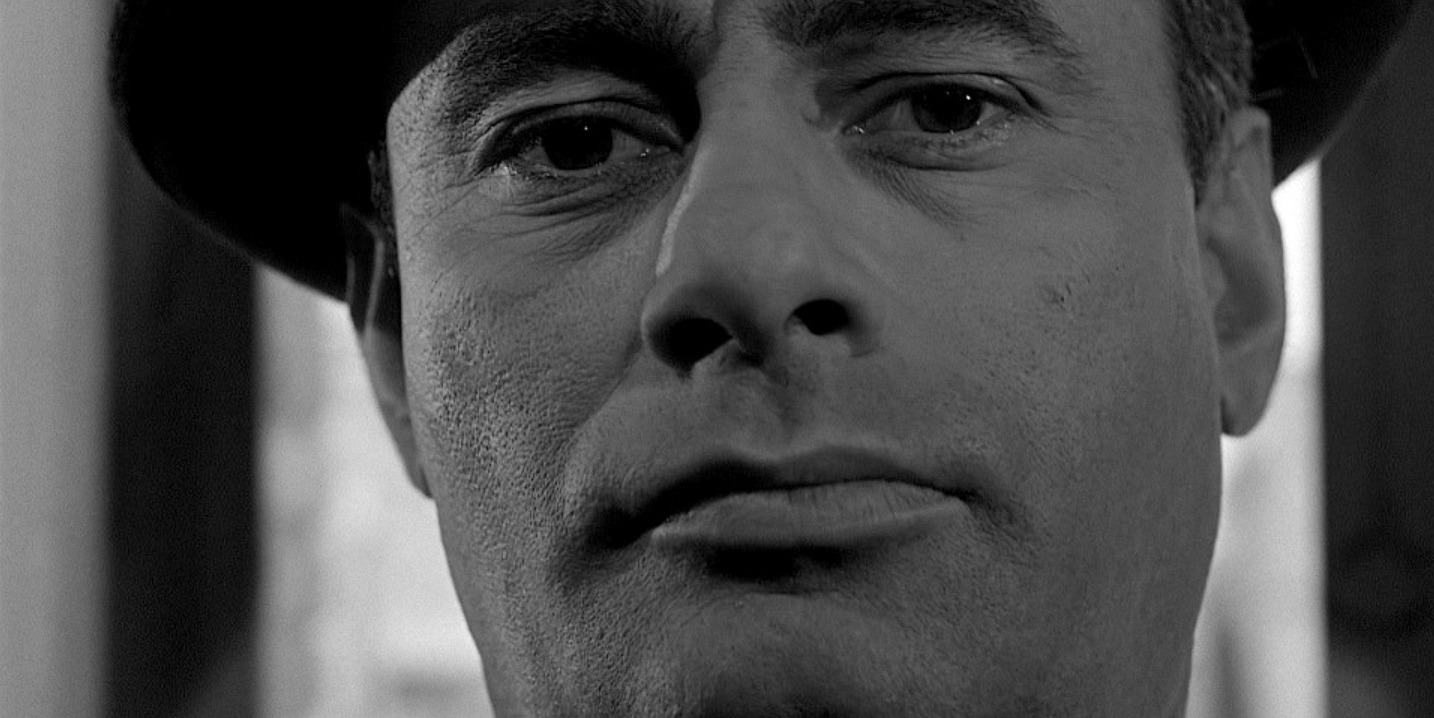
Halfway through our chat Gilroy mentioned Volker Schlondorff‘s Circle of Deceit (aka Die Fälschung), a 1981 drama that was shot in Beirut as the Lebanese civil war was raging blocks away. He insisted that I see it at the earliest opportunity.

Gilroy’s first viewing of Circle happened in the early ’90s, when he was working on the Beirut script (a task that took him a full year) for Ted Field‘s Interscope. He says he spoke to the projectionist after Circle ended, and that the projectionist said “what was that?”

The film costars Hanna Schygulla as Ganz’s temporary lover and Jerzy Skolimowski (director of Deep End, Moonlighting, The Shout) as his journalistic ally.

I rented a standard-definition version of Circle of Deceit on Amazon, and plan on watching it by the weekend.

Circle follows a German journalist (Bruno Ganz) sent to Beirut to report on the Lebanese Civil War. The conflict began in ’75, took 120,00 lives and generated an exodus of a million residents, and didn’t end until ’90. Circle was filmed in 1980 “under remarkable conditions with its crew confined to ‘safe’ portions of Beirut while the fighting went on elsewhere, but with ubiquitous evidence of real warfare everywhere.”

The New York Times described it as “a balanced, thoughtful, extremely moving vision of wartime tragedy.”
Read more

After 45 Years, “Wind” Team Needs Cannes Celebration

A lot of people will be trashing Netflix if they fail to cut some kind of arrangement with the Cannes Film Festival and wind up yanking five films from the festival slate, including Orson WellesThe Other Side of the Wind, Alfonso Cuaron‘s Roma and Paul Greengrass‘s Norway.

The near-final answer will come on Thursday, 4.12, when the festival announces the 2018 slate. Yes, there are always add-ons but who knows?

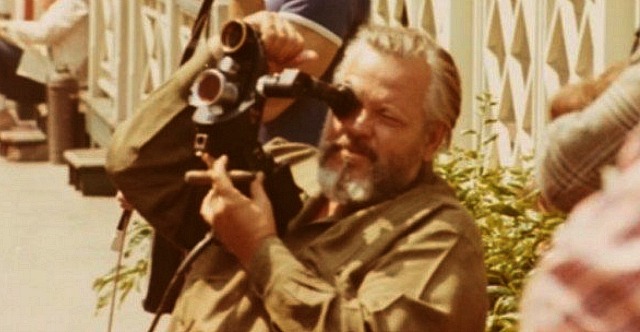
One guy who is speaking well of Netflix is author, screenwriter, former Variety critic and Other Side of the Wind costar Joseph McBride. The SF State University film professor plays a film critic, Charles Pister, in the Welles film, and not for some walk-on cameo. McBride went before the cameras for a six-year period during production on The Other Side of the Wind, from the early to mid ’70s, and had actual lines. Anyway, he recently posted the following on Facebook:

“There’s been a big flap over how villainous Netflix supposedly is threatening to withdraw its films from Cannes, including Orson Welles’s nearly completed The Other Side of the Wind and Morgan Neville’s companion documentary, They’ll Love Me When I’m Dead (both of which I am in).

“Netflix stepped up to the plate after Steven Spielberg, George Lucas, Clint Eastwood, Oliver Stone, Roger Corman and everyone else in Hollywood passed up the opportunity to finish The Other Side of the Wind. For that alone Netflix [deserves] the eternal gratitude of film history. They are heroes in this saga. As I wrote, it was my idea to bypass theatrical after two decades of futility, so people can blame me for that, but if not for Netfix the film would still be in cans in the Paris lab. Kudos to the producers for making this finally happen and to Netflix for supporting it so generously.

HE response to McBride: Netflix definitely stepped up and saved this film, but at the end of the day we all know that a Netflix streaming berth, though welcome, has a certain arid component. I’m sure you agree that a big whoop-dee-doo Cannes Film Festival debut of The Other Side of the Wind will provide a much-needed moment of emotional satisfaction — completion, closure — for all the players (including Peter Bogdanovich) who’ve been involved for so many decades.

You know that the ghost of Orson Welles will definitely be watching and perhaps even raising a glass a la Celeste Holm at the end of A Letter To Three Wives.

Read more

Can’t Trust A Trailer

Okay, I’ll admit that this new trailer for Ron Howard‘s Solo: A Star Wars Story (Disney, 5.25) sells you on the possibility that the film itself might be half-tolerable, and I’ll admit that the naturally glum, Prius-driving Aldenreich exudes a certain devil-may-care je ne sais quoi. I’ll give you all that. But he’s still four inches shorter than Harrison Ford, and his eyes are a lot smaller than the Real McCoy’s. Donald Glover‘s Lando Calrissian feels fine, but he sure as hell isn’t related to the “old smoothy” played by Billy Dee Williams.

If You Don’t Love Mistakes…

Either you’re the kind of movie hound who loves seeing the helicopter shadow during the opening credits of The Shining, or you’re not. If you don’t enjoy this kind of thing, fine, but Hollywood Elsewhere adores it. Ditto the pancake on Martin Balsam‘s face in Psycho, the kid plugging his ears in North by Northwest, etc. Because I watch films in a dimension outside of “suspension of disbelief.” My attitude is “I am suspending disbelief in my suspension of disbelief, and therefore I’m a free man on this train.” What are the other biggies that I’m missing?


Helicopter shadow is viewable only by watching a 1.37:1 version of Stanley Kubrick’s The Shining. HE to Leon Vitali: Any chance Warner Home Video will stream a 1.37:1 version?

Read more

Major Bradley Cooper Factor in ’18 Best Picture Race

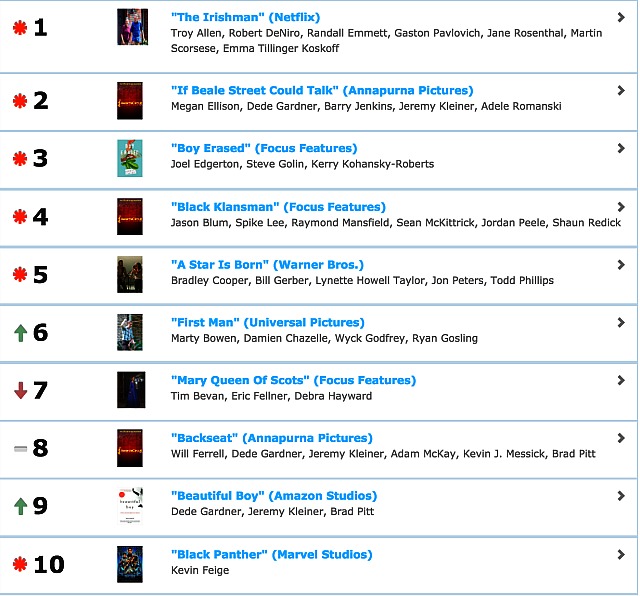
A week ago Awards Circuit editor Clayton Davis posted a 2018 Best Picture spitball chart.

Reps for director Martin Scorsese have insisted that The Irishman won’t open later this year due to extra time being needed to digitally de-age Robert De Niro and others in the cast. “Scorsese and Netflix may or may not be back in the fray with The Irishman,” Davis allows. “The IMDB has it listed for 2019 but [many] believe that if the quality is there and competition is thinning, Netflix will go for its first Best Picture nomination after missing out with Mudbound last year.”

If — I say “if” — The Irishman decides to jump in at the last minute it immediately becomes the Big Kahuna of Best Picture contenders. The Scorsese stamp, the super-sized budget and the old-guy star power (DeNiro, Pacino, Pesci) will immediately establish dominance.

I said the other day that competing heavy-hitters will include Barry JenkinsIf Beale Street Could Talk, Adam McKay‘s Backseat, Spike Lee‘s Black Klansman, Josie Rourke‘s Mary, Queen of Scots, Damien Chazelle‘s First Man, Steve McQueen‘s Widows, Bryan Singer and whatsisname‘s Bohemian Rhapsody, David Lowery‘s The Old Man and the Gun, Richard Linklater‘s Where’d You Go, Bernadette?, Mimi Leder‘s On The Basis of Sex, Bjorn Runge‘s The Wife and Jason Reitman‘s The Front Runner.

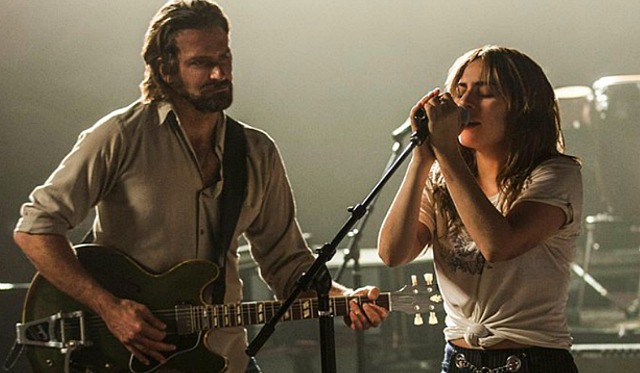
A very strong voice within is saying “no, no, a thousand times no” to Bradley Cooper‘s A Star Is Born (Warner Bros., 10.5), sight unseen for obvious reasons. Yes, the combination of New Academy Kidz and Lady Gaga fans could turn it into a contender and yes, Sean Penn says he loves it, but my God, the prospect of sitting through this film gives me the willies. To Boy Erased I say “really?”, and to Beautiful Boy I say “meth addiction?”

Read more

Don’t Kid Yourself

The same thing is happening in Hollywood. To me, I mean. As a columnist friend put it a couple of months ago, “The voracious corps — Penske Media, Hollywood Reporter, TheWrap, Vulture, N.Y. Times and a few others — is trying to vacuum up every advertising penny in the sector and drive all competitors out.”

From “Introducing HE:(plus),” posted on 2.27.18: “Award-season ad revenue is finite, and over the last two or three years the big gobble guys have muscled their way into the banquet room like the Al Capone mob. They’ve been throwing their weight around and sucking up the oxygen and indirectly eating me (and others I could mention) alive, no lie.

“Plus the new whiz-kid agency buyers are, like their forebears of a decade ago, interested only in numbers and page-views, and not in HE’s sui generis cosmology as well as its longtime award-season selling point — not just numbers but the quality of industry eyeballs — the coolest directors, producers, screenwriters, Academy members, agency guys, ubers, early adopters, grumpy know-it-alls, etc.

Read more

“Never?”

Nately: What are you talking about? America’s not going to be destroyed.
Old Italian Man: Never?
Nately: Well…
Old Italian Man: Rome was destroyed. Greece was destroyed. Persia was destroyed. Spain was destroyed. All great countries are destroyed. Why not yours? How much longer do you think your country will last? Forever?
Nately: Well…forever is a long time, I guess.
Old Italian Man: Very long.

Watching this scene resonates because it’s been 49 years since this scene was shot, and 74 years since the occupation of Italy by U.S. forces. And because the old man (i.e., Marcel Dalio, the croupier in Casablanca) is sounding wiser and wiser these days.

If Art Garfunkel‘s Nately could see into the future, the answer to the old man’s question would have been as follows: “Well, America will start to eat itself in 2016 with the election of a bestial authoritarian demagogue as President, and with subsequent polls showing that between 35% and 40% of registered voters actually support this animal, largely due to his having exploited racial paranoia and resentment over perceptions that America’s European Anglo-Saxon heritage is being flanked and overwhelmed by persons of African and Middle-Eastern ancestry. Along with their agreement with his view that climate change is fiction. And this will be the beginning of a period of crazed American xenophobia, and from this will come eventual destruction.”

Read more

Not So Fast, Team Wakanda!

With $665,355,740 in domestic earnings thus far, Black Panther is obviously a huge, historic, worldwide phenomenon. But it’s not a Titanic beater, and it probably never will be. And currently it’s not the all-time third highest grosser either. Not by inflationary standards, it’s not.

By the close of ’98 Titanic ended up with $600,788,188. If you add the nearly $58 million haul for Titanic 3D, which was released in 2012, the lifetime domestic gross is $659,353,944. But let’s stick to the ’97 and ’98 earnings.

The 2018 dollar is 52.8% higher than the 1998 dollar. $100 in 1998 is equivalent to $152.76 in 2018, and so Titanic‘s initial haul of $600,788,188 translates into $917,735,286 by current monetary standards.

After saluting Black Panther this morning as “the number 3 movie of all time in the U.S.,” Showbiz 411‘s Roger Friedman speculated that it might hit $700 million before it’s done. If that milestone is achieved, Black Panther will be $217,735,286 behind Titanic‘s domestic ’98 tally. By inflationary criteria.

Titanic‘s worldwide earnings (including the 2012 3D re-release) are at $2,187,463,944 — i.e., roughly $2.2 billion, and at least 90% of that was earned in ’98. Right now Black Panther‘s worldwide tally is at $1.3 billion, or $1,2999,855,740.

Windmills

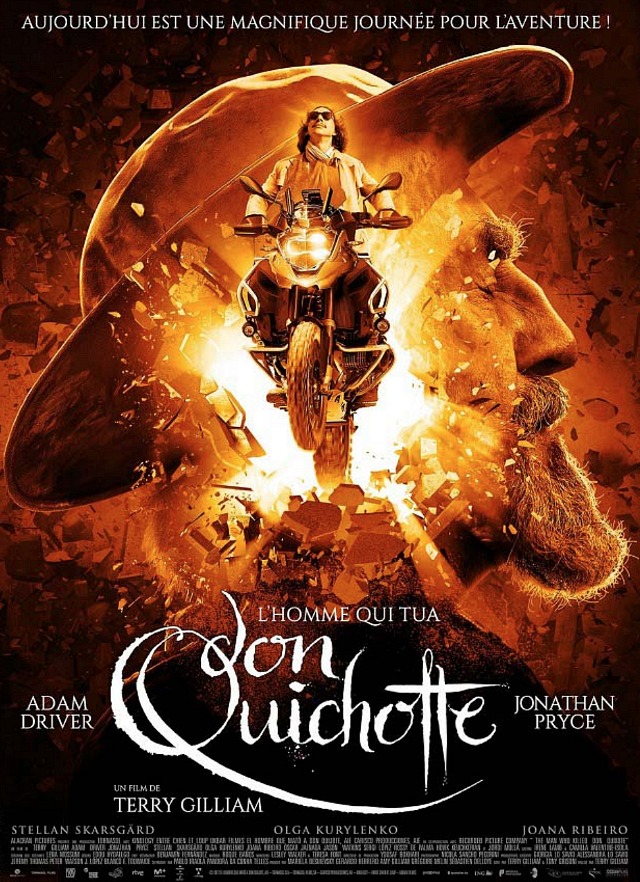
I’m sorry but I like the poster more than the trailer for Terry Gilliam‘s The Man Who Killed Don Quixote. The poster kills; the trailer is a “hmmm, yeah.” I’m doubly sorry that Gilliam won’t be able to screen his long-gestating film in Cannes next month, due to a lawsuit with Portugese producer Paulo Branco. Costarring Jonathan Pryce, Adam Driver, Stellan Skarsgård, Olga Kurylenko, Joana Ribeiro. Who remembers Lost in La Mancha? It doesn’t feel like it popped 16 years ago, but it did.

Read more

On The Other Hand…

Eric Kohn‘s 4.7 Indiewire piece about the Netflix-vs-Cannes brouhaha mentions a significant point, which is that a law overseen by France’s culture minister requires 36 months between a film’s French theatrical release and its streaming debut. So if Netflix were to theoretically commit to theatrical openings this year for its five films slated for the 2018 Cannes Film Festival, the company wouldn’t be able to stream them in France until 2021. That is beyond absurd. A six-month window would be more like it.

Kohn and Anne Thompson‘s latest Screen Talk:

Can’t Wait To Be Bludgeoned

…into submission by this thing, sitting there in my seat and getting pounded, elbowed, waffle-ironed and slam-banged for 156 minutes. And it’s all about perks, pomp and paychecks…an army of filmmakers hauling it in, and not so much as a taste for Hollywood Elsewhere. This movie will do nothing but sap and impurify my precious bodily fluids.

Menace to Cinematography

I’ve been wondering all my life why Orville Nix was so far from the Presidential motorcade when he captured his crappy footage on 11.22.63. The motorcade route was widely known, having been published in the local papers. Why was Nix so far away from Elm Street, a half-block to the north? Nix just before the big moment: “I can hear the motorcade coming. It’ll be coming down Elm any second now, but I don’t want to get too close. It’ll make for a better shot if I can capture the whole panorama. True, I won’t get a closeup or even a medium shot of the President and Mrs. Kennedy, but the grass and the asphalt road and the trees and the blue sky are just as important, if not more so.”

And what about that gifted cinematographer Abraham Zapruder? He wasn’t aiming his 8mm camera properly, and so most of what he captured was above the JFK limousine. In fact Zapruder almost managed to miss the grisly Kennedy head shot. 85% to 90% of the image is about Dealey Plaza grass — 10% or 15% of the Zapruder image, at most, shows the limousine and its occupants. Zapruder just barely captured what happened. He nearly missed it entirely.

Zapruder and Nix were typical suburbanites with typical photographing skills. Both clearly believed in the importance of touristy wide shots, and had no apparent use for MCUs or close-ups. If only someone with a knack for decent framings had been on the scene. If young Steven Spielberg, 16 or 17 years old at the time and visiting Dallas with his mother for some reason, had been at the base of the grassy knoll and shooting with an 8mm Kodak wind-up, history would have been in his debt.