Ice In His Veins

Is there anyone more efficient at throwing shade upon the human condition than Michael Haneke? The white-haired, 70something Austrian director is as brilliant as they come, but he’s one cold surgical fuck. Haneke is a humanist at heart, but there’s something almost Josef Mengele-like about the vibe in his films.

Happy End, his latest, focuses on a wealthy family based in the Calais area, and how their inability or disinterest in getting beyond their insularity and self-absorption has led to a barren environment defined by lies, deception, self-loathing, alcoholism, decrepitude and a persistent longing for death on the part of the 86 year-old George Laurent (Jean Louis Trintignant).
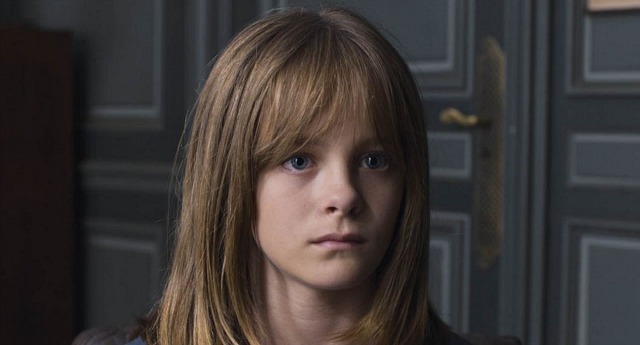

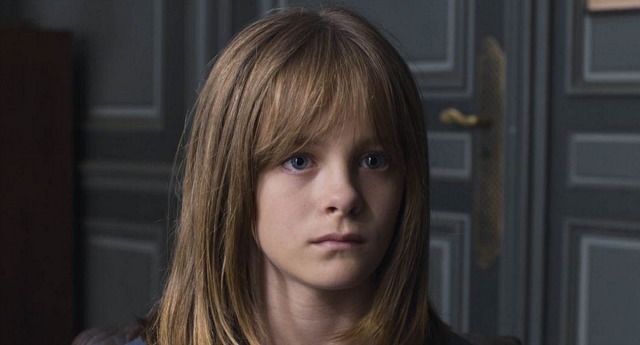
Happy End costar Fantine Harduin, who for my money has delivered the biggest breakout performance of the 2017 Cannes Film Festival.

The general reaction to Haneke’s Happy End, which I saw last night, is that the second half is better than the first. Make that the final third, or more precisely the last 20 or 25 minutes.

The other consensus view is that Happy End wouldn’t be much without two major performances, first and foremost Trintignant’s as the pater familias and financial kingpin who despises old age and longs for death, and secondly Fantine Harduin‘s as Eve Laurent, George’s attuned and quietly alarmed granddaughter.

Without these two characters Happy End would be too clinical and repellent to think about, much less recall. Let’s just bypass the parts that don’t focus on these two. Because the other characters, for me, felt like “who cares?” distractions, which is to say none at all.

But I’m telling you that Harduin has “it” — that mesmerizing, X-factor, can’t-take-your-eyes-off quality. She’s as much of a comer as Logan‘s Dafne Keen.
Read more

Few Drops More Of Alien Hate

With Alien: Covenant now playing nationwide, please re-consider my 5.7 review and let go with whatever agreements, disagreements or left-field reactions are stirring inside:

“All I can figure is that [director] Ridley Scott, 79, is white-knuckle terrified of appearing to be insufficiently attuned or otherwise out of synch with the demands of the big studios, with the movie culture of 2017, and particularly with what the megaplex idiots want when they pay to see one of these fucking films. And so he’s thrown everything slimy and gooey and pulsing that he can think of to make Alien: Covenant seem, by the aesthetic standards of your 2017 sensation monkey, intense and scary and mystifyingly cool.

“I was silently screaming at Scott, ‘I don’t give a fuck about any of this shit…I just wanted some kind of clever reboot of Cameron’s Aliens, and instead you’re heaping on godawful fucking backstories involving species creation and engineers (those awful, AWFUL bald-headed, seven-foot-tall Mr. Clean-type guys from Prometheus) and all your xenomorph variations.’

“I wanted to see both versions of the Michael Fassbender droids (the creepy David vs. the ostensibly more rational-minded Walter) fed into a giant actor grinder and ground up into synthie mulch. And on top of everything else Scott doesn’t even kill Danny McBride?

“The dense and labrynthian plotting virus that infected Prometheus (the work of the absolutely despised & demonic Damon Lindelof along with the skilled but opportunistic Jon Spaihts) has been inherited by A:C screenwriter John Logan, and obviously embraced by Scott. Last night this virus got into my system, and now I have an alien fetus growing inside me, right now.”

Thank God I’m Not Drinking

Early last evening I saw Michael Haneke‘s Happy End, another of his icy, misanthropic meditations about the corroded human condition. Whatever you may think about the film as a whole, the hypnotic performances by the oldest and younger members of the cast — Jean-Louis Trintignant, 86, and Fantine Harduin, 12 — are worth the price and then some.

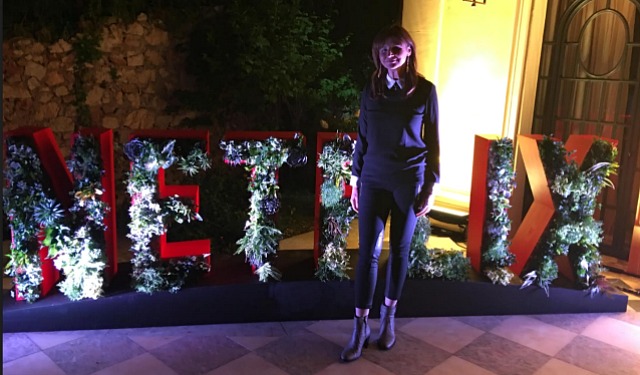
I should have gone straight home and tapped out some kind of review, but I wanted the passing satisfaction of attending a fine, opulent party rather than the lasting satsifaction of having filed a well-written (or at least a well-judged) piece. So I took a shuttle up to the lavish Netflix party in the hills above the city and “partied” — stood around, chatted and took pictures while eating hors d’oeuvres and sipping Badoit and Diet Coke.

I got back around midnight, and managed to post some photos of the event, blah blah blah. And now it’s 8 am and I have to catch an 8:30 screening of Yorgos LanthimosThe Killing of a Sacred Deer, which costars Colin Farrell and Nicole Kidman. And then there’s a Meyerowitz Stories luncheon at noon. I can begin to file about these and other Cannes diversions by mid afternoon, I suppose.

“Not Especially Fun To Watch But…”

Seemingly terrified of calling a spade a spade or not sounding perceptive or culturally conversant enough, Variety TV critic Sonia Saraiya tapdances around her fundamental reactions to the first couple of episodes of David Lynch‘s Twin Peaks: The Return (Showtime, 5.21). But if you boil the snow out of it, the core emerges:

(1) “Twin Peaks: The Return is weird and creepy and slow. But it is interesting. The show is very stubbornly itself — not quite film and not quite TV, rejecting both standard storytelling and standard forms. It’s not especially fun to watch and it can be quite disturbing. But there is never a sense that you are watching something devoid of vision or intention. Lynch’s vision is so total and absolute that he can get away with what wouldn’t be otherwise acceptable.”

(2) “But for every moment that feels fascinating in a new way, there is self-indulgence. The bankable popularity of Twin Peaks also makes for an inexplicably stupid scene at the Bang Bang where the indie-electronic band Chromatics performs to a room of middle-aged townies taking tequila shots. Nothing says rural, small-town, faded glory like an impossibly cool synthpop band. Could it be possible that sometimes, network notes are a good thing?”

Read more

Gatsby-esque

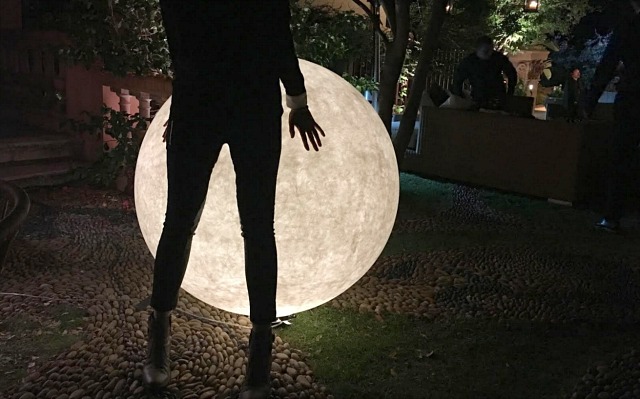
Tonight’s big Netflix party in the fragrant, well-tended hills above Cannes (43 Avenue du Roi Albert) was a perfectly posh and elegant affair, held in a Jay Gatsby-like, faded melon-colored mansion with a beautiful pool, a fountain, palm trees and a glowing globe. Team Hollywood Elsewhere (myself, Svetlana Cvetko, David Scott Smith, Loveless composer Evgueni Galperine) arrived around 9:30; I bailed two hours later but contentedly. What a vibe, what an atmosphere…tender is the night.


Read more

The Family Meyerowitz

The best I can say about Noah Baumbach‘s The Meyerowitz Stories (New and Selected) (Netflix, 5.21), a dramedy about a Jewish family with the usual anxieties and uncertainties, is that it’s mildly engaging. It gets you here and there. It mildly diverts.

Especially when things get testy or cryptic or flat-out enraged (i.e., 40ish brothers Ben Stiller and Adam Sandler trying to beat each other up, paterfamilias Dustin Hoffman ranting at a fellow diner in a restaurant who’s been putting his stuff on Hoffman’s table). Plus Stiller has a striking emotional breakdown scene, the likes of which he’s never before done.

But this mostly Manhattan-based ensemble film (with detours to Rhinebeck and Pittsfield) just isn’t all that riveting. It just doesn’t feel tightly wound or hungry to get over. It’s “good” but unexceptional. I didn’t dislike it, but feels very Netflix-y.

Where does Meyerowitz sit on the Baumbach scale? Way, way below the brilliantly anti-social Greenberg (’10), my all-time favorite Baumbach, and which delivered Stiller’s best performance of his career, hands down. And it has none of the pizazz of Noah’s two Greta Gerwig collaborations, Frances Ha (’12) and Mistress America (’15). I don’t know where it belongs, but tonally it’s kind of similar, I guess, to The Squid and the Whale (’05) and While We’re Young (’14).

During filming The Meyerowitz Stories was called Yen Din Ka Kissa, which is Hindi for something or other. “Where the day takes you”? Something like that. Pow, right in da kissa!

The story is basically is about three Meyerowitz kids — Sandler’s Danny, Stiller’s Matt-from-the-coast, and Elizabeth Marvel‘s Jean — coping with their troubled histories with their father, Dustin Hoffman‘s Harold Meyerowitz, a somewhat curmudgeonly sculptor who wasn’t that great of a dad, etc. There’s also the small issue of Harold’s possibly impending death, due to a head injury that happened while walking his dog.

Read more

Redoubtable Is A Bust

The output of legendary nouvelle vague director Jean-Luc Godard was the epitome of cool between 1960 and ’67, during which time he made Breathless, Le Petit Soldat, Vivre sa vie, Les Carabiniers, Contempt, Band of Outsiders, Masculin Feminin, La Chinoise and the legendary Weekend. But then came Godard’s militant Marxist period (’68 to late ’70s), during which he denounced his heyday flicks as bourgeois trash and devoted himself to revolutionary cinema. But when the familiar references to Hollywood genres and conventions began to fade from his films and as Godard became more focused on Maoist dogma and such, people stopped giving a shit.

So is Michael HazanaviciusRedoubtable, a new Godard biopic, about the sexy cool period or the hardhead Marxist period? You have to ask? Of course it’s about the latter, and boy, does it embrace Godard’s bitter sniping and pissed-off, ultra-didactic radicalism! It really bores into that, and so the movie becomes as much of a drag to 2017 audiences as Godard himself became a drag to his once-loyal fans starting in ’68.

I just watched this Hazanavicius film earlier this evening so I should know. Redoubtable isn’t oppressively awful but it does make you feel profoundly irked at Godard (Louis Garrel) and his hammerhead bickering and general aversion to anything remotely soothing or pleasurable.

In the lead-up to the Cannes Film Festival debut of Redoubtable, the idea began to sink in that it’s about a mid ’60s love affair between director Godard and actress-author Anne Wiazemsky (Stacy Martin). Well, it is that to some extent, but mostly it’s about how Godard’s frowning, screwed-down, butt-plugged revolutionary mentality began to decrease or suffocate whatever regard he might’ve once had for even a semblance of joie de vivre, and thereby destroyed his relationship with Wiazemsky.

Read more

Flush Panorama

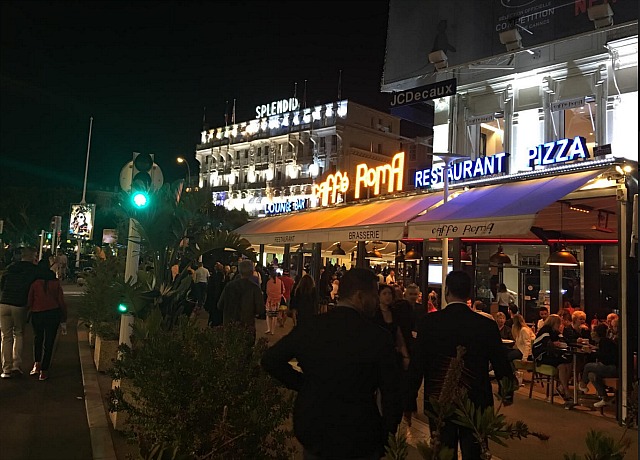
Now this is a choice spot from which to capture the hustle and bustle of the Cannes Film Festival. This was taken roughly an hour ago (12:45 pm) on the outer balcony on an 8th floor suite at 7 La Croisette, rented by Loveless producer Alexander Rodnyansky for interviews and whatever else. I was there to interview Alexander, who knows the international movie realm as well as anyone and possibly better than most, along with Loveless director-writer Andrey Zvagintsev. I have the audio uploaded and all, but I’ll run the piece later tonight or tomorrow morning.

Nobody Misses Hot Cannes Flicks Like Me…Nobody

This morning I chose to get some extra column-writing done instead of catching the 8:30 am screening, which was Robin Campillo‘s BPM — Beats Per Minute (aka 120 Battlements Par Minute). Naturally, it’s being called a likely Palme d’Or winner. I’ll be catching it at the 3 pm screening, but missing the 8:30 am screening continues Hollywood Elsewhere’s remarkable tradition of often (not always but with some regularity) missing the initial showings of hot Cannes films. Very few have this basic instinct.

Jordan Ruimy update: “Don’t raise your expectations too high for 120 BPM. It has some powerful moments, but some parts really drag. And some of the story felt very familiar. Still worth watching.”

6 pm update: Caught 3 pm screening of 120 BPM. It’s good but turn down your Palme d’Or predictions. It’s a fine, dug-in, impassioned tale but strategy, tactics and pushy rhetoric only travel so far.  French Shortbus meets Longtime Companion meets aggressive political protest.

Among All-Time Greatest Opening Sequences

The opening of Lina Wertmuller‘s Seven Beauties (’76) is an “oh, yeah” classic, but many have forgotten that it’s not really a main-title sequence. The title is announced but otherwise it’s just a mission-statement thing, a declaration that the film won’t be playing it straight, that satire will be used, etc. What other films have begun with impressionistic tonal mood-setters (music, montage) that seem to be main-title sequences but aren’t?