Wolf, Momma, Olive Oil

There are 50-plus songs here in The Wolf of Wall Street but the soundtrack album has only 16 tracks. And the song that pops through the most, the one I was humming after I saw it the first time, is Jimmy Castor‘s “Hey, Leroy, Your Mama’s Callin’ You.” It’s on Track #10. Fun, cool, danceable…a spry cousin of “El Watusi.”

Read more

Cold Touch

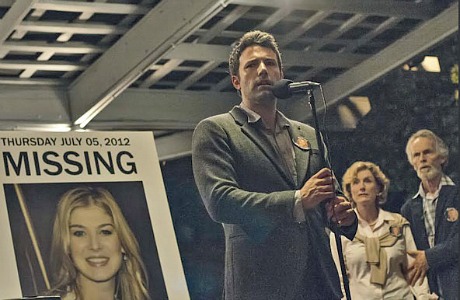
Yesterday the first photo from David Fincher‘s Gone Girl, an adaptation of Gillian Flynn’s psychological thriller about an apparently sociopathic husband (Ben Affleck) who has issues with his wife (Rosamund Pike), was posted on 20th Century Fox’s Twitter page. Pic has been rolling in California and Missouri (Cape Girardeau is one location) since last month. Tyler Perry, Neil Patrick Harris, Missi Pyle, Patrick Fugit, Casey Wilson and Emily Ratajkowski costarring. “Gillian adapted it and I think it’s very, very faithful to her book,” Affleck told EW‘s Jeff Lebrecque last month. “If you read the book and liked it, you will definitely like the movie.” (Flynn is a former EW writer.) Fox will open it on 10.3.14.


Affleck is just doing the scene and no biggie, but the 60ish couple (apparently the parents of Rosamund Pike’s character) are noticably “acting.” The husband’s left hand on his wife’s left arm conveying concern, alarm. I don’t like that shit. Don’t “act” — behave.

Disney Propaganda, Dissing of Travers (Cont’d)

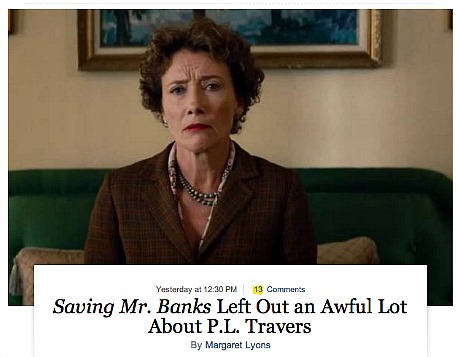
Saving Mr. Banks is produced by Disney, and stars Tom freaking Hanks as Walt himself. Of course Disney — the man and the corporation — will prevail! But it could have been a fairer fight in the movie, and what was presented as a joyless, loveless pedant finally giving herself over to the delight and imagination of the Wonderful World of Disney could just as easily been presented as a creative, passionate person, with dignity and real emotions, getting steamrolled by one of the most powerful companies in the world. Chim-chim-cheroo.” — Final graph from Margaret Lyons’ 12.27 Vulture piece about how the reputation of a very interesting woman has been more or less slandered.

None Too Swift

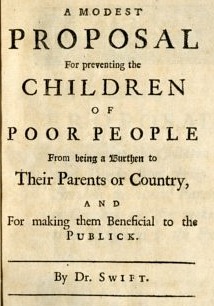
The harumphs and none-too-brights who either missed or dismissed the metaphorical/satirical import of The Wolf of Wall Street this week should look to their 18th Century predecessors, writes HE correspondent Dave DuBos. In 1729 Jonathan Swift anonymously published a satirical essay titled “A Modest Proposal.” The piece suggested that poor Irish citizens might ease their economic despair by selling their children as food for rich gentlemen and ladies. DeBos is suggesting that WoWS dissers are “direct descendants of those clueless fools in 1729 England who responded by saying ‘surely Mr Swift does not mean for us to eat the children of the poor!'” Satire now, as then, is for the few who get it.

Ready To Jettison iPhone

After six years of absolute loyalty, I’m ready to bail on the iPhone. I quite like the size, luminosity and reported speed of Samsung’s Galaxy Note 3, and am figuring Samsung is on the stick better than Apple these days. I almost jumped earlier this month but I don’t want to leave behind those familiar iPhone apps. But Apple has become a caretaker company — it’s no longer the place it was under Steve Jobs — and I want a phablet, dammit. I’ve read that the iPhone 6, due either next May or or sometime during the summer (or perhaps next fall), will be “jumbo” or close to Galaxy 3-sized. But I’ve also read the following: “Apple puts a ton of effort into keeping its devices pocketable and usable with one hand, [and so] the overall size of the iPhone 6 is likely going to be much smaller than the Galaxy Note 3. It may feature a larger screen than the iPhone 6 but we expect Apple to thin out the bezels and keep the size change to a minimum.” There’s also a report from BGR that the iPhone 6 will be bigger “but not as big as…Samsung’s Galaxy Note 3.” If the iPhone 6 re-design seems too small or cautious, I’m gone. I’m sick of Apple’s timidity.

“Egg Noodles and Ketchup”

Toward the end of the 1986 Academy Award telecast Earl W. Wallace and William Kelley were handed the Best Original Screenplay Oscar for co-authoring Witness, the 1985 Peter Weir film starring Harrison Ford and Kelly McGillis. When he got to the mike, Wallace said “I have a sneaking suspicion that my career just peaked.” 25 years later Colin Firth said almost exactly same thing when he picked up his Best Actor Oscar for The King’s Speech. And here’s The Wolf of Wall Street‘s Jonah Hill saying roughly the same thing about a week ago. Wallace, it turned out, was speaking the truth. Perhaps Firth was also — who knows? But Hill, 30, has loads of great work ahead of him. He’s just beginning so the egg noodles and ketchup remark (an allusion to the diminished quality of life that Ray Liotta‘s Henry Hill is coping with at the end of Goodfellas) doesn’t wash.

L.A. Vice Squad Bust In ’62

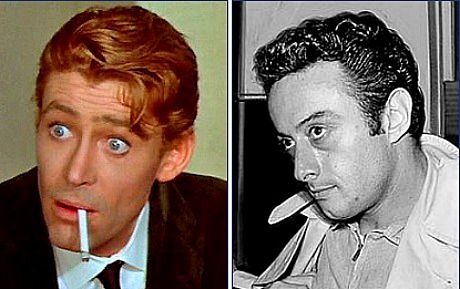
Four days ago the L.A. Times opinion page posted a short recollection piece by novelist and former L.A. cop Joseph Wambaugh. It’s about Peter O’Toole and Lenny Bruce getting pulled over by the fuzz a half-century ago after attending an illegal after-hours club that offered drugs and prostitute services. A petty, nickel-and-dime bust by today’s standards but this was 1962, when the country was still vaguely in the grip of prudish Eisenhower-era values. O’Toole was in town to do interviews for the then-upcoming Lawrence of Arabia, which no one had yet seen. Anyway it’s a good story. I love the idea of Bruce and O’Toole enjoying a late-night drink and a toke together and basically being up to no good. My kind of rambunctious company, even though both were known to be judgmental pricks on occasion. (Thanks to Todd McCarthy for the link.)


(l. Peter O’Toole; (r.) Lenny Bruce.

Read more

Don’t Look At The Camera

This new Miley Cyrus video is a profoundly flat experience. That whitewall pixie haircut obviously makes her look boyish and asexual. Okay, a bit dykey. But the main problem is her constant eyeballing of the lens, which for me is an instant death zap. Eye contact is basically a straightforward “hello, I’m open, come on in and we’ll see what happens.” But the essence of erotic intrigue is about wanting but not quite having that front-door access. Intimacy and eroticism is about hair aroma, sounds, secretions, close proximity, body warmth, touch, etc. It’s about being in a cave. You’re not trying to reach me with eye contact. We’re not addressing each other. I’m not there, you’re not there. Eye contact is for one-on-one chats at Starbucks or in a bar or in a kitchen. Or for job interviews. 99% of the time standard fourth-wall rules forbade the great exotic actresses of the ’20s, ’30s, ’40s, ’50s and ’60s to make eye-contact with movie cameras. This discipline resulted in a “restricted access” vibe that is/was 15 times hotter than anything in this video.

Coens Need To Go Dumber, A Bit Sillier

It suddenly hit me five minutes ago that director-writers Joel and Ethan Coen (Inside Llewyn Davis, A Serious Man, No Country For Old Men) need to go a little dumber and sillier for their next film. They obviously do this from time to time (Burn After Reading, Intolerable Cruelty, The Big Lebowski). I happen to regard Inside Llewyn Davis as a kind of glum, sardonic comedy. Every time I watch it (five times now) I go into a kind of serene LQTM mode. I’m just thinking that after the grayish, downhearted, “God more or less hates me and my life is constantly frustrating and depressing” vibes in ILD and A Serious Man (True Grit was more of an adaptation vacation than a deep-down Coen Brothers film) that they need to joke it up a bit more on their next outing. They probably know this better than I. A little change-up for the fans. Can’t hurt.

Read more

Bellowing Psychopath

The kids and I caught a 4:30 showing of The Wolf of Wall Street today at Leows 34th Street. A couple of HE people had said “see it with a paying audience and you’ll realize that this really is the new Scarface — people are mostly getting off on the insane manic humor, and very, very few are drawing any moralistic or metaphorical message whatsoever.” It was Jett’s second viewing, Dylan’s first. But right away there was trouble from a big black guy sitting a couple of seats to Dylan’s right. This dude wasn’t just talking all through the film — he was broadcasting his line-by-line, scene-by-scene commentary to the entire front section of the theatre.

When Dylan asked him why he was talking so much and where are his manners, the guy was indignant…”I’m enjoying myself!” The guy’s wife or girlfriend was trying to get him to chill also, but he was off on his own cloud. There was no reaching him, no guilt-tripping, no winning through persuasion or threat — he was (and probably still is at this very moment) a stone sociopath, a complete animal…gone.

We all know that African-American culture has always accepted talking during films, especially in New York. As manners have decreased and society has devolved in recent years incidents like today’s have probably increased. It has always seemed to me that theatre talkers have a certain under-educated je ne sais quoi with a vaguely alcoholic air. They never seem to be executive job material, I know that. I also know that the vast majority of New York theatre talkers I’ve run into in the past seem to be Swedish, Danish, Norweigan or Finnish. Have others noticed this?

Read more

Wolf Engages With Commoners

Last night HE’s New Orleans correspondent Dave DuBos wrote the following after catching The Wolf of Wall Street: “I thought the film was a hilariously dead-on satire. But when the lights came up, two women sitting next to me (I didn’t know them), one in her 30s and the other in her 40s, were appalled and disgusted. ‘I can’t get those images out of my mind,’ one said. ‘I want to unsee them and I can’t.’ But when I entered the men’s room, I heard a 20something guy say ‘That’s the craziest fucking movie I’ve ever seen. Were those guys really like that?’ He seemed to be in awe of them while the women were obviously put-off by the behavior.

“I also noticed numerous walk-outs,” DeBos writes. “People were clearly disturbed by that third-act scene when Jordan Belfort punches out his wife (twice) a la Jake La Motta.”

In other words, a typical American middle-class reaction. 90% apparently responded solely to subject matter while ignoring or flat-out missing the metaphor. They didn’t get (or chose not to consider) what it was saying — they only knew how it made them feel. Everything that Joe and Jane Popcorn see is processed as either (a) “whoo-hoo, that was entertaining!” or (b) “uhm, that got me emotionally” or (c) “Jesus, that wasn’t very entertaining” or “whoa, made me feel bad!”

Yes, the punch-out scene is very disturbing, Mrs. Clanton. Anyone with a smidgen of common humanity would and should feel repelled by the behavior in this scene. But there’s this other thing to consider when you’re watching a film, especially an art film about notoriously ill-behaved sociopaths. It’s called context. I know, I know…too intellectual, right?

Read more