At 1:47 cinematographer Robert Surtees does a kind of stylized fourth-wall breakthrough. Instead of resorting to the usual rack focus after Anne Bancroft exits the frame, he manually slows the focus on Katherine Ross‘s face, taking three or four seconds to portray what’s happening in her head. A similar device is used in The Verdict when the camera stares two or three developing Polaroid snaps of a comatose woman in a hospital bed. As they become more and more recognizable, a metaphor for the emergence of conscience in Paul Newman‘s ambulance-chasing attorney is conveyed. Name other instances in which a camera or a cinematographer stopped being invisible (i.e., unobtrusively delivering images) and in so doing briefly interrupted the narrative flow to actually “speak” to the audience about an emotional or intellectual development of some sort.
Daily
Detective Story
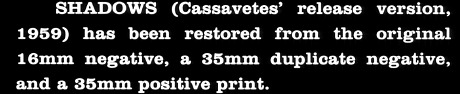
If you’ve read about John Cassevetes‘ Shadows (’59) you know he shot it twice — once in ’57 and again in ’59. The Wiki page says that “the second version is the one Cassavetes favored,” and it’s clearly stated that the new Criterion Bluray is offering the ’59 version. And yet a DVD Beaver screen capture shows a Times Square cityscape that was probably shot in April or May of ’57. How do we know this? Pic shows the 1957 Dean Martin dud Ten Thousand Bedrooms (which opened on April 3, 1957) on the marquee of what I presume to be the marquee of Leow’s State (B’way and 45th). Movies had longer runs back in the day but Bedrooms was generally regarded as a mediocre film and was “not a success” and therefore almost certainly was gone within three or four weeks. Notice also that The Ten Commandments wqs still playing at the Criterion after opening there on 10.5.56, or a good six months earlier.

Why Pick On Edgar Allen Poe?
For a reason presumably known to Lars Von Trier but obscured to almost everyone else, the narration for this Nymphomaniac clip is a reciting of the first sentence from Edgar Allen Poe‘s “The Fall of the House of Usher.” This suggests that the film will be perverse or pretentious or maddeningly oblique. Or perhaps a combination of all three. “During the whole of a dull, dark, and soundless day in the autumn of the year, when the clouds hung oppressively low in the heavens, I had been passing alone, on horseback, through a singularly dreary tract of country; and at length found myself, as the shades of the evening drew on, within view of the melancholy House of Usher.”
Foxcatcher Bumped
Award-season films are suddenly dropping like flies. It began with the date-shifting of Grace of Monaco. Then the discrediting of Diana (which no one ever thought was going to be good, much less exceptional). Then the possible postponement of Martin Scorsese‘s The Wolf of Wall Street (please, please stay the course, Paramount!). And now Bennett Miller‘s Foxcatcher — a 12.20 Sony Classics release that’s been drop-kicked into 2014. Look at the trailer, for God’s sake. Solemn mood, refined chops and what is clearly an exceptional, possibly nominatable Steve Carell performance. (Plus a very interesting one from Channing Tatum.) The season has just become less interesting, less dimensional. One less highly nutritious film for December. (I’ve read the script — trust me.) I for one feel cheated, shortchanged. If I were Carell right now I’d be punching the refrigerator door like nobody’s business.
Seen From Flying Aircraft

Tony Tasset’s 94-foot-tall rainbow arch on the Sony Studios lot was erected almost a year ago, but I wasn’t paying attention or whatever. Last night I noticed it for the first time when I drove on the lot through the Thalberg gate for a screening of Alex Gibney’s The Armstrong Lie.

The End
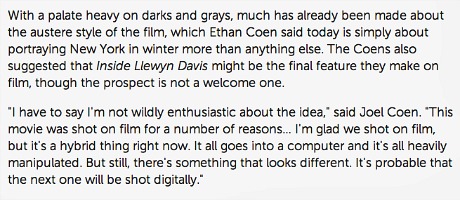
From Brian Brooks’ 9.26 Indiewire account of the Inside Llewyn Davis press conference, held at the New York Film Festival’s press venue, the Walter Reade theatre. Here, by the way, is Marcus Mumford and Oscar Isaac‘s cover of folk classic “Fare Thee Well (Dink’s Song),” which is heard at least a couple of times (thrice?) in the Coen brothers film. We’ll have to wait until 11.12 for the official Davis soundtrack and especially “Please Mr. Kennedy,” which, when performed by Isaac, Justin Timberlake and Adam Driver, is easily the most conventionally entertaining moment in the film.
Plain Spoken Inequality
Jacob Kornbluth‘s Inequality For All (Radius/TWC, 9.27) , which I first saw nine months ago in Park City, is easily one of the smartest and most articulate docs of 2013. A profile of economist and former Labor Secretary Robert Reich, it explains with cool clarity how the game has become more and more rigged by the rich since the Reagan era, and why so many wage-earning middle-classers (including Tea Party lowlifes) are feeling so shafted and angry these days. Everybody knows the dice are loaded. Everybody knows the fight is fixed. The poor stay poor, the rich get rich. That’s how it goes. Everybody knows.

(l to.r.) Inequality For All director Jacob Kornbluth, The Newsroom creator Aaron Sorkin, Inequality star Robert Reich at last night’s post-premiere gathering in Manhattan. (Photo: Shannah Laumeister.)
Each Dawn I Die
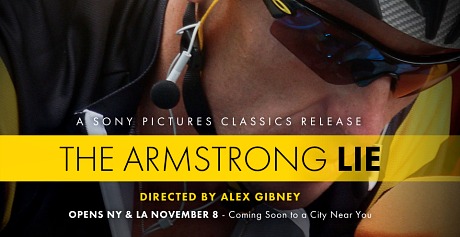
You could say that Alex Gibney‘s The Armstrong Lie (Sony Classics, 11.8), which I saw a good portion of last night at Sony Studios, is only nominally about the ethical outing of Lance Armstrong, the competitive cycling superstar who won the Tour de France seven times (between 1999 and 2005) only to be stripped of his titles in 2012 for doping and thereby exposed as an opportunistic liar. The film is really about the worldwide belief system known as moral relativism, which basically says “it’s not cool to lie or cut corners or cheat or steal, but if you do these things…uhhm, well, you wouldn’t be the first and…uhhm, if they come after you it’s probably better to deny, deny and double-deny and give them no quarter until there’s absolutely no viable option other than to come clean. And you can even grow that into a plus if you play your cards right and wear the right attitude (i.e., I was blind but now I can see).”
Long of Tooth
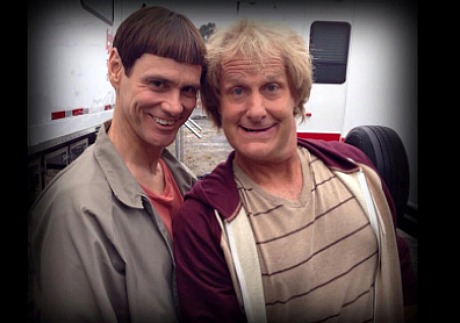
When Jim Carrey and Jeff Daniels costarred in the Farrelly Brothers’ Dumb and Dumber (’94) they were roughly 32 and 39 years old, respectively. Obviously not spring chickens but relatively buoyant, fresh-faced, elastic of bod. Now they’re costarring in the Farrelly’s Dumb and Dumber To, which I suspect will be funny and inventive (I was a fan of the Farrelly’s Three Stooges flick), but now we’re talking about a 51 year-old and a 58 year-old playing the same characters. Dumbasses in their 30s vs. dumbasses in their 50s are different equations. You’re supposed to mellow down and gather a little wisdom out as you get older. You can fall into dumb-shit situations when you’re youngish but guys with creases on their faces are supposed to be craftier and less susceptible.
“But She Did Not Show”
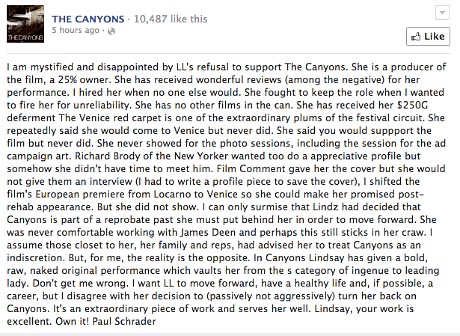
The following was posted on Facebook by The Canyons director Paul Schrader this morning, roughly five or six hours ago or around 7 am. In the lead-up to The Canyons Lohan had a chance to present a composed, sober-seeming version of herself but she (a) bailed on the Venice Film Festival, (b) never showed for ad photo sessions, and (c) blew off New Yorker critic Richard Brody as well as Film Comment, which had pledged to run a cover story on her? What is her basic malfunction?
One-Stop Shopping
Every time I come back to Los Angeles I miss that Manhattan-centric, delightfully comprehensive Harvey Karten email that lists all of the screenings happening over a three-week period. (Karten founded the Online Film Critics Society and the New York Film Critics Online.) It doesn’t contain every last screening but it has a large portion of them, and it’s certainly something to work from as you put your week together. Why doesn’t some LAFCA person in Los Angeles provide the same service? I don’t like having to scramble around and sift through e-mails and sometimes pester friends to see what’s doing. A decade or so ago somebody used to run a priveleged-access website that had all the LA screenings — disappeared five or six years ago.

Backyard of a comfortable Los Angeles home in Hancock Park — Wednesday, 9.25, 9:05 am.
Writing On The Wall
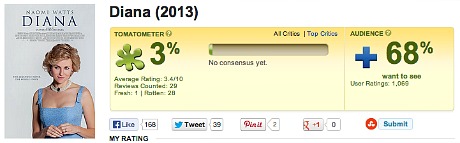
Oliver Hirschbiegel‘s Diana, which opened in Britain a few days ago and which eOne is releasing stateside sometime this fall, has a 3% positive Rotten Tomatoes rating. Face it — it’s a train wreck. And a major career pothole for Naomi Watts (who plays Diana Princess of Wales). How can Hirschbiegel make a film as masterful as Downfall and then follow it up with a couple of moderate mehs (2007’s The Invasion and ’09’s Five Minutes of Heaven) and then an out-and-out stinker like Diana? How do you un-learn how to make a film fit together just so and make it hit the mark?