
War Horse is a Steven Spielberg film, all right. Sound and fury, emotion on its sleeve, very handsome photography, first-rate actors conveying sensitivity and compassion. But beware of any shot of any young actress with a tear running down her cheek. Beware of dolly-in shots of handsome young farm lads. Beware of title cards that say “touched by kindness” and “hope survives.” Beware of French horny orchestral music that tries to melt you down.
Daily
“Put A Lot Of Pressure On That Woman!”
I’ve been meaning to post this since yesterday afternoon. I know a lot of the HE regulars are going to slap this Luc Besson film around. It’s obviously a film about enshrining portraying Aung San Suu Kyi, a tough, progressive Burmese politician, as a martyr. Which she certainly was during her ten years of house arrest. There’s a reason I didn’t make a big effort to see this in Toronto. I don’t respond well to stories about keeping the faith despite oppression and punishment.
Cohen Media Group will open The Lady on 11.30.11.
Bucket of Bleak
In my 9.5 Telluride Film Festival review of Steve McQueen‘s Shame (which will have its NY Film Festival screening on Thursday morning) I called it “a prolonged analysis piece that’s entirely about a malignancy — sex addiction — affecting the main character, and nothing about any chance at transcendence or way into light of any kind. The sex scenes are grim and draining and even punishing in a presumably intentional way. [And] this is what an art film does — it just stands its ground and refuses to do anything you might want it to do.”
I felt all alone for a while with many if not most of the other critics who’d written about Shame from Telluride or Venice offering a fair amount of praise. And then came a brief critique two days ago from N.Y. Times critic Manohla Dargis‘s in which she called Shame “another example of British miserablism, if one that’s been transposed to New York and registers as a reconsideration of the late 1970s American cinema of sexual desperation (Looking for Mr. Goodbar, Hardcore, Cruising, etc.).” After this I didn’t feel so bad.
I suppose it’s fair to call Paddy Considine‘s Tyrannosaur (Strand, 11.18) another serving of miserable Limey lifestyles, given the general grimness of the story, particuarly as it affects Olivia Colman‘s character. But when all is said and done, Tyrannosaur has heart and humanity. It’s a much warmer and chummier film than ice-cold Shame, at least in the third act. So there’s that at least.
Sooner Rather Than Later
As I’m flying back to Los Angeles on 10.8, I won’t be seeing Sunday’s NYFF showings of Simon Curtis‘s My Week With Marilyn. The tweets will of course address question #1: is Michelle Williams‘ performance as Marilyn Monroe a Best Actress Oscar contender? On 8.15 I ran a quote from a credible fellow who had seen this Weinstein Co. release. “There is absolutely, positively no doubt that Williams is right alongside Meryl Streep and Glenn Close at the very front of the Best Actress race,” he said.
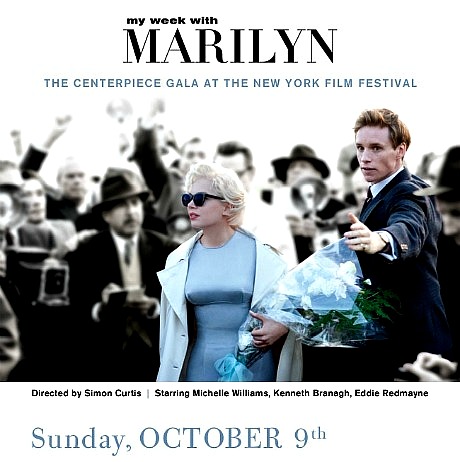
My Week With Marilyn is opening domestically on 11.4.
Nation of Broken Hearts
Two days ago the Guardian published a pro-Occupy Wall Street piece by Mark Ruffalo, who recently spent two days with the protestors. “99% of us have paid a dear price so that 1% could become the wealthiest people in the world,” he wrote toward the end. “It’s time to check ourselves, to see if we still have that small part that believes in the values that America promises. Do we still have a shred of our decency intact in the face of debasement?
“If you do, then now is the time to give that forgotten part a voice. That is what this movement is ultimately about: giving voice to decency and fairness.
“I invite anyone and all to participate in this people’s movement to regain your dignity and what you have worked for in this capitalist society. Each of us is of great value to the whole. Do not forget your greatness. Even when the world around you is telling you you are nothing. You have a voice. You want a better life for your children and the people you love. You live in a democracy. You belong, and you deserve a world that is fair and equal. You have a right to take your place and be heard.
“Show up at an Occupy Wall Street gathering in any major city in the US. Hit your social media outlets. Tweet it. Facebook it. Talk it up. It’s easy to do nothing, but your heart breaks a little more every time you do.”
Gloomhead Nihilism
Lars von Trier‘s Melancholia (Magnolia, on-demand 107, theatrical 11.11) screened last night at the New York Film Festival, and then the stars of the cast — Kirtsen Dunst, Charlotte Ginsbourg, Alexander Skarsgard — attended an after-party at the Stone Rose Lounge inside the Time Warner Center. It boiled down to free wine and beer and Deleon Tequila, and a sadistic deejay playing house music that put me in a bad mood and kept me there.
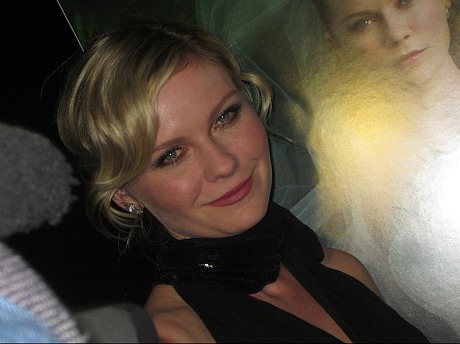
Melancholia star Kirsten Dunst during last night’s after-party at the Stone Rose Lounge.
After catching Melancholia at the Cannes Film Festival i called it “a morose, meditative in-and-outer that begins stunningly if not ecstatically and concludes…well, as you might expect a film about the end of the world to wrap itself up.
“Von Trier’s ensemble piece ‘isn’t about the end of the world but a state of mind,’ he said during the Cannes press conference. My thinking exactly. But it’s also a more striking thing for where it starts and what it attempts than how it plays.
“And yet I believe it’s the best…make that the gloomiest, most ambitious and craziest film Kirsten Dunst has ever starred in. Way bolder than Spotless Mind. It’s kind of La Notte-esque, now that I think about it. Dunst pretty much scowls all through Melancholia and does three nude scenes. What I really mean, I suppose, is that she’s never operated in such a dark, fleshy and grandiose realm.
“It’s basically just a stylishly nutso, intriguing, semi-bombastic ensemble piece about despair in the face of eventual ruination. You know…the kind of thing that most HE readers have in their heads each and every day.
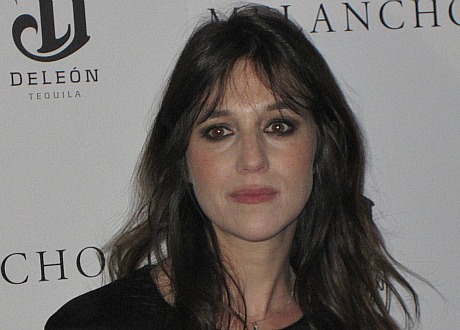
Charlotte Gainsbourg.
“I felt elation only in the very beginning, and somewhat at the very end. But otherwise it mostly felt like a meditative slog. It’s not without its intrigues but it lacks tension and a through-line and a story, really, of any kind.
“After the stunning, tableau-like, slow-motion opening, Melancholia gets down to basic business. Situation, circumstance, character, mood.
“Justine (Dunst) is getting married to Michael (Skarsgard) and her control-freak sister Claire (Charlotte Gainsbourg) has orchestrated the wedding with husband Keifer Sutherland‘s money, and not the funds of Dunst’s father (John Hurt). Charlotte Rampling has a couple of scenes as Dunst’s blunt, cynical mom.
“But right after the wedding Justine slips into gloom-head nihilism and suddenly stops being attentive to Skarsgaard and starts meandering and moping around and fucking some guy (Brady Corbet) she barely knows near a golf course sandtrap.
“Did I mention that the Earth is apparently on some kind of collision course with a planet called Melancholia, which has recently emerged from behind the sun? And that no one turns on a TV news station throughout the whole film, and that Gainsbourgh goes online only once?
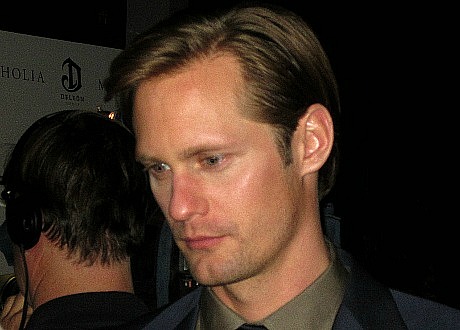
Alexander Skarsgard
“The movie is never ‘boring’ but only rarely gripping. It’s Von Trier, after all, but when all is said and done it’s basically a downhill swamp-trudge with tiny little pop-throughs from time to time.
“There’s an overhead tracking shot of two horseback riders galloping down a trail during a foggy morning that’s heartstoppingly beautiful. That plus the beginning I will never, ever forget.
“Death dance, death art…when worlds collide. Von Trier had a mildly intriguing idea here but didn’t know what to do with it, or he perhaps didn’t care to try. All he does is riff about how tradition and togetherness are over and very few of us care. My sense is that Von Trier experimented and jazz-riffed his way through most of the filming.
“All I know is that I feel the way Dunst’s Justine feels during most of the film, and I’m not dealing with the end of the world. Vaguely scared, unsettled…something’s coming.”
Corey Hemingway
As talk persists that Woody Allen‘s universally loved Midnight in Paris will probably land a Best Picture Oscar nomination, there’s also no denying that Corey Stoll‘s hugely enjoyable, spot-on performance as young Ernest Hemingway is a Best Supporting Actor contender. Okay, maybe not up there with Max Von Sydow and Christopher Plummer, but definitely duking it out with Albert Brooks and Phillip Seymour Hoffman and Andy Serkis.
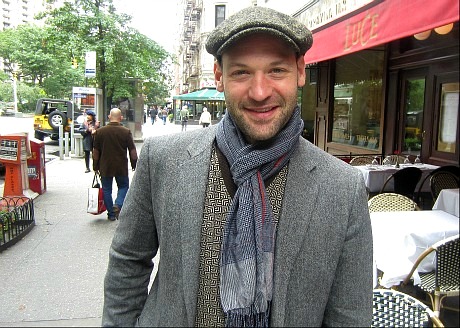
Stoll is on-screen for maybe ten or twelve minutes in Midnight in Paris, and it doesn’t matter. He’s definitely the guy you remember for the sly humor and the authority and the wit and what feels like an almost eerie capturing of a legendary man’s man who had a thing for elegant, run-on sentences about being “real” and a worshipper of beauty and being courageous and solemn and separating the wheat from the chaff. Across the river and into the trees and away from the cocktail phonies.
Stoll and I did a one-hour sitdown yesterday at Luce on the Upper West Side. Here’s what was said.
Why do people decide that this or that performance is Oscar-worthy? Usually because the actor/actress has generated some kind of extra punch and pizazz within the confines of a character, and exuded a certain je ne sais quoi confidence and charisma and an aura that’s a little bit like candy. You “like” the performance and want the actor to stick around and keep adding his/her flavor to the room.
Stoll’s Hemingway is definitely one of these pop-throughs. Bewigged and moustachioed in Allen’s partly period film, he sounds like most of us imagine Hemingway would have sounded. He puts out the appropriately boozy, blustery, brawny quality that we’ve all read or heard about, and is simultaneously playing Hemingway for real and riffing on the legend — a pretty neat trick.. While’s he’s on-screen you’re saying “yeah, good stuff…more of this, please.”
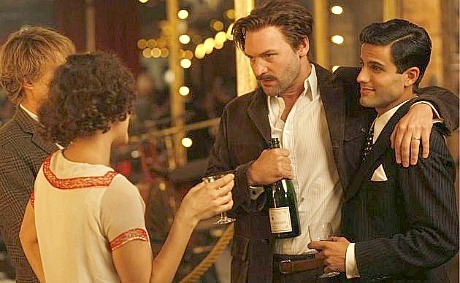
As Ernest Hemingway in Woody Allen’s Midnight in Paris.
Yes, I too would like to see Stoll play young Hemingway in an HBO miniseries that starts with his World War I experience as an ambulance-driver in Italy and ends with the 1926 publication of “The Sun Also Rises.”
Born and raised on Manhattan’s Upper West Side, the 35 year-old Stoll is no Hemingway in person. Not stuck on himself, I mean. He’s considerate, mild-mannered, unassuming and even-toned in conversation, and yet a straight-shooter. Say something that doesn’t seem right quite accurate and he’ll respond in a way that politely corrects.
I find this disparity fascinating. Some actors are commanding personalities with a kind of natural swaggering energy and macho aplomb and what-have-you, and others are like ultra-devoted priests of the cloth. Their interior energy is considerable, but they live to be unleashed by great characters and a general aura of make-believe. Alec Guinness was said to be like this, I once read, and so apparently is Stoll.
Stoll was believably brawny also as Detective Tomas “TJ” Jaruszalski in Law and Order: LA.
And he recently wrapped a role as Jeremy Renner‘s adversary in Tony Gilroy‘s Bourne Legacy, which will open on 8.3.12. The costars include Rachel Weisz, Edward Norton, Joan Allen, Scott Glenn and Oscar Isaac.
We got into this and that and whatever during our lunch. Shooting Midnight in Paris, how the Upper West Side has changed, where things might be for him in a few years, etc. It’s all here.
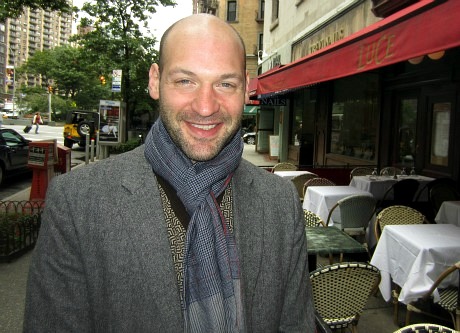
Stoll said something near the end of our chat about how Hemingway came along and wrote what he wrote at exactly the right time (i.e., the early to late 1920s), and that if he’d come along as a new-to-the-scene novelist ten years before or after it wouldn’t have worked as well for him, or perhaps not at all. That’s really what being an artist is about at the end of the day, isn’t it? Not just talent and dedication, but timing.
Wind Factor
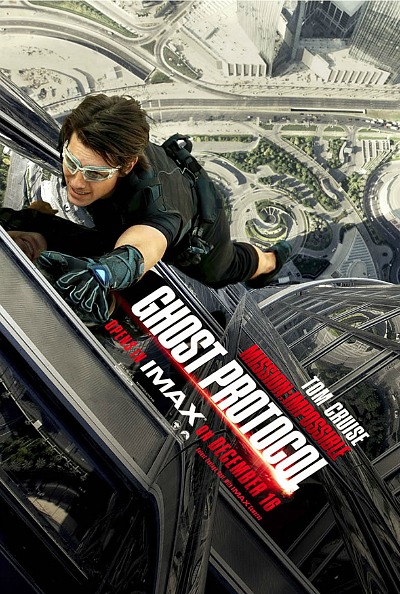
You’re dead if you fall from a height of…what, 50 feet? 75 feet? Something like that. But theoretically falling from the 124th floor of Dubai’s Burj Khalifa Tower, which is 2717 feet high, is, like, an abstraction, man.
Strategic Bala Move
Gerardo Naranjo‘s Miss Bala will now open on January 12, 2012 rather than the previously announced date of 10.14.11. This date isn’t posted on Coming Soon, the iMDB or even on the film’s own website. But Bala‘s marketing consultant David Dinerstein has just informed me of this.
“January 12th is a great date because it’ll give us more time for long-lead press and the ability to focus on a better awards campaign for the film,” Dinerstein said. “The Oscar nominations will be announced a few days later, and it’s already opened in Mexico, making it eligible for a Best Foreign Language Oscar.”
Pop quiz: what classic 1930s film used the word “bala” in a line of dialogue? Answer: King Kong. When Robert Armstrong‘s Carl Denham is trying to communicate with the hostile natives on Skull Island, he asks Captain Englehorn what the word for “friend” is, and Englehorn says “bala.” Denham opens his arms and takes a step forward, saying “Bala! Bala!” to the village chief. It doesn’t work.
To my knowledge Miss Bala is the first feature film has uses the Spanish term “bala” (which means bullet) in its title. Some English-speakers have had a confused reaction because Stephanie Sigman‘s character competes in a Miss Baja beauty contest.
Not In The Cards
Sony Home Video’s The Guns of Navarone Bluray streets on 10.18. It’ll look more robust and detailed than the various DVD versions, I’m sure, but according to a 9.29 Home Theatre Forum riff by restoration guru Robert Harris, this 1961 war film can only look as good as its appalling preservation history allows.
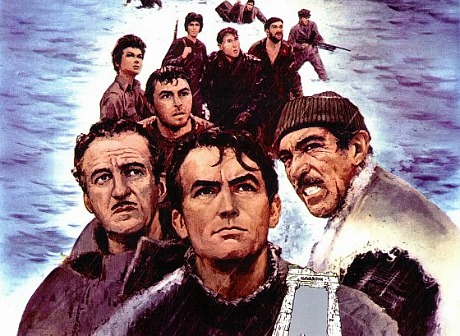
“To the best of my knowledge, The Guns of Navarone was photographed on the new Eastman 5250 stock, the first to have high level anti-dye fade characteristics,” Harris writes. “My comments are personal opinion, and some may disagree, but here goes.
“The film was a UK production, with some photography in Greece and L.A. Had a decision been made to have the original negative processed by Technicolor London, Technicolor Hollywood or any other high-end lab, Columbia wouldn’t be facing many of the problems they do today. Since dye transfer prints were produced, as well as at least a small number of 70mm blow-ups, why not allow the lab doing the printing to handle the production all the way through?
“Presumably based upon a studio contract, the processing work was given to Movielab, which is a couple of steps above forcing the professional photographer shooting your wedding photos to drop his exposed film through a slot at the local Uncle Joe’s Ribs, Photo Lab & Storm Door Company.
“I’m unaware of the production of separation masters to protect the show.
“In 1989, Columbia went to UCLA for aid to save the film, and archivist Robert Gitt performed the necessary tasks to the best of analogue abilities. The final result at least stabilized the image problems, while protecting the original mag tracks.
“Two decades later, a return to the original surviving elements in 4k was in order.
“But such a return doesn’t guarantee the superb image that this film could have had, had everything been done correctly back in 1961.
“As I recall, the final reel of original negative may also be missing. Dupes are built in throughout, and color, for the most part is, well… acceptable.
“I’m taking the long way around to make the point that there is nothing further that can be done to make the film look any better. And everything goes back to those early decisions.
“What does TGoN look like?
“Pretty much as the knowledgeable eye would think. Grainy in parts, occasional contrast problems along with optical anomalies, plus what some here will refer to as ‘force fields’ around certain objects, normally in high to low contrast situations. Flesh tones range from decent to awkward brownish green with red highlights.
“And there is very little that can be done about it.
“The technical folks at Sony/Columbia have used all the tools at their disposal, but one cannot make a proverbial silk purse from old Eastman stock processed by Movielab.
“And there you have it.
“This is a terrific and important film, that happens to be beautifully acted and is extremely entertaining.
“But the point needs to be made that not only does this Blu-ray not look like a new film, it isn’t going to look like what many will perceive a high quality, important 1961 production should look like. Know that going in, and enjoy the show, and you won’t be disappointed.
“They don’t make them like this anymore.”
Wells comment: I won’t be seeing the Navarone Bluray until I return to Los Angeles this weekend, but this sounds like a situation that requires a little tasteful DNRing. When you buy a Bluray you want that extra quality, and if the film itself doesn’t have this, you need to digitally crank it up.
Hire This Lefty
This New York Observer-captured clip of an Occupy Wall Street protestor making mince meat of a Fox News stooge never aired. The guy is easily as sharp and well-spoken and spot-on with his arguments as Cenk Uygur, if not more so. He should be on Young Turks or MSNBC or Current TV. And that Civil War-era Union army cap is a nice touch.
Finally, The Truth
You’ll recall that 20th Century Fox had its first press screenings of Rise of the Planet of the Apes very late in the game, only days before it opened on 8.5. When some suggested that the film might have built up more opening-weekend steam if early positive reactions had circulated earlier, Fox reps said that a demanding post-production schedule kept them from showing it any sooner.
“I know for a fact it was about effects delivery,” a rep told me. “It was down to the wire as this was originally going to be a Thanksgiving release.”
Now it turns out the real reason for Rise of the Planet of the Apes not being ready to show until early August was because of a re-shoot of the film’s finale that happened over the July 4th weekend.
Badass Digest‘s Devin Faraci, drawing from a Hollywood Reporter story, has written that “the original ending had James Franco’s character dying. At the hands of humans, no less. Shot to death by armed humans who have chased the apes into the forest. [And then] the ape horde descends on the people and tears them to pieces, a reversal of the opening scene where Bright Eyes is captured in the jungle.
“This isn’t the only change from an early version of the script,” he writes. “Originally Rocket and Caesar had a big brawl at the end as well. In fact lots of things changed lots of times over the course of the script’s development.
In any event, “Everybody hurried back to set this summer, just a month before release, to reshoot the ending.”
During last weekend’s Visual Effects Society Production Summit in Beverly Hills, Fox’s president of postproduction Ted Gagliano said Franco was brought in for the re-shoot over the July 4th holiday weekend. “We shot for three hours and (Franco) was back on the plane,” Gagliano recalled. He added that this change led to a challenging final weeks of what was originally a 41-week post schedule that involved extensive visual effects work.”
The original discarded ending will apparently be included on the Bluray.