Burden Grows

In addition to my previously posted list of 35 Toronto Film Festival must-sees (26 features, 9 documentaries) I’m today adding nine more films, selected from a new batch that TIFF announced this morning, which brings the total to 44. At best I’ll get to see maybe 25 of these. (My usual festival tally is between 20 and 25.) At least there’s the comfort of knowing that many if not most of the 2011 Telluride selections will overlap and therefore dent.
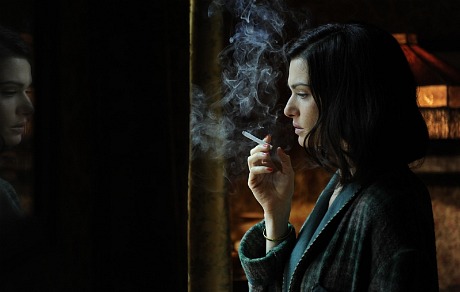

Rachel Weisz in Terrence Davies’ The Deep Blue Sea.

This morning’s add-ons:

Guy Lodge‘s…I meant to say Terrence DaviesThe Deep Blue Sea. (Lodge urged me to catch it on 8.7.) A 1950s-era tale about an affair between a married socialite (Rachel Weisz) and an ex-RAF pilot (Tom Hiddleston). Eventually and quite naturally Weisz’s older husband (Simon Russell Beale), a judge, finds out and the shit hits the fan. Based on the play of the same name by Terence Rattigan. “A career-best performance from Weisz, according to trusted sources who have seen it,” says Lodge.

Contemporary World Cinema (2):

Always Brando, d: Ridha Behi. About a young Tunisian actor named Anis Raache “who bears a stunning resemblance to young Marlon Brando,” and Behi having gone to the real Brando eight or nine years ago to pitch a young-old movie focusing on Raache and the real McCoy, or something like that. Brando died in before shooting began.

Miss Bala, d: Gerardo Naranjo. A Mexican beauty queen and a drug gang. This was a mid-level sensation at last May’s Cannes Film Festival. I missed it then, but not this time.

Galas (6):

Page Eight, d: David Hare. Contemporary espionage & moral dilemmas. Bill Nighy, Rachel Weisz, Michael Gambon, Ralph Fiennes and Judy Davis.

The Awakening, d: Nick Murphy. Allegedly “a sophisticated psychological/supernatural thriller in the tradition of The Others and The Orphanage.” W/ Rebecca Hall, Dominic West and Imelda Staunton.

Killer Elite, d: Gary McKendry. Scenic global thriller about special ops & assassins, blah blah. Jason Statham, Robert De Niro, Clive Owen, blah, blah.

That Summer, d: Philippe Garrel. “A couple living together in Paris – he’s a painter, she’s a film actress – befriend a couple of film extras who fall in love with each other. All four go to Rome where their relationships undergo profound changes as emotions shift and change.” Perfect!

Violet & Daisy, d: Geoffrey Fletcher. W/ Saoirse Ronan, Alexis Bledel and James Gandolfini.

Wuthering Heights, d: Andrea Arnold. W/ James Howson, Kaya Scodelario. Do I have to see this? Is it really necessary? What will it actually add?
Marquees Again


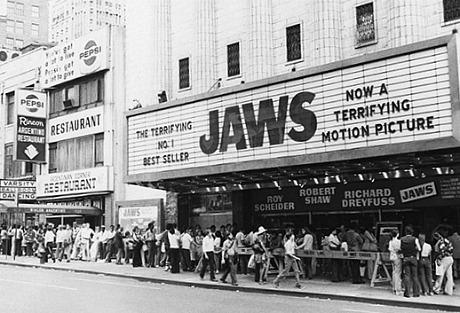
Jaws opened at the Rivoli (and at 463 other theatres) on 6.20.75.

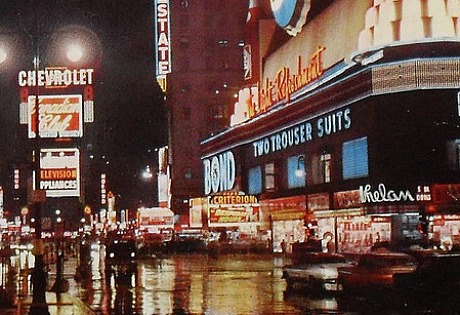
You can just barely make out the art for William Wyler’s The Desperate Hours (which opened on 10.6.55) on the Criterion marquee.

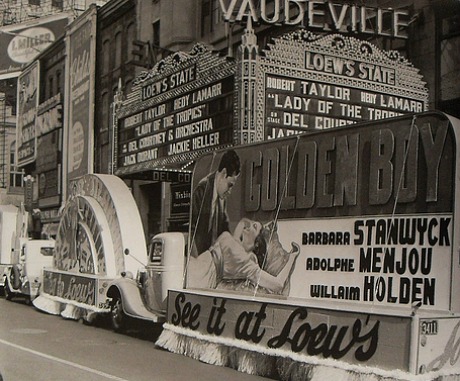
According to Frank Nugent’s 9.8.39 N.Y. Times review, Golden Boy opened at the Radio City Music Hall. Loew’s State was always a first-run house so the film must have been double-booked. Extra-popular films were sometimes shown that way in the old days. (King Kong opened simultaneously at the Roxy and Music Hall.) Note the billing of “Willaim” Holden, third-billed below Barbara Stanwyck and Adolf Menjou.

Nicholas Ray’s King of Kings opened at Leows’ State on 10.12.61.

Space Invaders

At the 31-second mark N.Y. Times columnist Paul Krugman suggests that if there was a huge government-spending program brought about by an emergency, like the spending prompted by the Great Depression and World War II, it would bolster our economy and make it robust, even, in less than two years. And then at 1:04 he theorizes that such a program could be brought about by the threat of invading space aliens.

Almost exactly the same point was made in a slightly different context by President Ronald Reagan in December 1985.

Speaking about sharp nuclear-policy differences between himself and Russian president Mikhael Gorbachev, Reagan said, “I couldn’t help but…when you stop to think that we’re all God’s children, wherever we live in the world, I couldn’t help but say to [Gorbachev] just how easy his task and mine might be if suddenly there was a threat to this world from some other species from another planet outside in the universe. We’d forget all the little local differences that we have between our countries and we would find out once and for all that we really are all human beings here on this Earth together.”

"Five Years Into The Future"

The drift is basically Guillermo del Toro telling Josh Horowitz about Alfonso Cuaron & Co. having achieved the next Big Thing (which he declines to describe) in the 3D Gravity (Warner Bros, 11.20.12). Sidenote: The video embed codes provided by mtv.com are infuriating, second only to the N.Y. Times in terms of making me want to mail a plastic sandwich baggie filled with dogshit to their offices.

Put This In Pipe

My Week With Marilyn Observation #1: “Good lord, when are people going to figure out that this show belongs to Michelle Williams and she alone? That is all anyone will be talking about once people actually see the movie. There is absolutely, positively no doubt that Williams is right alongside [Meryl] Streep and [Glenn] Close at the very front of the Best Actress race.”

My Week With Marilyn Observation #2: “It’s totally Michelle Williams’ film. She’s the only justification for making it and for watching it. She really captures Marilyn’s whispery allure, drifting attention span, lack of self-confidence and, most importantly, movie star charisma. I don’t go in for the all the Oscar speculation stuff, but she’s (a) the whole story, (b) a definite Oscar contender, and (c) a [provider of] a performance that older Hollywood people will respond to in a big way.”

Kinky Cronenberg at NYFF

The New York Film Festival’s closing-night film will be announced later this week, but for now the big announcement is that David Cronenberg‘s A Dangerous Method and Pedro Almodovar‘s The Skin That I Live In will both get the gala screening treatment. The voltage is entirely with the Cronenberg, a kind of Freudian-Jungian romantic-obsessive period piece that is said to be quite good. Almodovar’s film was seen last May in Cannes and was in large part tagged as a toney, intriguing but somewhat minor work.

The most promising aspect of the Cronenberg? From a distance, at least? The fact that Vincent Cassel‘s character is called “Otto Gross.”

I’m hearing that Tomas Alfredson‘s Tinker, Tailor, Solider, Spy won’t get the gala treatment because The Dark Knight Returns director Chris Nolan won’t let Tinker star Gary Oldman off the set, even for a night or two, and the NYFF won’t do a gala screening without stars so the film’s absence isn’t a quality but an attendance issue.

Gary Oldman‘s manager Douglas Urbanski wrote me the following about an hour ago: “Tinker was indeed offered the opening night slot for the New York Film Festival (something I also participated in last year, as it happens). However, the shooting schedule for The Dark Knight Rises could not be rearranged for Gary to be free and in New York that night. Gary would love to have gone, [but] even with enormous efforts from Chris Nolan, the schedule could not be adjusted.

“As for the other New York Film Festival slots mentioned, Gary was indeed available, but no one, neither the American distributor nor the Festival, asked Gary to attend.”

Fans of The Social Network will recall that Urbanski killed as Larry Summers in that scene with the Winklevii.

Lesson In Fear

This scene in Juan Antonio Bayona‘s The Orphanage (’07) in which Belen Rueda summons the ghosts of several children by playing the game “Uno, Dos, Tres, Toca la Pared” (i.e., One, Two, Three, Knock on the Wall), is one of the most genuinely creepy and unnerving scenes in the annals of adult (i.e., subdued) horror cinema, and it was done without resorting to a single visual effect.

Somewhere between 98% and 99% of horror filmmakers wouldn’t be able to deliver a scene like this if their lives depended on it — the idea wouldn’t even occur to them — and that is what I despise about the horror genre.

I’m sorry that this clip is underlit, but you can make out what’s going on with the kids slowly making their way into the room. The sound of the creaky door suddenly being opened off-screen is brilliant.

Branagh Walk-Back

I can’t reveal particulars, but another source is disagreeing with the hat-in-the-air praise for Kenneth Branagh‘s performance as Laurence Oliver in My Week With Marilyn that I passed along last April. This on top of a similar view posted yesterday by “Yahoo” has persuaded me to think, “Okay, let’s take it easy with the K. Branagh thing.” Particularly since the most recent opinion comes from a very perceptive fellow.

Stoppers

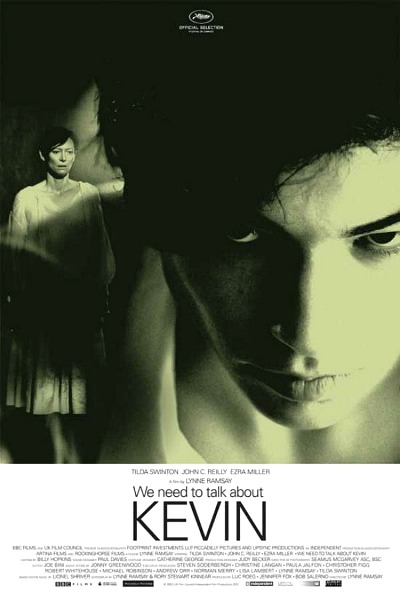
Every now and then an actor delivers a performance that is so odious and unpleasant to settle into that even sophisticated filmgoers find themselves resenting the actor on some level, despite the obvious. If the performance is off-putting enough, it can seriously harm or stall an actor’s career. For me Ezra Miller‘s inhabiting of an evil, acid-spewing fiend in We Need To Talk About Kevin is one of these. I instantly knew while watching Lynne Ramsay‘s film in Cannes that I’d be avoiding seeing this guy in anything else, if at all possible.

Unfair? A bit cruel? Yeah, it is. But that’s what a lacerating performance can sometimes achieve.

What other performances have been so instantly offensive that they all but stopped the career of the actor? All I can think of is Lorraine Braco‘s as a braying biochemist in Medicine Man (1992), which seemed to ruin her feature film work (at last in terms of choice roles) until she bounced back in ’99 with her psychiatrist role in The Sopranos. And, I suppose, Elizabeth Berridge performance as Mozart’s shrewish, low-rent wife in Milos Forman‘s Amadeus (’84). She pretty much went right into ’80s and ’90s TV after that grating turn. She played Annie Oakley in Hidalgo (’04).