Shot during a bar chat with Coming Soon’s Ed Douglas following last night’s 6 pm screening of Harry Brown, the London-based Michael Caine vigilante drama. Haven’t time to get into it, but Caine, an East End roughneck in his youth, knows how to eyeball the bad guys and give them all sorts of pain with magnificent conviction and style. The film satisfies as nicely in this regard as the confrontation scenes in Clint Eastwood‘s Gran Torino, if not more so.
I was taken by this chat between Maxim‘s Mark Ebner and 1010 News’ Jerry Agar about habitual criminal and teenaged fugitive Colton Harris-Moore. Ebner states that CHM is “a folk hero, Keyser Soze, a genius…like Frank Abnagale, he might be able to one day apply his skills to the greater good. He’s a true survivalist. They should drop this kid into Afghanistan.
A UK Telegraph story reports that Harris-Moore “has been on the run for almost two years and is thought to be hiding on the remote Orcas Island, a rugged spot in the northwest corner of Washington state near the Canadian border.
“Police believe he has been there since stealing a plane and landing it in mud on the sparsely populated, 57 square mile island on Feb 10.
“The manhunt was scaled back after no trace of him was found. Officials said search teams would be ‘redeployed if the situation warrants.’
“The plane was the fifth Harris-Moore is believed to have stolen during his crime spree and he is also suspected of taking speedboats and luxury cars for joyrides in Washington, Idaho and Canada.
“During one of his recent illegal flights air traffic controllers became alarmed as he skirted air space restricted for the Winter Olympics in Vancouver.
“His criminal exploits have led to him being been dubbed ‘America’s Most Wanted Teen Bandit’ by Time magazine and 30,000 people have subscribed to an internet fan club.
The 6ft 5 ins teenager, who turns 19 next week, lives in the open, sometimes in trees, and has been known to have pizzas delivered to the edge of woodland.
“Police believe he also hunts his own food in forests using a pair of night vision goggles.
He is believed to have learned to pilot a plane by reading flight manuals and playing simulator video games purchased with stolen credit cards.
“Detectives believe he is responsible for scores of burglaries and security videos from some of those show him barefoot.
“He once burgled a grocery store and drew a series of chalk outlines of footprints leading out the door, leaving a note that said “C-Ya!”
“The teenager grew up in a caravan on another island south of Orcas Island.
He has been on the run since April 2008 when he escaped from a halfway house where he had been serving a three-year sentence for burglary.
“Ed Wallace, a Sheriff’s Department spokesman in Washington state, said: ‘He’s almost like a feral child. Everybody wants this kid caught.'”
Recalling how N.Y. Times critic Frank Nugent panned Bringing Up Baby when it opened in March 1938, successor A.O. Scott acknowledges that Howard Hawks‘ film is “completely preposterous” on several levels. He also suggests that Nugent may have “missed the point. Story points don’t have to be new. They rarely are. It’s the execution that has to be fresh.
“Today, 72 years later, contrasted with the current crop of comedies, Bringing Up Baby is full of surprises. Who knows? Maybe in 2082 a movie like The Bounty Hunter will look like a great American classic. But I’d wait at least until then to find out. In the meantime there’s Bringing Up Baby, which never gets old.”
Here‘s Scott’s appreciation of The Friends of Eddie Coyle. Being an old-time Coyle fan myself, I tried to locate the embed code right after it ran but the N.Y. Times tech guys — the bane of my existence in a couple of respects — apparently hadn’t posted it.
The audio on this clip of Vice-President Biden‘s “big fucking deal” line is more audible than I realized at first — funny. I didn’t mean to sound dispirited about the passage of the health-care bill because it doesn’t contain what it should. I get what everyone’s feeling. It’s a very welcome thing, although I prefer to call it a reasonably good start.
As I submitted yesterday afternoon to yet another dental appointment (last Thursday’s appointment having been cancelled), Movieline‘s Stu VanAirsdale posted an article called “9 Most Memorable Paycheck Roles in Modern Cinema.” Stu was inspired by the news about John Malkovich and Frances McDormand joining Transformers 3…good God!
Since ’04 I’ve written a good 20 or 25 stories that note, mock or lament the taking of a paycheck job by this or that actor (or director). The vibes exuding from these performances can be fascinating — a mix of profound inner disgust and a professional attitude that says “I need this money to send my kid to the very best university so screw it…here I am! And I’m going to do the job well!”
I don’t have any issues with Stu’s unsurprising choices (Peter O’Toole in Caligula, “Chewy” Ejiofor in 2012, Michael Caine in Jaws 4: The Revenge, etc.)
I could add a few off the top of my head — Liam Neeson in Clash of the Titans and The A-Team; Sam Mendesdirecting the next Bond film; Guillermo del TorodirectingThe Hobbit — https://hollywood-elsewhere.com/2008/01/post_223.php (you’ll never convince me that Del Toro feels the same enthusiasm in adapting another Tolkien book that he felt in making Pan’s Labyrinth or The Devil”s Backbone, or in producing The Orphanage even); Cate Blanchett in the ’08 Indiana Jones film that was ruined by George Lucas; and Vince Vaughn in Fred Claus.
I’m running this to ask which actors and actress do HE readers believe merits the title of all-time Paycheck King and Queen — the actor or actress whose name is instantly and unmistakably synonymous with the term.
The easy calls, of course, are Robert De Niro and Michael Caine. But is there an actor/actress who measures up to these two who’s been lurking in the shadows? Who hasn’t gotten the recognition he/she deserves?
Keith Olbermann‘s special comment last night about the GOP’s imminent self-destruction was a goodie. If only this actually seemed so, or was actually in the cards. Here’s a transcript. Every time I post an MSNBC embed code subsequent posts on my site are obliterated or the general coding is thrown out of whack. May the person who designed these codes suffer in some agonizing way until he/she wakes up.
Each year the L.A. Press Club hands out National Entertainment Journalism Awards. But on the entry page, which says that you have to pay $40 for each entry, there’s a fairly significant typo.
A journalist friend says he recent read Sharon Waxman‘s “gloating” piece in The Wrap about how her website won nominations for all these awards. And yet none of the other folks I thought would be there, including Nikki Finke, Anne Thompson, David Poland, etc. even got a mention.
“You have to apply for a nomination and cough up forty bucks per submission (in each category) in order to qualify. I guess that’s why the entertainment website and entertainment blog nominees are so thin. Paying for awards is sort of desperate — still, I guess nobody really knows what’s going on, so lots of people are probably impressed by hearing about these awards.
“These awards don’t objectively judge the best in each field — just the best applicants in each field who fill out the long application forms and pay forty bucks per submission. If you read the submission rules it seems clear this is simply a moneymaking ruse that counts on the massive egos of journalists. I mean, just look at the nominees list — is this really the best of the bunch?”
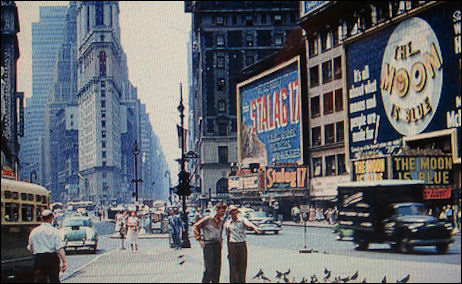
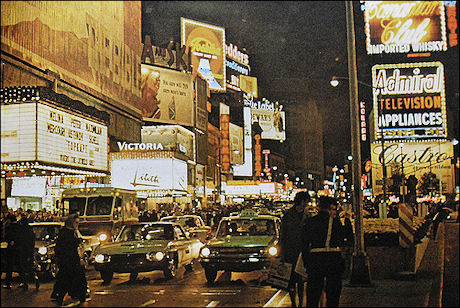
Taken in August 1953 looking south from 47th Street. It seems vaguely odd to consider Billy Wilder’s monochrome Stalag 17 being visually represented in grand vivid colors.
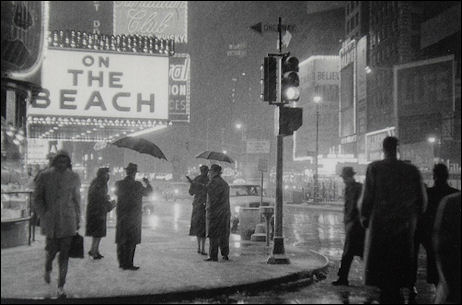
Early in the run of Stanley Kramer’s still-decent anti-war film, based on the novel by Nevil Shute. This north-facing shot of the Astor marquee was possibly taken soon after the film’s 12.17.59 opening.
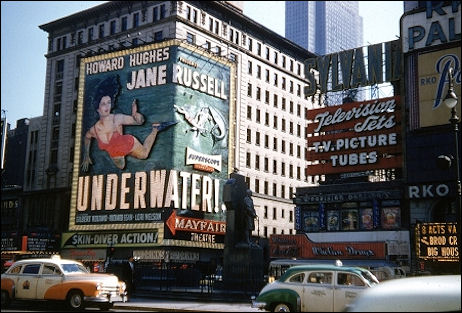
Early in the 1955 run of John Sturges’ now completely forgotten CinemaScope drama, which basically sold Jane Russell’s boobs through the filter of underwater photography.
I recently tried watching a spiffed-up DVD of Robert Rossen‘s Lilith (1964) with Warren Beatty and Jean Seberg. An intriguing moment or line pops through now and then, but mostly it’s a leaden dirge-like thing.
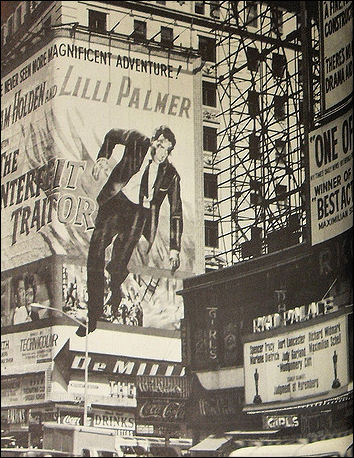
George Seaton‘s The Counterfeit Traitor was never a great or top-drawer World War II spy thriller, but it’s definitely a decent one — a solid B or B-plus. It came out on DVD in ’04 — available through Amazon. It’s visually drab, but I’ll never forget a scene in which Lili Palmer (playing an anti-German spy and William Holden‘s romantic interest) and three or four others are machine-gunned to death in the courtyard of a German prison. Klaus Kinski has a vivid scene as a guy being smuggled to safety inside a small yacht who smothers to death rather than cough and alert the Germans to his presence. Traitor opened on 4.17.62. Notice the splashy Oscar-award promotion given to Judgment at Nuremberg (which had opened roadshow-style in late ’61) at the next-door Palace.
This one was obviously written by a knowledgable conservative who remembers (or has read a lot about) what Republicans used to stand for before the foam-at-the-mouth Tea Party/Palin/Bachman idiots took over the agenda. I was ready for some great “kill” lines, but there are maybe one or two guffaws here. Downfall Hitler is a proud YouTube brand — a funnier Republican riff is required.
I finally get to see Harry “not quite Get Carter but good enough” Brown tonight after missing it at last September’s Toronto Film Festival, and after begging the film’s British publicist if I could see it on a disc when I was in London last fall during the Fantastic Mr. Fox junket. She ignored my e-mails despite the Daily Mail‘s Baz Bamigboye telling her I was okay.
It doesn’t deliver what you’d call a “pleasant” sit, but it’s about as intense and feisty as a political film like this could or should get, and every so often it plays like a good gangster/bank-robber film.
I wrote the following after catching it about 20 months ago:
“What can you say about a tough-minded, hard-nosed political drama that tells the truth, doesn’t mince words or pull punches, rekindles the viral excitement of a bygone era, offers several gripping performances and leaves you with a taste of ashes in your soul?
“This is the reality of The Baader Meinhof Complex — Uli Edel’s 149-minute drama about the famed German radical leftist group. It’s a strong but bleak account of the impassioned but self-destructive insanity that took hold among radical lefties in the late ’60s and ’70s, and which manifested with a particular ferocity and flamboyance among the Baader-Meinhoffers.
“Edel’s chops are fine, the story is the story, what happened is what happened, but my God…what do you do with a history of this sort? And where in this saga is a semblance of a common cultural current? It’s not as if a willingness to kill or be killed for one’s political beliefs is something that comes up these days on Sunday mornings at Starbucks after you’ve had your morning run.
“Maybe more of us should think and act in terms of life-or-death commitments. Maybe we’d be better off if more of us had the cojones to stand up and fight evil in a way that gives no quarter. But the film mainly sinks in as a revisiting of a time in which a small but dead-serious sector of the left-liberal community temporarily lost its bearings and in some cases jumped off a cliff in order to stop what they saw as a form of absolute establishment evil.”
Say it one last time: this sucker should have been called The Baader Meinhof Gang. You always need to think in popcorn terms when deciding on a title, and popcorn munchers don’t know from complexes. This is basically a high-voltage shoot ’em up about a political-minded Barrow gang that ends in death, jail and suicide.”
N.Y. Times columnist Paul Krugmanreports that “Newt Gingrich, the Republican former speaker of the House — a man celebrated by many in his party as an intellectual leader — [said that] if Democrats pass health reform, ‘They will have destroyed their party much as Lyndon Johnson shattered the Democratic Party for 40 years’ by passing civil rights legislation.
“I’d argue that Mr. Gingrich is wrong about that: proposals to guarantee health insurance are often controversial before they go into effect — Ronald Reagan famously argued that Medicare would mean the end of American freedom — but always popular once enacted.
“But that’s not the point I want to make today. Instead, I want you to consider the contrast: on one side, the closing argument was an appeal to our better angels, urging politicians to do what is right, even if it hurts their careers; on the other side, callous cynicism.
“Think about what it means to condemn health reform by comparing it to the Civil Rights Act. Who in modern America would say that L.B.J. did the wrong thing by pushing for racial equality? (Actually, we know who: the people at the Tea Party protest who hurled racial epithets at Democratic members of Congress on the eve of the vote.)
“And that cynicism has been the hallmark of the whole campaign against reform. Indeed, the emotional core of [it] was blatant fear-mongering, unconstrained either by the facts or by any sense of decency.”