
I may as well join the crowd and post this HD trailer for Ricky Gervais and Matthew Robinson‘s The Invention of Lying (Warner Bros., 9.25). Trailers always seem to misrepresent what a film actually is (i.e., how it plays) so you always need to take them with a grain. But the basic impression I’m getting is that TIOL may be a little too on-the-nose — an explicit comic thesis going through the movie motions. But maybe not.
Daily
Mann’s Women & Mortality Itself
Responding to my recent praise for Michael Mann‘s Public Enemies, legendary film critic F.X. Feeney shared some thoughts earlier this evening, focusing especially on Mann’s history of writing strong and defiant female characters.
“I’m so glad we agree about Public Enemies,” he began. “I think it’s a beautiful confluence of everything I ever loved about Last of the Mohicans and Heat — especially in its sense of America as a still-embattled frontier where men and women continuously invent and re-invent themselves, and protagonists (whether they live within the law or without it) who are defined by their refusals to conform.
“This is one reason I take exception to Mark Harris‘s view that Mann short-shrifts his female characters. Gong Li in Miami Vice goes her own way, at huge risk. So do Madeline Stowe‘s Cora in Mohicans, Ashley Judd in Heat, the angry women played by Diane Venora in Heat and The Insider, Tuesday Weld in Thief.
“Everywhere you look in Mann’s work (The Keep, Manhunter) women are all deeply observed, self-reliant and fully dimensional..
“I will admit La Cotillard takes the coupe du monde in their honors, but then she is not only great in herself but that magnificent hall-of-mirrors moment when Dillinger contemplates her angelic double, Myrna Loy, in Manhattan Melodrama. It seems to me that here, Mann grandly contradicts the old saw that men’s ‘immortal dreams of women’ are ‘unattainable.’ From where Dillinger sits, that dream has been attained quite fully, thank-you-very-much. A ticklish mystery, this.
“I love, too, that Public Enemies dramatizes the great line from Miami Vice — ‘time is luck’ — without having to state it aloud. Mann is contemplating mortality in this movie, more directly and philosophically than ever before — and doing so in the Ernest Hemingway sense of action as a philosophy.
“This is a soulful film that calls no attention to its soulfulness, trusting us to tune in.”
Feeney added the following early this morning:
“I offer what follows with a word of caution to your readers that they really should see Public Enemies before they read too much more about it. Although I’m careful to avoid blatant spoilers here, everybody should have the great pleasure of seeing this unique movie for the first time by their own lights.
“Rereading what I wrote about Dillinger watching Myrna Loy (who bears such a pleasing resemblance to Marion Cotillard’s Billie Frechette), I don’t feel I did this scene or my feelings about it justice.
“The moment is extremely moving in context, as a development in Dillinger’s psyche — he’s not a very reflective guy, but in this moment (courtesy of Mann’s fine filmmaking and Johnny Depp’s translucent acting) we’re given a privileged glimpse as he takes stock of his life.
“That JD has been loved and tasted goodness is something we know well, courtesy of Cotillard. That he’s able to see and appreciate this, as if he were a disembodied spirit regarding his own life with the clarity and compassion of a stranger, is a gift that comes to him courtesy of — wouldn’t you know it — the movies.
“I don’t think there’s another instance in Mann’s work where he’s ever so directly regarded ‘movies’ as a factor in our lives and culture. Celebrity (Ali), yes. Crusading jounalism (The Insider), absolutely. Mann has always been sensitive to the ways people project their personalities in any public arena, but he’s tended to leave ‘movies’ out of the equation.
“Indeed, you could argue that his films are ‘anti-movies’ in the sense that he is relentless about drawing from life, and not the work of other filmmakers. Yet here is a rare moment in which the silver screen is shown to reconcile a man to the chaos of his life.
“This is what I mean when I characterize Public Enemies as a meditation on mortality. It strikes me that Mann is casting a conscious, wondering eye at this art form where he’s spent so much of his own life, and its impact upon souls.”
Reaction: In Contention‘s Kris Tapley respectfully disagrees with some of what Feeney has to say.
MJ’s Passing Hurt Enemies
“I respect your love for Public Enemies,” a critic friend wrote this evening. “I have to say it didn’t bowl me over — it’s too diffuse, too uncertain on what story it really wanted to tell. Although, agreed, Marion Cotillard is terrific and there’s no doubt the film looks wonderful, like every Mann project.
“But there’s a point here — and maybe a post — in how the externals of last Thursday’s big NY screening at Leows’ 84th Street may have critically affected its reception.
“As I’m sure you know, the Manhattan screening was a clusterfuck — long lines, not enough seats, etc. Several major critics were heard loudly complaining about all of this, and while this is petty shit and shouldn’t influence any pro’s opinion — I remember giving raves to movies I saw sitting on the floor of the Eccles — it definitely can.
“The other imponderable was, bizarrely, Michael Jackson.
“What does he have to do with John Dillinger? Nothing. But, again, one big-time reviewer told me, having heard about the death just minutes before the film started, ‘I don’t think I can sit down and watch this movie now.’ Jackson’s tragedy was, at the very least, a distraction from what was about to demand (and deserve) our full attention as it unfolded onscreen.
“Is any of this Mann’s fault? Obviously not. And I can honestly say my feelings about the film had nothing to do with the mismanaged screening or the death of a pop star. I’m used to cattle-call screenings (and usually just bully my way through). And I thought Jackson’s death was sad, but weirdly predictable.
“But did all this strangely, subtly, unfairly, bring down other people’s enjoyment of the film? Yeah, probably.”
Soraya, Wah Do Dem Win
The L.A. Film Festival Audience Award for Best Narrative Feature went to Cyrus Nowrasteh‘s The Stoning of Soraya M. — a valuable selling point. (I respected and admired it but couldn’t get past the horrific subject matter.) The Audience Award for Best Documentary Feature went to Jeffrey Levy-Hinte‘s Soul Power. And Eva Norvind‘s Born Without won the Audience Award for Best International Feature.

The Target Filmmaker Narrative Award — the confusing moniker for the jury award — went to Sam Fleischner and Ben Chace‘s Wah Do Dem (What They Do), which I didn’t see and which no one told me to see and which no one told me anything about during my six days at the festival. The Target Documentary Award was given to Juan Carlos Rulfo and Carlos Hagerman‘s Those Who Remain (Los Que se Quedan).
Piggy Feet
This portion of a paragraph from a two-day-old Patrick Goldstein column made me blink: “When they weren’t dancing, Brett Ratner and Michael Jackson would watch movies together. [Ratner] says they must’ve watched the original version of Willie Wonka and the Chocolate Factory 50 times over the years.” Ratner is exaggerating, of course, but still. Speaking as someone who’s watched some great films as many as 25 or 30 times (like North by Northwest, say), the idea of anyone eagerly watching that 1971 film more than four or five times seems awfully strange. It’s good but not that good.
Why hasn’t Warner Home Video come out with at least a seasonal release date for the North by Northwest Bluray? George Feltenstein told High-Def Digest last February that they were preparing one.
Huddled Masses
Variety‘s Pamela McClintock is reporting that Transformers: Revenge of the Fallen has earned an estimated domestic haul of $201.2 million domestic, a result of business at 4,234 theaters. This is the biggest five-day haul ever after The Dark Knight. Pic’s worldwide total through Sunday was $387 million, one of the best global debuts of all time.
Excuse me but I need to go slit my wrists now.
The good news is that The Hurt Locker had a great opening also. The three-day estimate is $144,000, which came from playing at four theaters for a per-theater average of $36,000. Some were guessing a $30k-per-screen average based on Friday’s business. As Coming Soon’s Ed Douglas puts it, “This is pretty strong for a movie with no big name actors. It played to sold-out audiences at all 4 theaters (2 in NY, 2 in LA). It’s important to note that unlike other limited run films that have multiple prints at each theater, this was not the case for The Hurt Locker, thus demonstrating the true audience demand for the film and a representation of the film’s potential.”
Won’t Back Down
However Michael Mann‘s Public Enemies winds up faring commercially and critically, Marion Cotillard‘s performance as Billie Frechette, the girlfriend of Johnny Depp‘s John Dillinger, is an award-quality nail-down. No dramatic actress in recent memory has conveyed as much intestinal steel, and it’s all in her eyes. In each of her scenes they have a straight-from-the-shoulder, no b.s. quality. Every time you look at those watery French peepers and think, “God she’s beautiful,” a subsequent thought happens a split second later: “Man, she’s tough.”
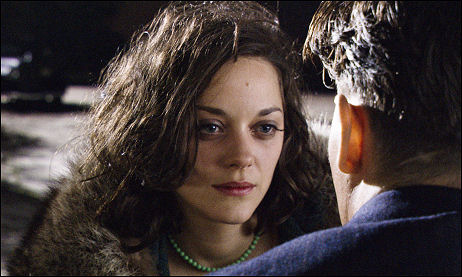
Marion Cotillard in Public Enemies
Even when Cotillard visibly melts at the end when Stephen Lang‘s G-man character delivers the final line (in what is easily the most moving scene), she does so with remarkable subtlety, like a survivor, like a woman who knows from dignity.
I came to this thought after reading Mark Harris‘s 6.28 N.Y. Times profile of Mann and the film, and particularly by this passage about Cotillard:
“[Mann’s] movies are known for many things, from technological virtuosity to narrative complexity, but prominent roles for women are not among his trademarks. The character of Billie Frechette is something of an exception. Several American actresses wanted the part; Ms. Cotillard won it even though her English was less than rock steady. ‘But she’s ferocious,’ Mr. Mann said. ‘She’s so focused and artistically ambitious that you knew that come hell or high water she was going to get there.'”
In short, Cotillard looks to me like a lock for Best Supporting Actress contention. Lang’s screen time is perhaps a bit too brief to warrant consideration but the way he handles that final scene with Cotillard is nothing short of beautiful. Another supporting standout is Stephen Graham‘s portrayal of Babyface Nelson — a screaming tempest, a madman with a tommy gun….”hey!”
In All Candor
I’m feeling a certain hesitancy about the fate of Public Enemies because of what I heard from a couple of critics after last Thursday night’s screening. (Others felt it was brilliant, which is also my view.) Like I said before, the critics and moviegoers who like their meatloaf, mashed potatoes and green beans are going to have problems with it. Public Enemies is a first-rate cops and robbers 1930s time-trip highdef-video art movie, but it ain’t meatloaf and it sure as hell ain’t McDonald’s. It’s a dish of almond praline semifreddo with grappa-poached apricots. Yes — a high falutin’ dessert, as in scrumptious. And then there’s that ending.
N.Y. Times reporter Brooks Barnes continued the food analogy in a recently-posted weekend box-office story, to wit: “People complain about Hollywood’s tendency to be unadventurous with its big-money titles, but the moviegoing masses clearly get the most excited when they are not being surprised. In other words, the multiplex really rocks when movies are served up the McDonalds way: predictably and comfortably.”
“Hold Me…”
I must have stuck my head into a couple of dozen bars, restaurants and clothing stores yesterday, and there were very few that weren’t playing tracks from Thriller. Clothing stores especially. “Billie Jean” in particular. And not once did I hear “Will You Be There?” It’s a little drippy here and there, but I’ve always felt this was Michael Jackson‘s best song. As much as I deplored who and what Jackson became over the last 16 years of his life, this song makes me put all that aside. I love the central melody and particularly the rhythm track — clap-clap, clap-pa-clap-clap.
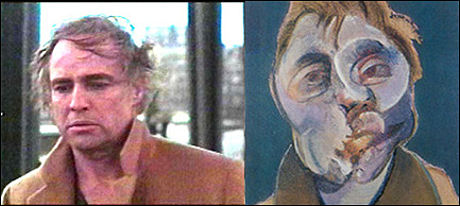
Camel-Colored Overcoat
I’m thinking I might do the odd thing and not sit here all day and write column stories. I’ve been telling myself I need to visit the Francis Bacon exhibit at the Met before it closes in August, and I’m thinking this is the day. I’ve worshipped his paintings nearly all my life, starting with my first viewing of Last Tango in Paris.
Takes One To Know One
An important tenet of auteurism is that the best films are always driven by an intimate connection between the director and the lead character. Alfred Hitchcock and James Stewart‘s Scotty Ferguson in Vertigo, Martin Scorsese and Harvey Keitel‘s Charlie in Mean Streets, etc. And it doesn’t really matter if the director admits to (or is even aware of) self-portraiture. Never trust the artist — trust the tale.
It hit me last night as I was preparing my questions for last night’s q & a with Hurt Locker director Kathryn Bigelow that there’s a certain kinship between herself and Jeremy Renner‘s Sgt. James character — a guy who lives for the thrill of a super-intense job (i.e., bomb defusing) and who isn’t much good at day-to-day normality.
The “tell” is in a 6.25 interview with Bigelow by Movieline‘s Kyle Buchanan.
Renner’s character “thrives on the theater of war and outside it he feels like an incomplete person,” Buchanan notes. “That’s a personality type I could apply to a lot of directors. Only when they’re on set do they feel most themselves. Does that describe you at all?”
“Oh, good question,” Bigelow answers. “I suppose, personally, from my frame of reference, production is very intense and nothing else comes quite close to that. And yet, as a kind of more meta version of myself at that time…I don’t know. I’d probably have to be far more self-aware than I am to answer that accurately. I thrive on production. It feels very much like a natural environment for me. I don’t know if I thrive in normal life.”
Coward that I am, I didn’t put this question to Bigelow last night. I suppose I was thinking that her response to Buchanan (“I’d probably have to be far more self-aware than I am to answer that accurately”) told me that asking this would result in an awkward moment and that she’d probably sidestep it. This is what happens when you come to really like a director personally — you start to feel protective.
But as I sit here this morning I’m fairly convinced of the Bigelow/James connection. It’s arguably why The Hurt Locker plays as well as it does, and why everyone is calling it her best film ever. Bigelow has always “gotten” guys in her films. We hold this truth to be self-evident.