The Naked and the Deadpan

Those Leslie Nielsen Naked Gun movies did pretty well in their time — the 1988 original took in $78 million (an excellent gross for the Reagan era) and the last one, Naked Gun 33 1/3: The Final Insult, earned $51 million domestic in ’94. But they’re old news and they’re over, for God’s sake. There’s no room for an old-dog comedy franchise in the Age of Obama. That’s what my attitude was, at least, until a Paramount employee slipped me a PDF copy of — prepare yourself — The Naked Gun: What 4? — The Rhythm of Evil.

Would such a property have worked a year or two after 9/11? Or two or three years ago? Maybe, maybe not. But right now people are so zombie-freaked by the destruction of their stock portfolios and retirement funds and the devaluation of their homes and their sharply-reduced ability to pay for their kids’ college tuitions that they’re probably ready to laugh at really dumb stuff again. Maybe. The key element, of course, is that is has to be seriously stupid. No fooling around, I mean.

What makes funny funny? There’s no explaining the how and why (and if you do you kill the joke), but I know it when I read it. And this script, penned by veteran sardonic-comedy guy Alan Spencer (Sledge Hammer, Hexed), made me laugh. It’s funny in a dry, smart, surreal-toxic sexual way. But then I’m from Mars so what do I know?

On top of which the films that I direct in my head when I’m reading stuff like this are always underplayed in an Ingmar Bergman-esque way, and the tendency of many (if not most) professional comedy directors is to broaden and underline so the least sophisticated dolts in Mumbai will get the joke. But the best stupid comedies are never aimed low — they’re written and directed by smart guys, and played as straight as Hamlet and aimed at jazz musicians and corporate CEOs and people who donate foundation money. Because once you start winking at the audience, you’re dead.

The three lead cop characters in Naked Gun: What 4? are Det. Vince Conklin (“Look, I represent the new America, the average person on the street desperate for change… like pennies, nickles, dimes”), Police Commissioner Roy McGlade (flip, blunt, crusty but benign) and Lt. Erica Litvak (30s, no-nonsense, a looker). Nielsen’s Lt. Frank Drebin has been put out to pasture, of course — living in Florida, golfing — so it’s wide open for whatever.

All I know is that “it’s ugly out there….like a boil on the buttock of a Sumo wrestler suffering from excema.” That’s a throwaway line from page four, delivered by a minor character.

I’m Not There

It’s not surprising to hear that Jonas Brothers: The 3D Concert Experience will clean up with a possibly $30 million (we all knew it was at least going to do Hannah Montana-level business). And learning that Slumdog Millionaire may take in a possible $9.5 million and thereby crack $110 million domestic is not exactly heart-stopping. But a decent summary of what may happen numerically has nonetheless been tapped out by Big Hollywood’s Steve Mason.

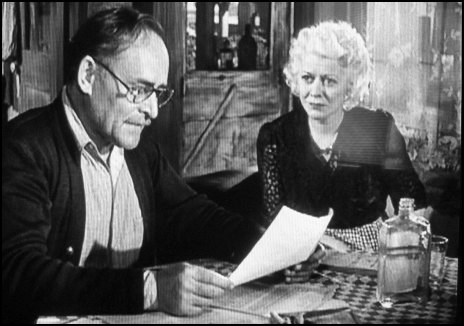
Two Older Guys

A somewhat older critic friend saw Watchmen yesterday and “dug it,” although his review will have to wait out the embargo. “As you may recall, I wasn’t a fan of The Dark Knight but I loved Batman Begins,” he said this morning. “I’m not a regular comic-book reader but have read Watchmen and felt like the film was faithful without being slavish — incredibly dark and violent, and not a comic-book movie for kids. And I thought [director Zack] Snyder‘s style was a perfect mesh with the material.

“On the other hand, I left the screening with a fellow critic (who shall remain nameless) whose first words were, ‘Did you hate that as much as I did?’ It will be polarizing, to say the least.”

“Undone By Reverence”

Finally, a non-vested, stand-up professional critic unblinkered by geek allegiances — Variety‘s Justin Chang — has weighed in on Watchmen and more or less called it a half-and-halfer.

“Auds unfamiliar with Alan Moore‘s brilliantly bleak, psychologically subversive fiction may get lost amid all the sinewy exposition and multiple flashbacks,” Chang says early on. “Though it cries out for equally audacious cinematic treatment, the novel has instead been timidly and efficiently streamlined by David Hayter (X-Men, X2: X-Men United) and Alex Tse, who struggle to cram as many visual and narrative details as possible into the film’s 161 minutes.

“From the clues and in-jokes embedded in Larry Fong‘s widescreen compositions and Alex McDowell‘s vaguely retro Gotham-noir production design to the meticulous narrative framework and whole chunks of dialogue lifted from the novel, there’s no question that Watchmen reps some sort of ultimate fanboy’s delight. Whether it’s Dreiberg’s flying owl ship or the staggering glass palace Dr. Manhattan conjures up on Mars, the filmmakers have spared no expense in their mission to visualize every last frame.

“Yet the movie is ultimately undone by its own reverence; there’s simply no room for these characters and stories to breathe of their own accord, and even the most fastidiously replicated scenes can feel glib and truncated. As Watchmen lurches toward its apocalyptic (and slightly altered) finale, something happens that didn’t happen in the novel: Wavering in tone between seriousness and camp, and absent the cerebral tone that gave weight to some of the book’s headier ideas, the film seems to yield to the very superhero cliches it purports to subvert.

“While [director Zack] Snyder still exults in gratuitous splatter (sawed-off limbs, dangling human entrails, a very random display of adolescent vampirism), he demonstrates a less oppressive directorial hand than he did in 300, avoiding that film’s ultra-processed digital look and shooting almost entirely on carefully mounted sets (pic was shot in Vancouver). William Hoy’s editing is fluent and measured, even when it cross-cuts rapidly in an attempt to echo the jumpiness of Gibbons’ comicbook panels.

While none of the actors leaves an indelible impression, Jackie Earl Haley‘s feral, ferrety Rorschach (narrating most of the film in gravelly voiceover) makes the most of his few unmasked appearances; Patrick Wilson is touching as a man emerging from physical and psychological impotence; and Matthew Goode is appropriately fey as the self-styled Veidt. Robert Wisden appears in a few scenes as Tricky Dick himself, complete with comically elongated nose, but doesn’t quite give Frank Langella a run for his money.

“After a victorious opening weekend, the pic’s b.o.. future looks promising but less certain.”

God’s Good Weasel

The slogan of Movieguide, a family-friendly Christlan conservative website that reviews movies with an eye for moral worthiness in themes and storylines, is “help us bring God’s light to an industry with much darkness — protect your family.” The site is published by Dr. Ted Baehr, a self-righteous media critic and chairman of The Christian Film and Television Commission. In short, a loon.


Dr. Ted Baehr

Baehr has just written a piece for Andrew Breitbart’s right-wing website Big Hollywood called “Sean Penn and His Buddies Will Sink Hollywood.”

“The Academy Award members painted themselves as a bunch of Commie rats last night when they applauded madly during Communist sympathizer Sean Penn’s gleeful greeting to them — ‘You Commie, homo-loving sons of guns!’ — after winning an award for portraying an assassinated homosexual leader,” Baehr wrote.

That’s it, the man has no sense of grace or wit or humor. He’s the pudgy kid who used to rat to the teacher about who was throwing spitballs when her back was turned.

“In the past, Penn has expressed support for Hugo Chavez, the neo-Marxist dictator of Venezuela, and Communist dictator Fidel Castro of Cuba.”

That firms it — Hugo Chavez is doing something right.

“What Penn and other Communist sympathizers in Hollywood refuse to recognize (at least publicly) is that American moviegoers usually reject movies that unabashedly promote a Communist or socialist viewpoint.”

Baehr has a point. People do tend to support movies about stand-alone, right-thinking heroes who stand up against repressive social convention or some kind of oppressive organized force. But give me half a day and I’ll think of some exceptions.

“For seven years, Movieguide has been looking at the political content of the Top 250 English-language movies that open nationally each year in the United States,” Naehr writes. “An examination of the domestic box office averages for movies promoting an unabashedly socialist or Communist viewpoint shows that such movies averaged only about $15.5 million and $7 million per movie from 2002 through 2008.

“And that includes the pro-Communist, socialist diatribes of Michael Moore , whose success at self-promotion leaves all other lefty filmmakers in the dust!”

Good God, the man is unhinged.

Baer’s Wikipedia bio says he has a rep for having accepted consultancy fees from reps of films his website has supported. It mentions a March 2004 article by Marshall Allen in Christianity Today that claimed Baehr’s public relations company, Kairos Marketing, accepted payment for consulting and promotional activities on behalf of six movies that were positively reviewed in Movieguide.”

Deep Web

How many HE readers have used kosmix.com as a search engine? A 2.22 N.Y. Times story about deep web search engines led me to it. Kosmix.com co-founder Anand Rajaraman was quoted saying that “the crawlable Web” — i.e., Google world — “is the tip of the iceberg.” Kosmix, the story said, “has developed software that matches searches with the databases most likely to yield relevant information, then returns an overview of the topic drawn from multiple sources.”

Kubrick Napoleon

Four months from now another big Stanley Kubrick coffee-table book called Stanley Kubrick: The Napoleon Film will be published by Taschen, running 1900 pages and costing I don’t know what….just under $300 quid? Written by Allison Castle and edited by Christiane Kubrick (i.e., Kubrick’s widow), it will focus entirely on the famous Napoleon biopic that Kubrick began working on in ’68 and bailed on four or five years later — i.e., “the greatest film that Kubrick never made.”

In a 1969 interview for his anthology book, The Film Director as Superstar, Joseph Gelmis asked Kubrick to define his passion about making a Napoleon movie.

“That’s a question that would really take this entire interview to answer,” Kubrick replied. “To begin with, he fascinates me. His life has been described as an epic poem of action. His sex life was worthy of Arthur Schnitzler. He was one of those rare men who move history and mold the destiny of their own times and of generations to come — in a very concrete sense, our own world is the result of Napoleon, just as the political and geographic map of postwar Europe is the result of World War Two.

“And, of course, there has never been a good or accurate movie about him. Also, I find that all the issues with which it concerns itself are oddly contemporary — the responsibilities and abuses of power, the dynamics of social revolution, the relationship of the individual to the state, war, militarism, etc., so this will not be just a dusty historic pageant but a film about the basic questions of our own times, as well as Napoleon’s.

“But even apart from those aspects of the story, the sheer drama and force of Napoleon’s life is a fantastic subject for a film biography. Forgetting everything else and just taking Napoleon’s romantic involvement with Josephine, for example, here you have one of the great obsessional passions of all time.”

It was said by Mystery Man after quoting the preceding passage that “Napoleon’s obsessional passion for Josephine is second only to Kubrick’s passion for Napoleon.”

Here‘s a PDF of Kubrick’s Napoleon screenplay, dated 9.29.69. And here’s an IGN script review that ran in 2000.

Robin of Fatsley

Roughly 40 days ago I read a Daily Mail story that said Sienna Miller had been dumped from Russell Crowe and Ridley Scott‘s Robin Hood project (once called Nottingham, now untitled). The reason was said to be Milller’s relative youth and very thin figure, which would have caused the not-thin Crowe to look too old and Friar Tuckish. I don’t know the final egoistic or caloric truth of things, but it’s what I read.

Now the Hollywood Reporter‘s Borys Kit has written that the rail-thin Cate Blanchett has been tapped for the Maid Marian role. Blanchett has always looked more starved than Miller, so one can assume that either (a) Crowe has been laying off starches, carbs and booze and hitting the old treadmill or (b) doesn’t mind looking like Friar Tuck and is cool with the proliferation of Fat Robin Hood cracks that are sure to be heard in comedy clubs nationwide and on Letterman and Leno. Crowe may have simply accepted being a man of constant tonnage.

That or he’s worked himself down to his old Cinderella Man weight (or close to it) and the Daily Mail observation is old news or was wrong in the first place.

It’s just funny how trade stories sometimes never discuss questions that everyone is wondering about because trade reporters don’t get into weight issues. I’m just saying that Crowe’s bulk is what came to mind when I read Kit’s Blanchett story. Instantly, I mean. And aren’t news stories supposed to answer who, what, when, where, how and possibly why?

Sushi Showdown

Tomorrow is Jeremy Piven day at Actors Equity headquarters at 165 West 46th Street, New York, NY. Hit for financial damages by the producers of Speed-the-Plow for abruptly bailing on their show, Piven will appear before a grievance committee to defend a claim that he was more or less forced to quit due to high levels of mercury in his bloodstream caused by gorging on sushi. I’m going to show up with my camera and try to take a photo. This sounds too good to pass up. I don’t know when the meeting is so I guess I’ll just show up at 9 am and take it from there.

Watchmen in Oz

HE reader Joel Meares caught Watchmen at a screening in Sydney last night (which would be Wednesday) and was came away “disappointed,” “confused” and “pretty mixed,” he says. Meares isn’t a geekboy and he isn’t exactly David Thomson either so his reactions are about what he liked and didn’t like — take it or leave it.

“I enjoyed the first half a lot,” he notes. “It’s dark, ambitious, New York noir stuff with lots of rain, violence and a gritty-sounding if sometimes unnecessary voice-over by Rorschach (the masked bloke played by Jackie Earle Haley). I liked the conceit that these people are washed-up superheroes, although I was never clear on whether or not they actually had super-powers. And the way it scuttles back and forth through time intrigued without adding any noteworthy confusion.

“I enjoyed Carla Gugino in her small role as the washed-up Silk Spectre. Malin Akerman is nowhere near as bad as I’d been hearing on the various sites. And Patrick Wilson is in fairly good form as the geeky Nite Owl.

“I liked that this is a comic book flick with a bit of sex and a lot of violence. I liked — to a point — the incorporation of real-life events (JFK assassination, Vietnam War, etc). I liked that Snyder uses songs from the mid ’80s and from just before, although these don’t always work with what’s happening on screen and seem a bit thrown in for the sake of it.

“I’ve never seen 300 so knew very little about Snyder’s style other than that it involves a lot of that slow-down, speed-up action stuff. He uses that technique in a lot in Watchmen‘s fight sequences and I was fairly neutral about it — didn’t find it too distracting, felt it didn’t add very much.

“My biggest problem with the film was that as soon as these guys put their suits back on and decide to save the world in the final portion (save the world from what I’m still not sure about, and the uber-villain’s explanation of his actions is out-of-this-world dumb), the film becomes ridiculous. Maybe you have to be a fan to get all that psychobabble from Billy Crudup‘s naked and very blue Dr. Manhattan.

“From the moment Snyder gives us one of the most laughable sex scenes I’ve ever seen, the movie goes off the rails. When it came to the Antarctica-set showdown in which they all come together to fight the villain and his strange blue pointy-eared tiger thing (where the hell did that come from?), I felt like I was watching some awful panto-opera take on Masters of the Universe.

“Everything that was good early on is unstuck by the time the credits role and I came away disappointed and confused.”

“Here’s a bit of background on myself. I’ve never read a comic book in my life, hadn’t heard of Watchmen until I started reading about the film, but I’ve been known to enjoy a good comic flick, I’m a pretty easy lay as you might say (loved Dark Knight, really liked Spider-man 2, enjoyed Iron Man, etc.). I thought last year’s best film was Revolutionary Road, and my favorite US film of the last few years is probably Zodiac.”

Bigger, Cleaner, Safer

The Slumdog Millionaire tykes Azharuddin Mohammed Ismail and Rubiana Ali Qureshi, whose real-life living conditions in Mumbai were described in suspiciously-timed stories that some regarded as anti-Slumdog smears, have been promised new homes. The abodes will be an upgrade over the small huts the kids have been living in with their families. But it isn’t clear who will actually provide the new digs — local Mumbai politicans or Slumdog Millionaire‘s director Danny Boyle, producer Christian Colson and Fox Searchlight, the film’s distributor.

Times Online reporter Rhys Blakely reported today that the “children’s families will be given proper homes under an arrangement that allows local politicians to allocate a small number of flats on a discretionary basis.” He also quoted Amarjeet Singh Manhas, the chairman of the Maharashtra Housing and Area Development Authority, as saying that the kids “deserve to be rewarded for the film’s success at the Oscars…the chief minister [of the state] has approved this…their families will receive notification in a couple of days.”

Daily Mail reporters Liz Thomas and Barney Henderson have also reported today that Boyle and Colson have told them that the kids and their famililes “will be moved to apartments worth ¬£20,000 each in the coming months.”

Slumdog Republican

“There’s an intra-Republican debate: some people say the Republican party lost its way because it got too moderate, some people say they got too weird or too conservative. [Louisiana governor Bobby Jindal] thinks they got too moderate, and he’s making that case. it’s just a form of nihilism. It’s just not where the country is, it’s not where the future of the country is [and] I think it’s insane. I think it’s a disaster for the party.” — Conservative-minded N.Y. Times columnist David Brooks, speaking last night to Jim Lehrer.

Here’s Cenk Uygur talking last summer about Jindal’s exorcism episode.

Thansk to HE reader “raygo” for coining the headline of this piece.