Fangs and Mormonism

I get it. I know why the mostly female audience (literally young or young at heart) is expected to flock big-time to Twilight (Summit, 11.21). It’s because they’ve read Stephenie Meyers‘ books (or book) and they basically expect the film to be Wuthering Heights with fangs. Fine — no problem with that.

And I know for sure that the vast majority of this audience doesn’t care very much about Meyers’ Mormon background. And that fans who are aware of this probably haven’t noticed (or cared to notice) what themes or metaphors in the books and the film express some aspect of Mormon culture.

But once the film is finally screened for people like me (which will be…what, two days before it opens?) and once it opens commercially, I’d like to read a concise and knowledgable piece that explains it all without going on and on. The Mormon Undercurrents in Twilight for Dummies. I’m not looking to bash the film because of any possible Mormon tissue within. Like I said, most of the fans don’t know or care about the undercurrents, and I have other fish to fry.

But if there’s any kind of theological Mormon presence in Twilight, I’d like to clearly understand what it is. Even if there’s just a faint aroma, I’d like to sniff it with forearmed knowledge.

Hoboken, Baby


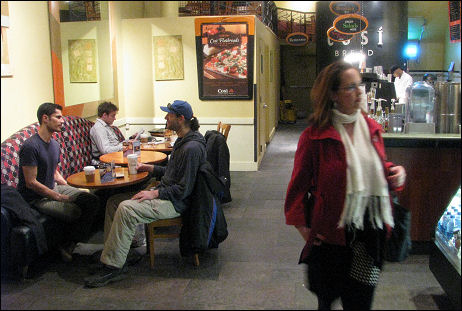
Hoboken cafe — Tuesday, 11.11.08, 5:35 pm

Tuesday, 11.11.08, 5:55 pm
Hoboken’s
Stevens Park, where Marlon Brando first came on to Eva Marie Saint (“It’s okay, I’m not gonna bite ya,” “Glasses, braces, your hair like a hunk of rope…you was really a mess”) in On The Waterfront — Tuesday, 11.11.08, 5:50 pm

Live Dead

Spoiler-Sensitive Types Beware: Baz Luhrman‘s Australia, which will have its first screening on or about 11.18, or eight days before it opens, is perceived in some quarters to be a little too broad and big-screen schmaltzy to warrant major interest. (That’s strictly a reaction to the trailer, of course.) Well, I have a suggestion for upping the intrigue. But before I mention it, though, the spoiler whiners need to stop reading right now.

Sunday’s news from Down Under was that Luhrman “has bowed to studio pressure for a happy ending by letting Hugh Jackman‘s character live instead of die.” My idea (and I think it’s inspired) is that 20th Century Fox should release the “dead Hugh” version in a small number of big-city theatres — 15 or 20 or 25 prints, tops — while mass-releasing the “live Hugh” version to mainstream theatres coast to coast.

What am I saying in essence? That Fox’s theatrical plan simply imitate the multiple version DVD aesthetic in the roll-out plan. We’re all familiar with alternate versions and Director’s Cuts and seeing different formats (35mm vs. IMAX) in different theatres, so why not follow this lead during the initial theatrical opening? I would frankly rather see the “dead Hugh” version, which I gather is the one Luhrmann favors. Who wouldn’t?

If I was Fox chairman Tom Rothman I’d release the “live Hugh” version wide so as to protect the film’s potential revenue, but where’s the harm in letting particular people see the director’s cut at the same time in a few select theatres? Obviously people like me would want to see both to compare. The film would take on a certain intrigue if this was to happen.

Hollywood honchos used to believe that putting out different versions of a film was an indication of weakness and indecision. I don’t think people see it that way any more. We all know there are different versions of everything — it’s par for the course. Show it all, let it all hang out.

Discipline

All right, that’s it — Twilight author Stephenie Meyer gets a permanent cultural demerit for telling Entertainment Weekly that Robert Pattinson‘s performance in the upcoming movie version is “Oscar-worthy.”


Twilight author Stephenie Meyer

Pattinson has a bright future ahead, but only a shameless and unrestrained egotist would call his performance, no matter how affecting or dynamic, a piece of Oscar bait, given that Twilight is generally considered to be gothic-romantic teen-girl trash and is therefore automatically out of consideration. On top of the fact that Summit Entertainment is barely screening Twilight and pissing journalists off as a result, or certainly making them suspicious.

Meyer “realizes that the hope of Twilight getting Oscar respect may have the blood drained out of it by the fact that this is a vampire romance and it’s basically aimed at teens,” according to Entertainment Weekly, but “when they see the movie — oh, my gosh — there’s no way not to love him!”

Maybe so — Patinson is obviously a good-looking guy and we’re all partial to Brits besides — but in what diseased realm does puppy-goth lovability translate into Oscar-worthiness? Meyer has to learn that without certain Oscar criteria agreed to and enforced by the filmmaking and film-reporting community, nothing means anything.

Oh, and Meyer gets another demerit for spelling her first name “Stephenie.”

New Costner Romance

Arizona Daily Star critic Phil Villarreal has reported that Oscar-winning screenwriter Michael Blake (Dances with Wolves) told him earlier today “he’ll collaborate again with Kevin Costner on The One, a romantic tragedy based on a screenplay Blake adapted from his short story.

Costner “will play an outcast from a wealthy family who has waited until middle age to meet the right woman,” Villarreal writes. (What does “waiting” mean? The guy never dates women? Is he into a Lars and the Real Girl type deal?) His holdout pays off when he meets the woman of his dreams, but the love story takes a tragic turn.

“It’s not going to be epic but will be pretty good in its own way, with true sentiment,” Blake says. A happy ending is promised, he adds.

Let me explain something. Happy endings aren’t that important. What matters if that an ending has to feel honestly arrived at and a natural outgrowth of the story. Viewers need to feel that on one level or another justice has been served and that the “right” thing has happened. And that doesn’t necessarily mean “happy.”

Blake hopes/believes that the project, a non-studio thing, will “start shooting soon,” PV writes.

Warming Trend?

“You’ll be holding your breath for the first 15 minutes of Quantum of Solace — the action is that gripping,” writes critic Marshall Fine. “And you’ll be out of breath by the end – the film is that compelling.

Casino Royale hinted at it, but this new James Bond film is the one that truly announces: Here’s the Bond for the 21st century. The Bourne films pointed the way but Quantum of Solace, directed by Marc Forster, will be the template for the adult spy thriller in the new millennium.

“It’s got a plot that engages without being gimmicky, action that thrills and a serious emotional palate that leaves little room for the kind of jokey badinage that Pierce Brosnan and his predecessors had to put up with.”

I’ve had to wait and wait and wait, but the Big Encounter happens tomorrow evening at the AMC Lincoln Square.

Old News

Last night Variety‘s Michael Fleming reported that the Weinstein Co. “has acquired worldwide film rights to the Pulitzer Prize and Tony-winning play August: Osage County and will produce a feature adaptation. TWC co-chairman Harvey Weinstein will join Jean Doumanian and Steve Traxler as producers of the pic, with playwright Tracy Letts doing the adaptation.”


Deanna Dunagan (r.) as Violet Weston, the family matriarch; Amy Morton (l.) as her daughter, and Rondi Reed (center) as Violet’s sister.

Except seven and a half months ago I wrote that “producer Jean Doumanian is partnering with the Weinstein Co. to produce a film version of Tracy Letts‘ masterful August: Osage County, which N.Y. Times critic Charles Isherwood called ‘the most exciting new American play Broadway has seen in years’ in his 12.5.07 review.”

So what’s new here? Steve Traxler is part of the deal, and the film will be out sometime in ’11 — three years hence. Are they sure they don’t need four or five? Don’t want to rush things. Haste makes waste.

Cut to the chase already and tell us if Harvey and Jean are signing Meryl Streep to play the chain-smoking mother from hell Violet Weston or if they intend to stay with Deanna Dunagan, who killed in the stage version.

“As always, a Broadway hit is one equation and a satisfying hit movie is another. The stage-to-cinema process is always about rethinking, reshuffling, compressing, diluting and, in one way or another, downgrading to some extent,” I wrote last March. “A need for a broader audience = the need to make a play more accessible to Average Joes = problems from the viewpoint of Broadway purists.

“The big questions are (a) will the movie version hold to the play’s three-hour length (there will certainly be pressure to trim it down at least somewhat, perhaps as much as a third), (b) will they try to movie-ize it (visually open it up, etc.) or stick to the pure theatrical scheme of everything happening in the Weston family’s two-story home, and (c) who will Doumanian-Weinstein get to direct…Mike Nichols?

“Doumanian and Traxler, who are lead producers on the Broadway production with Jeffrey Richards and Jerry Frankel, made a deal with Letts during the summer to work on a script,” Fleming reports. “Doumanian said she hopes to have a Letts-penned screenplay within two or three months.

“Weinstein is an investor in the stage play, which begins an eight-week engagement Nov. 21 at London’s National Theater. A national tour starts in the summer.”

Do Unto Others

I missed this yesterday. Every latent homophobe out there (and particularly the African Americans and Hispanics who voted for Barack Obama and California’s Prop Hate) needs to listen and reflect. Just a couple of minutes. Won’t mess your day in the slightest.

No Rules

Yesterday Big Bloggy Picture‘s Patrick Goldstein posted a discussion with Sony chairman Amy Pascal about “new rules” that sometimes come to mind when a particular type of movie has just tanked. Death of Soul Men = no more movies about soul singers. Death of The Invasion = WB chief Jeff Robinov reportedly telling producers that WB is “no longer doing movies with women in the lead,” etc. How phobic is Pascal along these lines?

“I did say [that] I hate movies that begin with a bet,” Pascal replies. “It’s a bad idea, because it usually means that it’s a fake story that revolves around a gimmick. But on the other hand, someone made My Fair Lady and it was great.

“Rules are oversimplifications, which are bad no matter how you look at it. It would be like my saying, ‘I’m so sick of Iraq movies, so I don’t ever want to see another script about Iraq.’ But that’s just my reaction in the moment. Someone will make a phenomenal movie about Iraq and everyone’s attitude will change.”

Wells to Pascal: Someone has made a phenomenal movie about Iraq, or at least a first-rate one set in Iraq — Kathryn Bigelow‘s The Hurt Locker.

“We all probably say things like [this], but it’s in the heat of the moment — everyone says things they don’t really mean. So if there’s a really young executive in a meeting and they hear you say something, even though you almost didn’t mean it the minute it came out of your mouth, they sometimes take it seriously, when they should probably do what you do, which is forget all about it five minutes later.”

In other words, we are all Walt Whitman in a sense. We mean what we say when we say it, and then the page turns and maybe we’re looking at things in a slightly different light. Declarations of conviction, faith and aversion are never final. “Do I contradict myself? Then I contradict myself,” Whitman wrote in “Song of Myself.” “I am vast. I contain multitudes.”

Put In Its Place

“A potentially exceptional story is told in a flatly unexceptional manner in Defiance,” says Variety‘s Todd McCarthy in an 11.10 review. “True-life yarn of a band of Jewish brothers who led a small but resilient resistance movement against the Nazis in Belorussia during World War II seems like such a natural for the bigscreen that it’s surprising it’s never cropped up before.

“But Edward Zwick‘s version of the grim but inspirational events becomes more conventional as it goes, topped by a climax straight out of countless war pics and Westerns.

“Through roughly the first half, viewer goodwill and interest are piqued by the story’s basic circumstances, the promise that at least some of these characters will find a way to prevail, Craig and Schreiber’s rugged appeal, and the muted beauty of Eduardo Serra‘s blue-, green- and gray-infused location cinematography in the forests of Lithuania.

“But through the remaining hour-plus of the script by Clayton Frohman and Zwick, it all becomes pretty standard-issue stuff, filled with noble and tragic heroism, familiar battle images and last-second rescues.

“None of the suffering, sacrifices, anxieties or tests of heart and soul are rendered with any special dimension or heightened force, nor depicted with anything near the staggering, hallucinatory impact of the two great Russian films to have depicted events in wartime Belorussia, Larisa Shepitko‘s 1977 The Ascent and her husband Elem Klimov‘s 1985 Come and See.”

“Zwick has made the debatable decision to have all the actors deliver their dialogue in English with a roughly Slavic-cum-Russian accent, then speak (subtitled) Russian when the occasion demands it. Given the odd disorientation this provokes, one wonders if the accents were worth the trouble.”

For What It’s Worth

I’m getting a funny aroma from this second-hand, loose-talk, Playlist-posted review of The Curious Case of Benjamin Button, which came from a conversation between Playlist editor Rodrigo Perez and a friend who’d just come from a screening. The gist is that “while the guy didn’t think it was terrible, [he] did say the film wasn’t the tearjerker we all heard it was supposed to be and was much more of an ’emotional dud.'”

That aside, the friend said that David Fincher‘s film has “the kind of tepidness that the Academy loves.”

The reason I’m skeptical is because of a line at the end of the fourth paragraph. After Perez expresses his own concern that Button might contain “some fanciful Forrest Gump-like elements within the story given that Gump screenwriter Eric Roth also penned Button,” he says that the friend “confirmed that the film contained some icky traces of that unfortunately highly-respected dud.”

Forrest Gump bothered the hell out of me, but it obviously worked on its own treacly and manipulative terms — many people were obviously knocked over by it — and calling it a “highly respected dud” is rash and intemperate. This tells me there’s a slash-and-burn, screw-emotion, hard-hearted mindset at work here.

“Apparently the older crowd [at the screening] was digging it and weepy,” Perez summarizes, “but it sounds like a film [that] younger audiences and younger critics might not get behind and support whole hog.” The friend added, however, that “if it becomes a popular hit a la Gump its chances with the Academy will increase.” Naturally.