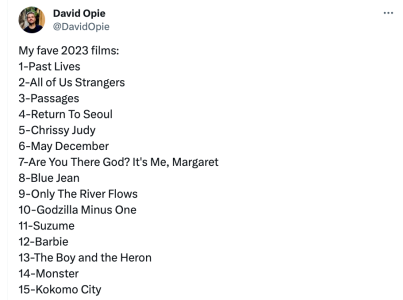
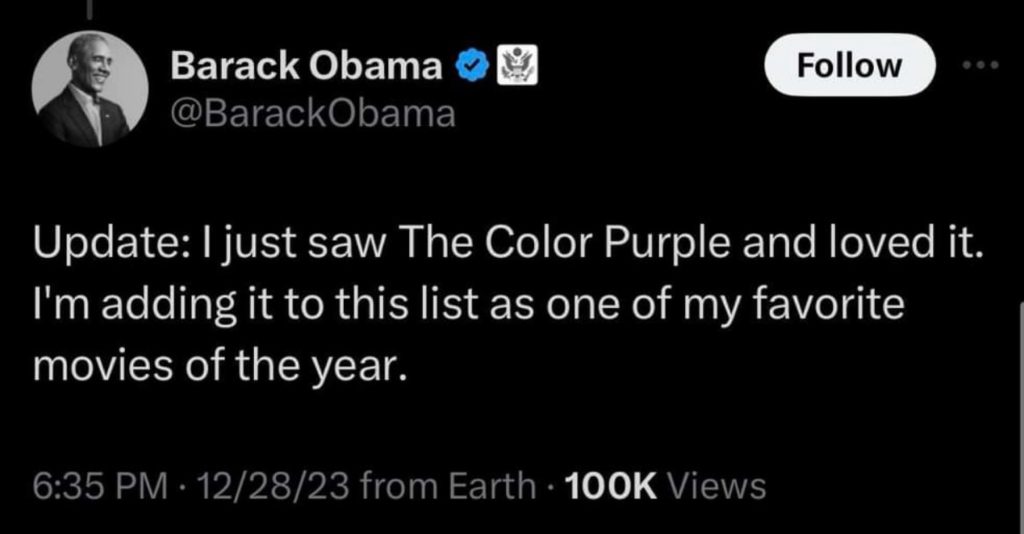
All of these films except Barbie and Godzilla Minus One are passive or “sensitive” or squishy to a fault…very little investment in straight-up, well-crafted, regular guy stuff…icky…kinda kewpie doll-ish…Jesus.
What about Maestro, The Holdovers, Poor Things, American Fiction, The Killer, The Pot-au-Feu, Ferrari, The Covenant, The Teacher’s Lounge, The Zone of Interest, Oppenheimer, Fallen Leaves, The Pigeon Tunnel, Blackberry, The Burial, Beau Is Afraid, Air, Black Flies, You Hurt My Feelings, Mission: Impossible — Dead Reckoning, Part One…what’s up with this guy?
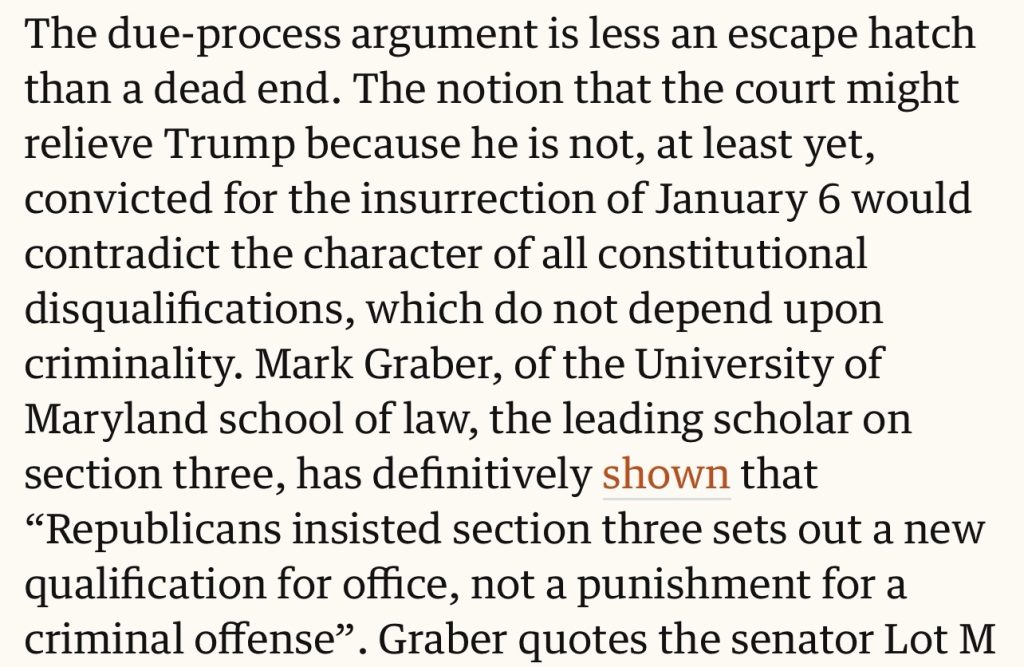
The whole “you can’t penalize Donald Trump because he hasn’t been convicted of insurrection” argument is a dodge based upon ignorance.
The “leave the animal alone” argument is based upon a mistakenunderstanding that blocking him from appearing on primary ballots in Colorado and Maine is punitive — an unfair punishment, his defenders believe, because Trump hasn’t been found guilty of insurrection in a court of law.
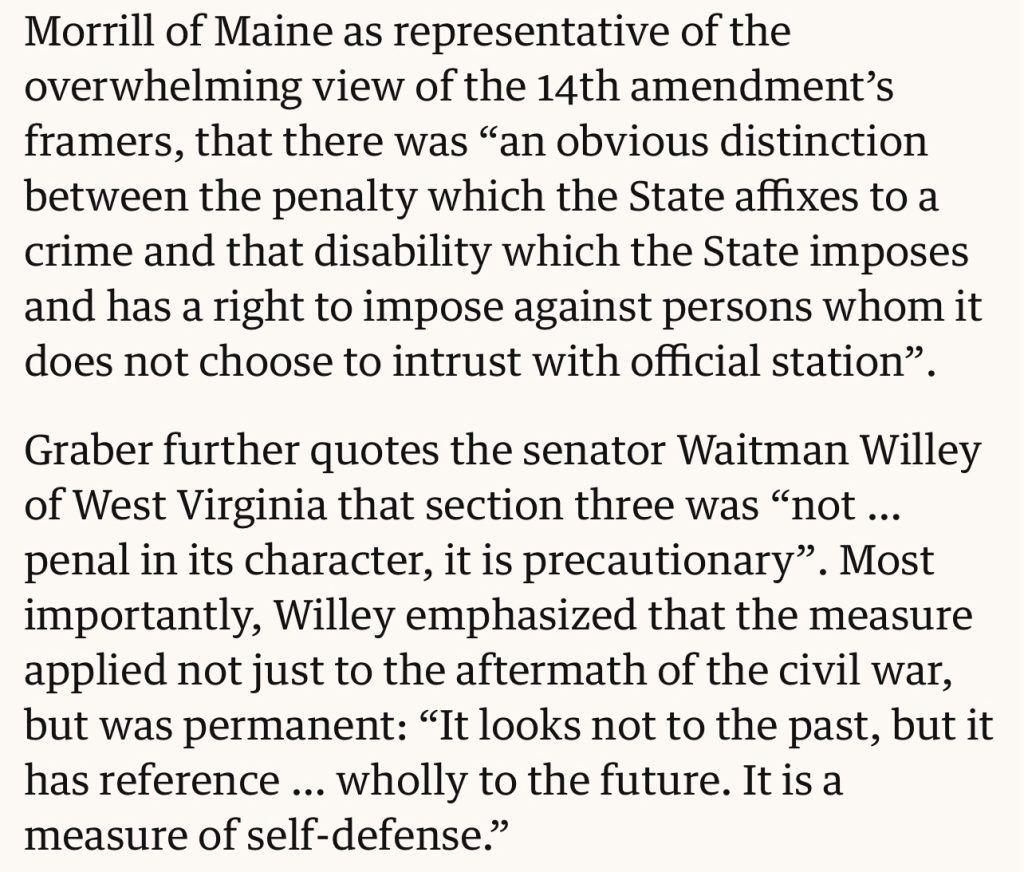
In fact section 3 of the 14th amendment is not about bitch-slapping an alleged insurrectionist but defending the workings of government from what judges may believe to be potential malignancy.
Leading section 3 scholar Mark Graber (University of Maryland school of law) says the amendment is about “qualificationforoffice, not a punishment for a criminal offense.”
— from a 12.26Guardianessay by Sidney Blumenthal. The subhead reads, “The [Supreme Court] can only rescue Trump by shredding originalism and textualism. Will it?”
The great Tom Wilkinson has passed at age 75. Hugs and condolences. For me Wilkinson’s two finest performances were the ones that resulted in Oscar noms — the grief-plagued small-town doctor in Todd Field‘s In The Bedroom (’01) and the brilliant, emotionally unstable attorney in Tony Gilroy‘s Michael Clayton (’07).
I’ve watched these two films repeatedly, year after year, and Wilkinson’s work has always been a central motivation. The performances are poles apart emotionally, and yet equally fascinating. I’m thinking about watching Clayton again tonight for tribute’s sake. I just re-watched Bedroom three or four weeks ago — I need some time off in that resepct.
Wilkinson won a Best Supporting Actor BAFTA Award for his performance in The Full Monty (’97). Honestly? I’ve never seen it because I’m afraid of middle-aged wangs bouncing around.
I’m just sorry that Wilkinson participated in historical fabrication by playing President Lyndon Johnson in Ava DuVernay‘s Selma (’14). Not by his own design, but still. The film fantasized that LBJ tried to pressure Martin Luther King into backing off on the 1965 Voting Rights Act with audio tapes of King’s hotel room indiscretions, which LBJ allegedly ordered J.Edgar Hoover to assemble. Complete bullshit.
Wilkinson was first-rate in In the Name of the Father (’93), Sense and Sensibility (’95), Shakespeare in Love (’98), The Patriot (’00), Eternal Sunshine of the Spotless Mind (’04), Batman Begins (’05), Valkyrie (’08) and The Grand Budapest Hotel (’14).
Wilkinson won both a Golden Globe and a Primetime Emmy Award for Best Supporting Actor in a Miniseries or Film for playing Benjamin Franklin in the HBO’s John Adams (2008).
In his latest (12.29) newsletterJeffSneider has posted a new For Your Consideration video (12.29) with Scott Mantz and Perri Nemiroff, in which they kick around the leading Best Supporting Actor contenders.
Their current faves are Oppenheimer‘s Robert Downey Jr. (strong impression as despicable Salieri figure), Barbie‘s Ryan Gosling (essentially a superficial goofball performance), Poor Things‘ Mark Ruffalo (hey, I’m playing a pathetic libertine asshole really broadly…ohhh!), Killers of the Flower Moon‘s Robert De Niro (easily the most irritating, one-note supporting performance of the year…his “King” Hale literally gave me a headache during my second viewing of KOTFM), May December‘s Charles Melton (a vote for Melton being a vote of compassionate support for all real-life minors who’ve been sexually assaulted by adults, plus he’s half Korean!) and American Fiction‘s Sterling K. Brown (funny, blunt-spoken gay guy).
And of course, Mantz, Nemiroff and Sneider completely ignore Blackberry‘s Glenn Howerton. Because they’re afraid of sounding like outliers…because they want to play a safe consensus game by favoring corporate-backed contenders.
It doesn’t matter how riveting Howerton’s Jim Basillie is, right? And to hell with that rickety, old-school requirement that at least one Oscar-aspiring supporting performance should hail from the indie sector, n’cestpas?
Mantz mentions that he had Howerton on his list but…uhm, that ship has sailed. “Way back in the day we had Glenn Howerton,” Nemeriff says dismissively.
At the top of his 12.29 column Sneider writes, “In addition to becoming outright boring, much of the entertainment media, which ostensibly exists to serve as the voice of the people who make up this beloved community of ours, instead serves as the voice of the corporations that finance it.”
That is precisely what Mantz, Nemiroff and Sneider are doing by blowing off Howerton in favor of Downey, Gosling, Ruffalo, De Niro, Melton and Brown.
It is HE’s view that Howerton’s performance is just as good as Downey’s, and at the same time is quite funny if you understand asshole behavior. Truth be told, Downey’s Lewis Strauss is a drag to hang out with, and by the end of the film you’re thinking “Jesus, I get it, he’s a dick…enough already.” Yes, Downey brilliantly plays a weasel, but how hard is it to radiate weasel vibes? Weasel weasel weasel weasel weasel weasel…Weasel J. Weisenheimer.
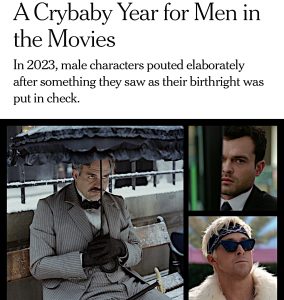
“ACrybabyYearFor MeninMovies,” a 12.27 N.Y. Times piece by Natalia Winkelman, lists six 2023 films that featured whiny-ass males weeping and hissyfitting about “a perceived loss of power to a woman.”
The man-babies are played by Mark Ruffalo, Ryan Gosling, Alden Ehrenreich, Samuel Theis, Joaquin Phoenix, et. al.
But one significant crybaby has been overlooked.
Cillian Murphy’s titular physicist character in Chris Nolan’s Oppenheimer, set in the 1940s and ‘50s, never frets over anything to do with power dynamics between men and women.
He is, however, called a “crybaby” by Gary Oldman’s Harry S. Truman in a pivotal third-act scene, and he does weep about having figurative blood on his hands over the A-bomb having killed thousands in Hiroshima and Nagasaki.
And so I figured that a Times article with “crybaby” in its headline…I naturally expected that J. Robert Oppenheimer would warrant some kind of side-mention…no?
“No” because Winkelman’s article is a feminist hit piece about shitty little men, not just in 2023 films but in all corners of the current culture. Oppie is therefore excused as his kind of wailing isn’t sexist in nature.
He does, however, whine about having “become death,” etc. Mainly, I would say, because he lacks a certain adult perspective. Oppie would’ve been fine with the A-bomb murdering tens of thousands of mostiy innocent Germans but he felt badly about tens of thousands of mostly innocent Japanese being wiped out. To this day I’m unsure about the difference.
What I’m really saying, I suppose, is that “crybaby” shouldn’t have been in the headline.
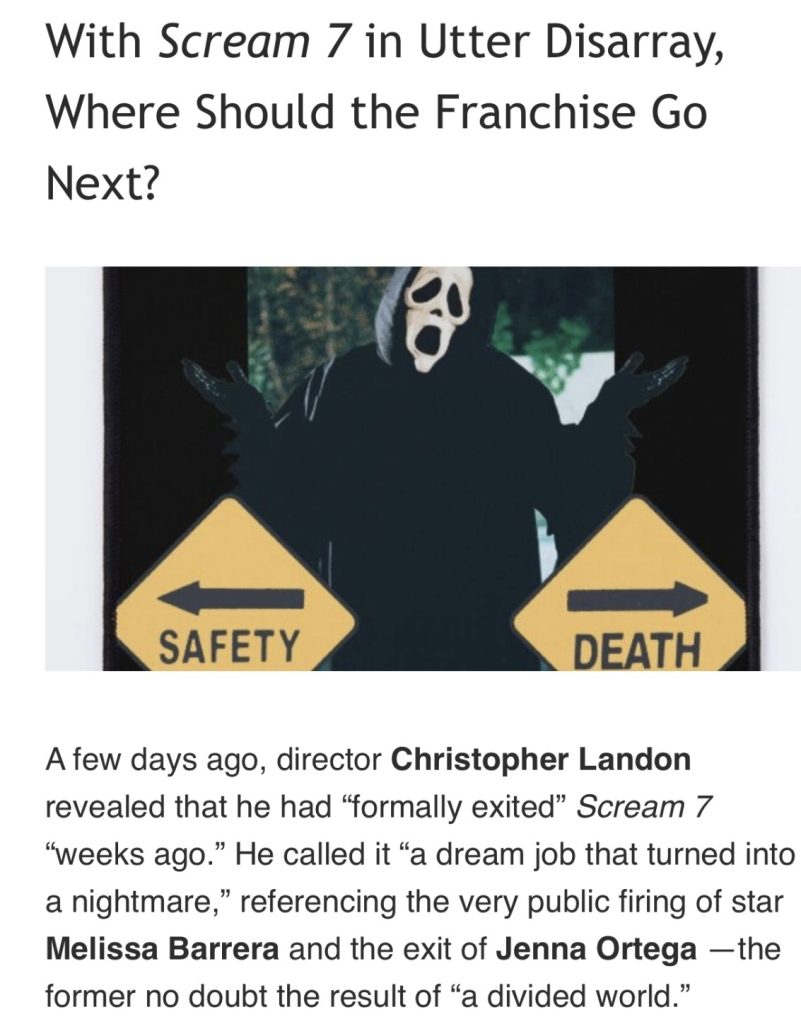
How and why could a smart industry columnist who knows what goes…how could anyone with a semblance of insight and rationality care about the emptiest, mostnihilistic and thoroughlyrepellentfranchise in the history of cinema?…what kind of person says “this franchise is important to me” and “I want it to continue”?
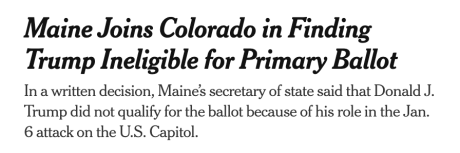
Maine’s Secretary of State Shenna Bellows has given the heave-ho to The Beast, at least as far as her state’s Republican primary ballot is concerned. Bellows’ decision comes a week after Colorado’s supreme court disqualified Trump from appearing on the ballot there.
From Bellows written decision:: “I am mindful that no secretary of state has ever deprived a presidential candidate of ballot access based on Section 3 of the 14th Amendment. I am also mindful, however, that no presidential candidate has ever before engaged in insurrection.”
A message is now being telegraphed to other states that are pondering whether or not insurrectionists deserve to be disqualified from appearing on state ballots: “Safety in numbers, bros! Jump in, join us, the water’s fine”, etc.
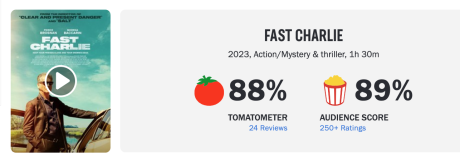
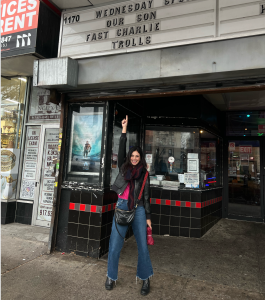
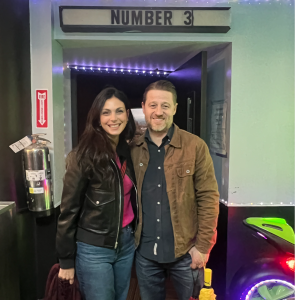
On the opening day of Philip Noyce‘s Fast Charlie, costar Morena Baccarin (Homeland, Gotham, The Endgame, the Deadpool franchise) naturally wanted to see the just-opened thriller, in which she costars with Pierce Brosnan, in a proper setting. And so two days later (Sunday, December 10th) she had quite the theatrical encounter. It happened on the third day of Fast Charlie‘s only NYC-area booking.
The bayou-based thriller was berthed at the Kent Theatre (1170 Coney Island Ave.), which is in the Kensington district.
Morena and actor-husband Ben McKenzie had decided to catch a screening over dinner on Friday, 12.8. They invited three family members but soon after discovered that only a single noon screening was scheduled for Sunday — the only showing that Fast Charlie was afforded that day. That’s correct — no late afternoons or evenings.
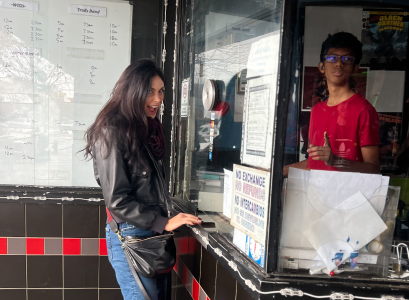
So come Sunday they all trouped out to the Kent, which is located, Morena says,”in a very old-school Brooklyn neighborhood…not a lot of people hanging around.” It was fairly rainy. They arrived around 11:30 am, and encountered a 15 year-old employee who was just opening up.
Morena: “Hey, we’re here to see Fast Charlie!”
15 Year Old Kid: “Uhm, whut?” (recovers from shock, collects himself) “Uhm, I’m not sure we’re showing it because Fast Charlie has not been a popular film so far. I’ll…uhhm, I’ll have to ask the manager.”
The manager said okay and so Morena, Ben and the gang entered the lobby, bought loads of candy and popcorn and settled into the film. Except the Kent staff had forgotten to turn the theatre lights off when the film began. Ben asked if they would mind doing so. The sound was fine, Morena recalls.
The film was great and they all had an excellent time, and the Kent staff was very polite. No, neither the 15 year-old kid or the manager realized that Morena was Brosnan’s top-billed costar. Or if they did they didn’t let on.
Morena and Ben would’ve preferred it if Vertical had booked Fast Charlie into the Cobble Hill Cinema plex, which is close to where they live. Or at one of the nearby Alamo theatres.
Fast Charlie team to Vertical Distribution: Thanks for an immersive last-exit-to-Brookyn experience that we’ll never forget!
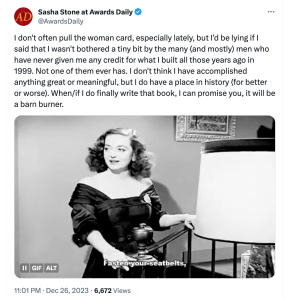
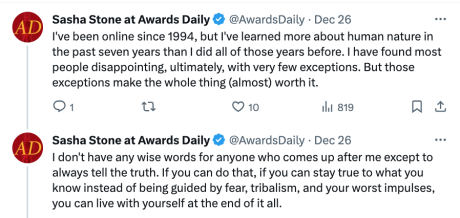
Eight months hence Hollywood Elsewhere will celebrate 20 pounding years in this dog-eat-dog racket. (25 if you count the Mr. Showbiz, Reel.com and Moviepoopshot iterations.) But now is the time to pay respect to the bold and brave Sasha Stone, who’s been plugging away for more than 24 years. And who may treat ys all to a recollection of these 20 years of struggle.