[Postedon5.4.15] The very first time I’ve ever heard that familiar John Williams theme coming out of a wooden, 1930s-era radio. It’ll probably turn out to be the last time. The radio is located at Dun-Well Doughnuts on Montrose near Bushwick. But that’s not the point.
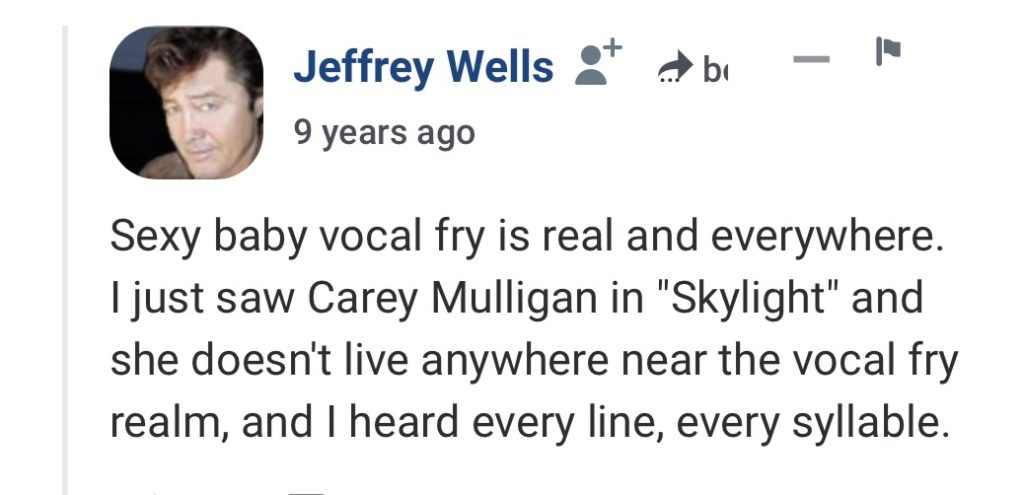
The waitress behind the counter spoke with the usual mincing, sexy-baby, beep-uh-duh-beep-beep vocal fry. When she asked if I wanted soy or almond milk (as they have no dairy), it sounded like “deebeedeesoyahahmand?” Uhm…are you asking if I want regular or low-fat milk? “M’sayingweeyonlyhavesoyahmand.” Soy or…? “Soyahamand.” Which is the least problematic? “Soy.”
OPPENHEIMER is still the best film of the year. I'm not sure if any film of 2023 can surpass it. This film is firing on all cylinders, with extraordinary performances, astounding visuals, and a sweeping, epic story. Watching this in IMAX 70MM is just an unmatched experience. pic.twitter.com/Ur7zY1r4kJ
“When will the Democratic Party stop sitting on its hands and do something about the dire reality of the coming presidential election?
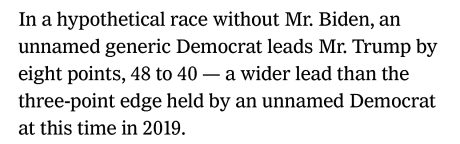
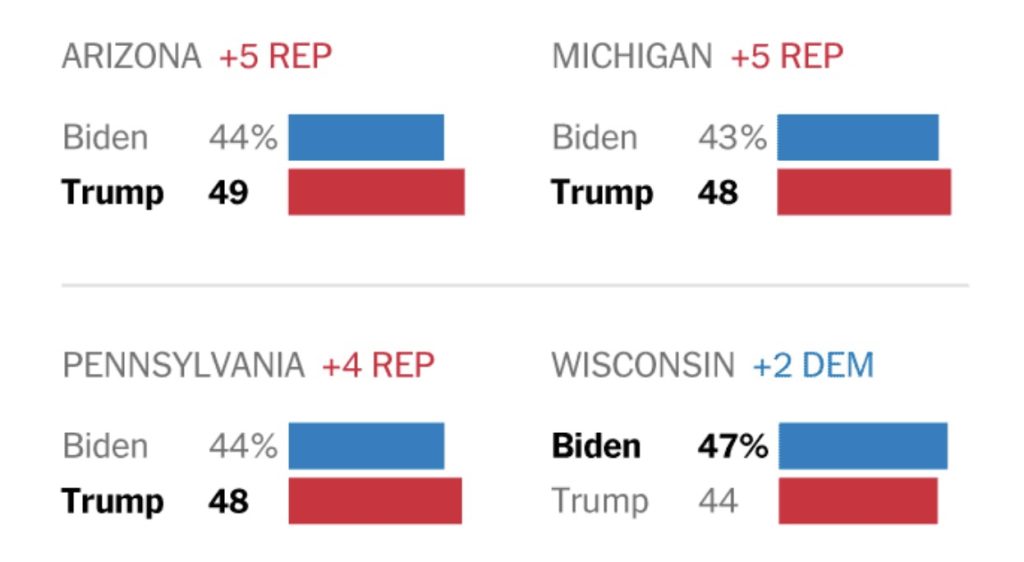
“The most recent New York Times/Siena College poll has President Biden behind Donald Trump in five of six swing states while his approval ratings among youth and minorities — two essential demographics for the party — continue to plummet.
“There comes a time when we have to say, ‘Dad, you’ve been a wonderful father and we love you dearly, but we are taking away the car keys.’
“We can all see it: the shuffle, the drifting focus, the mental confusion during a news conference in Vietnam. Mr. Biden’s handlers keep him under close wraps now, but the gasps among the electorate are going to be frequent when he gets out on the campaign trail debate circuit.
“This is no time to nominate an octogenarian who refuses to acknowledge his visibly dwindling abilities.
“The fact that Mr. Trump is only three years younger is irrelevant. Facts, logic and even multiple criminal proceedings are nonfactors when your opponent is a cult figure whose worshipers are willing to follow him blindly into authoritarianism.
“What the Democrats need to win is vigor, freshness and the hope of positive change. This is no time to cling to gentlemanly traditions of incumbency.
“Mr. Biden should go down in history as the president who led us out of our darkest hours, but if he refuses to pass the torch to a younger generation, he will be remembered as just another aging politician who refused to let go.
“If the Democratic Party sits back idly, pleading helplessness in our moment of need, it will prove that this country has not one but two dysfunctional parties.”
—- Written by Bill Ibelle, freelance writer, Providence, R.I.
Bill Maher to Neil deGrasse Tyson: “They respect you…you have a certain standing with them so school these deranged little bitches….don’t indulge their coddled asses.”
Okay, Maher didn’t literally say the last ten words in the above sentence but that’s what he meant.
“THESE PEOPLE ARE FUCKING NUTS AND YOU SHOULD BE CALLING THEM OUT.”
Bill Maher blasts Neil deGrasse Tyson for placating to the Woke ideology instead of challenging it. pic.twitter.com/QDcOoB900G
Yesterday’s Oscar Poker chat (the details are posted below) was lively, stimulating, funzie, contentious.
Sorry for posting it late but I’ve been trying to find my big, fat elephant-hide wallet, which has everything in it — cash, passport, driver’s license, all the cards, receipts, you name it. I was certain it had somehow dropped out of my overcoat while I was watching Maestro on Friday, 11.3, but Bernie the projectionist says it’s not there.
My last hope are the guys at Joe and the Juice, where I paid for a cappuccino sometime around 3 pm on Friday. Do they answer their phone? Of course not. You have to dig through their corporate website and then fill out a customer form. If they had the wallet, would they check the driver’s license and maybe try and call? Or reach out on Facebook? Of course not.
Jeff and Sasha recap portions of his 11.3 Maestro screening, a total turn-on event. They also discuss the Incredible Weeping Guy plus the (hopefully temporary) loss of Jeff’s elephant-hide wallet. Plus Anatomy of a Fall, Best Supporting Actress contenders, a fight with an old friend, political chatter and a discussion about how the identity-focused politics of Hollywood has ruined storytelling.
Underlining for emphasis: Incredible Weeping Guy was just behaving like a human being when he succumbed to Maestro, and that there’s nothing the least bit “wrong” or unwelcome or out of bounds about a guy tearing up during a screening. I’ve done it a few times myself — I’m just not as demonstrative as a rule.
0:00:00 – Jeff’s fight with his childhood friend over politics.
0:13:00 – Politics stuff — Israel/Hamas briefly.
0:14:00 – Jeff’s cat meows.
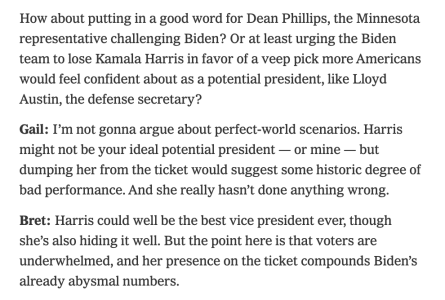
016:00 – Joe Biden and Dean Phillips
0:18:00 – Trump Derangement Syndrome
0:26:18 – Jeff on Maestro
0:28:00 – A Star is Born
0:36:00 – Nyad
0:39:00 – Grading on a curve
0:40:00 – Jeff’s friend openly weeping during Maestro
0:43:00 – Why storytelling matters
0:44:00 – The Holdovers — Alexander Payne’s film about kids left over at boarding school over Christmas
0:48:00 – The Taste of Things – a French film starring Juliette Binoche.
0:48:47 – Jeff’s friend “gasping and weeping” – what makes us cry in movies.
0:56:20 – May December – Todd Haynes’ film starring Natalie Portman and Julianne Moore
1:00 – Anatomy of a Fall – a French movie starring Sandra Huller about whether or not she murdered her husband.
1:20 – Most searched sex positions in New York Post article.
1:21 – Sasha’s road trip to Ohio for Thanksgiving.
1:22 – Best Actress is heating up.
1:30 – Sex in Anatomy of a Fall?
1:33 – Supporting Actress – Da’Vine Joy Randolph in The Holdovers, Penelope Cruz for Ferarri, etc.
1:33 – Outro
HE to Facebook contributor Scott Myers: Very nice photo, Scott, and yet (please don’t take this the wrong way) damn near every western tourist who’s ever visited Athens has waxed rhapsodic about the exact same nightscape vista.
The Parthenontemple took 11 years to build and several years more to “decorate,” whatever that meant. Roughly 448 BC to 437 BC. Well over four hundred years before the birth of Yeshua of Nazareth.
How many hundreds of thousands…how many tens of millions of visitors have expressed the exact same enthusiasm after enjoying a nice dinner on their Athens hotel rooftop or hotel-room-adjacent balcony?
No offense —- I’m sure it’s very cool to gaze upon. But in purely photographic (as opposed to historic or emotional) terms the photo is mainly of a flood-lighted rectangular white blob.
Candle-lit balcony dinner or no candle-lit balcony dinner, I would prefer to stay at one of those smaller places that are several hundred yards (perhaps a mile or so?) closer to the Acropolis. Some appear to be only a hop, skip and a jump from this fabled site.
My point is that an evening photo of the Parthenon from one of these smaller but closer establishments would allow Facebook viewers to appreciate a few minor architectural specifics…details that might appear to be, no offense, less blobby.
Did Elvis Presley, possibly accompanied by Priscilla and Lisa Marie or by some of his Memphis mafia security team…did Elvis ever savor the same view? Probably not as Elvis liked to keep his life familiar and local. He also liked short ribs as well as peanut-butter-and-banana sandwiches.
You know who would have stayed at a less touristy hotel and probably taken a more interesting (i.e., more architecturally tantalizing) photo? I hate to say this but Hannibal Lecter, a well-educated fellow with a vast knowledge of history, a cultivated man who appreciated the finer things in life…the cannibalism thing aside, Hannibal the psychiatrist is HE’s bro in this regard.
But I’m sure your hotel dinner was great. Better than strolling around town and exposing yourself to possible danger while finding a nice, highly recommended place to eat on your own, right?
Did you guys order a Greek salad with feta cheese? Or are you more surf-and-turf types?
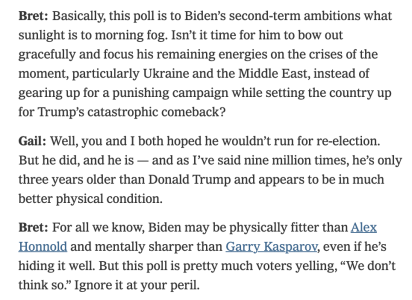
This is as seriousasaheartattack. It’s the doddering, slurry-voiced, squinty-eyed, 80something thing. Joe is Jimmy Carter in ‘79, and he’s really gotta step down. The Beastisatthedoor. Lyndon Johnson read the writing on the wall in March of ‘68 and acted accordingly. Trump will not defeat Gavin Newsom or Gretchen Whitmer.
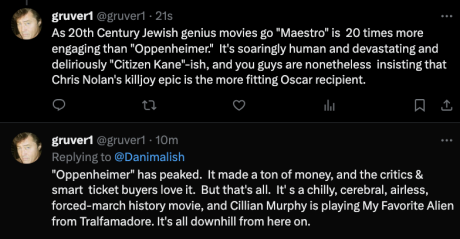
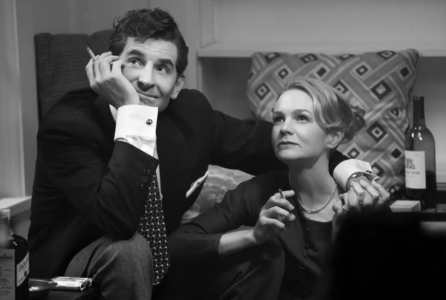
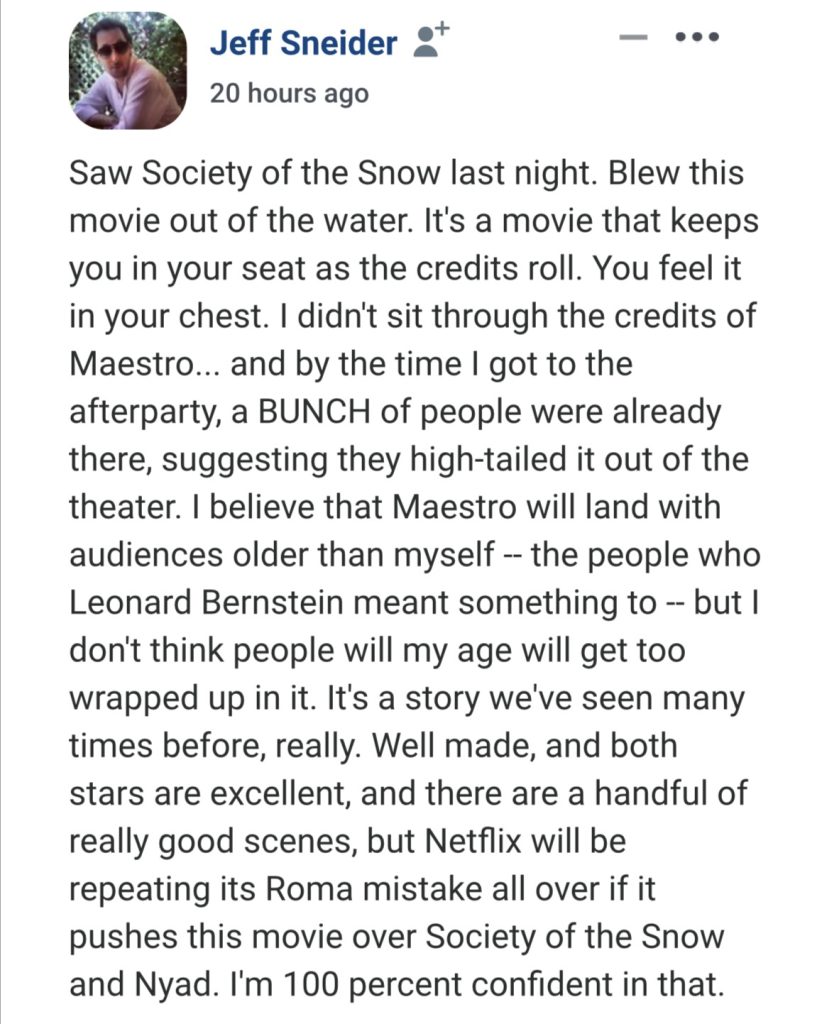
Yesterday the always-candid Jeff Sneider dismissed or back-handed Maestro on a generational basis. I naturally took offense, having been sweptoffmyfeet by Bradley Cooper’s rapturous biopic.
HEreply #1:
“How many major Best Picture contenders have you urinated upon? You pissed on Poor Things, you’re pissing on Maestro. Have you pissed on The Holdovers? I don’t think so but I’m asking.
“Juan Antonio Bayona is an excellent filmmaker, but he’s never come close to matching the impact of The Orphanage, his big debut effort. I’ll see Society of the Snow (a shitty title) this weekend.”
HEreply #2:
“And you’re playing an age-ist card? People in your somewhat younger age bracket will be less supportive of Maestro. than GenX-ers and boomers, you’re saying? The older and mid-range Millennials at the after-party, you mean?
“First of all, what is WRONG with them? Are they on shallowpills? Maestro is cinema with a capital C — it’sdealingcardsfromaCitizenKane–likedeck. And your party pallies didn’t respond because….what, it doesn’t reflect older and mid-range Millennial attitudes? Because it channels elite-social-class attitudes from a bygone era (‘40s through ‘80s)? Because, as I said in yesterday’sMaestrovs.Oppenheimerreview, “it hasn’t a woke bone in its entire body”?
“If this is the case (and I’m not saying that it necessarily is — I’m just speculating) you guys need to consider the possibility that you’re genetic mutants.”
Extremely dumb, dull, slow-on-the-pickup characters have been non-existent in straight dramas for the most part. 99% of the time such characters appear in comedies, of course. Which is why Leonardo DiCaprio‘s Ernest Burkhart character in Killers of the Flower Moon is a stand-out.
The man is dumb as a fencepost and mired in a slow, drip-drip, rural melodrama that doesn’t really develop or intensify during the first two hours, and so Ernest is unable to offer the slightest intrigue or payoff in such a film. And so KOTFM viewers are stuck with the guy.
What could Leo and director Martin Scorsese have been thinking?
Leo to Marty in 2020, or a year before filming began: “Wait, I’ve got it..let’s do what we can to bore audiences to death as far as Ernest is concerned…no competititve energy between Ernest and Mollie, I mean, which will make her seem more interesting by contrast. If we make Ernest the polar opposite of Jordan Belfort in The Wolf of Wall Street, audiences will be more intrigued by Mollie’s character because at least she has that moral revulsion thing going on…those dirty looks she gives everyone once the murders start happening.”
DiCaprio’s Burkhart “is too thick — intellectually, emotionally, morally — to do much of anything but allow his hand to be forced, first by Robert De Niro‘s King Hale, then by the federal agents tasked with taking him down.
“Ernest never really learns, never really comes clean, never really grasps the monstrousness of what’s happening until it’s too late. He’s just not sharp enough to see it, or to allow himself to be shown. The man is a zero — the mental and moral void into which King Hale’s Osage targets and their allies disappear.
“A sharper character would have implied that it takes some canniness, cunning or charisma to plunder a land and its people. Instead, Ernest shows us that the bigotry and greed that fueled the genocidal campaign against the Osage are ultimately stupid, and the resulting tragedy all the sadder for it.”
HE to fans of dullness: Please name some astoundingly stupid characters that weren’t used in comedies or for comic relief — characters who just take up space and little else — characters who do and say almost nothing. One laugh or chuckle and they’re disqualified. They have to be pure intellectual deadweight.
There are only two…okay, maybe three powerhouse performances in the Best Supporting Actress ranks right now. The top slot is absolutely owned by Da’Vine Joy Randolph‘s bereaved, drinking-too-much cook in Alexander Payne’s The Holdovers.
Almost in the same realm as Randolph is Penelope Cruz‘s fuming and resentful Laura Ferrari in Michael Mann‘s Ferrari — she has a single scene in which she completely owns and rules.
I still haven’t seen Jodie Foster‘s performance as the…best friendo or girlfriend of Annette Bening‘s titular character in Nyad. You could also throw in Viola Davis‘s mother-of-Michael Jordan performance in Ben Affleck‘s Air. You could even throw in Rachel McAdams‘ caring, supportive mom performance in Are You There God? It’s Me, Margaret.
Due respect but you can almpst certainly forget Julianne Moore in May December, America Ferrera in Barbie (that great third-act rant), Emily Blunt in Oppenheimer.
I haven’t yet seen Vanessa Kirby in Napoleon (HE’s NYC screening of Ridley Scott‘s film happens on 11.14) or Danielle Brooks in The Color Purple.