Pegg was alluding, of course, to the four big controversies that have spilled into the mainstream — the allegedly racist or sexist complaints about (a) Ahmed Best‘s performance as Jar-Jar Binks in Star Wars: The Phantom Menace, (b) John Boyega in the Star Wars sequel trilogy, (c) Kelly Marie Tran in The Last Jedi and The Rise of Skywalker, and, most recently, (d) Moses Ingram as Reva Savander in Obi-Wan Kenobi, the Disney + series.
These episodes may have partially been driven by flat-out racism, and that’s appalling. Negative reactions to Boyega may have qualified in this regard.
But the revulsion toward Jar-Jar Binks was about the conception –the character, the dopey voice, the dialogue. The wrath wasn’t directed at Best but the ogre known as George Lucas.
I never had the slightest problem with Kelly Marie Tran‘s performance as Rose Tico, but those who complained were less focused on her Asian heritage (who cares?) and more about her weight — the fans didn’t like the idea of a chubby Star Wars protagonist.
And the complaint about Ingram wasn’t about her ancestry but about her Baltimore street accent, which didn’t fall in line with the crisp British speech patterns of previous Imperial villains.
“I’ve apologized for the things I said about, you know, Jar Jar Binks,” Pegg told SiriusXM’s Jim Norton and Sam Roberts. “Because, of course, there was a fucking actor involved. [Best] was getting a lot of flack and…it was a human being. And because it got a lot of hate, he suffered, you know, and I feel terrible about being part of that.”
Again — it was Jar-Jar, not Best, that people loathed.
Pegg: “There’s no sort of like, ‘Oh, you’re suddenly being woke.’ No Star Trek was woke from the beginning, you know? This is massively progressive. Star Wars suddenly there’s, there’s a little bit more diversity and everyone’s kicking off about it. And it’s…it’s really sad.”
Woody Allen joke from the early ’60s, passed along by regional “friendo”: “I received an offer from a vodka company to be a spokesperson…to shoot some TV ads. So one of their reps called and I said, ‘First of all, I don’t do TV ads, and I don’t drink so I can’t be much of a vodka salesman, and if I did drink vodka I probably wouldn’t drink your brand so I can’t see this happening.’ And the vodka guy said, ‘Well, that’s too bad because we were going to offer you a $500 thousand fee.’ And Allen said, ‘Uhhm, hold on…let me put Mr. Allen on the phone.'”
Every industry name whores out at one time or another. Some more than others (Michael Caine in The Swarm and Jaws 4) but they all mostly do it. Ryan Gosling held his nose and cashed the paycheck for The Gray Man, and in the bargain enjoyed all kinds of exotic travel. One of the reasons that Brad Pitt is allegedly worth $300 million is because he occasionally stars in films like Bullet Train, for which he was allegedly paid $30 million.
Except for Leonardo DiCaprio. He’s been a wealthy, marquee-brand actor for 29 years, and has never once starred in a piece of Bullet Train or Gray Man-level schlock. This Boy’s Life, What’s Eating Gilbert Grape, The Basketball Diaries, Total Eclipse, Marvin’s Room, Titanic, The Man in the Iron Mask, Celebrity, The Beach, Don’s Plum, Catch Me If You Can, Gangs of New York, The Aviator, The Departed, Body of Lies, Revolutionary Road, Shutter Island, Inception, J. Edgar, Django Unchained, The Great Gatsby, The Wolf of Wall Street, The Revenant, Once Upon a Time in Hollywood, Don’t Look Up, Killers of the Flower Moon…26 respectable films, some more commercial or less arty than others but no franchise flicks and none aimed at the jizz-whizz action or gamer or Marvel crowd.
I’m sorry but I laughed out loud at the William F. Buckley joke — a joke propelled by territorial sexual resentment and urban cynicism. And I’m an LQTM guy — it takes a lot to make me actually laugh. I’ve never laughed once at anything Ryan Gosling has said…not once. I’ve laughed at three or four things that Brad Pitt has said, but I wouldn’t laugh if he said them while wearing that fucking kilt.
And neither is the fleurescent Eastmancolor mint green. Does HE have a slight preference? Does HE prefer the lemon-lime popsicle jacket worn by the darker-skinned Ryan Gosling, or the pale-skinned powder blue guy that Variety is chatting up? Answer: HE renders a firm “no” verdict to both. HE also says “no” (no offense) to The Gray Man, which Netflix will begin streaming tomorrow.
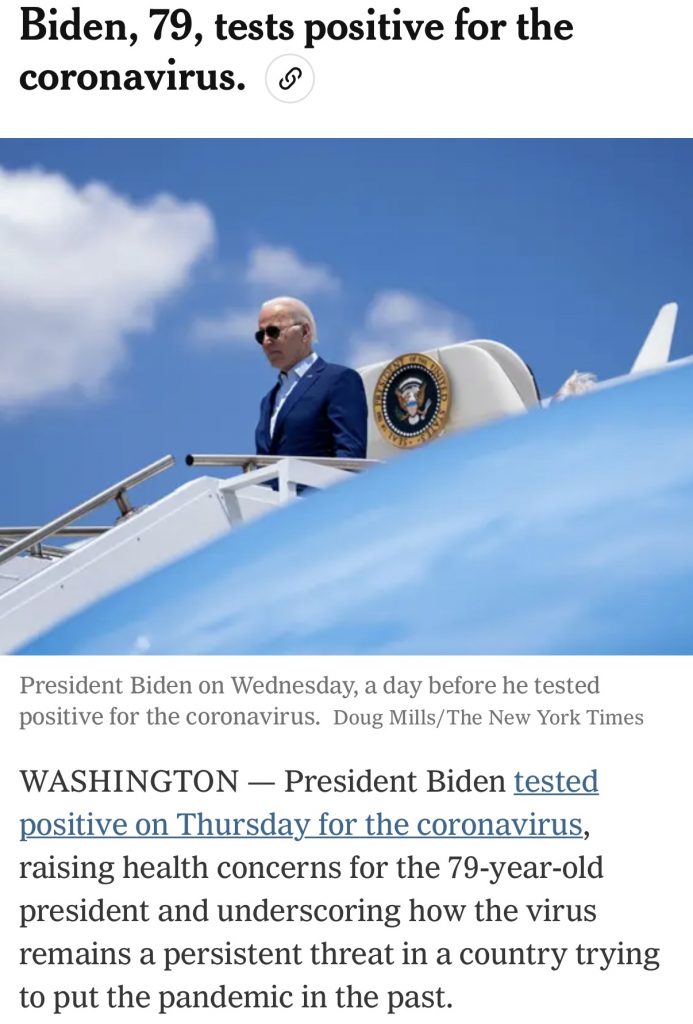
PresidentJoe BidentestingpositiveforCovid despite being double (or is it triple?) vaxxed means that some Nervous Nellie governors may call for new mask mandates. If so, it’ll be Biden’sfault — he will have done this to allofus. If I succumb to Covid flu symptoms again, fine…I don’t care. But I’d almost rather die than wear a mask again.
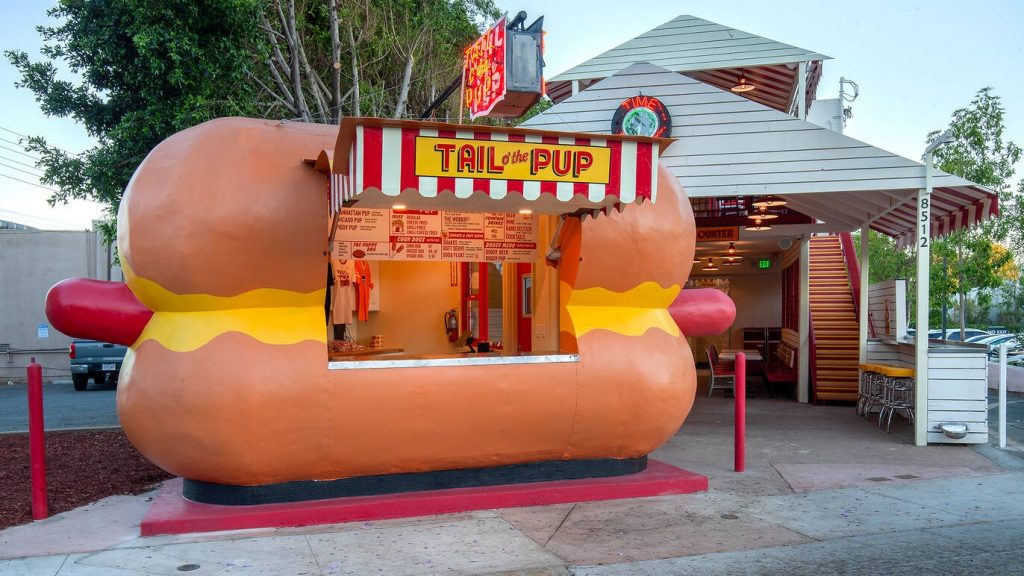
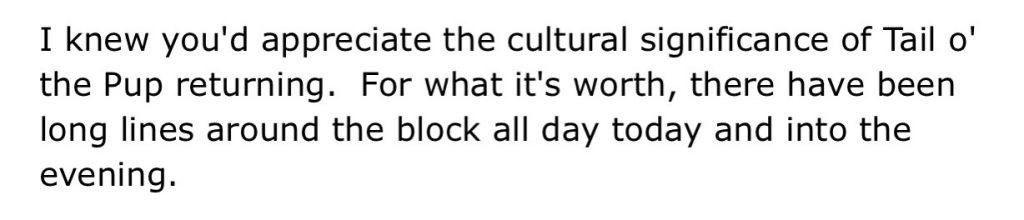
TailofthePup, a storied and beloved Los Angeles hot dog stand if there ever was one, is backinbusiness at 8512 Santa Monica Blvd. in WeHo. I’m genuinely sorry that I’m not there — 2700 miles to the east and I can smell the mustard and sautéed onions and sliced Jalapeño. Anthony Bourdain would have produced a great PartsUnknown segment about this. (Photos courtesy of Maxim Shapovalov.)
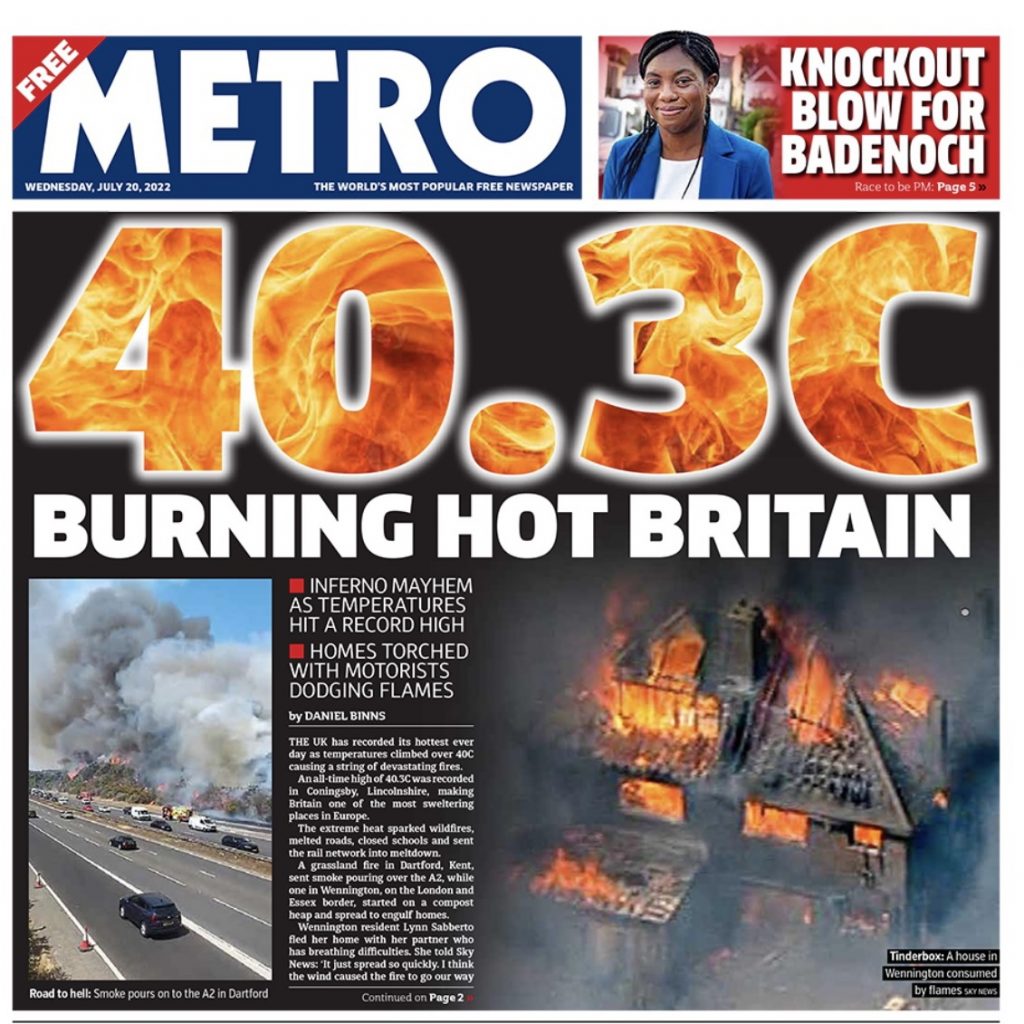
The thing that gets me about England is that fewer than 5% of the households have air conditioning. I know what it feels like to weaken and slowly melt. I was living in Paris during the summer of ‘03 (23 rue Tourlaque) so don’t tell me. All we had were fans.
HE is experiencing a Fairfield County brown-out as we speak…right now. But everyone has a.c., of course.
Regional power will be restored around 10 pm, give or take.
I’d like to believe that Halloween Ends (Universal, 10.14) will be the last and final flick in this soul-draining franchise. A pox upon those who always pay to see witlessfranchisehorrorflicks and almost never support elevatedhorror. We are what we eat, and we make our own beds.
My favorite David Gordon Green films are Pineapple Express (except for Danny McBride‘s performance) and the Terrence Malick-y George Washington.
A few months ago I watched the first episode of The Last Movie Stars (HBO Max, 7.21), a six-part Ethan Hawke documentary about Paul Newman, Joanne Woodward that seemed, based on episode #1, to be a celebration piece — a portrait of a fairly wonderful, for the most part glorious relationship.
I posted my understanding of the six-part doc series around 10 days ago.
Paul and Joanne first met in ’53 or thereabouts, got married in 1958 and stayed together for 50 years. Paul died on 9.26.08.
Hawke’s admiration for Newman-Woodward is upfront and unfettered, and his fascination with the transformative acting world of New York in the 1950s is fully conveyed. But this seems to basically be a valentine doc, and having dug into Shawn Levy‘s “Paul Newman: A Life” (’09), a very thoroughly researched and written biography…I shouldn’t say more but the basic approach seems to have been one of serious admiration.
I’ve since been told that this entirely isn’t the case. I’m told that Hawke doesn’t mention the name of a journalist, Nancy Bacon, with whom Newman had an affair in ’68 and ’69, but the affair is definitely mentioned. It’s also acknowledged that Newman was a functioning alcoholic, and that the booze was a real problem for a while. Woodward even kicked Newman out of their Westport home at one point, or so the story goes.
Before last night’s screening of Nope I had never paid much attention to Keke Palmer. I’m sorry but nothing she’d appeared in seemed edgy or alluring enough. But now Palmer is a name — she’s crossed over. And not just over her noteworthy Nope performance, but because of the Being Mortal thing.
I probably shouldn’t mention this, I realize, because everyone in the media seems to have sworn an oath of silence. But why is everyone being so silent?
I’m sorry but there was that kerfuffle last April (technically in late March) in which people were asking “what happened on the Being Mortal set, and what was it that Bill Murray did to piss somebody off so badly that the whole movie shut down…how is it that Aziz Ansari’s stab at launching a directing career was blown to pieces because of something that happened of a relatively minor, non-assaultive nature…something that nobody will talk about?”
All we know is that Murray did something he “thought was funny but it wasn’t taken that way.”
Palmer was asked about the incident on a Nope red carpet, and apart from saying that she loved working with Ansari she claimed to know nothing.
When’s the last time that a film stopped shooting over someone taking offense over something that happened that didn’t involve anything felonious?
I KNOW NOTHING, but the fact that nobody will say anything almost certainly proves that some kind of hot-button, hot-potato, avert-your-eyes issue is behind it. Murray aside nobody has said boo about it for three and a half months, which suggests that the complainer wasn’t a makeup or wardrobe person or a craft services guy or a truck driver.
On 4.29.22 or two and two-thirds months ago, I posted a theory about Greta Gerwig‘s Barbie: “As far as I can determine there’s only one way for Gerwig to go story-wise, and that’s to make a Barbie variation of The Truman Show” — a film about whether it’s better to live a life of plastic, isolated perfection or one that grapples with the unruly ups and downs of the real world.
Four weeks and one day later or on 5.27, World of Reel‘s Jordan Ruimyposted the following description: ‘The film is set in Barbieland, a beautiful, colorful society with Kens and Barbies. Ryan Gosling‘s Ken, said to be a ‘complete doofus’, is obsessed with Margot Robbie‘s Barbie, but loves the real world for all the reasons Barbie hates it (beauty standards, sexism, etc).
“Gerwig’s film eventually becomes a ‘fish out of water comedy’ as Ken and Barbie leave Barbieland for the real world. This motivates the Mattel CEO (Will FerrellJason on Twitter: “Sounds like the meta aspects of Gerwig’s Little Women mixed with Splash and Truman Show [with] Jacques Demy musical influences.”
Jordan Peele‘s Nope (Universal, 7.22) is a fairly empty diversion — a wacko visual-effects thrill ride and a Signs-like alien visitation thing.
The alien stuff aside, it has three cool elements — (a) a 1998 flashback scene involving a chimpanzee named Gordy, (b) the re-birth of Fry’s Electronics, the defunct chain store that died from Covid in early ’21, and (c) incessant third-act appearances by an army of “tall boys” or “air dancers” — those shimmering tube-like balloons that used-car lots use to attract attention.
It’s about the owners of a remote horse ranch somewhere in the Southwest, a brother and sister named OJ and Emerald Haywood (Daniel Kaluuya, Keke Palmer) who inherit the ranch when their horse-loving dad (Keith David) is killed by falling objects, apparently dropped by mean-as-fuck aliens.
Bit by bit and more and more, the aliens (whose presence is chiefly signified by saucer-like spaceships and a massive, floating, cloud-like bedsheet thing) begin to intimidate and then terrify OJ and Emerald.
And then OJ and Emerald hire a Fry’s guy (Brandon Perea) to capture video images of the visitors, and then they bring in a documentarian (Michael Wincott‘s “Antlers Holst”, a character cut from the Robert Shaw/”Quint” mold) to capture the alien spacecraft on celluloid. And then the threat element increases. And then it ends.
I saw Nope last night. I developed a thesis this morning that the aliens are a metaphor for white people’s oppression of BIPOCs. This is what Peele does, of course — racial re-fittings of genre tropes. Get Out was a racial spin on The Stepford Wives, and Us was a horror film about doppelgangers but finally about the absolute terror of Ken Kragen‘s “Hands Across America.”
Friendo: “Naah, you’re reading too much into it…Nope is just a UFO thriller.” HE: “But it’s not SAYING anything except ‘boo!’ It has no content…UNLESS you, the viewer, interpret the aliens as metaphors for white oppression. THEN it’s saying something.”
Nope has no structure, no real story, nothing that digs in and pays off. It’s an alien horror film equivalent of a Jasper Johns painting — paint flung and dripped and splattered upon the canvas.
Basic Nope strategy: Start with basic spooky UFO premise and then (a) throw out the rule book, (b) disconnect the logic terminals, (c) throw everything you can think of at the canvas, and (d) see what sticks.
Oh, and by the way? It’s really hard to understand Palmer and especially Kaluuya. As Eddie Murphy might say if he catches Nope, “I don’t what the fuck these guys are sayin’.” Remember Barbara Billingsley’s imitation of black “jive” in 1980’s Airplane? That’s how Palmer talks — half Billingsley, half vocal fry. Remember Murphy’s imitation of James Brown with those guttural scat riffs? That’s how Kaluuya sounds. I was able to understand him maybe 20% of the time, if that.
And they don’t look like brother and sister. Palmer could be Keith David’s daughter, no prob, but no way is Kaluuya his son. Kaluuya’s parents are from Uganda, Palmer’s are from Chicago, David’s are from Harlem/Queens.
No discipline, this fucking film. It’s “imaginative,” if you want to call it that. As slow and talky and stodgy as Cleopatra was, it at least made sense. Which is more than you can say for Nope. So Cleopatra is better.
Say it again — when Gordy appears, the film comes alive. What Gordy has to do with the dumbshit rascal white-oppressor aliens is anyone’s guess.
Steven Yeun costars in Nope, and I couldn’t understand why he was in it. Yes, he has something to do with Gordy (I won’t say) and he wears a red suit and a big white cowboy hat in one scene, but he has NOTHING to do with anything.
I need to re-watch this movie with subtitles some day.
Why the hell is Kaluuya’s character named “OJ,” of all things? That’s a statement of some kind, but what?
If Dore Schary had somehow returned from the dead and become the producer on this film, before filming began he would have invited Peele to lunch and said, “Look, I’m just a Jewish white-guy producer and I don’t know much about African Americans or horse ranches or Fry’s Electronics, but WHAT THE FUCK IS THIS MOVIE ABOUT?? You don’t know, do you? You’re just farting around with spooky alien visitors and trying to cook up something different and trippy, but THIS MOVIE IS BULLSHIT, JORDAN…you know it and I know it.”
And Peele would reply, “It’s a metaphor about white people’s oppression of BIPOCs.” And Schary would reply, “What are BIPOCs?” And Peele would say, “Don’t worry about it, bruh…I got this.”
No white-ass producer would dare say “bullshit” to Peele, of course, lest he/she be accused of harboring racist attitudes. Which is why Nope turned out this way…a crazy, impressionistic, Jasper Johns-like mess. Peele was apparently given carte blanche control, and this is what happens.
I do approve, however, of Peele bringing Fry’s back to life after it shut down all 31 locations in early ‘21. And I’l always approve of tube men and chimpanzees and stuff like that.
I was studying Palmer closely throughout the film, by the way. I don’t know if it was Palmer who didn’t get along with Bill Murray on the set of Being Mortal, but if it was I can see why. Palmer is buried inside herself and cranked up about everything, and Murray, I’m guessing, thought she was “wrapped too tight for New Orleans” and tried some kind of stilly, loosening-up prank, and she reacted badly, I’m guessing. She not only told him to back off but brought the temple down. Again — I don’t know what happened. I just want to make that clear. But Palmer excited my imagination.