These Two Scenes…

…are what cinched the Best Actor Oscar for the late Phillip Seymour Hoffman. His Truman Capote performance was so on-target that when I think of the Real McCoy I often flash on “Philly.” Everyone always points to the “weeping just before the Kansas hanging” scene, but these two are more subtle and more affecting at the same time.

Especially Capote’s dinner-table recollection about the death of his mother during the making of Beat The Devil, and particularly the inability of her widowed husband to handle his own grief. The non-verbal reaction of Chris Cooper‘s Alvin Dewey is perfect.

Reagan-Era Rumination

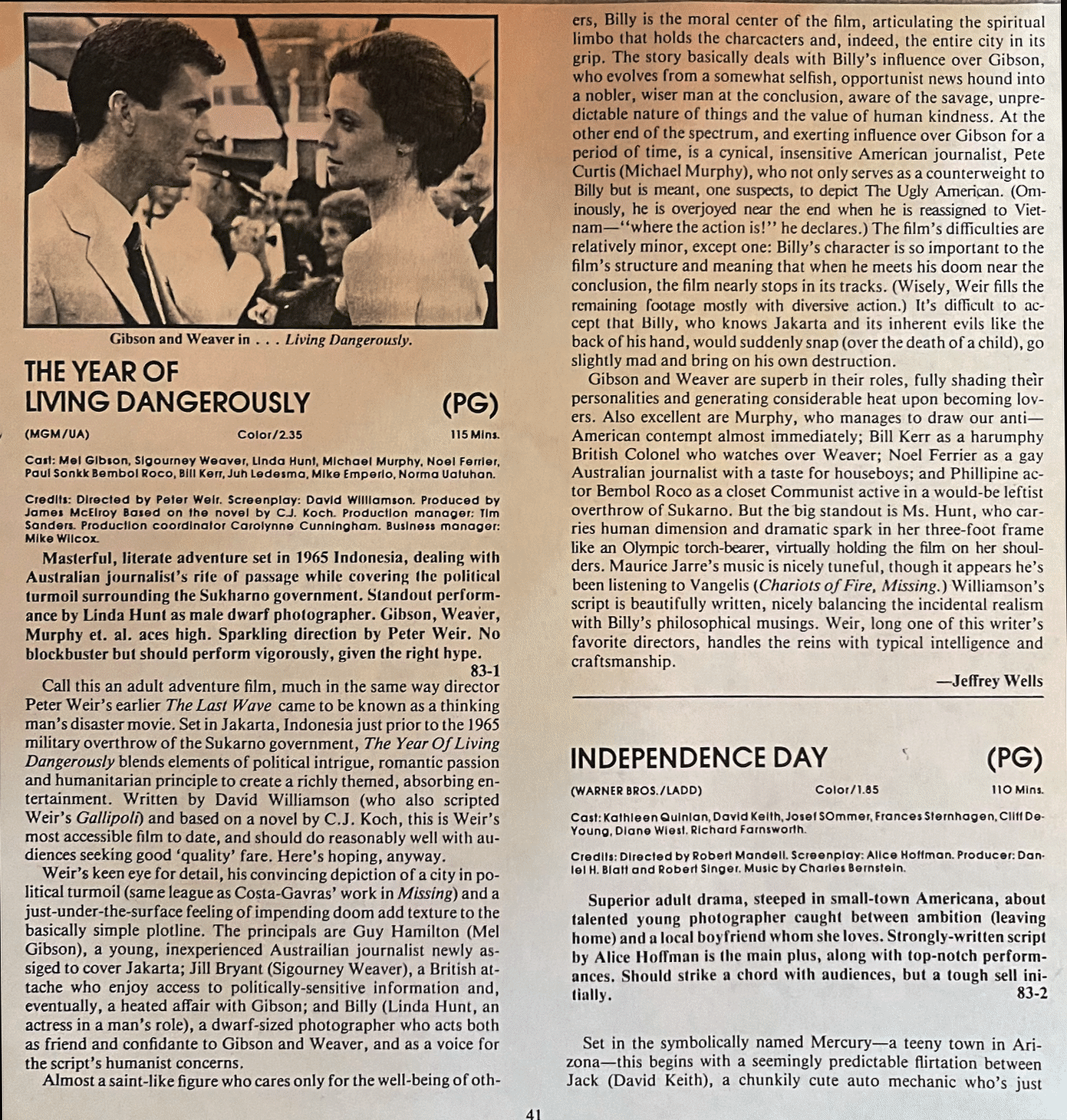
My admiration of Peter Weir‘s The Year of Living Dangerously (MGA/UA, 12.16.82) was immediate and unqualified. Probably the sexiest film ever about a wet-behind-the-ears journalist in an exotic, tinder-box situation — an adult-level thing, a gradually inevitable love story, a feeling of engagement on all levels, highly emotional toward the end.

Apart from the cardinal sin of having been made by white guys (which of course makes it a racist film…right, asshats?), The Year of Living Dangerously is easily among the greatest Asian-set moral and ethical dramas of its type. Where does it rank alongside Phillip Noyce‘s The Quiet American, Francis Coppola‘s Apocalypse Now, Joshua Logan‘s Sayonara, Oliver Stone‘s Platoon, etc.?

My last viewing was on laser disc in the early ’90s (I think) but I haven’t re-watched it since. Which is odd. I don’t like admitting this, but the reason I’ve stayed away is Linda Hunt‘s “Billy Kwan” character. The notion of Billy, a wise and perceptive man about town if there ever was one, suddenly succumbing to despair and offing himself over the excesses of Sukarno-influenced corruption has always struck me as crudely manipulative and un-earned. That hectoring little voice with the deep register, that haughty judgmental moralizing, that glare of outrage…bullshit.

But otherwise a haunting watch with a great Maurice Jarre score**, and certainly with a grand romantic ending.

Yes, Virginia — big studios actually supported and promoted this kind of film from time to time. Not often but it happened.

** I thought for sure the composer was Vangelis, but I was wrong.

Maple Street Monsters Are Embedded

Note to HE community: Please pay attention to this post, but especially to the final five paragraphs — thank you.

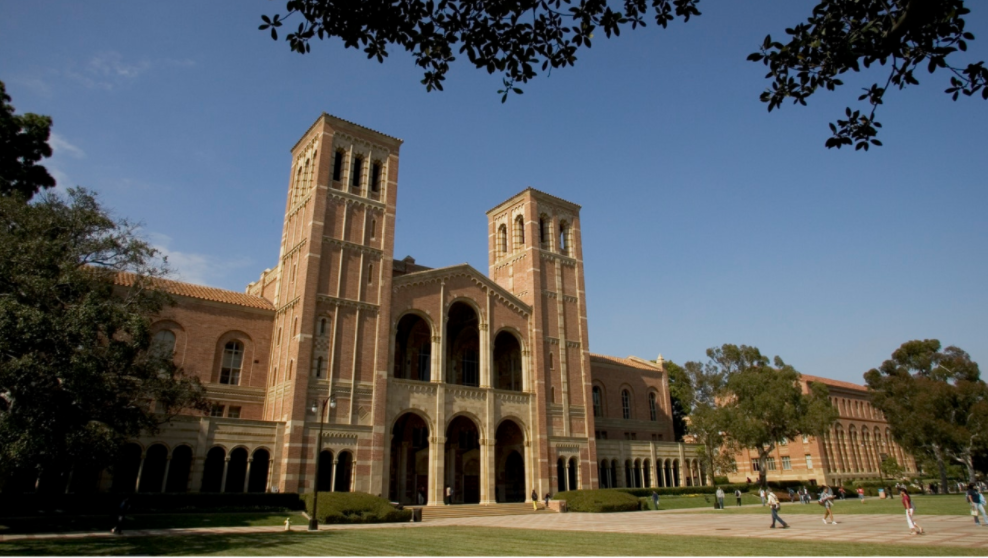
Yesterday Gordon Klein, a veteran professor at UCLA’s Anderson School of Management, posted an essay on Bari Weiss’s Substack about being hounded and threatened by campus wokester fanatics for not going along with a suggestion (contained in a 6.2.20 letter from a “non-black” student of Klein’s) that he grade his Black students with “greater leniency than others in the class” because, you know, they have it tougher than white students and need all the support they can get.

Excerpt from 6.2.20 letter: “The unjust murders of Ahmaud Arbery, Breonna Taylor and George Floyd, the life-threatening actions of Amy Cooper and the violent conduct of the [University of California Police Department] have led to fear and anxiety which is further compounded by the disproportionate effect of Covid-19 on the Black community.

“As we approach finals week, we recognize that these conditions place Black students at an unfair academic disadvantage due to traumatic circumstances out of their control.”
In other words, the white student was claiming, Black students are too socially handicapped and emotionally traumatized to get their shit together and study and apply themselves to the curriculum. Given all the social and psychological pressures, the only decent thing to do is give them a pass if their grades aren’t up to snuff.

More specifically, the final exam that Black students take should be a “no harm” exam — one that would be counted only if it boosted one’s grade.

Klein found this suggestion appalling, and as a result was subjected to a campus-wide hate and removal campaign in which he was tarred and feathered as “woefully racist.” This was followed by a suspension on 6.5.20, followed by a near-firing. He is now suing UCLA over this whole affair.

I was struck by this episode because it reminded me of a similar incident that happened when I was in 11th grade in Wilton High School — a critical year in terms of grade-point averages and applying to various colleges. I had been earning poor grades in everything except English composition and gym, and so I wrote a letter to the WHS principal and others in charge, pleading for leniency because I had it tougher than other students due to (a) an abusive alcoholic father, (b) a bad case of low self-esteem, (c) an inordinate aversion to boring classes, and (d) a deep-seated preference for listening to rock music.

I know this sounds satiric, but I did have it tougher than others back then. Or so I believed.

Excerpt from Wilton high-school letter: “The unjust, bloody beating that I received from my father when I was 16, along with various psychological pressures impacting my teenage mind…various forms of emotional torture, sexual intimidation by hot girls who haven’t found me sufficiently attractive, and the traumatizing conduct of the Wilton Police Department in their brutal confiscations of cases of beer, [confiscations] that have deprived me and my friends of the pleasures of getting buzzed on weekends, not to mention the fear and convulsions caused by the disproportionate effect of primal sexual urges that plague me night and day…

“As Wilton juniors approach finals week, I’m requesting that you recognize and sympathize with the fact that the afore-mentioned pressures and conditions, all of which are out of my control, have placed me at an unfair academic disadvantage. I therefore request that Wilton High School allow me to take ‘no harm’ final exams in my various courses — ones that would be counted only if they boost my grade.”

Wilton administrators refused my request, and soon after my life took a turn for the worse. It took me years to recover and take a stab at movie journalism. It is my earnest hope that present-day college professors and department heads and deans can see past the brusque and dismissive attitudes of the past and urge that all attending Black students to be treated with appropriate scholastic leniency.

Huddled Away in Exurbia

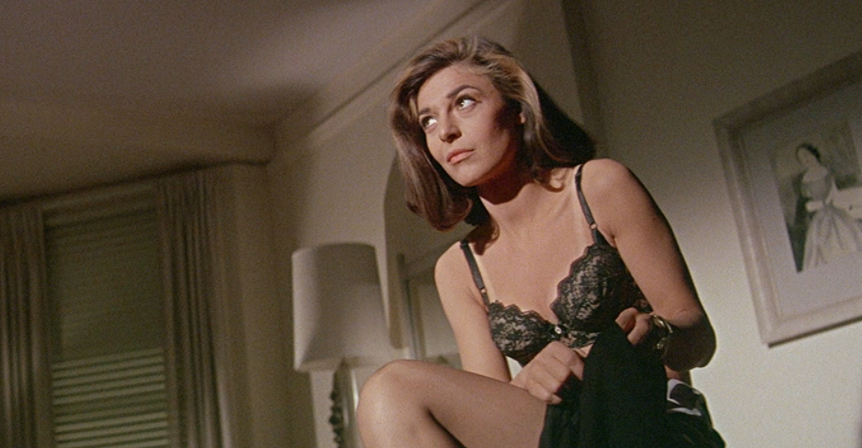
I visit and re-visit Mark Harris‘s “Mike Nichols: A Life.” It’s obviously been thoroughly researched and Harris has always been a smooth and engaging writer (and I love the chapter on the making of Who’s Afraid of Virginia Wolff) but for whatever reason I can only digest a modest portion at a time. And then I nod off or get distracted and wander away and forget about Harris-Nichols, and then, a week or a month later, I’ll start reading again. And always late at night.

I’m now reading the Graduate chapter, and a year-old exchange between Joe Leydon and myself is coming to mind.

Leydon: “Something else about The Graduate and not unlike The Sterile Cuckoo, which followed two years later. It appears timeless because it’s not at all reflective of its time. You’d never know from looking at these films (both of which I love, and both of which I saw back in the day) that the Vietnam War was going on.”

HE response: “The Graduate actually was reflective of its time as far as your vaguely stifling upper-middle-class norms were concerned. Anti-Vietnam War and anti-Dow Chemical napalm fervor (‘Dow shall not kill’) was hot on university campuses but not in your cushy suburbs. I can tell you that in Wilton, Connecticut — that leafy, well-tended, exurban hamlet that I felt half-oppressed and half-drugged by — the anti-Vietnam War thing only caught on in the aftermath of all the ’68 convulsions (MLK and RFK killings, LBJ folding his tent, Chicago Democratic Convention riots) and beyond.

“In ’66 and ‘67, the middle-class miasma was mainly about singing Beatles songs at parties and getting high and zoning out…an odd blend of vague resignation and regimentation and cruising around for nocturnal adventure. Whiffs of sexual secretions and Brooks Brothers shirts that smelled like pot (although scoring was very hard unless you were “in” with certain folkies and/or hung out with certain people in Westport) and and the sounds of Buffalo Springfield and Revolver and Sgt. Pepper. In short, the Vietnam War didn’t really begin to intrude upon this strata of American culture (Brentwood and Beverly Hills being somewhat similar to Wilton) until the Tet Offensive and then Johnson’s announcement that he wouldn’t be running again, etc.

“So Nichols and Graduate screenwriter Buck Henry did, in fact, capture the way things were for the Benjamin Braddocks and Elaine Robinsons in ’66 and ’67.”

Read more

An Apology

…for saying yesterday that I “like” For Your Eyes Only (‘81), the 12th James Bond film. At 53, Roger Moore (whom I interviewed at Pinewood during filming) sauntered through with aplomb, but costar Carole Bouquet was…what’s the polite way of saying this?…overly poised. And the film, which I’m re-watching this evening, is a lightweight, mostly-played-for-chuckles B movie — silly action scenes, rote scoring, flat cinematography, too many zoom-lens shots, wooden villains, thin or plodding dialogue. Not A-level, not sexy…casual, throw-away stuff. Like a late ‘60s Jean Paul Belmondo film.

Okay, the cliff-climbing scene at the end isn’t bad. especially when the rope-tethered Moore falls and has to use his climbing-boot shoelaces to get out of a tough spot. And costar Topol holds his own. And that closing phone chat between Margaret and Denis Thatcher and a parrot…yup.

“Orange” Significantly Upgraded

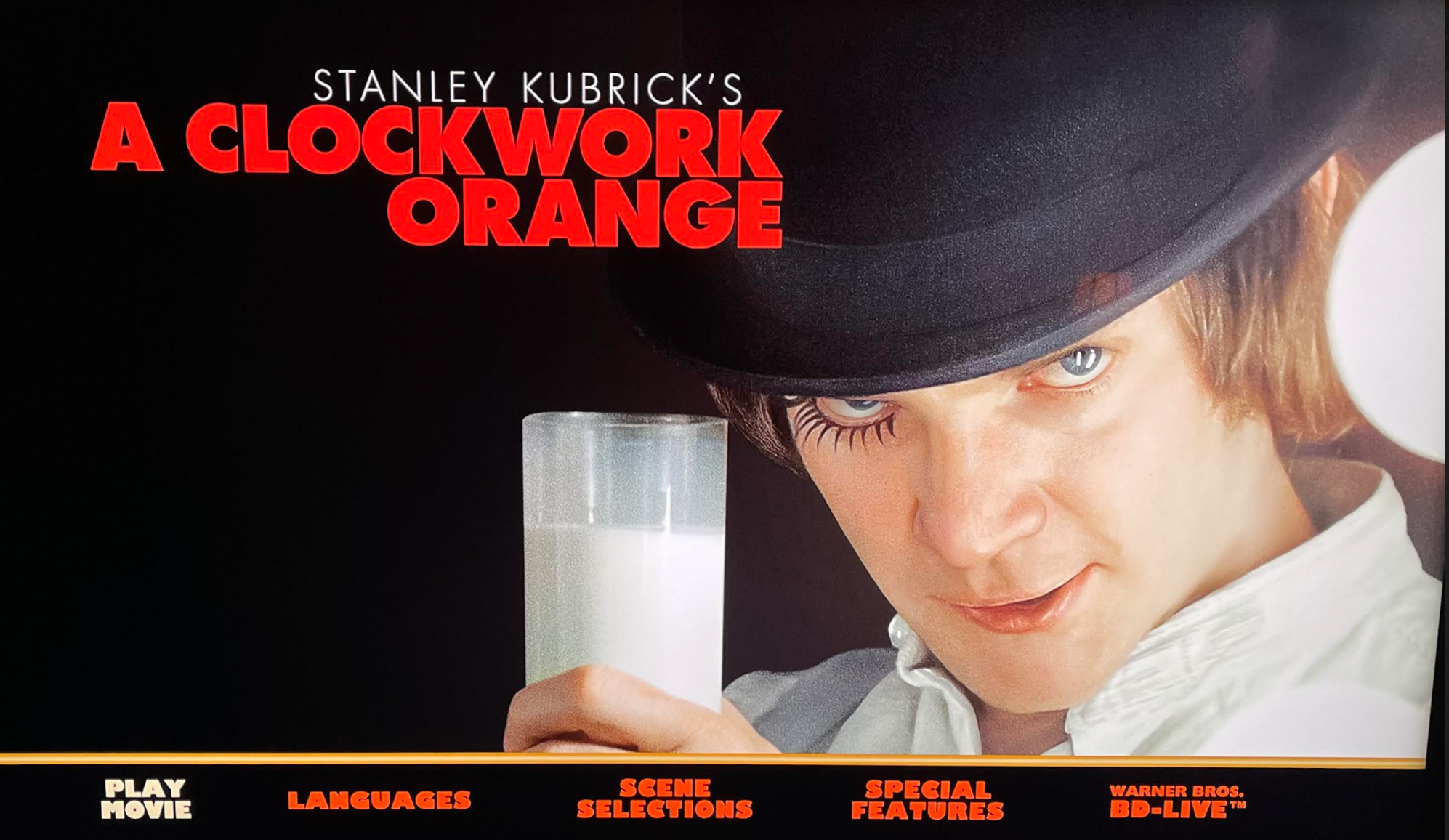
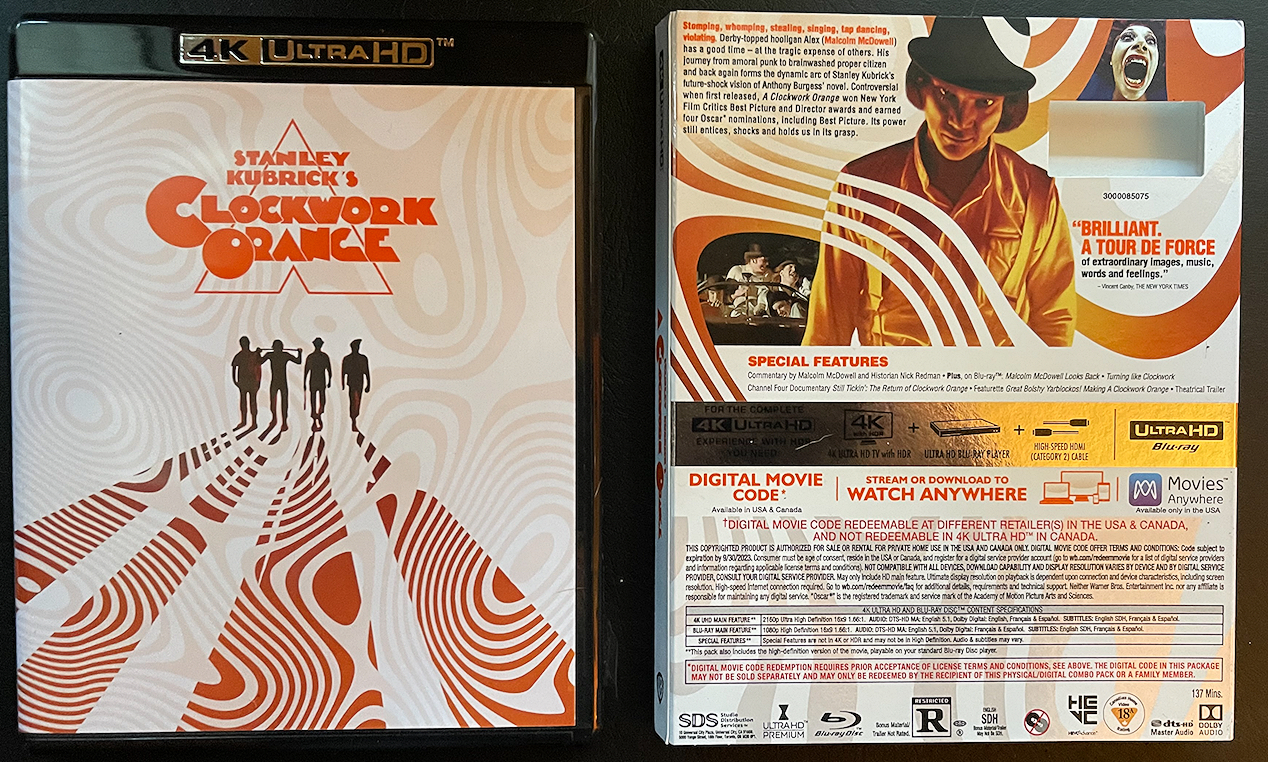
The new 4K Clockwork Orange Bluray arrived yesterday, a package with two discs (4K + 1080p version) and an assortment of previously made doc extras.

It looks much, much better than the 2011 Bluray — richer, bigger, more detail, very celluloid-y. I was 94% pleased with the quality.

Tatiana watched it for the first time in her life. Within six or seven minutes she wanted to quit because of the rapes, beatings and generally cruel atmosphere. “You need to hang on a bit,” I said. “It doesn’t stay on this level. It’s a masterful film. Give it a chance.”

The reason I wasn’t 100% satisfied is an odd perception of softness in the middle of the frame here and there. Not in every shot but in many of them, and especially during the first act. Not “out of focus”, mind, but the focus seems a tiny bit soft in the center.

No, I’m not imagining this. I’m certain that here and there the center-frame sharpness isn’t quite what it could or should be.

I noticed this slight softness in the morning scene when Alex’s mom tries to get him out of bed, and when Mr. Deltoid pays a visit. Ditto during the cat lady scene. Not a major distraction but a very SLIGHT one. I wanted razor sharpness at the center of the frame, and this new disc holds back a bit. I felt a tiny bit burned.

I know that back in ’71, 35mm film and 16mm film could only render desired sharpness to a certain point. A Clockwork Orange was not, I realize, intended to look like 70mm. But I’m certain something is slightly off.

I think the Warner Bros. video guys made a judgment call — “do we maximize sharpness so that 1080p/4K viewers like Jeffrey Wells will be extra-delighted? Or do we present the film as it actually appeared in ‘71?” They went with the latter.

The package contains three or four mini-docs about the film. The best by far is Gary Leva‘s “Turning Like Clockwork.”

Sorry For My Inattention

I’ve only seen Old Yeller (’57) once, I think, but it’s commonly regarded as one of the most emotionally affecting family-friendly flicks ever released. What I really mean is that it delivered a highly traumatic climax (tearful kid forced to shoot beloved dog because of rabies). Millions of youths were devastated, and Bill Murray was one of them — he recalled crying over the shooting scene in Stripes. And I’m sure that the late Tommy Kirk, the teenaged star of that classic Disney film, was proud when he watched Murray’s schpiel.

Old Yeller was certainly the highpoint of Kirk‘s career. He was 15 during filming. A fairly major Disney star between the mid ’50s and early ’60s, Kirk’s career began to wind down around his 20th or 21st birthday and certainly by his mid 20s. Emotional instability was a factor, due to some extent to being gay and closeted and full of loneliness and uncertainty about how to be himself and yet maintain his career and especially keep things status quo with his Disney employers. His career also suffered over a pot bust in ’64.

I had never paid attention to Kirk’s saga before yesterday, which is when his death was announced. I’m very sorry for what the poor guy went through. His fate was sealed when the mother of a 15 year-old kid Kirk wad been seeing in ’63 outed him to Disney management. Walt Disney himself personally lowered the boom, according to one account. If I had been in Disney’s shoes at the time, I would have taken Kirk aside and…I don’t know what I would have done. I’d like to think I would have found an affectionate and supportive way of telling Kirk to keep his lifestyle under wraps, but maybe Kirk’s teenaged persona was starting to wane anyway at that point.

Kirk quote from Wiki excerpt: “I consider my teenaged years as being desperately unhappy. I knew I was gay, but I had no outlet for my feelings. It was very hard to meet people and, at that time, there was no place to go to socialize. It wasn’t until the early ’60s that I began to hear of places where gays congregated. The lifestyle was not recognized and I was very, very lonely. When I was about 17 or 18 years old (in ’58 or ’59), I finally admitted to myself that I wasn’t going to change. I didn’t know what the consequences would be, but I had the definite feeling that it was going to wreck my Disney career and maybe my whole acting career. It was all going to come to an end.

“Even more than MGM, Disney was the most conservative studio in town. The studio executives were beginning to suspect my homosexuality, [and] certain people were growing less and less friendly. Walt let me go, but asked me to return for The Monkey’s Uncle bbecause the Jones films had been moneymakers for the studio.”

I’m very sorry for that trauma. Many child actors have found it difficult to shift into adult roles, but Kirk had a double burden going on. The poor guy was pretty much out of the acting game or at least his way down by ’66 or thereabouts. He subsequently got along and lived a life of a once-famous child star for 50-plus years. He was “found” dead in his Las Vegas residence. He was 79.

Late to “Gucci” Table

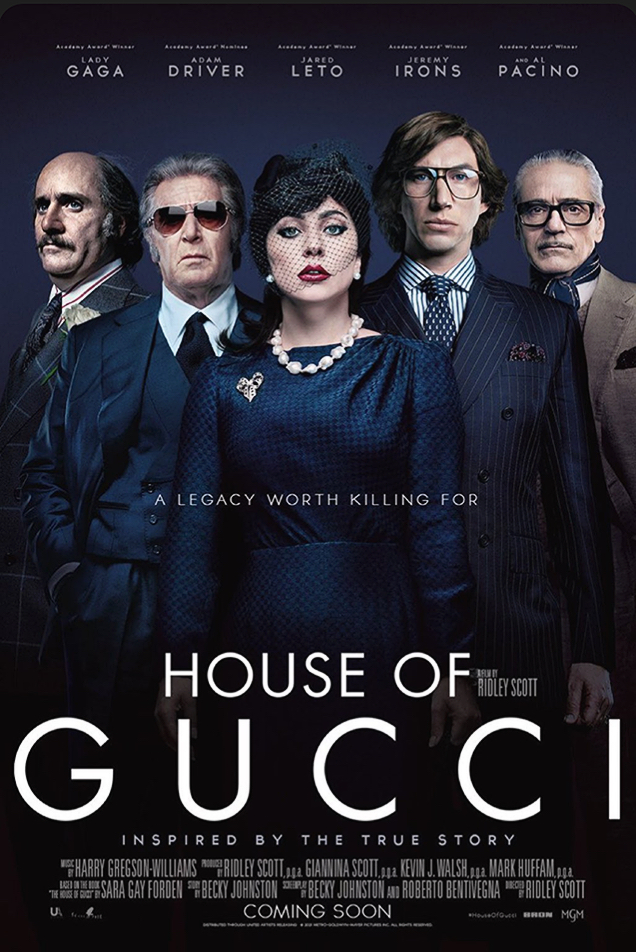
I agree with what everyone said yesterday. The poster art emphatically says “this is not a big classy fall movie from the formidable Ridley Scott, but another mid-range streamer.” Or, you know, a TNT movie from the early aughts. Or jacket art for a mid ’80s VHS tape. Or the new American Hustle.

Norma Desmond: “It’s The Oscars That Got Small”

From Anne Thompson‘s “We Need the Academy Awards to Save the Movies That Only Get Made Because Oscars Exist,” posted on 9.30:

“The Oscars need to stay classy and aspirational, but they increasingly alienate vast swatches of moviegoers who see them as simply representing woke limousine liberals. The board of governors often have blind spots when it comes to marketing themselves, and the Oscars. As they cater to ABC’s demands for a popular show with younger appeal, the board also makes dumbfounding rule changes — like not announcing all the craft categories, or Best Popular Film, requiring voters to be active — that generate so much blowback that they wind up reversing themselves.

“Some Hollywood insiders think the Oscars should be more democratized. ‘The Oscars are only vital for the industry future if they can engage their widest possible audience in celebrating the cinema, finding ways to make it relevant to many, fun, inspiring and important to culture,’ says one independent producer, adding that the awards ‘risk further alienating the public by continuing to feel self-congratulatory, insular, and elitist.”

Paul Schrader to Thompson: “It’s the big spotlight. We saw last year what happens when you put a dimmer on the big spotlight. It probably would have been better just to have a virtual announcement last year. It made the awards feel small, which is death to the concept of the Academy Awards. We have to reassert its place as the big show.”

The Soderbergh Oscars all but murdered the notion of the Oscars being “big” in any sense of that term. In one fell swoop they became the woke death-pill Oscars…Oscars trapped in an elite rhetorical closet…a combination of a “we need to share our stories at length” and “lemme outta here so I can snort some heroin in the bathroom” …the Oscar telecast from a train station that injected an unprecedented surge of despair.

Nobody wants to watch another Oscar telecast like that again…ever.

Sorkin’s Tricky Response to Rudin Situation

Friendo: “Did you read Aaron Sorkin‘s remarks about Scott Rudin in a 9.30 Vanity Fair interview? ‘Scott got what he deserves,’ he said. One could get the impression that the Being The Ricardos director-writer is establishing distance perimeters in order to shore up his Oscar campaign. Aaron is Oscar-ready.”

HE: “But right after that Sorkin said, ‘Right now Scott is lying flat on the mat, and I don’t know how it’s helpful for me to stand on his torso and kind of jump up and down.’ So he’s saying one thing and then saying another. Industry rule #1 is that you stand by your friendships and partnerships. If you’ve worked with someone and you’ve done well by each other, you don’t kick them when they’re down or have been credibly accused of something ugly. You can run and hide (that’s human nature) but throwing an ex-partner under the bus by condemning or distancing…well, it’s tricky. Sorkin is not saying “Scott who?” but he is saying “Scott was.” Does this make him seem principled or a bit hungry?

Vanity Fair‘s Rebecca Ford: “You’ve worked with Rudin throughout your career, on The Social Network, Steve Jobs, Moneyball, The Newsroom, and this play. Do you have a relationship with him anymore? What is it like to sort of see this unfold with someone who was your collaborator?”

Sorkin: “In the last, I think, 12 years, I’ve worked with Scott a lot — three feature films, an HBO series, and a Broadway play. And it was painful to read that Hollywood Reporter story, particularly because it’s pretty likely that some of those assistants who were being abused were working on something I wrote while they were being abused. So I took it personally. Whether it’s a movie set, or a rehearsal room for a play, or backstage for a play, or a television series, morale is important to me. And I take a lot of pride in creating a place where people are really happy to come to work, where they feel a sense of ownership, a sense of authorship, a sense of family. And we have that at Mockingbird. We’ve always had that in Mockingbird. So this came as a big shock.

“I’ll tell you that in a number of the follow-up stories that I read, you’ll see people quoted saying, ‘Everybody knew, everybody knew.’ And that’s ludicrous. Everybody did not know. I certainly didn’t know, and I don’t know anybody who knew. First of all, I have my own experience with Scott, and it’s a higher class of bullying, but I get it. The stories that I had heard over the last 12 years were the kinds of things that—they could have been scenes from The Devil Wears Prada.  There was no violence. There’s nothing physical at all in the stories that I heard. Had I known, there’s no chance I would’ve tolerated it, there’s no chance Bart Sher would’ve tolerated it, that Jeff Daniels would’ve tolerated it. So we didn’t know. And once we did, we did something about it.

Ford: “When you say you had your own experiences with a higher class of bullying, what do you mean?”

Sorkin: “Listen, I think Scott got what he deserves. He’s lying flat on the mat right now, and I don’t know how it’s helpful for me to stand on his torso and kind of jump up and down.”